
Stage 08
Case Execution and Delivery in Foreign Military Sales
Contracts awarded, articles produced, deliveries made, training delivered, and the follow-on support that keeps the system operating for the rest of its life. The longest-duration stage.
What happens
A Foreign Military Sales case is implemented only when the purchaser has signed the LOA, any required initial deposit has been received and deposited, and the implementing transactions have occurred. The deposit opens the gate. Case execution begins only after the Implementing Agency processes Obligational Authority.
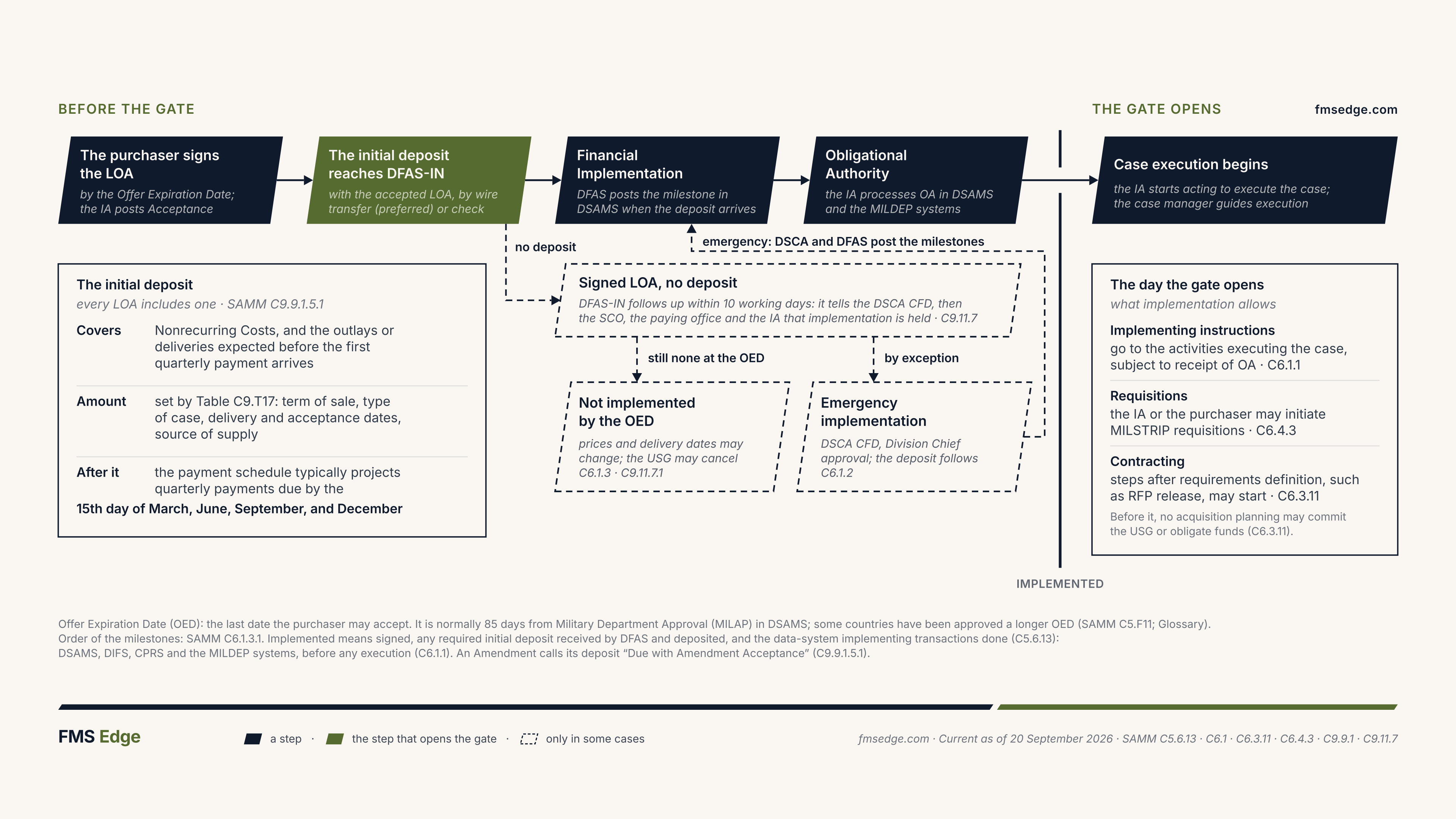
Implementation ends when the case is financially implemented in the Defense Management System, as its implementation milestone shows, unless procedures authorize otherwise [SAMM ]. Execution begins once the has processed [SAMM , ]. Execution is the longest phase in the life cycle of a . It can last many years for a major system sale case. During case execution, there are many actions that occur in the areas of acquisition, finance, logistics, and training.
Acquisition and contract award
C6.3.1 dictates that acquisition in support of cases will be conducted in the same manner as it is for U.S. requirements, thus affording the international partner the same benefits and protection that apply to Department of War (DoW) procurement. This is one reason why international partners often prefer to buy via [SAMM ]. Accordingly, procurement and supply actions for cases are normally carried out in the same manner by the same DoW procurement and logistics activities that support U.S. forces, although Implementing Agencies () may establish offices or positions within these organizations, specifically to coordinate and monitor support. A typical case includes items from both U.S. supply stocks and from new procurement.
procurement requirements may be consolidated on a single contract with U.S. requirements or may be placed on a separate contract, whichever is most expedient and cost effective [SAMM ].
A purchaser's official written direction to use other than ("sole source") should be included in its . It can also be sent separately, with a reference to the [SAMM , ].
Once a has been accepted by the partner nation and implemented, designating one of its procurements for other than would be an , subject to the 's acceptance [SAMM ].
In that situation, the may be amended to include the designation. Instead of an Amendment, a Modification may be used if the request comes from the official who requested the or from his or her replacement. A Modification may also be used if the request comes from an official known to have equal or greater authority than the official who signed the [SAMM ].
Requests for other than under the authority of 10 U.S.C. 3204(a)(4) should serve the purchaser's objective requirements rather than improper or unethical considerations. U.S. Government () representatives must remain objective when they give the partner options or recommendations, and may not solicit such requests. As a rule, the does not look into the circumstances behind a foreign purchaser's request [SAMM ].
DoW contracting agencies are encouraged to give deference to a foreign purchaser's requests made under the International Agreement exception, so long as they know of no indication that a request violates U.S. law or ethical business practices. The must consult its counsel where facts indicate that granting a request may violate U.S. law or ethical business practices. When the decides that a request should not be approved, the memorandum that tells the purchaser must be coordinated with the Office of International Operations and with (SPP) [SAMM ].
The case manager
The case manager is the focal point for activity on the case and manages every aspect of it. The functions in Table C2.T1 are examples that may be assigned to people at different organizational levels, depending on the complexity and type of case. Not every function applies to every case, and a complex case may include functions the table does not list [SAMM ].
An case is not generally under the sole domain of any one organization. Many organizations can touch or impact an case during its life cycle. As such, many organizations and people can be involved in the management of an case. However, there should be one person assigned as the case manager for each case. Prior to case implementation, the assigns a case manager to integrate and manage all aspects of the case.
The case manager is accountable for all aspects of assigned cases in compliance with applicable laws and regulations [SAMM , ]. This includes planning and execution functions as well as all financial, logistical, and acquisition matters associated with each program. The objective is to provide all articles and services within the cost and schedule estimated on the [SAMM , ]. The case manager follows the program closely and watches for problems that could affect the estimated cost or schedule. The case manager develops a program master plan that separates the case into management components, indicates significant activities in the execution of the case, and establishes an implementation schedule. A master plan is required for major sales, which include sales that reach the notification thresholds of Section 36(b) of the and proposed sales that would raise the purchaser's current active program by more than fifteen percent. (/FPRE) or the may also require a plan for other sales. Depending on the size or nature of the case, the plan covers the following: , key milestones (contract status, , delivery schedule, training, contractor support, etc.); status, issues/risk; and key points of contact and responsibilities. The case manager provides the master plan to higher authority and to the international partner to forecast events and track progress. The master plan will be updated and reissued after significant project milestones, prior to Program Management Reviews, and as part of the development of amendments to the case [SAMM ].
The case manager relies on many others to meet the case objectives. Effective case management depends on frequent communication with the program manager, the , and numerous other key personnel in other organizations. When potential cost overruns or delays are identified, the case manager is expected to consult with the program manager, the contractor, and the international partner to ensure all potential options are explored and informed decisions can be made. Case amendments and modifications should be processed promptly to ensure the case reflects up-to-date estimates and descriptions for the program. After all articles and services have been provided, the case manager ensures that cases are closed in a timely manner.
Case management organizations and procedures vary among the Military Departments (). The case manager for blanket order or Supply Support Arrangement () cases normally resides at the applicable . The case manager for defined order cases may be in the or in the weapon . The case manager for training cases resides at the training organization.
Case and program reviews
Case and program reviews are conducted periodically to keep the status of a purchaser's programs accurate and timely [SAMM ]. Five things bear on whether a case review is needed: the size and complexity of the program, resources, political-military changes in the region, political visibility or sensitivity, and the purchaser's desires or requirements [SAMM ].
The objectives of a review must be clearly identified, including why it is being held, what it is to deliver afterwards and the outcomes it seeks. The purchaser nation's own policy or legislation may require it to have periodic information on the status of its country accounts, issues, cases and programs. The purchaser's preferences about how reviews are conducted should be accommodated as far as possible. The should record the number and type of reviews, as the manpower matrix in Table C9.T2A explains. For funding them, the manual points to Section C6.5.7 [SAMM ].
C6.5 provides more comprehensive information on reviews. Table C6.T5 of the identifies various types of reviews as well as the typical representatives, frequency, and timing for each. The Case-Related Manpower Functions and Funding Source Matrix, C9.T2A, helps identify the appropriate source of funding for each type of review. Depending on the type of review and the international partner/program involved, the following topics may be addressed during a case or program review as applicable:
- contract status
- delivery status
- Supply Discrepancy Reports ()
- Critical/urgent requirements and procedures
- Spares, supply, and shipment status
- Configuration issues
- Case financial status (commitments, obligations, and expenditures)
- adjustments
- Price increases and funding issues
- Transportation/shipping problems
- Training program
- Case closure
Sustainment and follow-on support
The ensures that an purchaser can obtain the support articles and services it needs, including construction of necessary support facilities, to bring equipment into service and sustain it. The also covers what the purchaser needs to operate the equipment responsibly and effectively, in line with the U.S. intent in approving the transfer [SAMM ].
When an is prepared, the complete sustainability package must be offered to the purchaser. To the best extent possible, it should also be included in estimates and responses to partners for international competitions [SAMM ].
In some instances the may identify, in coordination with the Under Secretary of War for Acquisition and Sustainment's office (OUSW(A&S)), possible co-sustainment options that support regional sustainment of platforms, weapon systems, sub-systems and components. When the and OUSW(A&S) determine that these options are viable, the notifies 's Office of International Operations, Regional Execution Directorate (/REX), so that /REX can begin discussions with the partner. Besides the system itself, the other items to consider in a total package include follow-on support, initial support, ammunition, software, training, technical assistance and intelligence mission data, among others [SAMM ].
Follow-on support, unlike initial support, involves the being in a reactive role rather than a proactive role. That is, the DoW responds to demands initiated by the international partner. Follow-on logistics support encompasses all the various services and materiel required to sustain a after its operations begin. Follow-on support includes replenishment of and repair parts, procurement of new support equipment not provided for in the initial allowance, procurement of repair and engineering services, replenishment of munitions, updates of technical publications, etc. Follow-on logistics support is designed to maintain defense systems/equipment in an operating condition or to modify an original configuration after a or item of major equipment has been originally acquired.
Timely follow-on logistics support is important to the success of the program. Without it, the equipment, usually purchased at a considerable cost, will become inoperable and of little value to the international partner, who might then question the value of major purchases. Follow-on support should be considered at the same time as initial support. This is necessary because of the lead-time required to negotiate and implement the various types of follow-on support agreements and, in some instances, because of long lead times to procure required items.
To prevent a lapse in follow-on support services that the purchaser requires and that have been provided under an existing , the may start an or Amendment for follow-on support services without a formal . The must notify the purchaser that the or Amendment is being developed. That notification is included in the case package, and in the Defense Management System () as the "based on" reference in its field [SAMM ].
The purchaser concurs when it accepts the or Amendment. Because the additional follow-on support services are a , a Modification cannot be initiated [SAMM ].
The purchasing country has several options from which to choose in terms of the types of cases available for follow-on support. Defined order cases, blanket order cases, and are all used in providing follow-on support. Each has distinct advantages and disadvantages as well as certain restrictions on the types of support that can be provided.
Blanket Order cases or lines can provide unclassified items or services that are not . The types include spares and repair parts (repairables and consumables); maintenance (rebuild, repair, and minor alterations or modifications); support equipment (test equipment, tools); supplies (commercial consumable items, fuel, personnel items); training aids; and unclassified software. They also include technical assistance (technical assistance teams, specialist advice or actions, item checkout, system integration, systems evaluation, and study groups that develop engineering requirement plans). Publications are another type (books, maps, reports, forms, stock lists, catalog data and technical order manuals) [SAMM ].
Blanket Order training cases or case lines may carry training, classified as well as unclassified, but classified training must go on a separate classified training line. Blanket Order lines may also include classified publications, technical manuals and reports among them. The line and its line note must then be developed in accordance with Table C5.T11 [SAMM ].
A case is designed to provide more responsive follow-on spare parts support for U.S. produced military hardware owned by international partners. may offer such arrangements with approval from . A consists of two cases. The first case, the I case, is established up-front to buy “equity” in the DoW’s supply system for DoW-stocked, non- items used by the international partner on a recurring basis. This enables the DoW to augment defense stocks in anticipation of demands and increases the probability of spare and repair parts being available for issue from DoW stock. The second case, the II case, is a Blanket Order case used by the international partner to requisition those items.
The DoW offers the as an effective means of replenishing the in-country stocks of spares and repair parts, which were initially furnished with end items of equipment. The is an arrangement for the furnishing of secondary items from the U.S. logistics system to a country in support of specific /systems [SAMM ]. Under the arrangement, the country makes a financial investment in the DoW logistics system to fund its anticipated support requirements [SAMM ]. The describes the end items supported rather than a definitive list of items or quantities, although items and quantities may be negotiated [SAMM ]. The investment permits the to augment its stocks in anticipation of the country’s actual demands [SAMM ]. The is used for replenishment of consumables or for replacement of repairable components [SAMM ]. The is not intended for initial support, but, rather, as a mechanism to resupply the initial support package [SAMM , ].
Spare and repair parts that are centrally stocked or centrally managed, for defense systems the purchaser shares with U.S. forces, are provided on cases. Whether an item is eligible rests on its (), with the exceptions that follow [SAMM ].
Some items are not provided on cases even when an eligible identifies them. They are , , , classified materiel, cryptographic equipment, explosive ordnance items, parachutes, initial spare parts, controlled medical items, modification kits, tool sets, publications, ozone depleting substances, commercial items of materiel that can more readily be provided from in-country, and packages or similar documentation that conveys manufacturing process information [SAMM ].
The purchaser uses the II case to requisition the spare and repair parts it needs to replenish its in-country stocks [SAMM ]. Through the II case it also withdraws stocks from DoW inventories and deposits funds for routine replenishment of the I. Unless stock levels of an item are adequate to support all purchasers, II requisitions received before the augmentation stock arrives are placed on backorder until the I matures. As augmentation stocks become available, II requisitions can be filled from stock [SAMM ].
Key players at this stage
Partner nation
- Foreign Liaison Officer (FLO)Partner nation military or civilian representative stationed in the United States, often at a U.S. Implementing Agency (AFSAC, USASAC, NAVSUP WSS, or a SYSCOM)
Embassy — Security Cooperation Organization
- Security Cooperation Organization Chief (Embassy)U.S. Embassy Security Cooperation Organization, whose chief is the Senior Defense Official/Defense Attaché (SDO/DATT)
DSCA
- DSCA Country Portfolio DirectorDefense Security Cooperation Agency: International Operations (IOPS) / Regional Execution (REX)
Service international affairs office
- Navy: NIPO Country DirectorNavy International Programs Office (NIPO), Global Security Cooperation
Case manager
- Air Force: AFSAC Command Country ManagerAir Force Security Assistance & Cooperation Directorate (AFSAC), AFLCMC/WF
- Army: USASAC Country Program ManagerU.S. Army Security Assistance Command (USASAC), Regional Operations Directorate
- Army: USASAC Central Case ManagerU.S. Army Security Assistance Command (USASAC)
- Navy: NIPO Country DirectorNavy International Programs Office (NIPO), Global Security Cooperation
- Navy: NAVSUP WSS Case ManagerNaval Supply Systems Command Weapon Systems Support (NAVSUP WSS)
Program office
- Weapon System Program OfficeMilitary Department program management office for the weapon system
Industry
- Prime Contractor Program OfficeU.S. defense contractor
Common pitfalls
- slips cascade into the training pipeline; partner aircrew or operators sit idle
- Amendment-versus-modification judgment disputed; a scope change treated as a mod when it should have been an amendment triggers audit findings
- Spares consumption exceeds forecast; partner readiness falls in the gap between the initial support package and the follow-on support case
- Configuration changes from the program office that the partner did not plan for
What to watch for
An case's scope is the key factor in deciding whether a particular change calls for an Amendment, a Modification or a new . Scope for Defined Order, Blanket Order and cases is defined in Section C5.6.4. When a change would alter the purpose of the , a new should be developed for the new requirements, and the existing one should not be amended or modified. Adding UH-60s to an F-35 case, or a frigate to a blanket order training case, is an example of such a change [SAMM ].
Pen and ink changes to Modifications are not authorized. Once the has signed and countersigned a Modification, any further change must be made with a new Modification, or with an Amendment if applicable [SAMM ].
Guides on this stage
References
SAMM
- SAMM C6.1.1: Routine Case Implementation.
- SAMM C6.1.3.1
- SAMM C6.3.4.2: Timing of Requests.
- SAMM C6.3.4.3: Policy Requirements.
- SAMM C2.2.2: Responsibilities.
- SAMM C2.T1: Case Manager Responsibilities
- SAMM C2.2.3: Accountability.
- SAMM C2.2.4: Authority.
- SAMM C6.5.2: Reasons for Case Review.
- SAMM C4.3.2: Total Package Approach.
- SAMM C6.7.2.2: Follow-on Support Services.
- SAMM C5.6.4.2.2: Items Provided on Blanket Order Cases or Case Lines.
- SAMM C5.T11: Blanket Order Case Conditions for Classified Publications
- SAMM C5.6.4.3: Cooperative Logistics Supply Support Arrangements.
- SAMM C6.4.3.2.2
- SAMM C5.6.4.3.3: Items Not Provided on Cooperative Logistics Supply Support Arrangement Cases.
- SAMM C5.6.4.3.2: Items Provided on Cooperative Logistics Supply Support Arrangement Cases.
- SAMM C6.4.3.2.1
- SAMM C6.4.3.2.4
- SAMM C6.7.1.1: Scope.
- SAMM C6.T7: Modification for Foreign Military Sales Cases
- SAMM C6.7.3.3: Pen and Ink Changes to Modifications.
- SAMM C6: C6 - Foreign Military Sales Case Implementation and Execution
- SAMM C6.3.4: Requests for Other than Full and Open Competition.
- SAMM C6.3.4.1: Legal Requirements.
- SAMM C10: C10 - International Training
- SAMM C11: C11 - Security Assistance and Security Cooperation Programs
- SAMM C6.7: Amendments and Modifications.
- SAMM C6.3.1: Compliance with Department of War Regulations and Procedures.
- SAMM C2.2.6: Case Reporting and the Master Plan.
- SAMM C6.5: Case Reviews.
- SAMM C6.T5: Frequency and Timing of Reviews Matrix
- SAMM C6.7.3.1: Use of a Foreign Military Sales Case Modification.
- SAMM C6.7.2.1: Letter of Offer and Acceptance Amendment Overview.
Public authorities
- GAO-26-108140: U.S. Government Accountability Office, GAO-26-108140, Weapon System Sustainment: DOD Identified Critical Cost Growth, and the Army Should Take Action to Yield Cost Savings (23 April 2026)
Facts referenced
- Increase to the FMS purchaser's current active program above which a proposed sale is a major sale needing a program master plan: fifteen percent (as of 11 September 2026; SAMM C2.2.6)
- Operating and support (O&S) cost as a share of a U.S. weapon system's total life-cycle cost, a historical figure for U.S. Department of War programs, not a share of a Foreign Military Sales case's value: approximately 70 percent (as of 20 September 2026)
Security Assistance (SA)
A group of programs authorized by federal statutes by which the United States provides defense articles, military training, and other defense-related services by grant, lease, loan, credit, or cash sales in furtherance of national policies and objectives, and those that are funded and authorized through the Department of State to be administered by Department of Defense/Defense Security Cooperation Agency, which are considered part of security cooperation.
SAMM Glossary, as of 12 September 2026
Glossary entry →Open the manual’s entry → (opens in new tab)
Emergency Implementation
The act of implementing a case after the Foreign Military Sales (FMS) purchaser has signed the case but has not yet paid the required initial deposit. This is performed on exceptional cases with the approval of DSCA (Office of Business Operations (OBO)) due to extenuating circumstances that require urgent implementation.
SAMM Glossary, as of 12 September 2026
Glossary entry →Open the manual’s entry → (opens in new tab)
Implementing Agency (IA)
The military department or defense agency responsible for the execution of military assistance programs. With respect to FMS, the military department or defense agency assigned responsibility by the Defense Security Cooperation Agency to prepare an LOA and to implement an FMS case. The implementing agency is responsible for the overall management of the actions that will result in delivery of the materials or services set forth in the LOA that was accepted by a foreign country or international organization.
SAMM Glossary, as of 12 September 2026
Glossary entry →Open the manual’s entry → (opens in new tab)
Foreign Military Sales (FMS) Case
A Letter of Offer and Acceptance (LOA) that the purchaser has accepted, together with every Amendment and Modification later made to it: the agreement under which the U.S. Government transfers defense articles and services in the Foreign Military Sales (FMS) program.
FMS Edge glossary, as of 10 October 2026
Glossary entry →Open the manual’s entry → (opens in new tab)
SAMM: Security Assistance Management Manual
SAMM Acronyms, as of 12 September 2026
Glossary entry →Security Assistance Management Manual (SAMM) →
FMS: Foreign Military Sale
SAMM Acronyms, as of 12 September 2026
Full And Open Competition
When used with respect to a contract action, means that all responsible sources are permitted to compete.
SAMM Glossary, as of 12 September 2026
Glossary entry →Open the manual’s entry → (opens in new tab)
Letter of Request (LOR)
The term used to identify a request from an eligible FMS participant country for the purchase of U.S. defense articles and services. The request may be in message or letter format.
SAMM Glossary, as of 12 September 2026
Glossary entry →Open the manual’s entry → (opens in new tab)
LOR: Letter of Request
SAMM Acronyms, as of 12 September 2026
Letter of Offer and Acceptance (LOA)
The legal instrument that lists the defense articles and services, including training, that the U.S. Government transfers to a foreign country or international organization, with their estimated costs and the terms and conditions. The benefitting partner does not sign a Building Partner Capacity (BPC) LOA.
The Letter of Offer and Acceptance (LOA) is the instrument the U.S. Government uses to sell under the Arms Export Control Act (AECA); signed LOAs and their later Amendments and Modifications are also called Foreign Military Sales (FMS) cases [SAMM C5.6.1].
FMS Edge glossary, as of 10 October 2026
Glossary entry →Open the manual’s entry → (opens in new tab)
Exception to Policy (ETP) (SAMM)
Exception to SAMM policy. Does not include exceptions outside of SAMM purview.
SAMM Glossary, as of 12 September 2026
Glossary entry →Open the manual’s entry → (opens in new tab)
LOA: Letter of Offer and Acceptance
SAMM Acronyms, as of 12 September 2026
Defense Security Cooperation Agency (DSCA)
The Department of War agency that directs, administers and provides guidance to the Department's components and its representatives at U.S. missions for the execution of the security cooperation programs for which it is responsible [SAMM C1.3.2.2]. The agency also provides financial and technical assistance, arranges the transfer of defense materiel, training and services to international partners, and promotes military-to-military contacts.
FMS Edge glossary, as of 10 October 2026
Glossary entry →Open the manual’s entry → (opens in new tab)
DSCA: Defense Security Cooperation Agency
SAMM Acronyms, as of 12 September 2026
Glossary entry →Defense Security Cooperation Agency (DSCA) →
Foreign Disclosure
The authorized release or transfer of classified or controlled unclassified information (CUI) from the U.S. government to foreign governments, international organizations, or foreign nationals. This process is governed by strict policies and procedures to ensure that the release of information aligns with U.S. national security and foreign policy objectives.
SAMM Glossary, as of 26 October 2026
Glossary entry →Open the manual’s entry → (opens in new tab)
Transportation Plan
A document that details the transportation and security arrangements for moving classified or sensitive material, and identifies individuals responsible for providing security at various points during transportation.
SAMM Glossary, as of 12 September 2026
Glossary entry →Open the manual’s entry → (opens in new tab)
Memorandum of Agreement (MOA)
In the manual's usage, a written agreement between sovereign states, or between a state and an international organization, signed by authorized representatives and legally binding under international law.
FMS Edge glossary, as of 10 October 2026
Glossary entry →Open the manual’s entry → (opens in new tab)
CISMOA: Communications Interoperability and Security Memorandum of Agreement
SAMM Acronyms, as of 12 September 2026
Security Cooperation Information Portal (SCIP)
A web-based tool, managed by the Defense Security Cooperation Agency (DSCA), that gives international purchasers, their agents such as freight forwarders, and authorized U.S. Government personnel information on Foreign Military Sales (FMS) cases and other security cooperation programs.
It covers case, line, requisition and supply data, supply transactions and end-use monitoring information, drawn from the Defense Security Assistance Management System (DSAMS) and the Military Departments' case execution systems.
FMS Edge glossary, as of 10 October 2026
Glossary entry →Open the manual’s entry → (opens in new tab)
Arms Export Control Act (AECA)
The basic U.S. law providing the authority and general rules for the conduct of Foreign Military Sales and commercial sales of defense articles, defense services, and training. The Arms Export Control Act (AECA) came into existence with the passage of the Foreign Military Sales Act (FMSA) of 1968. An amendment in the International Security Assistance and AECA of 1976 changed the name of FMSA to the AECA.
SAMM Glossary, as of 12 September 2026
Glossary entry →Open the manual’s entry → (opens in new tab)
Case Description
A short title specifically prepared for each Foreign Military Sales case by the Implementing Agency.
SAMM Glossary, as of 12 September 2026
Glossary entry →Open the manual’s entry → (opens in new tab)
Weapon System
A combination of one or more weapons with all related equipment, materials, services, personnel, and means of delivery and deployment (if applicable) required for self-sufficiency.
SAMM Glossary, as of 12 September 2026
Glossary entry →Open the manual’s entry → (opens in new tab)
Contracting Officer
A person with the authority to enter into, administer, and/or terminate contracts and make related determinations and findings. The term includes certain authorized representatives of the Contracting Officer acting within the limits of their authority as delegated by the Contracting Officer. A Contracting Officer whose primary responsibility is to enter into contracts is called a procuring contracting officer. One whose primary responsibility is to administer contracts is called an administrative contracting officer. One whose primary responsibility is to terminate contracts and/or settle terminated contracts is called a "termination contracting officer." A single contracting officer may be responsible for duties in any or all of these areas.
SAMM Glossary, as of 12 September 2026
Glossary entry →Open the manual’s entry → (opens in new tab)
Military Department (MILDEP)
One of the departments within the DoD created by the National Security Act of 1947, as amended. The Military Departments are: the Department of the Air Force, the Department of the Army, and the Department of the Navy.
SAMM Glossary, as of 12 September 2026
Glossary entry →Open the manual’s entry → (opens in new tab)
Cooperative Logistics
The logistics support provided a foreign government/agency through its participation in a U.S. DoD logistics system, with reimbursement paid to the USG for the support provided.
SAMM Glossary, as of 12 September 2026
Glossary entry →Open the manual’s entry → (opens in new tab)
CLSSA: Cooperative Logistics Supply Support Arrangement
SAMM Acronyms, as of 12 September 2026
Glossary entry →Cooperative Logistics Supply Support Arrangements (CLSSA) →
International Logistics Control Office (ILCO)
The office in each Military Department that manages the logistics support programs and transactions of Foreign Military Sales (FMS) and other security cooperation programs, and the central point in the continental United States for monitoring purchasers' requisitions.
A purchaser reports a valid supply discrepancy to the International Logistics Control Office (ILCO) of the Military Department concerned [SAMM C2.1.5.4.3].
FMS Edge glossary, as of 10 October 2026
Glossary entry →Open the manual’s entry → (opens in new tab)
ILCO: International Logistics Control Office
SAMM Acronyms, as of 12 September 2026
Glossary entry →International Logistics Control Office (ILCO) →
System Program Office
The office of the program manager and the single point of contact with industry, government agencies, and other activities participating in the system acquisition process.
SAMM Glossary, as of 12 September 2026
Glossary entry →Open the manual’s entry → (opens in new tab)
Major Item
Defense articles identified in the Military Articles and Services List (MASL) with a unit of issue other than "XX" (dollar lines)." Control over the programming of these items is required.
SAMM Glossary, as of 12 September 2026
Glossary entry →Open the manual’s entry → (opens in new tab)
SDR: Supply Discrepancy Report
SAMM Acronyms, as of 12 September 2026
Payment Schedule
List of dollar amounts and when they are due from the foreign customer. The payment schedule is included in the Letter of Offer and Acceptance (LOA) presented to the customer. After acceptance of the LOA, the payment schedule generally serves as the basis for billing to the customer. Changes in the estimated costs of an Foreign Military Sales case may require changes in the accompanying payment schedule.
SAMM Glossary, as of 12 September 2026
Glossary entry →Open the manual’s entry → (opens in new tab)
Total Package Approach (TPA)
A means of ensuring that Foreign Military Sales customers are aware of and are given the opportunity to plan for and obtain needed support items, training, and services from the USG contractors, or from within the foreign country's resources which are required to introduce and operationally sustain major items of equipment or systems.
SAMM Glossary, as of 12 September 2026
Glossary entry →Open the manual’s entry → (opens in new tab)
TPA: Total Package Approach
SAMM Acronyms, as of 12 September 2026
Rough Order of Magnitude (ROM) (Foreign Military Sales)
The Implementing Agencies’ (IAs) response to a Foreign Military Sales Letter of Request for P&A. It is an initial, non-binding cost estimate intended for planning and feasibility assessment, giving the foreign government or international organization (partner) a general idea of the potential cost and availability of defense articles or services. Furnishing this data does not constitute a commitment for the USG to offer for sale the articles and services.
SAMM Glossary, as of 12 September 2026
Glossary entry →Open the manual’s entry → (opens in new tab)
Price and Availability (P&A)
Preliminary pricing and availability estimates for articles or services that an Implementing Agency (IA) prepares at the request of a foreign government or international organization for an international competition, or of a U.S. Government requesting authority for building partner capacity.
Price and Availability (P&A) responses are estimates of cost and availability, not valid for preparing a Letter of Offer and Acceptance (LOA), and furnishing them does not commit the U.S. Government to offer the articles or services for sale [SAMM C5.5.2, C5.5.1].
FMS Edge glossary, as of 10 October 2026
Glossary entry →Open the manual’s entry → (opens in new tab)
Foreign Military Sales (FMS)
The part of U.S. security assistance, authorized by the Arms Export Control Act (AECA), in which eligible foreign governments and international organizations buy defense articles, services and training from the U.S. Government under formal government-to-government agreements.
The articles come either from Department of War stocks or from new procurement under contracts the Department manages [22 U.S.C. 2761, 22 U.S.C. 2762]. A sale is FMS whatever the source of the purchaser's financing.
FMS Edge glossary, as of 10 October 2026
Glossary entry →Open the manual’s entry → (opens in new tab)
Initial Spares
Components and related materiel bought to replace parts that wear out, are lost or are damaged during a system's initial period of operation, as part of its logistics support.
FMS Edge glossary, as of 10 October 2026
Glossary entry →Open the manual’s entry → (opens in new tab)
DSAMS: Defense Security Assistance Management System
SAMM Acronyms, as of 12 September 2026
Glossary entry →Defense Security Assistance Management Systems (DSAMS) →
Change in Scope
A change in scope occurs when there is a change to the materiel or service requirements that change the original purpose of a contract or Letter of Offer and Acceptance (LOA). These changes may or may not change the total estimated cost of the contract or LOA as a result of (1) changes to the function/type of work; (2) increases or decreases in quantity of items; (3) increases or decreases to the amount of man years; and (4) increases or decreases to the performance period or Months.
SAMM Glossary, as of 12 September 2026
Glossary entry →Open the manual’s entry → (opens in new tab)
Significant Military Equipment (SME)
Defense articles for which special export controls are warranted because of the capacity of such articles for substantial military utility or capability. These items are identified on the U.S. Munitions List in the International Traffic in Arms Regulations by an asterisk preceding the item category listing.
SAMM Glossary, as of 12 September 2026
Glossary entry →Open the manual’s entry → (opens in new tab)
Military Articles And Services List (MASL)
A catalogue of materiel, services, and training used in the planning and programming of International Military Education and Training (IMET), and Foreign Military Sales (FMS). Separate MASLs are maintained for IMET and FMS training that provides data on course identification, course availability, price, and duration of training.
SAMM Glossary, as of 12 September 2026
Glossary entry →Open the manual’s entry → (opens in new tab)
Foreign Military Sales Order (FMSO)
A term used to describe Letters of Offer and Acceptance (LOAs) that implement Cooperative Logistics Supply Support Arrangements. Two LOAs are written: a FMSO I and a FMSO II.
SAMM Glossary, as of 12 September 2026
Glossary entry →Open the manual’s entry → (opens in new tab)
FMSO: Foreign Military Sales Order
SAMM Acronyms, as of 12 September 2026
Major End Items
Any end item that is Significant Military Equipment or Major Defense Equipment or where control over the programming of these items is required. See also "end item."
SAMM Glossary, as of 12 September 2026
Glossary entry →Open the manual’s entry → (opens in new tab)
Acquisition Advice Code
Materiel management codes, listed in Table 58, Volume 10 of the Cataloging Data and Transaction Standards used to specify requirements, restrictions, and methods for acquiring an item.
SAMM Glossary, as of 12 September 2026
Glossary entry →Open the manual’s entry → (opens in new tab)
AAC: Acquisition Advice Code
SAMM Acronyms, as of 12 September 2026
Major Defense Equipment (MDE)
Any item of Significant Military Equipment on the U.S. Munitions List having a nonrecurring research and development cost of more than $50 million or a total production cost of more than $200 million. Also defined in section 47 (6), Arms Export Control Act.
SAMM Glossary, as of 12 September 2026
Glossary entry →Open the manual’s entry → (opens in new tab)
Excess Defense Articles (EDA)
Defense articles owned by the USG which are neither procured in anticipation of military assistance or sales requirements, nor procured pursuant to a military assistance or sales order. EDA are items (except construction equipment) that are in excess of the Approved Force Acquisition Objective and Approved Force Retention Stock of all DoD components at the time such articles are dropped from inventory by the supplying agency for delivery to countries or international organizations.
SAMM Glossary, as of 12 September 2026
Glossary entry →Open the manual’s entry → (opens in new tab)
Technical Data
Recorded information of a scientific or technical nature, regardless of form or characteristic. Examples of technical data packages include research and engineering drawings and associated lists, specifications, standards, process sheets, manuals, technical reports, catalog item identifications, and related information and computer software documentation.
SAMM Glossary, as of 12 September 2026
Glossary entry →Open the manual’s entry → (opens in new tab)
Contract Award
This occurs when a contracting officer has signed and distributed a contract to a contractor.
SAMM Glossary, as of 12 September 2026
Glossary entry →Open the manual’s entry → (opens in new tab)
MDE: Major Defense Equipment
SAMM Acronyms, as of 12 September 2026
Defense Article (Foreign Assistance Act; Arms Export Control Act, not including commercial sales subject to the International Traffic in Arms Regulation)
Any weapon, weapon system, munition, aircraft, vessel or other implement of war, together with the property, equipment, tooling, components and parts used to furnish military assistance or sales or to make, maintain or use such items; the International Traffic in Arms Regulations (ITAR) define the term separately for commercial exports.
Section 47 of the Arms Export Control Act (AECA) defines the term, and the U.S. Munitions List designates the specific items that fall within it [SAMM C4.4] [22 U.S.C. 2794].
FMS Edge glossary, as of 10 October 2026
Glossary entry →Open the manual’s entry → (opens in new tab)
End Use Monitoring (EUM)
Mandated by Section 40A of the Arms Export Control Act (AECA) (22 U.S.C. 2785), activities undertaken by the U.S. Government to ensure that defense articles and defense services transferred to foreign partners under security assistance/cooperation authorities are monitored and used according to the terms and conditions specified in Letters of Offer and Acceptance and other transfer agreements, and as required by the AECA or the Foreign Assistance Act of 1961.
SAMM Glossary, as of 12 September 2026
Glossary entry →Open the manual’s entry → (opens in new tab)
EUM: End Use Monitoring
SAMM Acronyms, as of 12 September 2026
MASL: Military Articles and Services List
SAMM Acronyms, as of 12 September 2026
Glossary entry →Military Articles And Services List (MASL) →
Source Code (SC) (Letter of Offer and Acceptance)
A single digit code on every line on a Letter of Offer and Acceptance that identifies the source for the item. Codes include:
S = Shipment from DoD stocks or performance by DoD personnel
P = From new procurement
R = From rebuild, repair, or modification by the USG
X = Mixed source, such as stock and procurement, or undetermined
E = Excess items, as is
F = Special Defense Acquisition Fund items
Also known as "Source of Supply (SoS) Code."
SAMM Glossary, as of 12 September 2026
Glossary entry →Open the manual’s entry → (opens in new tab)
Type of Assistance (TA) Code
A code used to reflect the type of assistance (if any) and/or the planned source of supply for items/services identified on the Letter of Offer and Acceptance. Also known as a type of finance code.
SAMM Glossary, as of 12 September 2026
Glossary entry →Open the manual’s entry → (opens in new tab)
SAMM C6.1.1: Routine Case Implementation.
“Case implementation begins when the purchaser accepts the LOA and satisfies applicable initial deposit requirements and continues through completion of required case implementation actions in DSAMS and other applicable systems. Case implementation ends when the case is financially implemented in DSAMS, as reflected by the applicable implementation milestone, unless otherwise authorized under emergency implementation procedures. For management and tracking purposes, …”
Security Assistance Management Manual, as of 26 October 2026
SAMM C6.1.3.1
“The FMS purchaser signs and accepts the LOA or Amendment, and the IA posts the “Acceptance” milestone in DSAMS. If the initial deposit is not received by DFAS-IN, they will notify the DSCA CFD. Upon approval from the DSCA CFD, DFAS-IN notifies the U.S. Military Group (MILGP), the FMS purchaser's paying office, and the IA that the initial deposit has …”
Security Assistance Management Manual, as of 26 October 2026
SAMM C6.3.1: Compliance with Department of War Regulations and Procedures.
“Acquisition for Foreign Military Sales (FMS) purchasers must be in accordance with DoW regulations and other applicable USG procedures. This affords the foreign purchaser the same benefits and protection that apply to DoW procurement and is one of the principal reasons why foreign governments and international organizations prefer to procure through FMS channels. FMS requirements may be consolidated with USG …”
Security Assistance Management Manual, as of 26 October 2026
SAMM C6.3.4: Requests for Other than Full and Open Competition.
“The competitive procurement process is used to the maximum extent possible when procuring articles or services. The Competition in Contracting Act (CICA) (10 U.S.C. 3204), however, provides certain limited circumstances in which the contracting activity can consider FMS purchaser requests for procurement using other than full and open competition (commonly referred to as “sole source”) when the contract to be …”
Security Assistance Management Manual, as of 26 October 2026
SAMM C6.3.4.2: Timing of Requests.
“Official written direction to use other than full and open competition should be submitted in the Letter of Request (LOR), or it can be submitted separately with a reference to the LOR. The designation of a procurement to be conducted using other than full and open competition for an LOA that has already been accepted by the partner nation and …”
Security Assistance Management Manual, as of 26 October 2026
SAMM C6.3.4.3: Policy Requirements.
“Requests for other than full and open competition using the authority of 10 U.S.C. 3204(a)(4) should be to meet the objective requirements of the purchaser and not for improper or unethical considerations. USG representatives must remain objective in providing options or recommendations to the partner and may not solicit requests for other than full and open competition. In general, the …”
Security Assistance Management Manual, as of 26 October 2026
SAMM C2.2.2: Responsibilities.
“The CM is the focal point for case activities and manages all aspects of the FMS case. Tasks listed in Table C2.T1. are examples of functions that may be assigned to individuals at various organizational levels depending upon the complexity and type of case. Not all functions are applicable to every case, and complex cases may include functions not listed …”
Security Assistance Management Manual, as of 26 October 2026
SAMM C2.2.3: Accountability.
“The CM works to accomplish the program objectives of the assigned case while adhering to applicable laws and regulations and working within the organizational structure of the Military Department (MILDEP) or defense agency. The CM achieves successful performance when the case objectives are met. These objectives are to: provide all articles or services included in the case on schedule, within …”
Security Assistance Management Manual, as of 11 September 2026
SAMM C2.2.4: Authority.
“FMS cases require concentrated management effort. The CM has a role in each of the major elements of the case: acquisition, programming, logistics, and finance, and is involved in every aspect of planning and executing assigned cases. Effective case management depends on the performance and interaction of many organizations. The CM must have the authority to take action and task …”
Security Assistance Management Manual, as of 11 September 2026
SAMM C2.2.6: Case Reporting and the Master Plan.
“The CM coordinates actions required for successful execution of the case, and uses established channels to convey information to higher authorities, supporting activities, and the purchaser on how the case is progressing. The CM serves as the central point of contact, and acts as the U.S. representative to the FMS customer for questions and problem resolution. To this end, the …”
Security Assistance Management Manual, as of 11 September 2026
SAMM C6.5: Case Reviews.
“The USG security cooperation (SC) community goal is to provide consistent, incomparable support to our purchasers. Towards this goal, thorough reviews are conducted periodically to ensure accurate and timely status of customer's programs. There are several categories of reviews: USG Annual Case Reviews/Reconciliations, which are discussed in Chapter 16; financial management reviews (FMRs) outlined in Chapter 9; and general Foreign …”
Security Assistance Management Manual, as of 11 September 2026
SAMM C6.5.2: Reasons for Case Review.
“The following items influence a decision about the need for a case review: USG resources, desires or requirements of the FMS purchaser, political visibility or sensitivity, political-military changes in a region, and the size and complexity of the program. Review objectives must be clearly identified, including why the FMS review is being conducted, as well as post-review deliverables and desired …”
Security Assistance Management Manual, as of 11 September 2026
SAMM C4.3.2: Total Package Approach.
“The Total Package Approach (TPA) ensures that FMS purchasers can obtain support articles and services, to include construction of necessary support facilities, required to introduce and sustain equipment and to operate in a responsible and effective manner consistent with U.S. intent in approving the transfer. The complete sustainability package must be offered to the purchaser when preparing a Letter of …”
Security Assistance Management Manual, as of 26 October 2026
SAMM C6.7.2.2: Follow-on Support Services.
“In order to prevent a lapse in follow-on support services that are required by the FMS purchaser and that has been provided under an existing LOA, the IA may initiate a follow-on support services LOA or Amendment without a formal Letter of Request (LOR). The IA must notify the FMS purchaser that an LOA or Amendment is being developed, which …”
Security Assistance Management Manual, as of 11 September 2026
SAMM C5.6.4.2.2: Items Provided on Blanket Order Cases or Case Lines.
“Types of unclassified, non-SME items or services that can be provided on Blanket Order cases or lines include spares and repair parts (consumables and repairables), support equipment (tools, test equipment), supplies (fuel, personnel items, commercial consumable items), maintenance (repair, rebuild, minor modifications or alterations), technical assistance (specialist advice or actions, system integration, item checkout, systems evaluation, study groups to develop …”
Security Assistance Management Manual, as of 26 October 2026
SAMM C5.6.4.3: Cooperative Logistics Supply Support Arrangements.
“CLSSAs provide for pre-stock and storage of DoW-stocked non-SME items that are needed and used by the FMS purchaser on a recurring basis. CLSSA LOAs reflect support for end items with no definitive listing of items or quantities, although items and quantities may be negotiated with the FMS purchaser as part of the CLSSA management process. CLSSA programs consist of …”
Security Assistance Management Manual, as of 5 October 2026
SAMM C6.4.3.2.1
“The Foreign Military Sales Order (FMSO) I case provides for the purchase and sustainment of equity in the DoW inventory and pipeline. Following the receipt of adequate stocks to sustain the fill of incoming requisitions, which is referred to as FMSO I maturity, the FMSO I provides for 5 months of on hand stock (FMSO I Part A) and 12 …”
Security Assistance Management Manual, as of 26 October 2026
SAMM C6.4.3.2.2
“The FMSO II case is used by the purchaser to requisition spare and repair parts that are needed to replenish in-country stocks.”
Security Assistance Management Manual, as of 26 October 2026
SAMM C5.6.4.3.3: Items Not Provided on Cooperative Logistics Supply Support Arrangement Cases.
“MDE, SME, EDA, parachutes, explosive ordnance items, commercial items of materiel more readily provided from in-country, controlled medical items, modification kits, ozone depleting substances, TDPs or other similar documentation that conveys manufacturing process information, publications, tool sets, cryptographic equipment, classified materiel, and initial spare parts are not provided on CLSSA cases even when they are identified by an eligible AAC.”
Security Assistance Management Manual, as of 5 October 2026
SAMM C5.6.4.3.2: Items Provided on Cooperative Logistics Supply Support Arrangement Cases.
“Centrally stocked or centrally managed spare and repair parts of defense systems common to FMS purchaser and U.S. forces are provided on CLSSA cases. CLSSA item eligibility is based on the Acquisition Advice Code (AAC), except as noted in Section C5.6.4.3.3.”
Security Assistance Management Manual, as of 5 October 2026
SAMM C6.4.3.2.4
“The purchaser withdraws stocks from DoW inventories and deposits funds for routine FMSO I replenishment using the FMSO II case. Unless item stock levels are adequate to support all purchasers, FMSO II case requisitions received prior to receipt of augmentation stock are placed on backorder pending maturity of the FMSO I. As augmentation stocks become available, requisitions received under the …”
Security Assistance Management Manual, as of 26 October 2026
SAMM C6.7.1.1: Scope.
“The scope of an FMS case is the key factor in determining whether to prepare an Amendment, Modification, or new LOA to accomplish a particular LOA change. Section C5.6.4. defines scope for Defined Order, Blanket Order, and Cooperative Logistics Supply Support Arrangement (CLSSA) cases. When the change would alter the purpose of the LOA (e.g. adding UH-60s to a F-35 …”
Security Assistance Management Manual, as of 11 September 2026
SAMM C6.7.3.3: Pen and Ink Changes to Modifications.
“Pen and ink changes to Modifications are NOT authorized. After a Modification has been signed and countersigned by the USG, any further changes must be accomplished by using a new Modification (or Amendment if applicable).”
Security Assistance Management Manual, as of 11 September 2026