
Guide
What is the difference between an LOA amendment and a modification?
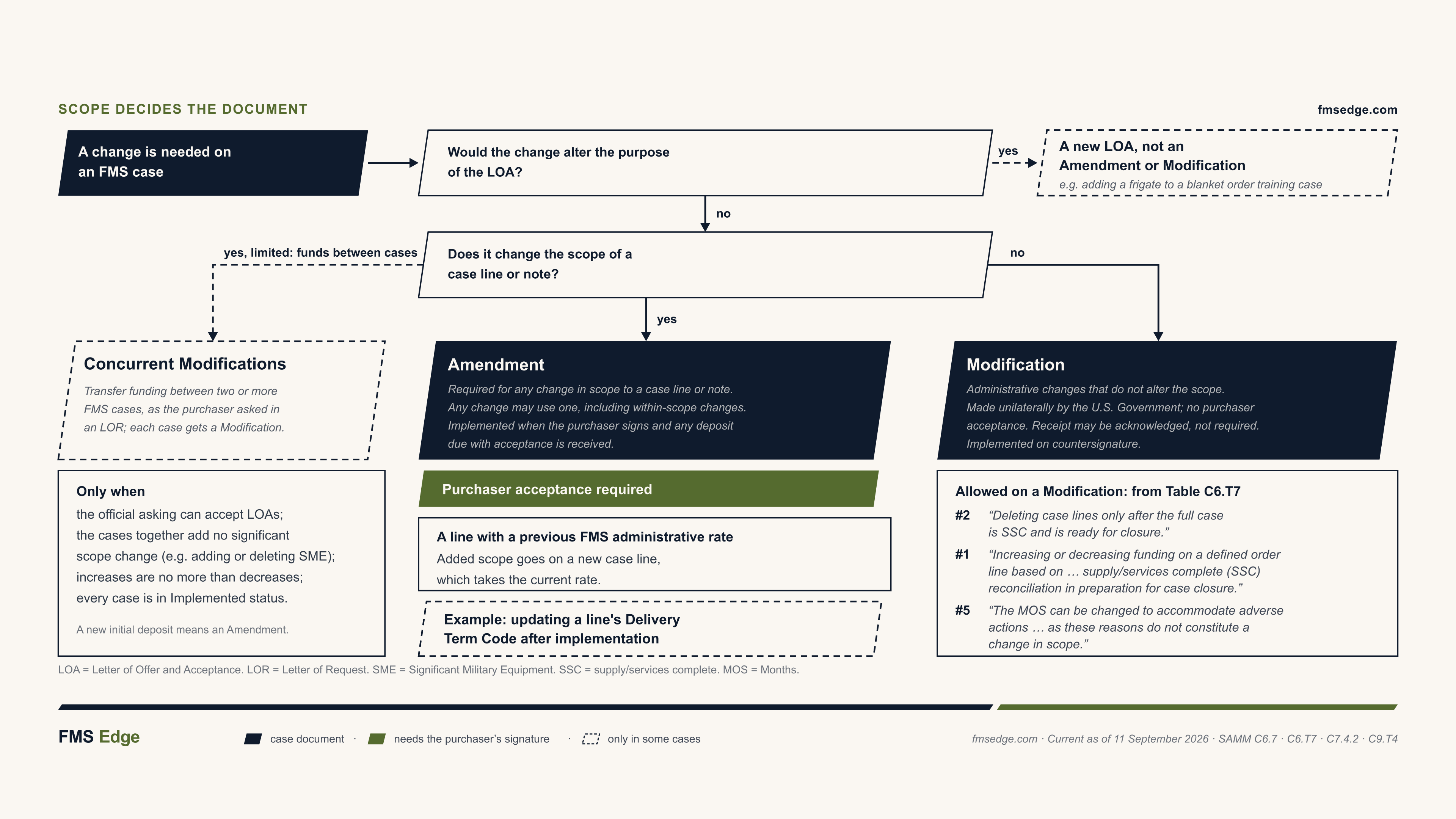
An amendment changes the scope of a case and takes effect only when the purchaser signs it. A modification makes changes that do not alter the scope; the U.S. Government issues it on its own authority under the standard terms the purchaser already accepted. A change that alters the purpose of the case needs a new .
Scope decides the document. A change that would alter the purpose of the Letter of Offer and Acceptance needs a new LOA. An Amendment is required whenever a change alters the scope of a case line or note, and it needs the purchaser's acceptance; added scope on a line that carries a previous FMS administrative rate goes on a new case line. A Modification makes administrative, within-scope changes, and the U.S. Government makes it unilaterally. Concurrent Modifications move funds between cases at the purchaser's request.
Why a Letter of Offer and Acceptance changes
An international partner’s requirements and the conditions and circumstances of the accepted may change during the course of implementation and execution. Examples of changes include the following:
- Increased or decreased costs of items
- Revised delivery dates
- Additional items required
- Changes in system configuration
To authorize these changes and establish an audit trail, proper documentation must be prepared for accurate and complete case management. The decision to use a new , an amendment, or a modification to implement a change will be shaped by the special conditions surrounding each change. interests are best served through use of the document that best safeguards U.S. and international partner’s interests while most efficiently accomplishing the needed program change. The scope of the case is a key issue to consider in deciding whether to prepare an Amendment, Modification, or new . A scope change takes place when the original purpose of a case line or note changes. This may be reflected through either an increase or decrease in dollar value, quantity, or lead-time.
Specific details on identifying the correct document to use and on complying with the necessary administrative requirements of review and/or countersignature by are found in , Section C6.7. A case manager who has doubt as to which document is appropriate after reviewing the guidance should consult the policy office and/or .
Major changes in scope: a new Letter of Offer and Acceptance
Revisions that significantly change original requirements are normally considered to be major changes in scope. Examples are the addition or deletion of or a substantial expansion of a program. Major changes normally require the preparation of a new . New for major changes to an ongoing program will cross reference the previous .
Amendments: changes in scope the purchaser must accept
An amendment represents a bilateral change to the case. By virtue of being bilateral, an amendment will not become effective unless the international partner accepts the change. The international partner has a choice to either accept or reject an amendment offered by the .
Acceptance of the change is signified by the international partner signing the amendment. Some amendments may require initial deposits, and these will not be implemented until sufficient payments have been received to cover the current financial requirements, including . Rejection of the change is signified by declining to sign the amendment.
Modifications: changes that do not affect scope
Changes to existing cases that do not impact the scope of the case are accomplished via modifications. When the partner accepts the original , they agree to accept the provisions of the standard terms and conditions. Section 4 of the standard terms and conditions permits the U.S. to make changes to the case under certain circumstances. An modification is the document the U.S. uses to inform the international partner of these unilateral changes. Because the international partner already agreed to such unilateral modifications by the in the standard terms and conditions of the , the international partner is not required to accept a modification. A modification is implemented on countersignature, or on U.S. Government signature when countersignature is not required. A modification does have a signature block for the international partner to sign but, in this instance, the signature simply acknowledges receipt rather than signifying acceptance. Examples of changes implemented by a modification are outlined in the C6.T7.
The modification also plays a critical role in financial management by the U.S. community. Under Section 4.1 of the standard terms, the U.S. uses its best efforts to advise the partner of cost increases above ten percent, changes and significant delays; a modification is the usual way that notice is given. A modification should also be provided for cost reductions, even if relatively minor, when all items are on order and prices are reasonably firm.
Pen and ink changes
A pen and ink change refers to a minor change that is authorized after an or amendment is offered to the international partner but is made prior to the international partner’s acceptance. Pen and ink changes are generally used to correct minor administrative or arithmetic errors. The authorizes the international partner to make any pen and ink changes by issuing an email or memorandum. Minor changes the may approve include a small arithmetic change that does not raise , an address correction or minor note wording. A pen and ink change to the or needs (OBO/FPRE/) approval. Pen and ink changes made by the international partner without prior authorization by the are considered a counteroffer and are not valid.
Pen and ink changes to modifications are not authorized. The reason for this is that a modification is a unilateral document and becomes effective upon issuance by the without requiring international partner acceptance. Any required changes to a modification must be accomplished by issuing another modification.
References
SAMM
- SAMM C6.7.1.1 — Scope.
- SAMM C6.7.2.8 — Amendment Implementation.
- SAMM C6.7.3.4 — Modification Implementation.
- SAMM C6.7.3.1.4 — Purchaser Acknowledgement.
- SAMM C6.7.2.7.3 — Major Changes to Amendments.
Related
Foreign Military Sales (FMS)
A process, authorized by the Arms Export Control Act, through which eligible foreign governments and international organizations may purchase defense articles, services, and training from the United States Government.
SAMM Glossary, as of 12 September 2026
Glossary entry →Open the manual’s entry → (opens in new tab)
Letter of Offer and Acceptance (LOA)
The legal instrument used by the USG to transfer itemized defense articles, defense services, and design and construction services to foreign partners.
When used under the authorities provided in the Arms Export Control Act for Foreign Military Sales, the LOA is a binding agreement signed by the USG and the foreign partner to transfer such articles and services.
When used under Building Partnership Capacity (BPC) authorities, the BPC LOA is not signed by the Benefitting Partner.
SAMM Glossary, as of 12 September 2026
Glossary entry →Open the manual’s entry → (opens in new tab)
LOA — Letter of Offer and Acceptance
SAMM Acronyms, as of 12 September 2026
FMS — Foreign Military Sale
SAMM Acronyms, as of 12 September 2026
DSCA — Defense Security Cooperation Agency
SAMM Acronyms, as of 12 September 2026
Glossary entry →Defense Security Cooperation Agency (DSCA) →
SAMM — Security Assistance Management Manual
SAMM Acronyms, as of 12 September 2026
Glossary entry →Security Assistance Management Manual (SAMM) →
Implementing Agency (IA)
The military department or defense agency responsible for the execution of military assistance programs. With respect to FMS, the military department or defense agency assigned responsibility by the Defense Security Cooperation Agency to prepare an LOA and to implement an FMS case. The implementing agency is responsible for the overall management of the actions that will result in delivery of the materials or services set forth in the LOA that was accepted by a foreign country or international organization.
SAMM Glossary, as of 12 September 2026
Glossary entry →Open the manual’s entry → (opens in new tab)
Security Cooperation
Activities undertaken by the DoD to encourage and enable international partners to work with the United States to achieve strategic objectives. It includes all DoD interactions with foreign defense and security establishments, including all DoD-administered security assistance programs, that: build defense and security relationships that promote specific U.S. security interests, including all international armaments cooperation activities and security assistance activities; develop allied and friendly military capabilities for self-defense and multinational operations; and provide U.S. forces with peacetime and contingency access to host nations.
SAMM Glossary, as of 12 September 2026
Glossary entry →Open the manual’s entry → (opens in new tab)
Cooperative Logistics
The logistics support provided a foreign government/agency through its participation in a U.S. DoD logistics system, with reimbursement paid to the USG for the support provided.
SAMM Glossary, as of 12 September 2026
Glossary entry →Open the manual’s entry → (opens in new tab)
CLSSA — Cooperative Logistics Supply Support Arrangement
SAMM Acronyms, as of 12 September 2026
Glossary entry →Cooperative Logistics Supply Support Arrangements (CLSSA) →
Significant Military Equipment (SME)
Defense articles for which special export controls are warranted because of the capacity of such articles for substantial military utility or capability. These items are identified on the U.S. Munitions List in the International Traffic in Arms Regulations by an asterisk preceding the item category listing.
SAMM Glossary, as of 12 September 2026
Glossary entry →Open the manual’s entry → (opens in new tab)
Termination Liability (TL) (Foreign Military Sales)
The potential cost for which the U.S. Government would be liable if a particular Foreign Military Sales case that includes procurement contracts is terminated prior to completion.
SAMM Glossary, as of 12 September 2026
Glossary entry →Open the manual’s entry → (opens in new tab)
DSAMS — Defense Security Assistance Management System
SAMM Acronyms, as of 12 September 2026
Glossary entry →Defense Security Assistance Management Systems (DSAMS) →
Security Assistance (SA)
A group of programs authorized by federal statutes by which the United States provides defense articles, military training, and other defense-related services by grant, lease, loan, credit, or cash sales in furtherance of national policies and objectives, and those that are funded and authorized through the Department of State to be administered by Department of Defense/Defense Security Cooperation Agency, which are considered part of security cooperation.
SAMM Glossary, as of 12 September 2026
Glossary entry →Open the manual’s entry → (opens in new tab)
Payment Schedule
List of dollar amounts and when they are due from the foreign customer. The payment schedule is included in the Letter of Offer and Acceptance (LOA) presented to the customer. After acceptance of the LOA, the payment schedule generally serves as the basis for billing to the customer. Changes in the estimated costs of an Foreign Military Sales case may require changes in the accompanying payment schedule.
SAMM Glossary, as of 12 September 2026
Glossary entry →Open the manual’s entry → (opens in new tab)
Total Case Value (Letter of Offer and Acceptance)
The total value of the Letter of Offer and Acceptance at the time of calculation, which includes the cost of the materiel, services, all Indirect Pricing Components, administrative charges, and all accessorial charges.
SAMM Glossary, as of 12 September 2026
Glossary entry →Open the manual’s entry → (opens in new tab)
Initial Deposit
Funds that are required to cover outlays and/or deliveries that are anticipated to occur before the receipt of the first quarterly payment. These funds must accompany the accepted Letter of Offer and Acceptance.
SAMM Glossary, as of 12 September 2026
Glossary entry →Open the manual’s entry → (opens in new tab)