
Stage 03
Case Development and LOA Preparation in Foreign Military Sales
In case development, the prepares the in the Defense Management System, and the case manager is normally responsible for its overall content. For major system sales, the case manager works with program managers and item managers to decide the line items. When the data is complete, the posts the approval () milestone and the document goes to the for writing, review and countersignature.
What happens
The data compiled for a is the data (). When the has completed the and its quality review, it will post the approval () milestone in the Defense Management System (), which moves the document from development to Write status [SAMM , ]. The is responsible for assigning each document a case development category and must enter it in when the case is created. Table C5.T9 sets the processing standard for each category [SAMM ].
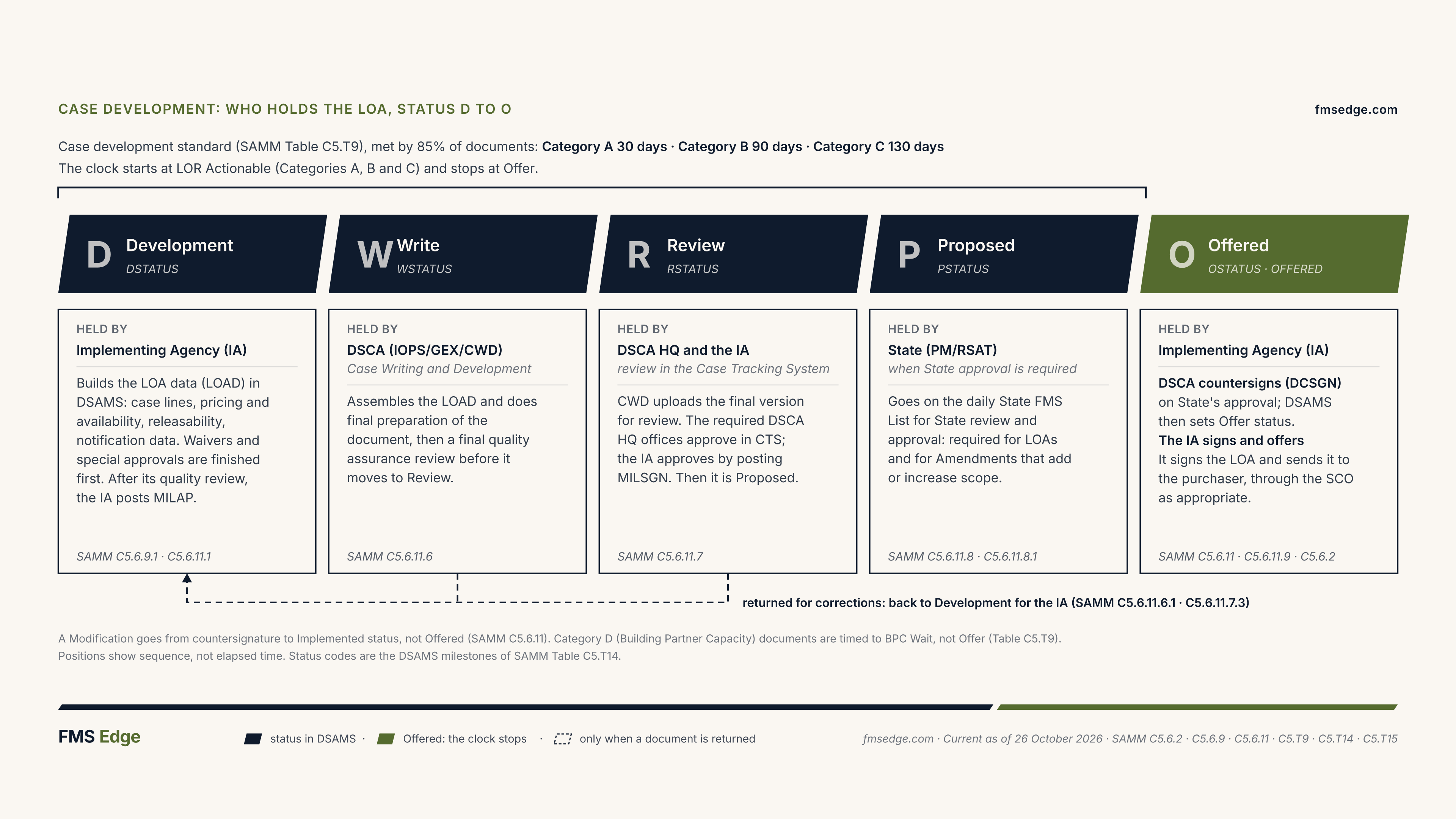
While a Letter of Offer and Acceptance is being prepared it moves through five statuses in DSAMS, from Development to Offered. The case development standard, counted from LOR Actionable to Offer, is 85% of documents within 30 days for Category A, 90 days for Category B and 130 days for Category C.
LOA data and the program office
An actionable must contain enough detail in its requirements for the responsible organization, such as a program office, to begin developing the . That detail includes the defense articles, commodities, quantities, services, support and integration, among other things [SAMM ].
To initiate case development, the country director tasks preparation of the using . Every case has an assigned case manager, and it is normally the case manager who has primary responsibility for the overall content.
For major system sales, the case manager coordinates with program managers and item managers to determine the line items to be included on the case to meet requirements identified in the international partner’s . Cost and availability estimates are developed for all articles and services included in each line. These estimates may be based on current Department of War (DoW) inventories or on information from U.S. defense contractors.
personnel also prepare notes that pertain specifically to the lines and case being developed. If the international partner has requested any waivers, the will staff the waiver request(s) and ensure it is appropriately reflected in the case [SAMM ].
As the data is being developed, the case manager and country director should both be alert for issues that may require further coordination, not only within the and other DoW organizations, but also with the Department of State and other non-DoW agencies. When outside coordination is required, the time required and the level at which it should occur will depend on a number of political, technical, and financial factors. When an includes a requirement for an item managed by another (e.g., U.S. Navy helicopters with U.S. Army electronics), the must be coordinated with all organizations involved [SAMM ].
Some more complex sales involving political issues, such as basing rights, need participation by the , the Office of the Under Secretary of War for Policy, the , or the Department of State. Some unique or complex financial or other business arrangements also need coordination with the Departments of Commerce and Treasury.
Line items and the Total Package Approach
When compiling , case managers should adhere to the policy of the [SAMM ]. ensures international partners are afforded the opportunity to acquire the full complement of articles and services necessary to field, maintain, and utilize major items of equipment efficiently and effectively. To a large degree, depends on receiving a comprehensive . In addition to the itself, a case that follows the concept will address areas such as training, technical assistance, publications, initial support, and follow-on support.
Changes while the case is in development
Between the date an is deemed actionable and the offer, a purchaser may significantly change the requirements it has already given. Such a change may mean rework by the on any case development already completed on the original information. When that happens, the may enter new dates in , such as a new " Actionable" date, so that case development can be tracked more accurately against the standard timeframes. The criteria for a significant change include those in Table C5.T5 [SAMM ].
If the requirements of a case change before its document is offered, the document should be adjusted and updated to include any of the changes that are suitable. The must review each change, as it reviews the initial requirements, against the criteria in Table C5.T4A to see whether the updated requirements are allowable. The should fold a minor change into the current development effort without changing the document milestones. For a significant change under Section C5.2.5.3, the must then enter a new " Actionable" date so that preparation of the document can be tracked against the revised date [SAMM ].
Writing, review and approval
Once the has finished the process and its quality review of the package, whether for a Basic , an Amendment or a Modification, it will post the milestone in . That moves the document from development to Write status. It also creates a case record on the 's dashboard in the , where the uploads the off-line documentation for transmission to the Case Writing and Development Division of the ( (/GEX/CWD)). Once this is done, the case record and the 's off-line documentation pass to that division in the application for processing. The division can see from various reports when case documents have moved to Write status [SAMM ].
In Write status, (/GEX/CWD) assembles the and conducts a final quality assurance review before moving the document to Review status [SAMM ]. In Review status, headquarters and coordinators review the final version of the [SAMM ]. In Proposed status, the document goes on the daily List for review and approval by the Department of State [SAMM ].
approval is required for an and for any later Amendment that adds or increases scope. Each day (/GEX/CWD) sends the List Report, which describes the defense articles and services that documents transfer. produces the report, and it carries the " Description" that the enters in the Case Detail Window. The is responsible for that description and follows Table C5.T17 in writing it [SAMM ].
Key players at this stage
Program office
- Weapon System Program OfficeMilitary Department program management office for the weapon system
Partner nation
- Foreign Liaison Officer (FLO)Partner nation military or civilian representative stationed in the United States, often at a U.S. Implementing Agency (AFSAC, USASAC, NAVSUP WSS, or a SYSCOM)
DSCA
- DSCA Country Portfolio DirectorDefense Security Cooperation Agency: International Operations (IOPS) / Regional Execution (REX)
- DSCA Country Finance DirectorDefense Security Cooperation Agency: Office of Business Operations, Financial Policy & Regional Execution Directorate (OBO/FPRE)
Service international affairs office
- Air Force: SAF/IA Country DirectorDeputy Under Secretary of the Air Force for International Affairs (SAF/IA), regional division (SAF/IAR)
- Army: DASA(DE&C) Regional Desk OfficerOffice of the Deputy Assistant Secretary of the Army: Defense Exports & Cooperation, under ASA(ALT)
- Navy: NIPO Country DirectorNavy International Programs Office (NIPO), Global Security Cooperation
Case manager
- Air Force: AFSAC Command Country ManagerAir Force Security Assistance & Cooperation Directorate (AFSAC), AFLCMC/WF
- Army: USASAC Country Program ManagerU.S. Army Security Assistance Command (USASAC), Regional Operations Directorate
- Navy: NIPO Country DirectorNavy International Programs Office (NIPO), Global Security Cooperation
- Navy: NAVSUP WSS Case ManagerNaval Supply Systems Command Weapon Systems Support (NAVSUP WSS)
Industry
- Industry Business DevelopmentU.S. defense contractor
Common pitfalls
- The program office cannot deliver reliable data (cost and availability estimates) inside the case development standard, and the slips
- Partner changes quantities or adds scope during development, triggering case rework
- Surcharge computation errors discovered during review send the back to the
- scoped too thin
What to watch for
Guides on this stage
References
SAMM
- SAMM C5.T9: Case Development Categories and Standards
- SAMM C5.T4A: Mandatory Criteria Before Letter of Request Actionable (Before Case Development Activities)
- SAMM C5.6.5.1: Implementing Agencies.
- SAMM C5.2.5.3: Letter of Request Changes During Case Development.
- SAMM C5.6.3.3.1: Requirement Changes Prior to Offer.
- SAMM C5.T5: Letter of Request Changes Considered “Significant” for New Letter of Request Actionable Date
- SAMM C5.6.11.6: Write Status.
- SAMM C5.6.11.7: Review Status.
- SAMM C5.6.11.8: Proposed Status.
- SAMM C5.6.11: Coordination and Countersignature of Letter of Offer and Acceptance Documents.
- SAMM C5.6.11.8.1
- SAMM C5.T17: Implementing Agency Responsibilities concerning the State Description
- SAMM C5.6.2.1: Case Development Extenuating Factor.
- SAMM C5.2.5.2.4: Letter of Request Complete.
- SAMM C5.6: Letter of Request Responses - Letter of Offer and Acceptance
- SAMM C5.2.3: The Department of War Components Authorized to Receive Letters of Request.
- SAMM C5.T3A: Military Department Organizations Authorized to Receive Letters of Request
- SAMM C5.T3B: Other Department of War Implementing Agencies Authorized to Receive Letters of Request
- SAMM C5.6.11.1
- SAMM C5.4: Rough Order of Magnitude Pricing.
- SAMM C5.5.2: Price and Availability Responses.
- SAMM C5.6.2: Letter of Offer and Acceptance Document Preparation Timeframe.
- SAMM C5.6.11.3: Documents to Accompany Letters of Offer and Acceptance During Coordination.
- SAMM C5.T13: General Rough Order of Magnitude, Price and Availability, and Letter of Offer and Acceptance Preparation Responsibilities
- SAMM C4.3.2: Total Package Approach.
Public authorities
- DSCA 13-16: DSCA Policy Memo 13-16 (SAMM E-Change 222)
- DSCA 18-42: DSCA Policy Memo 18-42
Facts referenced
- Case development standard, Category A (blanket order, CLSSA; LOR Actionable to Offer): 30 days (as of 26 October 2026; SAMM C5.T9)
- Case development standard, Category B (defined order; LOR Actionable to Offer): 90 days (as of 26 October 2026; SAMM C5.T9)
- Case development standard, Category C (defined order with complicating factors; LOR Actionable to Offer): 130 days (as of 26 October 2026; SAMM C5.T9)
- Case development standard, Category D (BPC; LOR Receipt or Customer Request Complete to BPC Wait): 60 days (as of 26 October 2026; SAMM C5.T9)
- Case development standard, share of documents expected to meet the standard: 85% (as of 26 October 2026; SAMM C5.T9)
SAMM: Security Assistance Management Manual
SAMM Acronyms, as of 12 September 2026
Glossary entry →Security Assistance Management Manual (SAMM) →
LOR: Letter of Request
SAMM Acronyms, as of 12 September 2026
Implementing Agency (IA)
The military department or defense agency responsible for the execution of military assistance programs. With respect to FMS, the military department or defense agency assigned responsibility by the Defense Security Cooperation Agency to prepare an LOA and to implement an FMS case. The implementing agency is responsible for the overall management of the actions that will result in delivery of the materials or services set forth in the LOA that was accepted by a foreign country or international organization.
SAMM Glossary, as of 12 September 2026
Glossary entry →Open the manual’s entry → (opens in new tab)
Letter of Offer and Acceptance Data (LOAD)
Data required to develop a Letter of Offer and Acceptance.
SAMM Glossary, as of 12 September 2026
Glossary entry →Open the manual’s entry → (opens in new tab)
Security Assistance (SA)
A group of programs authorized by federal statutes by which the United States provides defense articles, military training, and other defense-related services by grant, lease, loan, credit, or cash sales in furtherance of national policies and objectives, and those that are funded and authorized through the Department of State to be administered by Department of Defense/Defense Security Cooperation Agency, which are considered part of security cooperation.
SAMM Glossary, as of 12 September 2026
Glossary entry →Open the manual’s entry → (opens in new tab)
Weapon System
A combination of one or more weapons with all related equipment, materials, services, personnel, and means of delivery and deployment (if applicable) required for self-sufficiency.
SAMM Glossary, as of 12 September 2026
Glossary entry →Open the manual’s entry → (opens in new tab)
Military Department (MILDEP)
One of the departments within the DoD created by the National Security Act of 1947, as amended. The Military Departments are: the Department of the Air Force, the Department of the Army, and the Department of the Navy.
SAMM Glossary, as of 12 September 2026
Glossary entry →Open the manual’s entry → (opens in new tab)
Defense Security Cooperation Agency (DSCA)
The Department of War agency that directs, administers and provides guidance to the Department's components and its representatives at U.S. missions for the execution of the security cooperation programs for which it is responsible [SAMM C1.3.2.2]. The agency also provides financial and technical assistance, arranges the transfer of defense materiel, training and services to international partners, and promotes military-to-military contacts.
FMS Edge glossary, as of 10 October 2026
Glossary entry →Open the manual’s entry → (opens in new tab)
Foreign Military Sales (FMS)
The part of U.S. security assistance, authorized by the Arms Export Control Act (AECA), in which eligible foreign governments and international organizations buy defense articles, services and training from the U.S. Government under formal government-to-government agreements.
The articles come either from Department of War stocks or from new procurement under contracts the Department manages [22 U.S.C. 2761, 22 U.S.C. 2762]. A sale is FMS whatever the source of the purchaser's financing.
FMS Edge glossary, as of 10 October 2026
Glossary entry →Open the manual’s entry → (opens in new tab)
Letter of Offer and Acceptance (LOA)
The legal instrument that lists the defense articles and services, including training, that the U.S. Government transfers to a foreign country or international organization, with their estimated costs and the terms and conditions. The benefitting partner does not sign a Building Partner Capacity (BPC) LOA.
The Letter of Offer and Acceptance (LOA) is the instrument the U.S. Government uses to sell under the Arms Export Control Act (AECA); signed LOAs and their later Amendments and Modifications are also called Foreign Military Sales (FMS) cases [SAMM C5.6.1].
FMS Edge glossary, as of 10 October 2026
Glossary entry →Open the manual’s entry → (opens in new tab)
LOA: Letter of Offer and Acceptance
SAMM Acronyms, as of 12 September 2026
DSAMS: Defense Security Assistance Management System
SAMM Acronyms, as of 12 September 2026
Glossary entry →Defense Security Assistance Management Systems (DSAMS) →
Letter of Request (LOR)
The term used to identify a request from an eligible FMS participant country for the purchase of U.S. defense articles and services. The request may be in message or letter format.
SAMM Glossary, as of 12 September 2026
Glossary entry →Open the manual’s entry → (opens in new tab)
FMS: Foreign Military Sale
SAMM Acronyms, as of 12 September 2026
Defense Article (Foreign Assistance Act; Arms Export Control Act, not including commercial sales subject to the International Traffic in Arms Regulation)
Any weapon, weapon system, munition, aircraft, vessel or other implement of war, together with the property, equipment, tooling, components and parts used to furnish military assistance or sales or to make, maintain or use such items; the International Traffic in Arms Regulations (ITAR) define the term separately for commercial exports.
Section 47 of the Arms Export Control Act (AECA) defines the term, and the U.S. Munitions List designates the specific items that fall within it [SAMM C4.4] [22 U.S.C. 2794].
FMS Edge glossary, as of 10 October 2026
Glossary entry →Open the manual’s entry → (opens in new tab)
Defense Service (Foreign Assistance Act (FAA); Arms Export Control Act (AECA))
Any service, test, inspection, repair, training or publication, any defense information, and any technical or other assistance used to furnish military assistance or sales. The term excludes military education and training under the Foreign Assistance Act (FAA), and design and construction services provided under section 29 of the Arms Export Control Act (AECA). Under the International Traffic in Arms Regulations (ITAR) the term also covers help given to foreign persons in designing, producing, maintaining, operating or using defense articles, and the furnishing of controlled technical data.
Section 47 of the AECA defines the term [SAMM C4.4].
FMS Edge glossary, as of 10 October 2026
Glossary entry →Open the manual’s entry → (opens in new tab)
P&A: Price and Availability
SAMM Acronyms, as of 12 September 2026
National Funds
Source of funding that is provided directly from the purchaser.
SAMM Glossary, as of 12 September 2026
Glossary entry →Open the manual’s entry → (opens in new tab)
Letter of Credit (Bank Letter of Credit (BLOC) Memorandum of Understanding (MOU))
A legal instrument issued by a bank, Export Credit Agency, or other lending institution, that guarantees the Foreign Military Sales (FMS) partner's payment due to the U.S. Government under applicable FMS Letter of Offer and Acceptance. LC Number: Unique identifier for a specific Letter of Credit.
SAMM Glossary, as of 12 September 2026
Glossary entry →Open the manual’s entry → (opens in new tab)
CTA: Country Team Assessment
SAMM Acronyms, as of 12 September 2026
Combatant Command (CCMD)
A unified or specified command with a broad continuing mission under a single commander established and so designated by the President, through the Secretary of Defense and with the advice and assistance of the Chairman of the Joint Chiefs of Staff. Also called CCMD.
SAMM Glossary, as of 12 September 2026
Glossary entry →Open the manual’s entry → (opens in new tab)
DCS: Direct Commercial Sales
SAMM Acronyms, as of 12 September 2026
Total Package Approach (TPA)
A means of ensuring that Foreign Military Sales customers are aware of and are given the opportunity to plan for and obtain needed support items, training, and services from the USG contractors, or from within the foreign country's resources which are required to introduce and operationally sustain major items of equipment or systems.
SAMM Glossary, as of 12 September 2026
Glossary entry →Open the manual’s entry → (opens in new tab)
TPA: Total Package Approach
SAMM Acronyms, as of 12 September 2026
MDE: Major Defense Equipment
SAMM Acronyms, as of 12 September 2026
Significant Military Equipment (SME)
Defense articles for which special export controls are warranted because of the capacity of such articles for substantial military utility or capability. These items are identified on the U.S. Munitions List in the International Traffic in Arms Regulations by an asterisk preceding the item category listing.
SAMM Glossary, as of 12 September 2026
Glossary entry →Open the manual’s entry → (opens in new tab)
Case Tracking System (CTS)
A DSCA application directly fed from the Defense Security Assistance Management System that allows all draft Letters of Offer and Acceptance (LOA) electronic packages, developed by the Implementing Agencies, to be submitted to DSCA Case Writing and Development Division for end-phase LOA development and reviewed by DSCA stakeholders, prior to final review by the U.S. Department of State, and culminating in a final LOA.
SAMM Glossary, as of 12 September 2026
Glossary entry →Open the manual’s entry → (opens in new tab)
DSCA: Defense Security Cooperation Agency
SAMM Acronyms, as of 12 September 2026
Glossary entry →Defense Security Cooperation Agency (DSCA) →
CTS: Case Tracking System
SAMM Acronyms, as of 12 September 2026
SCIP: Security Cooperation Information Portal
SAMM Acronyms, as of 12 September 2026
Glossary entry →Security Cooperation Information Portal (SCIP) →
Major End Items
Any end item that is Significant Military Equipment or Major Defense Equipment or where control over the programming of these items is required. See also "end item."
SAMM Glossary, as of 12 September 2026
Glossary entry →Open the manual’s entry → (opens in new tab)
Offer Date
The date which appears on the offer portion of an Letter of Offer and Acceptance and which indicates the date on which an Foreign Military Sales offer is made to a foreign buyer.
SAMM Glossary, as of 12 September 2026
Glossary entry →Open the manual’s entry → (opens in new tab)
Cooperative Logistics Supply Support Arrangements (CLSSA)
Military logistics support arrangements designed to provide responsive and continuous supply support at the depot level for U.S.-made military materiel possessed by foreign countries and international organizations. The CLSSA is normally the most effective means for providing common repair parts and secondary item support for equipment of U.S. origin that is in allied and friendly country inventories.
SAMM Glossary, as of 12 September 2026
Glossary entry →Open the manual’s entry → (opens in new tab)
CLSSA: Cooperative Logistics Supply Support Arrangement
SAMM Acronyms, as of 12 September 2026
Glossary entry →Cooperative Logistics Supply Support Arrangements (CLSSA) →
Defined Order Case
A Letter of Offer and Acceptance (LOA) that provides specific defense articles and/or defense services with definitive items, quantities, and/or Months of anticipated materiel delivery or performance of services on the LOA lines.
SAMM Glossary, as of 12 September 2026
Glossary entry →Open the manual’s entry → (opens in new tab)
End Item
A finished combination of end products, component parts or materials, assembled or completed and ready for its intended use, issue or deployment, such as an aircraft, a truck, a mobile generator or a rifle.
FMS Edge glossary, as of 10 October 2026
Glossary entry →Open the manual’s entry → (opens in new tab)
Technology Release
The formal U.S. Government decision processes that seek approval to transfer specific defense items, technical data, or defense services to a foreign partner pursuant to Foreign Military Sales, Direct Commercial Sales, or Cooperative Agreements.
SAMM Glossary, as of 26 October 2026
Glossary entry →Open the manual’s entry → (opens in new tab)
Major Defense Equipment (MDE)
Any item of Significant Military Equipment on the U.S. Munitions List having a nonrecurring research and development cost of more than $50 million or a total production cost of more than $200 million. Also defined in section 47 (6), Arms Export Control Act.
SAMM Glossary, as of 12 September 2026
Glossary entry →Open the manual’s entry → (opens in new tab)
Excess Defense Articles (EDA)
Defense articles owned by the USG which are neither procured in anticipation of military assistance or sales requirements, nor procured pursuant to a military assistance or sales order. EDA are items (except construction equipment) that are in excess of the Approved Force Acquisition Objective and Approved Force Retention Stock of all DoD components at the time such articles are dropped from inventory by the supplying agency for delivery to countries or international organizations.
SAMM Glossary, as of 12 September 2026
Glossary entry →Open the manual’s entry → (opens in new tab)
EDA: Excess Defense Articles
SAMM Acronyms, as of 12 September 2026
Defense Integrated Financial System (DIFS)
A financial system providing DoD-level financial management functions for the security assistance (SA) program. This includes centralized Foreign Military Sales (FMS) trust fund accounting, foreign customer billing, and financial management reporting. DIFS consolidates FMS data from the Army, Navy, Air Force, and other implementing agencies, and provides efficient accountability for oversight of the financial and program management aspects of SA.
SAMM Glossary, as of 12 September 2026
Glossary entry →Open the manual’s entry → (opens in new tab)
Performance Standard
A specific measure used to evaluate how well an activity or job is done, which includes a threshold to meet established objectives or requirements.
SAMM Glossary, as of 26 October 2026
Glossary entry →Open the manual’s entry → (opens in new tab)
COMSEC: Communications Security
SAMM Acronyms, as of 12 September 2026
SAMM C5.5.2: Price and Availability Responses.
“P&A responses are estimates of cost and availability of defense articles or services. P&A responses are not valid for use in preparing a Letter of Offer and Acceptance (LOA). The data compiled for an LOA is referred to as LOA data (LOAD). For all partner requests for LORs for P&A, except for Building Partner Capacity (BPC) (see Section C15.2.8.) and …”
Security Assistance Management Manual, as of 26 October 2026
SAMM C5.6.11.1
“When the IA has completed the LOAD process and its quality review of the LOAD package for the Basic LOA, Amendment or Modification, it will post the MILAP milestone in DSAMS, which moves the document from development to Write status in DSAMS and creates a case record on their respective CTS dashboard for off-line documentation to be uploaded for transmission …”
Security Assistance Management Manual, as of 11 September 2026
SAMM C5.6.2: Letter of Offer and Acceptance Document Preparation Timeframe.
“The time required to prepare LOA documents (LOAs, Amendments, and Modifications) varies with the complexity of the sale. Standards are established and tracked by specific case category as shown on Table C5.T9. The Implementing Agency (IA) is responsible for assigning a case development category to each LOA document for tracking against the specific standard in accordance with guidance provided in …”
Security Assistance Management Manual, as of 26 October 2026
SAMM C5.T4A: Mandatory Criteria Before Letter of Request Actionable (Before Case Development Activities)
“Table C5.T4A. Mandatory Criteria Before Letter of Request Actionable (Before Case Development Activities) # Criteria 1 Potential purchaser is an eligible FMS recipient. See Section C4.1. 2 The defense article or defense service sought may be sold. See Section C4.4. and Section C4.5. 3 The request was submitted and received through proper channels. See Section C5.2.2. 4 No sanctions exist …”
Security Assistance Management Manual, as of 26 October 2026
SAMM C5.T13: General Rough Order of Magnitude, Price and Availability, and Letter of Offer and Acceptance Preparation Responsibilities
“Table C5.T13. General Rough Order of Magnitude, Price and Availability, and Letter of Offer and Acceptance Preparation Responsibilities Implementing Agency DSCA Case Writing and Development Division LOAD Development Input Letter of Request Create Case/Line Structure MTDS MTCR Review Critical Program Information (CPI) Anti-tamper (AT) Requirements Pricing (to include accessorial charges) and Delivery Data Terms of Sale Line Description Notes Case-unique …”
Security Assistance Management Manual, as of 26 October 2026
SAMM C5.6.5.1: Implementing Agencies.
“Organizations authorized to receive LORs and responsible for preparing and processing LOAs in accordance with the SAMM are known as IAs (See Table C5.T3A. or Table C5.T3B.). When an LOR received by an IA includes a requirement for an item managed by another IA, the LOR must be coordinated with all organizations involved. The IA should consider a Multi-Service LOA …”
Security Assistance Management Manual, as of 5 October 2026
SAMM C4.3.2: Total Package Approach.
“The Total Package Approach (TPA) ensures that FMS purchasers can obtain support articles and services, to include construction of necessary support facilities, required to introduce and sustain equipment and to operate in a responsible and effective manner consistent with U.S. intent in approving the transfer. The complete sustainability package must be offered to the purchaser when preparing a Letter of …”
Security Assistance Management Manual, as of 26 October 2026
SAMM C5.2.5.3: Letter of Request Changes During Case Development.
“During the time period between when an LOR is deemed actionable and the presentation of an offer, a purchaser may significantly change previously-provided requirements. This may result in rework by the IA for any case development work already completed based on the original information. In these instances, the IA may enter new dates in DSAMS (e.g., new "LOR Actionable" date) …”
Security Assistance Management Manual, as of 5 October 2026
SAMM C5.6.3.3.1: Requirement Changes Prior to Offer.
“If the case requirements change before the LOA document has been offered to the purchaser, the LOA document should be adjusted and updated to reflect any changes that are suitable for inclusion. As with the initial requirements, the IA must review any changes in accordance with the criteria on Table C5.T4A. to see if the updated requirements are allowable. If …”
Security Assistance Management Manual, as of 11 September 2026
SAMM C5.6.11.6: Write Status.
“In Write status, the DSCA (IOPS/GEX/CWD) will assemble the LOAD provided by the IA and conduct final preparation of Basic LOAs, Amendments or Modifications. When completed, DSCA (IOPS/GEX/CWD) will conduct a final quality assurance review on the submitted LOA document before moving the package to Review status in DSAMS. DSAMS feeds will update the CTS application accordingly.”
Security Assistance Management Manual, as of 11 September 2026
SAMM C5.6.11.7: Review Status.
“In Review status, the DSCA (IOPS/GEX/CWD) will upload the final version of the LOA for review by DSCA HQ and IA coordinators, in the CTS application. Coordinators will be notified via e-mail from the CTS application. Once the required DSCA HQ offices approve within the CTS application, and the IA approves via the MILSGN milestone in DSAMS, the document is …”
Security Assistance Management Manual, as of 11 September 2026
SAMM C5.6.11.8: Proposed Status.
“In Proposed status, staffed and approved LOA documents will be added to the daily State FMS List and submitted for review and approval by State. See Section C5.6.11.8.1. for additional information on the State List Report.”
Security Assistance Management Manual, as of 11 September 2026
SAMM C5.6.11.8.1
“State approval is required for LOA and subsequent Amendments that add or increase scope. DSCA (IOPS/GEX/CWD) submits the State List Report daily, which provides State with descriptions of defense articles and services being transferred on LOA documents. The report is produced by DSAMS and includes the “State Description” entered by the IA on the DSAMS Case Detail Window. The IA …”
Security Assistance Management Manual, as of 26 October 2026