
Guide
Who works in Foreign Military Sales, and how are they trained and certified?
is run by the workforce (the military and civilian personnel of the Implementing Agencies in the three military departments and the defense agencies, the organizations in U.S. embassies, and the program offices that buy for a partner alongside their own service), with U.S. industry on the other side of most contracts. The Defense University trains and certifies that workforce: certification is a condition of employment for civilians and an order for service members, at proficiency levels that are currently Level 1 Foundational, Level 2 Practitioner, Level 3 Expert, and Level 4 Executive (as of 20 September 2026).
Who the purchaser deals with in a Foreign Military Sale, and what passes between them. The Implementing Agency's case manager runs through the whole case as the U.S. representative to the purchaser, and each box opens that player's page.
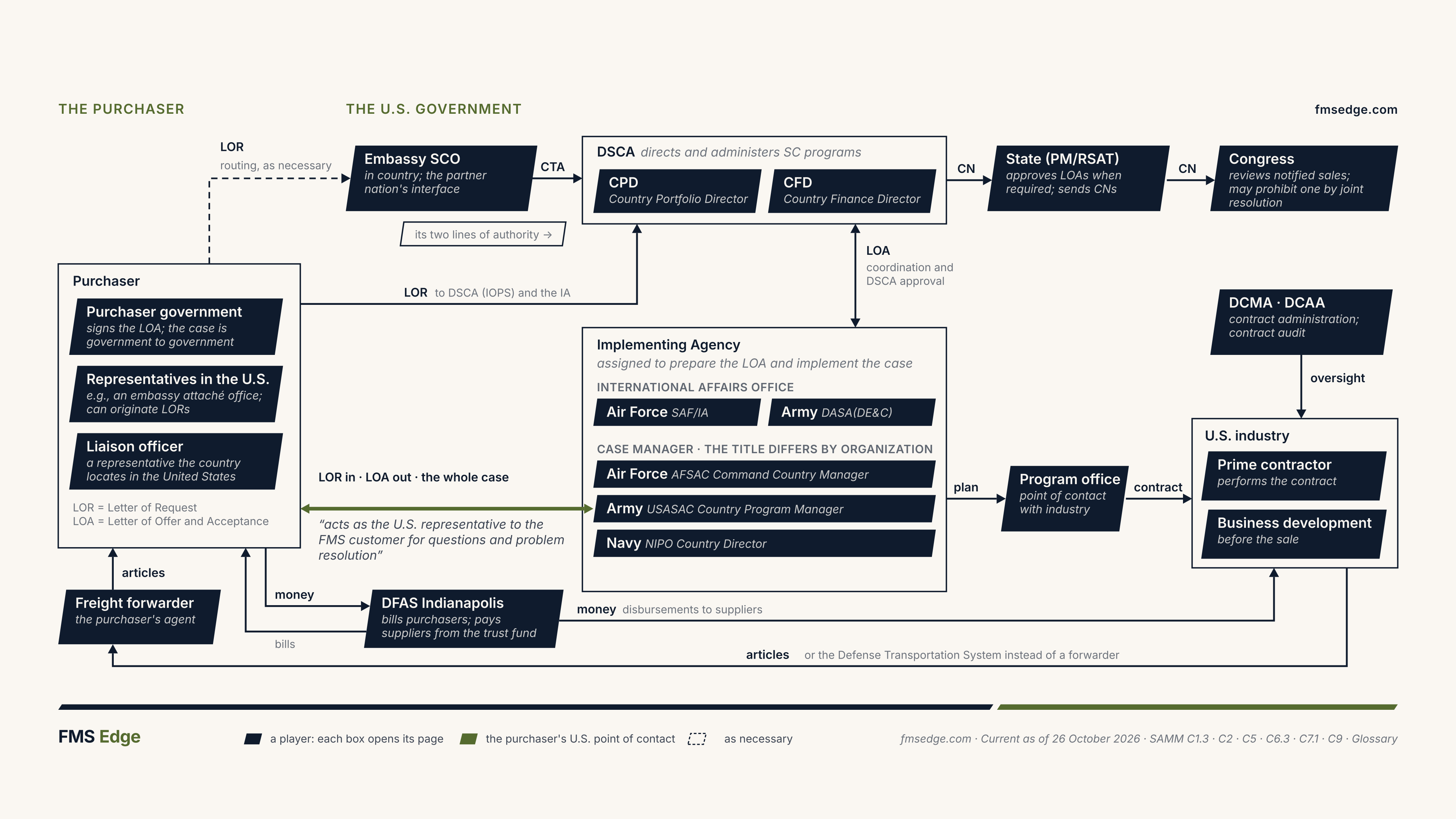
Who works in Foreign Military Sales, and how are they trained and certified?
is run by the workforce, which the Defense University trains, certifies and tracks [SAMM ] []. By law, the workforce is made up of the following []:
- Service members and Department of War civilians in the organizations of U.S. missions overseas
- Those in the geographic and functional combatant commands who plan, monitor or conduct activities
- Those in the military departments who perform activities, including work on policy
- Other military and civilian personnel of the defense agencies and field activities who perform activities
- Department of War personnel who assess, monitor or evaluate and activities
- Others who contribute significantly to , as the Department determines
covers everything the Department of War does to encourage international partners, and enable them, to work with the United States toward strategic objectives [SAMM ]. Execution of foreign policy in terms of reaches from the Secretary of War through the to the , and finally to the in-country Senior Defense Official/Defense Attaché (/), , and .
The three Military Departments () manage most and Building Partner Capacity cases. Accordingly, the offices that support , for the most part, overlay the existing domestic infrastructure. As one might expect from such an arrangement, the policies, databases, and organizational elements used to manage vary among . Still, the organizations are similar in that each has the following:
- A dedicated headquarters element
- An that is responsible for support equipment, spare parts, and repair services
- An training activity that manages both stand-alone schoolhouse training, such as , and training in support of systems sales
The mission of the Defense University () to train, certify and track the workforce requires a learning and workforce management system to support it. uses Cornerstone on Demand (CSOD), a commercial off-the-shelf management system with learning and performance management modules. Under a partnership with the Defense Acquisition University (), runs an instance of CSOD within 's license and support structure and draws on 's expertise and contract support for a comparable system to manage education and training, tracking and certification. CSOD has two modules: one for learning management, certification, registration and business analytics, and one for in-depth tracking, career planning and improved management capabilities [SAMM , ].
References
SAMM
- SAMM C1.1.1: Definition and Purpose.
- SAMM C13.3.6.1: Cornerstone on Demand
- SAMM C2.2: Department of War – Case Managers.
- SAMM C2.1.8: United States Military Group Support to Industry.
- SAMM C1.3.2.6: Implementing Agencies.
- SAMM C13.3.6: Education, Training, and Workforce.
- SAMM C13.3.6.1.1
Public authorities
- 10 U.S.C. §384
- DSCU Certification 2.0: Defense Security Cooperation University, Security Cooperation Workforce Certification 2.0 Program
- DAWIA: Defense Acquisition Workforce Improvement Act (DAWIA), 10 U.S.C. ch. 87
Facts referenced
- Status of security cooperation workforce certification for civilians and service members: a condition of employment for civilians and an order for service members (as of 20 September 2026)
- Security Cooperation Workforce Certification 2.0 proficiency levels: Level 1 Foundational, Level 2 Practitioner, Level 3 Expert, and Level 4 Executive (as of 20 September 2026)
Related
Foreign Military Sales (FMS)
The part of U.S. security assistance, authorized by the Arms Export Control Act (AECA), in which eligible foreign governments and international organizations buy defense articles, services and training from the U.S. Government under formal government-to-government agreements.
The articles come either from Department of War stocks or from new procurement under contracts the Department manages [22 U.S.C. 2761, 22 U.S.C. 2762]. A sale is FMS whatever the source of the purchaser's financing.
FMS Edge glossary, as of 10 October 2026
Glossary entry →Open the manual’s entry → (opens in new tab)
Security Cooperation
Activities by which the Department of War encourages and enables international partners to cooperate with the United States toward strategic objectives, spanning every interaction with foreign defense and security establishments and every security assistance program the Department administers.
Under chapter 16 of Title 10, their purposes are to develop allied and friendly security capabilities for self-defense and multinational operations, to give U.S. forces peacetime and contingency access, and to build relationships promoting specific U.S. security interests [10 U.S.C. 301(7)].
FMS Edge glossary, as of 10 October 2026
Glossary entry →Open the manual’s entry → (opens in new tab)
Technology Release
The formal U.S. Government decision processes that seek approval to transfer specific defense items, technical data, or defense services to a foreign partner pursuant to Foreign Military Sales, Direct Commercial Sales, or Cooperative Agreements.
SAMM Glossary, as of 26 October 2026
Glossary entry →Open the manual’s entry → (opens in new tab)
Security Cooperation Programs
Any program, activity (including an exercise), or interaction of the Department of Defense with the security establishment of a partner or international organization to achieve a purpose as follows:
To build and develop allied and friendly security capabilities for self-defense and multinational operations.
To provide the armed forces with access to the partner or international organization during peacetime or a contingency operation.
To build relationships that promote specific United States security interests.
SAMM Glossary, as of 12 September 2026
Glossary entry →Open the manual’s entry → (opens in new tab)
Defense Security Cooperation Agency (DSCA)
The Department of War agency that directs, administers and provides guidance to the Department's components and its representatives at U.S. missions for the execution of the security cooperation programs for which it is responsible [SAMM C1.3.2.2]. The agency also provides financial and technical assistance, arranges the transfer of defense materiel, training and services to international partners, and promotes military-to-military contacts.
FMS Edge glossary, as of 10 October 2026
Glossary entry →Open the manual’s entry → (opens in new tab)
Combatant Command (CCMD)
A unified or specified command with a broad continuing mission under a single commander established and so designated by the President, through the Secretary of Defense and with the advice and assistance of the Chairman of the Joint Chiefs of Staff. Also called CCMD.
SAMM Glossary, as of 12 September 2026
Glossary entry →Open the manual’s entry → (opens in new tab)
Senior Defense Official (SDO) and Defense Attaché (DATT)
Principal DoD official in a U.S. embassy, as designated by the Secretary of Defense. The SDO or DATT is the Chief of Mission's principal military advisor on defense and national security issues, the senior diplomatically accredited DoD military officer assigned to a diplomatic mission, and the single point of contact for all DoD matters involving the embassy or DoD elements assigned to or working from the embassy. The SDO or DATT is considered the dual-hatted chief of both the Security Cooperation Organization and Defense Attaché Office in the embassy. This position was established by DoDD 5205.75, Department of Defense Operations at U.S. Embassies, December 21, 2007. The same document gives coordinating authority (see glossary definition) to the SDO or DATT for the purpose of ensuring that all DoD elements in a country are working in consonance with each other and under the guidance of the Chief of Mission. The SDO or DATT program replaces the now defunct U.S. Defense Representative model.
SAMM Glossary, as of 12 September 2026
Glossary entry →Open the manual’s entry → (opens in new tab)
Defense Attaché Office (DAO)
A DoD organization assigned to a U.S. diplomatic mission overseas for the purposes of overt gathering of military information, representing the U.S. DoD in the conduct of military liaison activities, and performing as a component of the U.S. country team. Several DAO's have been designated by the President as being responsible for security assistance functions in a host country.
SAMM Glossary, as of 12 September 2026
Glossary entry →Open the manual’s entry → (opens in new tab)
Security Cooperation Organization (SCO)
A Department of Defense element that is part of the United States Diplomatic mission located in a foreign country to carry out security assistance and security cooperation management functions under the supervision and coordination authority of the senior defense official/defense attaché.
SAMM Glossary, as of 12 September 2026
Glossary entry →Open the manual’s entry → (opens in new tab)
Military Department (MILDEP)
One of the departments within the DoD created by the National Security Act of 1947, as amended. The Military Departments are: the Department of the Air Force, the Department of the Army, and the Department of the Navy.
SAMM Glossary, as of 12 September 2026
Glossary entry →Open the manual’s entry → (opens in new tab)
Security Assistance (SA)
A group of programs authorized by federal statutes by which the United States provides defense articles, military training, and other defense-related services by grant, lease, loan, credit, or cash sales in furtherance of national policies and objectives, and those that are funded and authorized through the Department of State to be administered by Department of Defense/Defense Security Cooperation Agency, which are considered part of security cooperation.
SAMM Glossary, as of 12 September 2026
Glossary entry →Open the manual’s entry → (opens in new tab)
FMS: Foreign Military Sale
SAMM Acronyms, as of 12 September 2026
International Logistics Control Office (ILCO)
The office in each Military Department that manages the logistics support programs and transactions of Foreign Military Sales (FMS) and other security cooperation programs, and the central point in the continental United States for monitoring purchasers' requisitions.
A purchaser reports a valid supply discrepancy to the International Logistics Control Office (ILCO) of the Military Department concerned [SAMM C2.1.5.4.3].
FMS Edge glossary, as of 10 October 2026
Glossary entry →Open the manual’s entry → (opens in new tab)
Professional Military Education (PME)
Career training designed to provide or enhance leadership and the recipient force's capabilities to conduct military planning, programming, management, budgeting, and force development to the level of sophistication appropriate to that force.
SAMM Glossary, as of 12 September 2026
Glossary entry →Open the manual’s entry → (opens in new tab)
SAMM C13.3.6.1.1
“DSCU’s mission to train, certify, and track the SC workforce requires a learning and workforce management system to support that effort. CSOD is a commercial-off-the-shelf (COTS) management system that includes learning and performance management modules. Through a partnership with the Defense Acquisition University (DAU) to implement an instance of CSOD within their license and support structure, DSCU leverages DAU expertise …”
Security Assistance Management Manual, as of 11 September 2026
SAMM C1.1.1: Definition and Purpose.
“Security cooperation (SC) comprises all activities undertaken by the DoW to encourage and enable international partners to work with the United States to achieve strategic objectives. It includes all DoW interactions with foreign defense and security establishments, including all DoW-administered security assistance (SA) programs, that build defense and security relationships; promote specific U.S. security interests, including all international armaments cooperation …”
Security Assistance Management Manual, as of 26 October 2026
SAMM C13.3.6.1: Cornerstone on Demand
“Cornerstone on Demand (CSOD) is a modular education-context Defense Security Cooperation University (DSCU) business management system that provides DSCA with customer-facing and administrative business management capabilities.”
Security Assistance Management Manual, as of 11 September 2026