
Guide
What is the Security Cooperation Information Portal (SCIP)?
The is a web-based tool, managed by the , that gives purchasers, their agents such as freight forwarders, and U.S. Government personnel with the right permissions access to case information drawn from the Defense Management System and the Military Departments' case execution systems.
What is the Security Cooperation Information Portal (SCIP)?
The is a web-based tool, managed by the , that provides information about the Letters of Offer and Acceptance of U.S. and about other key and processes. Its users are international purchasers, their agents such as freight forwarders, and U.S. Government personnel who hold the right permissions.
is a secure, controlled, unclassified Department of War (DoW) web-based computer information system that provides authorized users with access to and ’ case-related data and reports to support management responsibilities for those cases. All U.S. Government () personnel (including and support contractors) and foreign purchasers (including their authorized freight forwarders) who have job responsibilities requiring access (i.e., need to know) to the system information are eligible to obtain accounts. encourages personnel to become familiar with ’s capabilities.
system access is available worldwide from any computer (i.e., does not have to be from a or DoW domain) as long as there is adequate internet access and an active, authorized user account.
The data extracts are obtained from multiple authoritative DoW and U.S. financial and logistics systems. Refresh status indicators and information are provided to users in the “Case Information Community” to document the date/time of the last data refresh from those systems.
Prior to the development of , information relating to the DoW’s execution of was individually available from each of the respective U.S. implementing agencies. The execution information had to be combined by the user to provide a comprehensive tri-service (Army, Navy, and Air Force) view or an entire overview of a country program. In addition, customers did not have access to the tri-service case development system known as the Defense Management System (). With , customers can view information relating to their cases. This access allows customers to view case status information from the day the case is first initiated in the system for case development work. information can be accessed by users worldwide with access to a web browser and the appropriate account permissions.
What can a purchaser see in SCIP?
A purchaser with the right permissions sees case information in : data from and selected case execution data from the and systems, in one standard format, whichever of them manages the case [SAMM ].
does not permit system access by international customers. draws on case data, giving customers access to selected information.
gives web-based visibility of information about and other key and processes. It presents, in a standard format, data drawn from case information and from selected parts of case execution held in and systems, such as the Centralized Integrated System for (), the , the and the . gives this case information whichever or manages the case, and it is a tool for foreign partners, customer agents such as freight forwarders, and personnel with appropriate permissions [SAMM ].
enables international customers, customer agents (e.g., freight forwarders), and personnel, with appropriate permissions, to access a variety of features, which are gathered into “Communities”.
is another medium available to the international partner for submitting and tracking requisitions as well as monitoring case status. Requisition submission capability (both individual and batch), support, and user guides are available in the Case Information, U.S. Air Force (), and Navy Communities. The gives the user access to data from the logistics databases, to data from the and to case management information from .
is also home to the , a secure web-based application that consolidates in-transit information and transportation plans for defense articles in one source. takes in data from carriers, consolidation points, contractors, depots, freight forwarders, the Defense Logistics Agency, the , and the ports of embarkation and debarkation.
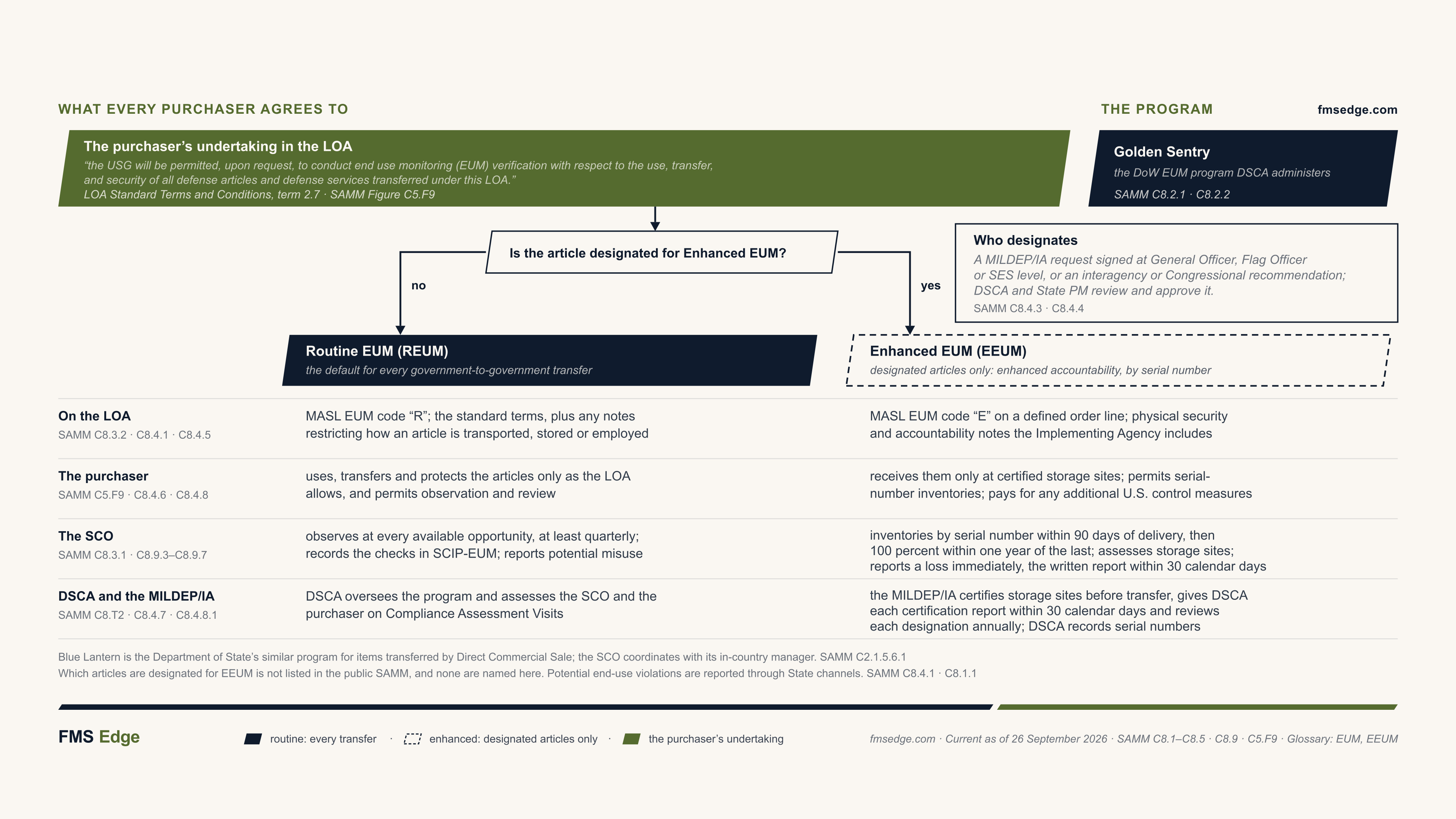
Every purchaser agrees in the LOA that the U.S. Government may verify how the articles it buys are used, transferred and secured. Golden Sentry, the Department of War end-use monitoring program DSCA administers, carries out that verification. Which articles are designated for Enhanced End-Use Monitoring is not listed in the public SAMM, and none are named here.
How does the Security Cooperation Office use SCIP?
The uses as a planning tool.
The provides the country-level planner with insights into the timing of the partner nation’s acquisitions, allowing the planner to develop training requirements for the pre- and post-equipment delivery. should maintain a account and use to obtain routine case information. can find answers in to many questions raised by the partner nation regarding cases.
use the End-Use Monitoring () community to track defense articles transferred to the partner nation and to conduct periodic reporting; they must conduct routine observations at least quarterly and document them in the SCIP-EUM database [SAMM , ].
also use the community to capture their own costs of carrying out the program [SAMM ].
procedures require the to identify and maintain contact with the primary and alternate host nation administrators for tokens [SAMM ].
How do international customers get access to SCIP?
International customers can reach through secure electronic tokens, and each partner has a primary and an alternate host nation administrator for those tokens. Guidance for on partner access to is found in Policy Memorandum 14-11, which covers how the tokens are distributed and replaced [SAMM ].
The chief designates, in writing, a , who oversees and keeps custody of each token within the .
also carries a partner’s requests for the return of excess funds. When a return of excess funds meets the criteria in C9.11.5.1, a designated representative of the partner must request it through , which requires a token for access. Returned funds will be sent to the partner’s authorized bank account only when a designated representative asks for them [SAMM ]. Where a request cannot be submitted in , the requester and the bank account information will be authenticated face to face instead [SAMM ].
References
SAMM
- SAMM C2.1.5.1: Case Information and Monitoring via Security Cooperation Information Portal.
- SAMM C2.1.5.6.2: Security Cooperation Information Portal End Use Monitoring Community.
- SAMM C8.3.1: Routine End Use Monitoring.
- SAMM C13.3.5.1: Security Cooperation Information Portal
- SAMM C9.11.9: Returning Excess FMS Funds to a Partner.
- SAMM C9.11.9.1.1.2
Related
Security Cooperation Information Portal (SCIP)
A web-based tool, managed by the Defense Security Cooperation Agency (DSCA), that gives international purchasers, their agents such as freight forwarders, and authorized U.S. Government personnel information on Foreign Military Sales (FMS) cases and other security cooperation programs.
It covers case, line, requisition and supply data, supply transactions and end-use monitoring information, drawn from the Defense Security Assistance Management System (DSAMS) and the Military Departments' case execution systems.
FMS Edge glossary, as of 10 October 2026
Glossary entry →Open the manual’s entry → (opens in new tab)
Defense Security Cooperation Agency (DSCA)
The Department of War agency that directs, administers and provides guidance to the Department's components and its representatives at U.S. missions for the execution of the security cooperation programs for which it is responsible [SAMM C1.3.2.2]. The agency also provides financial and technical assistance, arranges the transfer of defense materiel, training and services to international partners, and promotes military-to-military contacts.
FMS Edge glossary, as of 10 October 2026
Glossary entry →Open the manual’s entry → (opens in new tab)
Foreign Military Sales (FMS)
The part of U.S. security assistance, authorized by the Arms Export Control Act (AECA), in which eligible foreign governments and international organizations buy defense articles, services and training from the U.S. Government under formal government-to-government agreements.
The articles come either from Department of War stocks or from new procurement under contracts the Department manages [22 U.S.C. 2761, 22 U.S.C. 2762]. A sale is FMS whatever the source of the purchaser's financing.
FMS Edge glossary, as of 10 October 2026
Glossary entry →Open the manual’s entry → (opens in new tab)
Security Assistance (SA)
A group of programs authorized by federal statutes by which the United States provides defense articles, military training, and other defense-related services by grant, lease, loan, credit, or cash sales in furtherance of national policies and objectives, and those that are funded and authorized through the Department of State to be administered by Department of Defense/Defense Security Cooperation Agency, which are considered part of security cooperation.
SAMM Glossary, as of 12 September 2026
Glossary entry →Open the manual’s entry → (opens in new tab)
Security Cooperation Programs
Any program, activity (including an exercise), or interaction of the Department of Defense with the security establishment of a partner or international organization to achieve a purpose as follows:
To build and develop allied and friendly security capabilities for self-defense and multinational operations.
To provide the armed forces with access to the partner or international organization during peacetime or a contingency operation.
To build relationships that promote specific United States security interests.
SAMM Glossary, as of 12 September 2026
Glossary entry →Open the manual’s entry → (opens in new tab)
SCIP: Security Cooperation Information Portal
SAMM Acronyms, as of 12 September 2026
Glossary entry →Security Cooperation Information Portal (SCIP) →
Building Partner Capacity (BPC) Programs
Security cooperation and security assistance activities funded with USG appropriations (not including Foreign Military Sales Credit and Military Assistance Program/Merger).
SAMM Glossary, as of 12 September 2026
Glossary entry →Open the manual’s entry → (opens in new tab)
Locally Employed Staff (LES)
Foreign nationals and other local residents, U.S. citizens and family members of U.S. Government employees among them, who work in support positions at a U.S. embassy, consulate or other overseas post in their country of residence. They are normally paid according to local wage scales and benefit plans.
FMS Edge glossary, as of 10 October 2026
Glossary entry →Open the manual’s entry → (opens in new tab)
DSCA: Defense Security Cooperation Agency
SAMM Acronyms, as of 12 September 2026
Glossary entry →Defense Security Cooperation Agency (DSCA) →
Security Cooperation
Activities by which the Department of War encourages and enables international partners to cooperate with the United States toward strategic objectives, spanning every interaction with foreign defense and security establishments and every security assistance program the Department administers.
Under chapter 16 of Title 10, their purposes are to develop allied and friendly security capabilities for self-defense and multinational operations, to give U.S. forces peacetime and contingency access, and to build relationships promoting specific U.S. security interests [10 U.S.C. 301(7)].
FMS Edge glossary, as of 10 October 2026
Glossary entry →Open the manual’s entry → (opens in new tab)
Military Department (MILDEP)
One of the departments within the DoD created by the National Security Act of 1947, as amended. The Military Departments are: the Department of the Air Force, the Department of the Army, and the Department of the Navy.
SAMM Glossary, as of 12 September 2026
Glossary entry →Open the manual’s entry → (opens in new tab)
DSAMS: Defense Security Assistance Management System
SAMM Acronyms, as of 12 September 2026
Glossary entry →Defense Security Assistance Management Systems (DSAMS) →
FMS: Foreign Military Sale
SAMM Acronyms, as of 12 September 2026
Implementing Agency (IA)
The military department or defense agency responsible for the execution of military assistance programs. With respect to FMS, the military department or defense agency assigned responsibility by the Defense Security Cooperation Agency to prepare an LOA and to implement an FMS case. The implementing agency is responsible for the overall management of the actions that will result in delivery of the materials or services set forth in the LOA that was accepted by a foreign country or international organization.
SAMM Glossary, as of 12 September 2026
Glossary entry →Open the manual’s entry → (opens in new tab)
International Logistics
The planning, negotiating, and implementation of supporting logistics arrangements between nations, their forces and agencies. It includes furnishing logistics support (major end items, materiel, and/or services) to, or receiving logistics support from, one or more friendly foreign governments, international organizations, or military forces, with or without reimbursement. It also includes planning and actions related to the intermeshing of a significant element, activity, or component of the military logistics systems or procedures of the United States with those of one or more foreign governments, international organizations, or military forces on a temporary or permanent basis. International logistics involves planning and actions related to the utilization of U.S. logistics, policies, systems, and/or procedures to meet requirements of one or more foreign governments, international organizations, or forces.
SAMM Glossary, as of 12 September 2026
Glossary entry →Open the manual’s entry → (opens in new tab)
CISIL: Centralized Integrated System - International Logistics
SAMM Acronyms, as of 12 September 2026
Glossary entry →Centralized Integrated System International Logistics (CISIL) →
Management Information System for International Logistics (MISIL)
System used by the U.S. Navy to manage the execution and accounting of all Foreign Military Sales cases.
SAMM Glossary, as of 12 September 2026
Glossary entry →Open the manual’s entry → (opens in new tab)
Security Assistance Management Information System (SAMIS)
An information system used by the U.S. Air Force (USAF) to process and manage data related to Air Force Materiel Command negotiations, acquisition, and physical delivery for international logistics support requirements in support of the USAF security assistance mission.
SAMM Glossary, as of 12 September 2026
Glossary entry →Open the manual’s entry → (opens in new tab)
Case Tracking System (CTS)
A DSCA application directly fed from the Defense Security Assistance Management System that allows all draft Letters of Offer and Acceptance (LOA) electronic packages, developed by the Implementing Agencies, to be submitted to DSCA Case Writing and Development Division for end-phase LOA development and reviewed by DSCA stakeholders, prior to final review by the U.S. Department of State, and culminating in a final LOA.
SAMM Glossary, as of 12 September 2026
Glossary entry →Open the manual’s entry → (opens in new tab)
International Logistics Control Office (ILCO)
The office in each Military Department that manages the logistics support programs and transactions of Foreign Military Sales (FMS) and other security cooperation programs, and the central point in the continental United States for monitoring purchasers' requisitions.
A purchaser reports a valid supply discrepancy to the International Logistics Control Office (ILCO) of the Military Department concerned [SAMM C2.1.5.4.3].
FMS Edge glossary, as of 10 October 2026
Glossary entry →Open the manual’s entry → (opens in new tab)
Defense Integrated Financial System (DIFS)
A financial system providing DoD-level financial management functions for the security assistance (SA) program. This includes centralized Foreign Military Sales (FMS) trust fund accounting, foreign customer billing, and financial management reporting. DIFS consolidates FMS data from the Army, Navy, Air Force, and other implementing agencies, and provides efficient accountability for oversight of the financial and program management aspects of SA.
SAMM Glossary, as of 12 September 2026
Glossary entry →Open the manual’s entry → (opens in new tab)
Enhanced Freight Tracking System (EFTS)
A secure web-based application, resident in the Security Cooperation Information Portal, that serves as a consolidated source for security cooperation defense articles in-transit information and transportation plans. EFTS receives data from DLA, contractors, depots, the Defense Transportation System, carriers, freight forwarders, consolidation points, and ports of embarkation and debarkation.
SAMM Glossary, as of 12 September 2026
Glossary entry →Open the manual’s entry → (opens in new tab)
EFTS: Enhanced Freight Tracking System
SAMM Acronyms, as of 12 September 2026
Defense Transportation System (DTS)
The part of the worldwide transportation infrastructure that supports Department of War transportation needs in peace and war, made up of military (organic) and commercial resources that are organic to the Department, under contract to it or controlled by it [SAMM C7.6.1].
It takes in organic and commercial aircraft and ships, commercial small-package services under Department contract, and U.S. military air and ocean terminals in and outside the United States.
FMS Edge glossary, as of 10 October 2026
Glossary entry →Open the manual’s entry → (opens in new tab)
Security Cooperation Organization (SCO)
A Department of Defense element that is part of the United States Diplomatic mission located in a foreign country to carry out security assistance and security cooperation management functions under the supervision and coordination authority of the senior defense official/defense attaché.
SAMM Glossary, as of 12 September 2026
Glossary entry →Open the manual’s entry → (opens in new tab)
SCO: Security Cooperation Organization
SAMM Acronyms, as of 12 September 2026
EUM: End Use Monitoring
SAMM Acronyms, as of 12 September 2026
Security Cooperation Officer Token Administrator
The individual designated, in writing, by the Security Cooperation Office Chief to oversee and maintain the custody of each Security Cooperation Information Portal (SCIP) token within the Security Cooperation Organization.
SAMM Glossary, as of 12 September 2026
Glossary entry →Open the manual’s entry → (opens in new tab)
SAMM: Security Assistance Management Manual
SAMM Acronyms, as of 12 September 2026
Glossary entry →Security Assistance Management Manual (SAMM) →
SAMM C13.3.5.1: Security Cooperation Information Portal
“The SCIP provides web-based visibility of information about FMS and other key SC programs and processes by drawing upon data that is sourced from DSAMS case information and selected portions of case execution derived from MILDEP/IA systems (e.g., CISIL, MISIL, SAMIS, and the Case Tracking System (CTS)) in a standardized format. SCIP provides case information, regardless of which MILDEP/IA is …”
Security Assistance Management Manual, as of 11 September 2026
SAMM C2.1.5.6.2: Security Cooperation Information Portal End Use Monitoring Community.
“MILGPs use the SCIP EUM community to track defense articles transferred to the partner nation, to conduct periodic reporting, and to capture MILGP costs associated with the execution of the EUM program.”
Security Assistance Management Manual, as of 26 October 2026
SAMM C8.3.1: Routine End Use Monitoring.
“Unless designated otherwise, Routine End Use Monitoring (REUM) is required for all defense articles and services provided via government-to-government programs. MILGP personnel are required to observe and report to the Combatant Command (CCMD), DSCA, and Department of State (State) any potential misuse or unapproved transfer of U.S.-provided defense articles. MILGP personnel should perform REUM observations at every available opportunity in …”
Security Assistance Management Manual, as of 26 October 2026
SAMM C2.1.5.1: Case Information and Monitoring via Security Cooperation Information Portal.
“MILGPs should maintain a Security Cooperation Information Portal (SCIP) account and use SCIP to obtain routine case information, monitor execution, and communicate select information to other users. SCIP is a web-based system that provides both USG personnel and international customers with access to FMS case-related data. The data is drawn from MILDEP case execution systems and other financial and logistics …”
Security Assistance Management Manual, as of 26 October 2026
SAMM C9.11.9: Returning Excess FMS Funds to a Partner.
“A return of excess FMS funds that meets the criteria outlined in Section C9.11.5.1. must be requested by a designated representative of the FMS partner through the Security Cooperation Information Portal (SCIP), which requires a token for access. Returned FMS funds will be sent to a partner’s authorized bank account only when requested by a designated representative.”
Security Assistance Management Manual, as of 11 September 2026
SAMM C9.11.9.1.1.2
“Receive return of excess funds requests submitted by foreign partners in SCIP. The request must include the holding account number, exact amount to be returned, requester’s contact information, and bank account information for the return of excess FMS funds. Return of excess FMS fund requests received via other means (i.e. email) must be redirected to the CFD through SCIP by …”
Security Assistance Management Manual, as of 5 October 2026