
Stage 09
Reconciliation and Closure in Foreign Military Sales
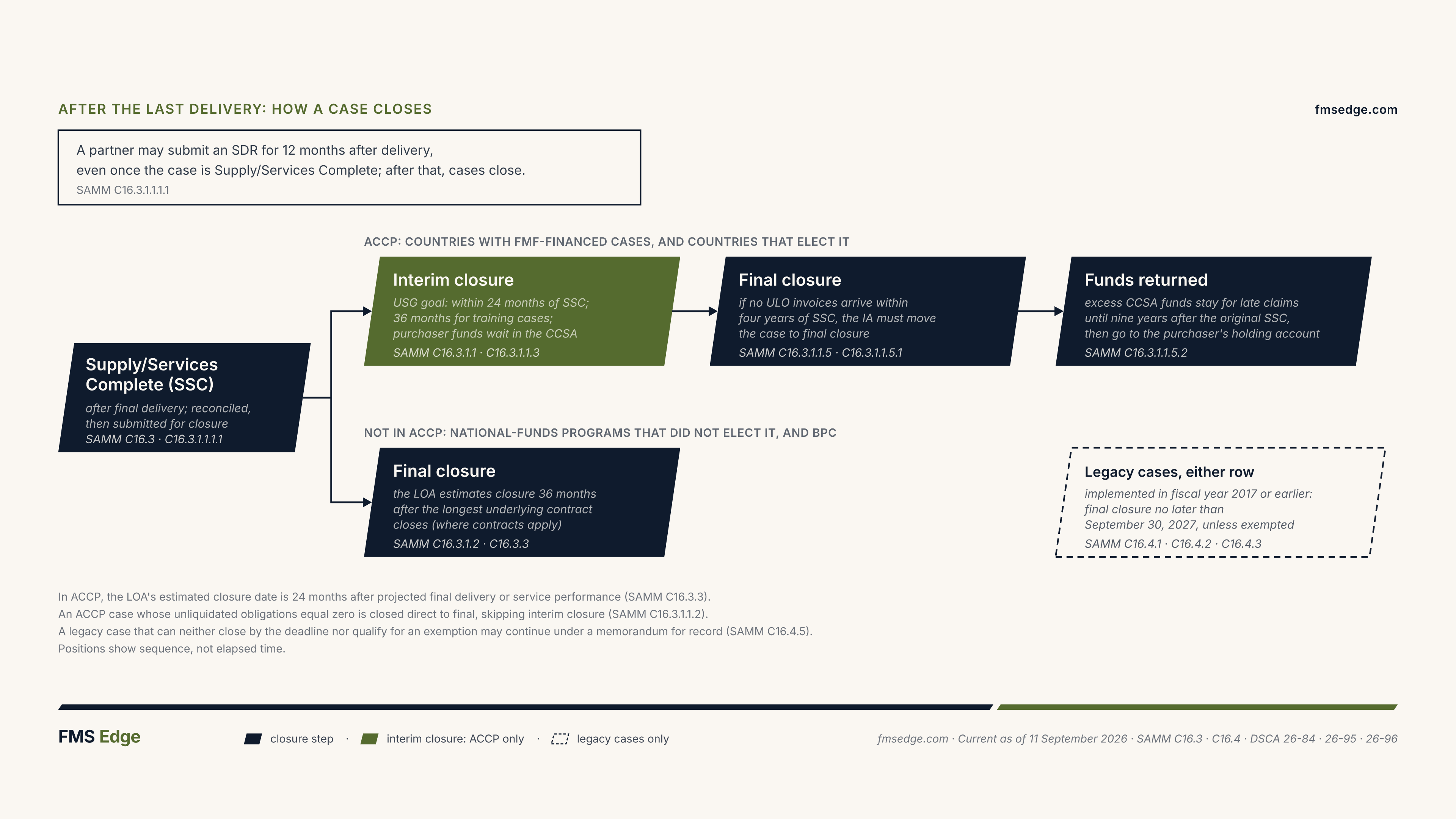
After the last delivery, the declares the case Supply/Services Complete and reconciles it for closure. Under the Accelerated Case Closure Procedures, a case with unliquidated obligations is interim closed and later final closed, and a case with none goes straight to final closure.
What happens
A case closes after it is Supply/Services Complete (SSC). Under Accelerated Case Closure Procedures a case is usually closed first on an interim basis while funds are held for its open obligations; if no invoices arrive within four years of SSC it must move to final closure, and funds still held go to the purchaser's holding account nine years after SSC. Other cases close once, after their contracts close.
As the delivery of articles and services listed on a case nears completion, the case manager should begin making preparations to complete reconciliation and close the case. The key players in closure are the , the Defense Finance and Accounting Service - Indianapolis (), and the international partner. Ultimately, responsibility for successful case closure rests with the case manager at the .
Reconciliation
Reconciliation is the financial and logistical work that keeps a case's accounting accurate, its data complete, its schedules current and its reporting timely and complete. Successful reconciliation throughout the life of a case speeds up closure [SAMM ]. Each case manager must perform an annual case and review or reconciliation on each case [SAMM ].
Active case review and reconciliation, from implementation of the until the case is Supply/Services Complete, are critical parts of effective case management. The annual review compares data between systems, data with performance, with their underlying contracts, and system data with the hardcopy or electronic supporting documents. Case managers remain responsible for timely reconciliation and closure certification however the delegates the work [SAMM ]. They should not wait until a case is ready to close before reconciling it. Instead, as materiel is delivered and services are performed, they should reconcile and close out the lines of accounting, requisitions, funding documents and other program documents [SAMM ].
Supply and services complete
A case is not a candidate for closure until it is Supply/Services Complete (), that is, until every logistical action has been completed and every condition of the has been met [SAMM ].
The manual points to C16.2.12 for what makes a case Supply/Services Complete and to C16.3.6 for closure inhibitors [SAMM ].
It is policy to close an case as soon as it is feasible to do so. Timely closure reduces the administrative distraction of monitoring dormant cases that are logistically, but not financially, complete. This allows case managers to focus on executing and reconciling active cases. Additionally, closing cases promptly expedites the release of excess case funds back to the international partner.
An declares a case or line Supply/Services Complete () when all items are delivered and title has transferred, all services have been performed, all warranty periods have elapsed and no items are in storage [SAMM , , , , ]. For services other than training, performance also means that the period of performance has elapsed [SAMM ]. For a country under suspension or sanctions, also requires that no deliveries are pending and that no future deliveries shall occur once the sanctions are lifted [SAMM ]. A partner may still submit Supply Discrepancy Reports () for 12 months after delivery [SAMM ].
Once a line or case meets the conditions for , the shall code it with that status and the actual date within 5 business days [SAMM ]. The coding goes into Socium and the appropriate information management systems. It shall not be delayed under any circumstances [SAMM ].
Blanket order lines and cases are generally managed by value. So, where appropriate, status may be applied to them on the basis of their unused value rather than the absence of open orders, together with the purchaser's agreement that no further activity will occur. Whether a case has reached does not depend on how far its data is reconciled, except for data that is preventing delivery or the completion of services. Nor does it depend on how funding or manpower is allocated, or on how workload is distributed or transferred. Where possible, lines and sublines at should carry the code completed (CMPLTD) or shipped (SHPD) in the Defense Management System () [SAMM ].
When a case enters , the Country Finance Director () in (/FPRE) will post the CLOSHOLD milestone in , which blocks new amendments, modifications and revisions to the case. To process an amendment or modification on a case under CLOSHOLD for its final reconciliation before closure, the must ask to lift the milestone temporarily and give a detailed justification for the change [SAMM ]. The will review the request and, if it approves, remove the milestone for as long as the case action needs, then reapply it so that closure can continue [SAMM ].
Interim and final closure
The Accelerated Case Closure Procedures () are the standard closure process, and they allow a case to be closed after even if Unliquidated Obligations () remain [SAMM ]. Final closure occurs when all materiel has been delivered, services have been performed, the other requirements of the have been satisfied and known financial transactions are complete, and the purchaser receives a final statement of account [SAMM ].
The final statement of account comes in the next DD Form 645, the Billing Statement. Under 7000.14-R, the Financial Management Regulation (), Volume 15, Chapter 3, closing a case does not stop billing and reporting. It moves the case records from active to inactive status, so that later activity can still be recorded. For general closure policy, the manual points to that chapter [SAMM ].
must include a note identifying an estimated case closure date on all except I [SAMM ]. After a case is declared , the will reconcile the case logistical and financial records and submit a case closure certification to within a specified time frame depending on the applicable case closure procedure used. will then complete the case closure/reconciliation process and ultimately provide the international partner with a final bill. An case is considered closed when the international partner receives the final bill or a final statement of account (DD Form 645).
There are two methods of case closure: Accelerated Case Closure Procedures () or non-. is the standard case-closure method for cases. is voluntary, except for those international partners that have Foreign Military Financing ()-funded cases. For those partners, participation in is mandatory for all cases regardless of the funding source. maintains the list of participants in the Case Reconciliation and Closure Guide ( Appendix 7), Chapter 3. Most international partners participate in or are automatically included in it [SAMM , ].
The methodology allows a case to be closed even if there are outstanding against the case [SAMM ]. Examples of an obligation include a work request for services, a procurement contract, or an inventory requisition. Under , the case manager, with assistance from contract and financial management personnel, estimates the value. The value is the difference between the estimated final-case obligations and the current cumulative case expenditures. The amount is billed and collected from the international partner and placed by into an international partner-owned, country-level . At this point, the case is considered “Interim Closed,” and the international partner receives a final bill (DD 645) indicating that the case is closed. Subsequent case disbursements for the will be processed against the , thus enabling cases closed by to remain closed. International partners receive regular statements as part of their quarterly DD Form 645 Quarterly Billing Statement attachments. If the balance exceeds anticipated , the international partner may receive a refund.
Even though the international partner receives a “final bill” when a case is interim closed under , eventually the case has to be “Final Closed.” An Interim is not moved into Final Closed status until all outstanding obligations equal the final disbursements. However, if invoices are not received within four years of , the must move the case to final closure regardless of the dollar amount [SAMM , ]. If there are excess collections at final closure, the international partner may receive a reimbursement from the [SAMM ].
A case whose value is zero shall be closed directly to final closure, with no interim closure, even if its supporting contracts are still open [SAMM ]. Direct final closure should also be used as fully as possible when a contract tied to the case meets four criteria [SAMM ].
First, the performance period of the contract's , Contract Line Item () or subline item (SLIN) for the case has ended, and the case is . Second, the contract must not be tied to any litigation, for which the manual points to C16.3.1.1.6 [SAMM ]. Third, any contract type under 16.101 qualifies. Fourth, the contract's Mechanization of (MOCAS) status code must be listed in Section 1 ("Active Contracts"), Section 2 ("Physically Completed") or Section 4 ("Payment Adjustments") [SAMM ].
Non- is used for international partners that have elected not to participate in and whose programs are wholly financed with [SAMM ]. Normally, the estimated closure date for a non- is 36 months after closure of the longest underlying contract [SAMM ]. Under non-, closure eligibility requires, among other conditions, that no exist on the underlying [SAMM ]. If no contracts apply, the closure date should be within 36 months after final delivery or service performance [SAMM ].
For the exact wording of the estimated closure date note, the manual points to Appendix 6. Cases with long-running contracts may face closure difficulties, but for an case the estimated closure date is 24 months after the projected final delivery or service performance [SAMM ].
After closure
Although final closure marks the end of the life cycle of an case from a practical and operational standpoint, cases never really close from a Department of War (DoW) accounting perspective. DoW policy requires that all charges or credits against a case be processed, regardless of when they arise [SAMM ]. Thus, although very infrequent, it is possible for a case to be considered closed for many years, only to be reopened when a final audit finds a lost expenditure. If the international partner participates in the , this newly discovered expenditure will be processed against the . If the international partner is a non- participant, then the affected case could be reopened.
Reopening a case is undesirable for both the international partner and the . For the international partner, it may mean trying to justify a new expenditure for a case reported as delivered and complete years before. At a minimum, reopened cases distract all concerned from the important business of processing, implementing, managing, reconciling, and closing currently active cases.
Key players at this stage
DSCA
- DSCA Country Finance DirectorDefense Security Cooperation Agency: Office of Business Operations, Financial Policy & Regional Execution Directorate (OBO/FPRE)
Service international affairs office
- Navy: NIPO Country DirectorNavy International Programs Office (NIPO), Global Security Cooperation
Case manager
- Air Force: AFSAC Command Country ManagerAir Force Security Assistance & Cooperation Directorate (AFSAC), AFLCMC/WF
- Army: USASAC Country Program ManagerU.S. Army Security Assistance Command (USASAC), Regional Operations Directorate
- Army: USASAC Central Case ManagerU.S. Army Security Assistance Command (USASAC)
- Navy: NIPO Country DirectorNavy International Programs Office (NIPO), Global Security Cooperation
- Navy: NAVSUP WSS Case ManagerNaval Supply Systems Command Weapon Systems Support (NAVSUP WSS)
Program office
- Weapon System Program OfficeMilitary Department program management office for the weapon system
Industry
- Prime Contractor Program OfficeU.S. defense contractor
Common pitfalls
- Contractor claims surface after Supply/Services Complete, blocking closure
- Surcharge reconciliation disputes between the and
- Partner assumes 'Final Closed' means no residual liability and is surprised by a post-closure bill
- Sustainment case (Blanket Order / ) not in place before the initial support period ends, creating a readiness gap
What to watch for
Several sets of closure inhibitors identify conditions that stop a case from being certified and closed. prescribes a standard set of pre-certification inhibitors, which flag the conditions that prevent a case from being certified for closure. They are set out in Table AP7.C3.T5 of the Reconciliation and Closure Guide. The ' automated management systems carry matching inhibitors to varying degrees. A separate set of post-certification inhibitors flags the conditions that prevent the case itself from closing. For those, the manual points to C16.3.9.1 [SAMM ].
If a case with contracts in litigation is eligible for interim closure under C16.3.1.1.6, the shall tell the partner nation so. It shall also tell the partner that the case may not move to final closure until the litigation is resolved, except where the associated case lines have a value of zero [SAMM ].
To process further disbursement, obligation or transactions, an case that has already reached final closure (closure type '3') must go back to interim closure (closure type '2') [SAMM ].
The shall consult (/FPRE/FP) before moving such a case back to interim closure if the new charges are $100,000 or more above the value assessed at interim closure [SAMM ]. The same applies if the charges would cut the purchaser's balance by more than 75 percent. will then decide whether the should go ahead with the change of closure type or whether the case should be reopened [SAMM ].
Valid are processed against interim closed cases (closure type '2'). To process a valid , a final (closure type '3') is moved back to interim closure status, unless the purchaser has a threshold of zero, which requires the case to be reopened [SAMM ]. During interim closure the takes only 'ND' and 'S' series transactions, so the is reported with those transaction types. Once the actions are complete, and as long as every other inhibitor has been cleared, the case should be final closed [SAMM ].
Guides on this stage
References
SAMM
- SAMM C16.3.1.1.3
- SAMM C16.1.1.1: Reconciliation Defined.
- SAMM C16.2.1: Execution Phase Reconciliation.
- SAMM C16.1.5: Closure Criteria.
- SAMM C16.2.12.1.1
- SAMM C16.2.12.1.2
- SAMM C16.2.12.1.3
- SAMM C16.2.12.1.4
- SAMM C16.2.12.1.2.2: Other Services.
- SAMM C16.2.12.1.5
- SAMM C16.3.1.1.1.1: Cases are Supply/Services Complete Following Final Delivery.
- SAMM C16.2.12.2: Supply/Services Complete Status Application.
- SAMM C16.1.1.2: Closure Defined.
- SAMM C16.3.3: Estimated Case Closure Dates.
- SAMM C16.3.1: Closure Types.
- SAMM C16.3.1.1.5: Interim to Final Closure.
- SAMM C16.3.1.1.5.1
- SAMM C16.3.1.1.2
- SAMM C16.3.1.2.1.3
- SAMM C16.3.6: Closure Inhibitors.
- SAMM C16.3.1.1.6.1
- SAMM C16.3.14.2: During Final Closure Status.
- SAMM C16.3.17.1: Accelerated Case Closure Procedure Cases.
- SAMM C16: C16 - Case Reconciliation and Closure
- SAMM C16.2.12: Reconciliation for Closure of Supply/Services Complete Cases.
- SAMM C16.2.12.1: Supply/Services Complete Eligibility Requirements.
- SAMM C16.3.1.1: Accelerated Case Closure Procedures.
- SAMM C16.3.1.2: Non-Accelerated Case Closure Procedure.
- SAMM C4.T2A: Security Cooperation Customer and Regional Codes and Foreign Military Sales Eligibility
Public authorities
- SAMM Appendix 7: Security Assistance Management Manual, Appendix 7, Case Reconciliation and Closure Guide (RCG)
- ACCP: Accelerated Case Closure Procedures (ACCP)
Facts referenced
- ACCP closure goal after Supply/Services Complete, all cases other than training: 24 months (as of 11 September 2026; SAMM C16.3)
- ACCP closure goal after Supply/Services Complete, training cases: 36 months (as of 11 September 2026; SAMM C16.3)
- Months after delivery during which a partner may submit a Supply Discrepancy Report, after which cases are closed (ACCP eligibility): 12 months (as of 28 September 2026; SAMM C16.3.1.1.1.1)
- Business days within which the IA codes lines and/or cases Supply/Services Complete, with the actual SSC date, once the SSC conditions are reached: 5 business days (as of 11 September 2026; SAMM C16.2.12.2)
- Time after Supply/Services Complete without unliquidated-obligation invoices after which a case in interim closure must move to final closure: four years (as of 28 September 2026; SAMM C16.3.1.1.5.1)
- Estimated case closure date written into the LOA, non-ACCP cases, after closure of the longest underlying contract: 36 months (as of 11 September 2026; SAMM C16.3.3)
- Months after final delivery or service performance within which a non-ACCP case with no underlying contracts should close (estimated closure date): 36 months (as of 11 September 2026; SAMM C16.3.3)
- Estimated case closure date written into the LOA, ACCP cases, after projected final delivery or service performance: 24 months (as of 11 September 2026; SAMM C16.3.3)
- Amount by which charges on an ACCP case in final closure must exceed the ULO value assessed at interim closure before the IA consults DSCA (OBO/FPRE/FP) on moving the case back to interim closure: $100,000 (as of 11 September 2026; SAMM C16.3.14.2)
- Reduction of the purchaser's Case Closure Suspense Account (CCSA) balance beyond which the IA consults DSCA (OBO/FPRE/FP) before moving an ACCP case in final closure back to interim closure: 75 percent (as of 11 September 2026; SAMM C16.3.14.2)
SAMM: Security Assistance Management Manual
SAMM Acronyms, as of 12 September 2026
Glossary entry →Security Assistance Management Manual (SAMM) →
Implementing Agency (IA)
The military department or defense agency responsible for the execution of military assistance programs. With respect to FMS, the military department or defense agency assigned responsibility by the Defense Security Cooperation Agency to prepare an LOA and to implement an FMS case. The implementing agency is responsible for the overall management of the actions that will result in delivery of the materials or services set forth in the LOA that was accepted by a foreign country or international organization.
SAMM Glossary, as of 12 September 2026
Glossary entry →Open the manual’s entry → (opens in new tab)
Foreign Military Sales (FMS) Case
A Letter of Offer and Acceptance (LOA) that the purchaser has accepted, together with every Amendment and Modification later made to it: the agreement under which the U.S. Government transfers defense articles and services in the Foreign Military Sales (FMS) program.
FMS Edge glossary, as of 10 October 2026
Glossary entry →Open the manual’s entry → (opens in new tab)
DFAS-IN: Defense Finance and Accounting Service - Indianapolis
SAMM Acronyms, as of 12 September 2026
Payment Schedule
List of dollar amounts and when they are due from the foreign customer. The payment schedule is included in the Letter of Offer and Acceptance (LOA) presented to the customer. After acceptance of the LOA, the payment schedule generally serves as the basis for billing to the customer. Changes in the estimated costs of an Foreign Military Sales case may require changes in the accompanying payment schedule.
SAMM Glossary, as of 12 September 2026
Glossary entry →Open the manual’s entry → (opens in new tab)
Letter of Offer and Acceptance (LOA)
The legal instrument that lists the defense articles and services, including training, that the U.S. Government transfers to a foreign country or international organization, with their estimated costs and the terms and conditions. The benefitting partner does not sign a Building Partner Capacity (BPC) LOA.
The Letter of Offer and Acceptance (LOA) is the instrument the U.S. Government uses to sell under the Arms Export Control Act (AECA); signed LOAs and their later Amendments and Modifications are also called Foreign Military Sales (FMS) cases [SAMM C5.6.1].
FMS Edge glossary, as of 10 October 2026
Glossary entry →Open the manual’s entry → (opens in new tab)
LOA: Letter of Offer and Acceptance
SAMM Acronyms, as of 12 September 2026
Defense Security Cooperation Agency (DSCA)
The Department of War agency that directs, administers and provides guidance to the Department's components and its representatives at U.S. missions for the execution of the security cooperation programs for which it is responsible [SAMM C1.3.2.2]. The agency also provides financial and technical assistance, arranges the transfer of defense materiel, training and services to international partners, and promotes military-to-military contacts.
FMS Edge glossary, as of 10 October 2026
Glossary entry →Open the manual’s entry → (opens in new tab)
FMS: Foreign Military Sale
SAMM Acronyms, as of 12 September 2026
SDR: Supply Discrepancy Report
SAMM Acronyms, as of 12 September 2026
Security Cooperation
Activities by which the Department of War encourages and enables international partners to cooperate with the United States toward strategic objectives, spanning every interaction with foreign defense and security establishments and every security assistance program the Department administers.
Under chapter 16 of Title 10, their purposes are to develop allied and friendly security capabilities for self-defense and multinational operations, to give U.S. forces peacetime and contingency access, and to build relationships promoting specific U.S. security interests [10 U.S.C. 301(7)].
FMS Edge glossary, as of 10 October 2026
Glossary entry →Open the manual’s entry → (opens in new tab)
Security Assistance (SA)
A group of programs authorized by federal statutes by which the United States provides defense articles, military training, and other defense-related services by grant, lease, loan, credit, or cash sales in furtherance of national policies and objectives, and those that are funded and authorized through the Department of State to be administered by Department of Defense/Defense Security Cooperation Agency, which are considered part of security cooperation.
SAMM Glossary, as of 12 September 2026
Glossary entry →Open the manual’s entry → (opens in new tab)
DSAMS: Defense Security Assistance Management System
SAMM Acronyms, as of 12 September 2026
Glossary entry →Defense Security Assistance Management Systems (DSAMS) →
DSCA: Defense Security Cooperation Agency
SAMM Acronyms, as of 12 September 2026
Glossary entry →Defense Security Cooperation Agency (DSCA) →
Unliquidated Obligation (ULO)
The amount of obligations that have not been liquidated by payments (disbursements).
SAMM Glossary, as of 12 September 2026
Glossary entry →Open the manual’s entry → (opens in new tab)
Foreign Military Sales (FMS)
The part of U.S. security assistance, authorized by the Arms Export Control Act (AECA), in which eligible foreign governments and international organizations buy defense articles, services and training from the U.S. Government under formal government-to-government agreements.
The articles come either from Department of War stocks or from new procurement under contracts the Department manages [22 U.S.C. 2761, 22 U.S.C. 2762]. A sale is FMS whatever the source of the purchaser's financing.
FMS Edge glossary, as of 10 October 2026
Glossary entry →Open the manual’s entry → (opens in new tab)
Foreign Military Sales Order (FMSO)
A term used to describe Letters of Offer and Acceptance (LOAs) that implement Cooperative Logistics Supply Support Arrangements. Two LOAs are written: a FMSO I and a FMSO II.
SAMM Glossary, as of 12 September 2026
Glossary entry →Open the manual’s entry → (opens in new tab)
Case Closure Suspense Account (CCSA)
Country level account maintained by Defense Finance Accounting Service Indianapolis that summarizes disbursement activity and unliquidated obligation balance for each interim closed case.
SAMM Glossary, as of 12 September 2026
Glossary entry →Open the manual’s entry → (opens in new tab)
Closed Case
An Foreign Military Sales case for which all materiel has been delivered, all services have been performed, all financial transactions, including all collections, have been completed, and the customer has received a final statement of account.
SAMM Glossary, as of 12 September 2026
Glossary entry →Open the manual’s entry → (opens in new tab)
Accounting Classification Reference Number (ACRN)
A two position alphanumeric field which identifies a specific line of accounting within a contract or funding document.
SAMM Glossary, as of 12 September 2026
Glossary entry →Open the manual’s entry → (opens in new tab)
Contract Line Item Number (CLIN)
Part of defense contracts that break the contract down by the commodities being procured (labor hours of services, funding for travel, quantity product A, etc.). They help identify the supplies or services to be acquired as separately identified line items on a contract that provides for accounting traceability.
SAMM Glossary, as of 12 September 2026
Glossary entry →Open the manual’s entry → (opens in new tab)
Federal Acquisition Regulation (FAR)
The FAR is the primary regulation for use by federal executive agencies for the acquisition of supplies and services with appropriated funds. The document, published in 1984, consolidated the major procurement regulations of various departments and agencies. The intent of the FAR is to standardize the content, decrease the volume of documents, and to achieve consistency throughout government. The principal agencies involved in putting together the FAR were DoD, the General Services Administration, and the National Aeronautics and Space Administration, the three largest buyers. The FAR is broader than just contracting and applies to all goods and services. It directs the defense program manager in many ways, including contract award procedures, acquisition planning, warranties, and establishing guidelines for competition. Besides the FAR, each agency has its supplement to describe its own particular way of doing business. The DoD supplement is called Defense FAR Supplement.
SAMM Glossary, as of 12 September 2026
Glossary entry →Open the manual’s entry → (opens in new tab)
Contract Administration Services (CAS)
All those actions accomplished in or near a contractor's plant for the benefit of the U.S. government which are necessary to the performance of a contract or in support of the buying offices, system/project managers, and other organizations, including quality assurance, engineering support, production surveillance, pre-award surveys, mobilization planning, contract administration, property administration, industrial security, and safety.
SAMM Glossary, as of 12 September 2026
Glossary entry →Open the manual’s entry → (opens in new tab)
National Funds
Source of funding that is provided directly from the purchaser.
SAMM Glossary, as of 12 September 2026
Glossary entry →Open the manual’s entry → (opens in new tab)
CLSSA: Cooperative Logistics Supply Support Arrangement
SAMM Acronyms, as of 12 September 2026
Glossary entry →Cooperative Logistics Supply Support Arrangements (CLSSA) →
Defense Integrated Financial System (DIFS)
A financial system providing DoD-level financial management functions for the security assistance (SA) program. This includes centralized Foreign Military Sales (FMS) trust fund accounting, foreign customer billing, and financial management reporting. DIFS consolidates FMS data from the Army, Navy, Air Force, and other implementing agencies, and provides efficient accountability for oversight of the financial and program management aspects of SA.
SAMM Glossary, as of 12 September 2026
Glossary entry →Open the manual’s entry → (opens in new tab)
SAMM C16.1.1.1: Reconciliation Defined.
“Reconciliation refers to the financial and logistical actions that ensure proper accounting, accuracy and thoroughness of data, currency of schedules, and timeliness and completeness of reporting. In turn, successful reconciliation throughout the life of a case expedites case closure.”
Security Assistance Management Manual, as of 11 September 2026
SAMM C16.2.1: Execution Phase Reconciliation.
“Active case review and reconciliation, extending from Letter of Offer and Acceptance (LOA) implementation until the case is Supply/Services Complete (SSC), are critical components of effective case management. It is mandatory that each case manager (CM) performs an annual case and payment schedule review and/or reconciliation on each case, which includes comparing data between systems, comparing LOA data to performance, …”
Security Assistance Management Manual, as of 28 September 2026
SAMM C16.1.5: Closure Criteria.
“Cases are not considered candidates for closure until they become SSC, meaning all logistical actions are completed and all conditions of the LOA are satisfied. See Section C16.2.12. for a detailed outline of what constitutes SSC. Closure inhibitors are discussed in Section C16.3.6.”
Security Assistance Management Manual, as of 11 September 2026
SAMM C16.2.12.1: Supply/Services Complete Eligibility Requirements.
“Eventually, an active line or case transitions into SSC status. A process exists for deciding that an FMS case or line is SSC. (See RCG Figure AP7.C2.F14. and Figure AP7.C2.F15.). The reconciliation condition of data (other than that which is preventing item delivery or actual completion of services), the allocation of resources (funding and/or manpower), or the distribution/transfer of workload …”
Security Assistance Management Manual, as of 5 October 2026
SAMM C16.2.12.1.1
“Verification that all items are delivered; title has transferred.”
Security Assistance Management Manual, as of 5 October 2026
SAMM C16.2.12.1.2
“Verification that all services have been performed.”
Security Assistance Management Manual, as of 5 October 2026
SAMM C16.2.12.1.3
“All warranty periods have elapsed.”
Security Assistance Management Manual, as of 5 October 2026
SAMM C16.2.12.1.4
“No items are in storage.”
Security Assistance Management Manual, as of 5 October 2026
SAMM C16.2.12.1.2.2: Other Services.
“The period of performance (POP) has elapsed.”
Security Assistance Management Manual, as of 5 October 2026
SAMM C16.2.12.1.5
“If the country is under suspensions and/or sanctions, there are no deliveries pending, and no future deliveries shall occur once sanctions are lifted.”
Security Assistance Management Manual, as of 5 October 2026
SAMM C16.3.1.1.1.1: Cases are Supply/Services Complete Following Final Delivery.
“FMS cases are marked as Supply/Services Complete (SSC) following final delivery of defense articles. At this time the Implementing Agencies will accomplish final reconciliation actions and prepare cases for closure. A partner may submit an SDR for 12 months following delivery of defense articles/services and is not restricted from doing so simply because a case entered SSC status. After the …”
Security Assistance Management Manual, as of 28 September 2026
SAMM C16.2.12.2: Supply/Services Complete Status Application.
“Once the conditions for SSC are reached, lines and/or cases shall be coded by the IA with this status and the actual date of SSC within five (5) business days in Socium and the appropriate security cooperation (SC) information management systems. This coding shall not be delayed under any circumstance. The management of blanket order case/line items is generally conducted …”
Security Assistance Management Manual, as of 11 September 2026
SAMM C16.3.1.1: Accelerated Case Closure Procedures.
“ACCP is the standard or typical closure process. This type of closure allows a case to be closed after SSC, even if there are outstanding Unliquidated Obligations (ULOs) on the case. Purchaser funds are placed in a Case Closure Suspense Account (CCSA) pending final resolution of the ULOs. This program is voluntary, except for those countries that have FMF-funded cases, …”
Security Assistance Management Manual, as of 28 September 2026
SAMM C16.1.1.2: Closure Defined.
“Closure occurs in the life of a case when all material was delivered, services were performed, other requirements of the Letter of Offer and Acceptance (LOA) were satisfied, known financial transactions (including collections) were completed, and the purchaser receives a final statement of account in the next DD Form 645, "Foreign Military Sales Billing Statement". From a practical and operational …”
Security Assistance Management Manual, as of 28 September 2026
SAMM C16.3.3: Estimated Case Closure Dates.
“On all LOAs except Foreign Military Sales Order (FMSO) I LOAs, IAs must include a note identifying an estimated case closure date. See Appendix 6 for exact LOA note wording. Cases with long-running contracts may experience closure challenges, but for ACCP program cases, the estimated closure date is 24 months after the date of projected final delivery or service performance. …”
Security Assistance Management Manual, as of 11 September 2026
SAMM C16.3.1: Closure Types.
“Two broad categories of closure exist: Accelerated Case Closure Procedures (ACCP) and non-ACCP. ACCP applies to all countries/programs that have cases financed with Foreign Military Financing (FMF) funds, or those countries that elect to participate. For cases under ACCP all commitments and obligations must be completed, however expenditures do not have to be finalized prior to closure. The non-ACCP category …”
Security Assistance Management Manual, as of 11 September 2026
SAMM C16.3.1.1.5: Interim to Final Closure.
“The IAs and DFAS-IN should continue to monitor and reconcile cases in interim closure for transition to final closure. This may result in a return of excess funds in the Case Closure Suspense Account (CCSA) maintained at DFAS-IN. After all invoices are paid to satisfy unliquidated obligations (ULO), DFAS-IN is responsible for returning excess funds in the CCSA account to …”
Security Assistance Management Manual, as of 28 September 2026
SAMM C16.3.1.1.5.1
“If ULO invoices are not received within four years of Supply / Services Complete (SSC), regardless of the dollar amount, Implementing Agencies (IAs) must move the case to final closure status using the process outlined in Section AP7.C4.6. During this time invoices can be paid by reopening the case as outlined in Section AP7.C4.13.3.”
Security Assistance Management Manual, as of 28 September 2026
SAMM C16.3.1.1.2
“A case shall be direct final closed (i.e., not interim closed) if the ULO equals zero, even if the supporting contracts remain open. If a contract associated with the case meets the following criteria, direct final closures should be utilized to the fullest extent possible. Performance Period: The performance period of the contract ACRN, CLIN/SLIN of the associated case has …”
Security Assistance Management Manual, as of 28 September 2026
SAMM C16.3.1.2: Non-Accelerated Case Closure Procedure.
“Non-ACCP procedures are used to accommodate those countries that have not elected to participate in the ACCP process and whose FMS programs are completely financed with national funds (vice with FMF). While ACCP case closure always has a higher priority, non-ACCP cases with no supporting contracts should be closed as quickly as possible. BPC program cases are also closed under …”
Security Assistance Management Manual, as of 11 September 2026
SAMM C16.3.1.2.1.3
“No ULOs exist on underlying ACRNs.”
Security Assistance Management Manual, as of 11 September 2026
SAMM C16.3.6: Closure Inhibitors.
“Multiple sets of closure inhibitors exist that identify conditions preventing the certification and closure of cases. DSCA prescribes a standard set of pre-certification inhibitors that are used to identify conditions that prevent the certification of cases for closure. These inhibitors are outlined in RCG Table AP7.C3.T5. To varying degrees, the IAs' automated management systems have corresponding inhibitors. In addition, a …”
Security Assistance Management Manual, as of 11 September 2026
SAMM C16.3.1.1.6.1
“If cases with contracts subject to litigation are eligible for interim closure in accordance with Section C16.3.1.1.6., IAs shall notify partner nations of this fact, and that the case may not proceed to final closure until the litigation is resolved except when associated case lines have a ULO value of zero.”
Security Assistance Management Manual, as of 28 September 2026
SAMM C16.3.14.2: During Final Closure Status.
“For processing additional disbursement, obligation and expenditure authority transactions, ACCP cases previously in final closure status (closure type '3'), must revert to interim closure status (closure type '2'). When charges exceed the ULO value assessed at interim closure by $100,000 or more or they will reduce the CCSA balance of the purchaser by more than 75 percent, the IA shall …”
Security Assistance Management Manual, as of 11 September 2026
SAMM C16.3.17.1: Accelerated Case Closure Procedure Cases.
“Valid SDRs will be processed against interim closed cases (closure type '2'). A final closed case (closure type '3') will be moved to interim closure status to process a valid SDR unless the purchaser has a $0.00 ULO threshold, which requires a case to be reopened. DIFS accepts only 'ND' and 'S' series transactions during interim closure. Therefore, SDR will …”
Security Assistance Management Manual, as of 11 September 2026