
Program Office
Foreign Military Sales Program Office (Weapon System Program Manager)
Weapon System Program Office
A program office is the U.S. Government's acquisition office for a , led by a program manager with a multidisciplinary team. When the system is sold through , the same office that manages it for the Department of War supports the purchase. It works with the case manager on the line items of the and may buy the purchaser's requirement separately or with U.S. requirements on the same contract.
What they do
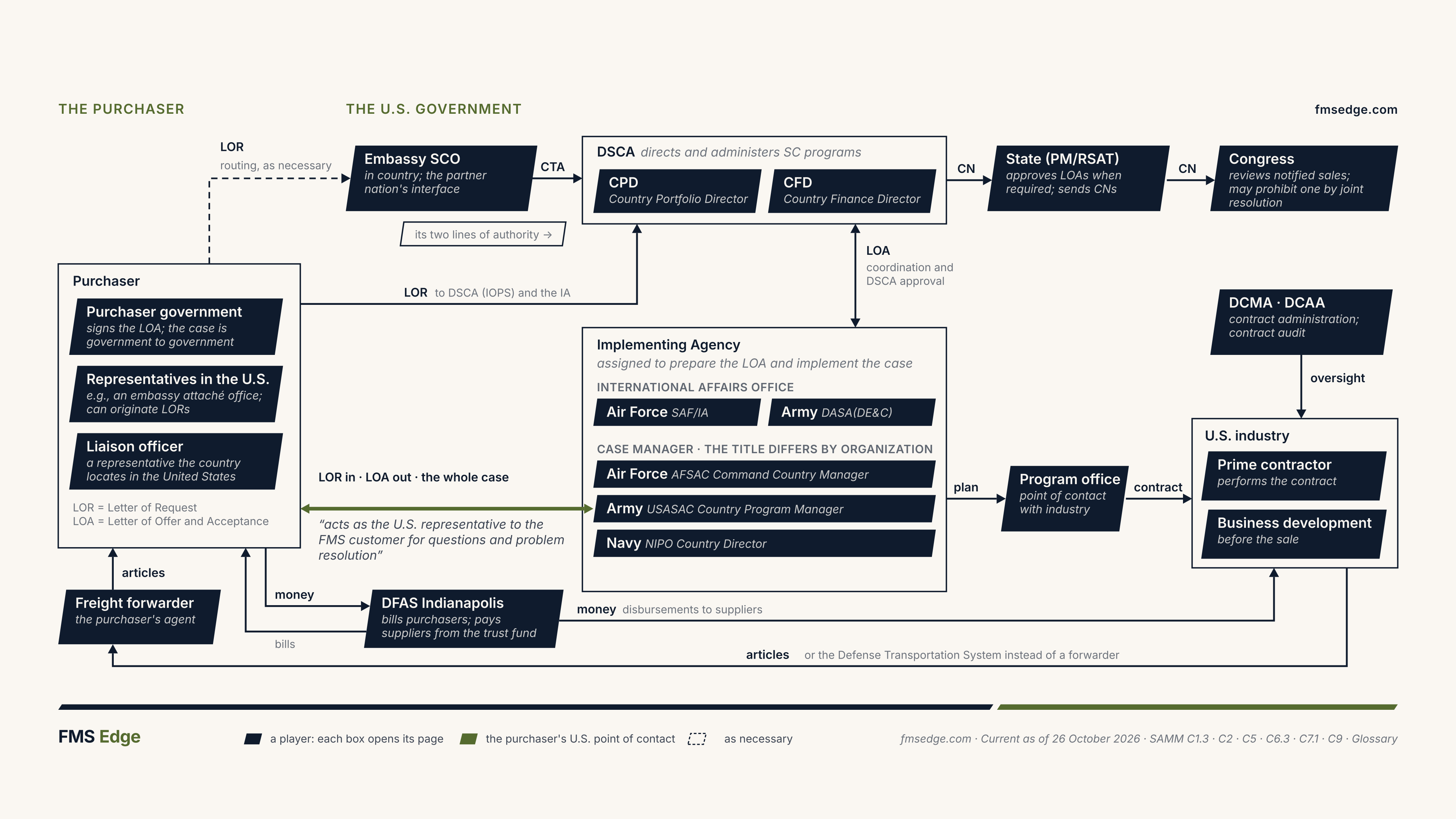
Who the purchaser deals with in a Foreign Military Sale, and what passes between them. The Implementing Agency's case manager runs through the whole case as the U.S. representative to the purchaser, and each box opens that player's page.
An acquisition program manager (PM) is responsible for leading a multidisciplinary team to manage all aspects of an individual acquisition program and for guiding the program toward meeting all cost, schedule, and system performance goals. An acquisition program management team typically includes functional experts from program management, systems engineering, testing, finance, contracting, logistics, information technology, and manufacturing.
The program manager is responsible for formulating the acquisition strategy and executing approved acquisition plans. The program manager typically performs these functions with the assistance of a multidisciplinary support team. Collectively, the program manager, with the respective support team, constitute the program office.
With the support of the system program management office team, the program manager is responsible for leading the program through the remaining phases, decision reviews, and acquisition milestones of the defense acquisition system process. In addition, the program management office remains in place to manage all the technical and life-cycle sustainment aspects of the system after the system is delivered to U.S. forces. The program management office will also be responsible for acquiring any additional quantities for the Department of War (DoW) as well as potentially developing improved or modified configurations.
If the U.S. agrees to sell the system through , the acquisition will be accomplished with support by the same program management office that is managing the system for the DoW. The system program management office may acquire the requirements either as separate individual procurements or by consolidating the requirements with DoW requirements on the same U.S. contract.
Under DoDI 5000.85, a program office is established before Milestone A, or earlier as necessary. In an case, the program manager's responsibilities include conducting the acquisition in the same manner as for DoW requirements, applying the relevant elements and principles of the 5000-series regulations, establishing integrated product teams, and identifying and mitigating risks. They also include developing management plans and schedules, seeing that contracting officers start the contract actions the program needs, and planning the training and logistics support for the partner. The list also covers supporting the case manager in reporting to higher headquarters on program execution and in periodic program reviews with the partner. How the case manager and the program manager divide this work varies across DoW components.
For major weapon systems, the Military Departments () establish program management offices responsible for the following:
- Developing and acquiring the initial system
- Managing all technical aspects of the systems delivered to U.S. forces
- Procuring any additional quantities for the DoW
- Engineering improved or modified configurations
An Integrated Product Team (IPT) typically consists of a program manager, supported by personnel from several functional disciplines (program management, engineering, testing, contracting, logistics, and financial management).
When an international partner decides to acquire a sophisticated through the program, formal logistics support planning begins when the international partner submits a comprehensive , which, in addition to identifying the desired configuration, identifies the country’s operational requirements, and existing logistics support capabilities. However, before the is submitted, there should be informal meetings and discussions between the international partner, the weapon , the , the office, and, potentially, the contractor or manufacturer. These discussions should address the configuration of the product, delivery methods, and how the item is to be sustained.
For major system sales, the case manager coordinates with program managers and item managers to determine the line items to be included on the case to meet requirements identified in the international partner’s . Cost and availability estimates are developed for all articles and services included in each line. These estimates may be based on current DoW inventories or on information from U.S. defense contractors.
Effective case management depends on frequent communication with the program manager, the , and numerous other key personnel in other organizations. When potential cost overruns or delays are identified, the case manager is expected to consult with the program manager, the contractor, and the international partner to ensure all potential options are explored and informed decisions can be made.
The title of the case manager may differ from one organization to another, such as Command Country Manager, Country Manager, Line Manager, Program Support Manager or Program Manager, but all of these case managers perform case management functions. Case management responsibilities vary with the type of and with the , and they may change as the case moves through its stages, case reconciliation and closure included. The is responsible for keeping the information about the case manager (CM) in the Defense Management System () current [SAMM ].
Air Force directs the management of its business on a line-by-line basis. or the Air Force and Cooperation Directorate (), as applicable, assigns line management responsibility to the major command having cognizance over the article or service being provided and a Program Manager () to oversee the development and execution of major system acquisition .
Manpower for case-related programs is funded from either the Administrative Surcharge or case lines, and Table C9.T2A describes each case-related manpower function and how it should be funded. For Building Partner Capacity () case-related programs funded under Title 10, manpower comes from one of three sources: Title 10 funded case lines, Title 10 funded Program Support Costs, or Title 10 funded Costs. Table C9.T2B describes those functions and their funding. Any request to deviate from these funding sources must be coordinated with the , Financial Policy Division (/FPRE/FP) [SAMM ].
Table C9.T2A sets out case-related activities and functions and the proper funding source for each. Those in its " Admin" column are indirect costs that the Administrative Surcharge funds, and they should not be included or priced as direct costs on the . Those under its " Case", "Non-Standard" and "Frequency" columns are direct costs that the purchaser funds, and they should be included as line items on the case. A request to deviate from the table's funding sources, or to have the table clarified, must be coordinated with (/FPRE/FP) [SAMM ].
When an or case line item was "accepted" after August 1, 2006, any program management services on it will be put on well-defined services line items. For each such line item, the tailored line item description note must state in detail exactly which services will be provided and how long they will be performed [SAMM ].
Active pipeline stages
Where this role is most involved across the FMS pipeline:
Who they work with
The most frequent counterparts across an FMS case:
Cross-service terminology
The seat differs by service. Air Force: the Program Manager (), who oversees the development and execution of major system acquisition . Army: Program Management Office personnel, working with the life cycle command's Management Directorate. Navy: the program office's case manager, Business Financial Manager and program analyst.
Guides for this seat
References
SAMM
- SAMM C2.2.1.1
- SAMM C5.1.4: Acquisition Planning.
- SAMM C5.T4A: Mandatory Criteria Before Letter of Request Actionable (Before Case Development Activities)
- SAMM C9.4.2.5: Manpower Funding Sources.
- SAMM C9.4.2.1: Foreign Military Sales Case-Related Manpower Functions and Funding Source Matrix.
- SAMM C9.4.2.3.1: Cases “Accepted” After August 1, 2006.
- SAMM C9.T2A: Foreign Military Sales Case-Related Manpower Functions and Funding Source Matrix
- SAMM C5.T3A: Military Department Organizations Authorized to Receive Letters of Request
Public authorities
- DoDI 5000.85: DoD Instruction 5000.85, Major Capability Acquisition, 6 August 2020, Change 1, 4 November 2021
- WarU Foreign Military Sales (FMS) Systems Acquisition JST: Warfighting Acquisition University (WarU), Foreign Military Sales (FMS) Systems Acquisition Job Support Tool (JST), April 2026
Military Department (MILDEP)
One of the departments within the DoD created by the National Security Act of 1947, as amended. The Military Departments are: the Department of the Air Force, the Department of the Army, and the Department of the Navy.
SAMM Glossary, as of 12 September 2026
Glossary entry →Open the manual’s entry → (opens in new tab)
Weapon System
A combination of one or more weapons with all related equipment, materials, services, personnel, and means of delivery and deployment (if applicable) required for self-sufficiency.
SAMM Glossary, as of 12 September 2026
Glossary entry →Open the manual’s entry → (opens in new tab)
Foreign Military Sales (FMS)
The part of U.S. security assistance, authorized by the Arms Export Control Act (AECA), in which eligible foreign governments and international organizations buy defense articles, services and training from the U.S. Government under formal government-to-government agreements.
The articles come either from Department of War stocks or from new procurement under contracts the Department manages [22 U.S.C. 2761, 22 U.S.C. 2762]. A sale is FMS whatever the source of the purchaser's financing.
FMS Edge glossary, as of 10 October 2026
Glossary entry →Open the manual’s entry → (opens in new tab)
Letter of Offer and Acceptance (LOA)
The legal instrument that lists the defense articles and services, including training, that the U.S. Government transfers to a foreign country or international organization, with their estimated costs and the terms and conditions. The benefitting partner does not sign a Building Partner Capacity (BPC) LOA.
The Letter of Offer and Acceptance (LOA) is the instrument the U.S. Government uses to sell under the Arms Export Control Act (AECA); signed LOAs and their later Amendments and Modifications are also called Foreign Military Sales (FMS) cases [SAMM C5.6.1].
FMS Edge glossary, as of 10 October 2026
Glossary entry →Open the manual’s entry → (opens in new tab)
FMS: Foreign Military Sale
SAMM Acronyms, as of 12 September 2026
Letter of Request (LOR)
The term used to identify a request from an eligible FMS participant country for the purchase of U.S. defense articles and services. The request may be in message or letter format.
SAMM Glossary, as of 12 September 2026
Glossary entry →Open the manual’s entry → (opens in new tab)
LOR: Letter of Request
SAMM Acronyms, as of 12 September 2026
System Program Office
The office of the program manager and the single point of contact with industry, government agencies, and other activities participating in the system acquisition process.
SAMM Glossary, as of 12 September 2026
Glossary entry →Open the manual’s entry → (opens in new tab)
Implementing Agency (IA)
The military department or defense agency responsible for the execution of military assistance programs. With respect to FMS, the military department or defense agency assigned responsibility by the Defense Security Cooperation Agency to prepare an LOA and to implement an FMS case. The implementing agency is responsible for the overall management of the actions that will result in delivery of the materials or services set forth in the LOA that was accepted by a foreign country or international organization.
SAMM Glossary, as of 12 September 2026
Glossary entry →Open the manual’s entry → (opens in new tab)
Security Cooperation
Activities by which the Department of War encourages and enables international partners to cooperate with the United States toward strategic objectives, spanning every interaction with foreign defense and security establishments and every security assistance program the Department administers.
Under chapter 16 of Title 10, their purposes are to develop allied and friendly security capabilities for self-defense and multinational operations, to give U.S. forces peacetime and contingency access, and to build relationships promoting specific U.S. security interests [10 U.S.C. 301(7)].
FMS Edge glossary, as of 10 October 2026
Glossary entry →Open the manual’s entry → (opens in new tab)
LOA: Letter of Offer and Acceptance
SAMM Acronyms, as of 12 September 2026
Market Research
A process for gathering data on product characteristics, suppliers' capabilities, and the business practices that surround them. Includes the analysis of that data to inform acquisition decisions. There are two types of market research: strategic market research and tactical market research.
SAMM Glossary, as of 12 September 2026
Glossary entry →Open the manual’s entry → (opens in new tab)
Contracting Officer
A person with the authority to enter into, administer, and/or terminate contracts and make related determinations and findings. The term includes certain authorized representatives of the Contracting Officer acting within the limits of their authority as delegated by the Contracting Officer. A Contracting Officer whose primary responsibility is to enter into contracts is called a procuring contracting officer. One whose primary responsibility is to administer contracts is called an administrative contracting officer. One whose primary responsibility is to terminate contracts and/or settle terminated contracts is called a "termination contracting officer." A single contracting officer may be responsible for duties in any or all of these areas.
SAMM Glossary, as of 12 September 2026
Glossary entry →Open the manual’s entry → (opens in new tab)
Security Assistance (SA)
A group of programs authorized by federal statutes by which the United States provides defense articles, military training, and other defense-related services by grant, lease, loan, credit, or cash sales in furtherance of national policies and objectives, and those that are funded and authorized through the Department of State to be administered by Department of Defense/Defense Security Cooperation Agency, which are considered part of security cooperation.
SAMM Glossary, as of 12 September 2026
Glossary entry →Open the manual’s entry → (opens in new tab)
DSAMS: Defense Security Assistance Management System
SAMM Acronyms, as of 12 September 2026
Glossary entry →Defense Security Assistance Management Systems (DSAMS) →
SAF/IA: Deputy Under Secretary of the Air Force International Affairs
SAMM Acronyms, as of 12 September 2026
Performing Activity
An activity which is responsible for performing work or service, including the production of material and/or the procurement of goods and services from other contractors and activities.
SAMM Glossary, as of 12 September 2026
Glossary entry →Open the manual’s entry → (opens in new tab)
Defense Security Cooperation Agency (DSCA)
The Department of War agency that directs, administers and provides guidance to the Department's components and its representatives at U.S. missions for the execution of the security cooperation programs for which it is responsible [SAMM C1.3.2.2]. The agency also provides financial and technical assistance, arranges the transfer of defense materiel, training and services to international partners, and promotes military-to-military contacts.
FMS Edge glossary, as of 10 October 2026
Glossary entry →Open the manual’s entry → (opens in new tab)
DSCA: Defense Security Cooperation Agency
SAMM Acronyms, as of 12 September 2026
Glossary entry →Defense Security Cooperation Agency (DSCA) →
SAMM C2.2.1.1
“The term "case manager" may differ contingent on the organization, i.e., Country Manager, Command Country Manager, Security Assistance Program Manager, Program Support Manager, Line Manager, etc., but all perform case management functions. Case management responsibilities vary by type of LOA and IA. Case management responsibilities may change as the case evolves through stages, to include case reconciliation and closure. The …”
Security Assistance Management Manual, as of 11 September 2026
SAMM C9.4.2.5: Manpower Funding Sources.
“Manpower for FMS case-related programs is funded from one of two sources: the FMS Administrative Surcharge or FMS case lines. See Table C9.T2A. for a description of case-related manpower functions and how each function should be funded. Manpower for Title 10 funded BPC case-related programs is funded from one of three sources: Title 10 funded BPC Program Support Costs, Performing …”
Security Assistance Management Manual, as of 11 September 2026
SAMM C9.4.2.1: Foreign Military Sales Case-Related Manpower Functions and Funding Source Matrix.
“The Foreign Military Sales Case-Related Manpower Functions and Funding Source Matrix table describes FMS case-related activities/functions and their proper source of funding. The activities/functions listed in Table C9.T2A. in the "FMS Admin" column represents indirect costs funded by the FMS Administrative Surcharge and should not be included and/or priced as direct costs on the Letter of Offer and Acceptance (LOA). …”
Security Assistance Management Manual, as of 11 September 2026
SAMM C9.4.2.3.1: Cases “Accepted” After August 1, 2006.
“For LOAs or case line items “accepted” after August 1, 2006, any program management services will be included on well-defined, services line items on the case. The tailored line item description note for each of these line items must include details describing exactly what services will be provided and the length of time they will be performed.”
Security Assistance Management Manual, as of 11 September 2026