
Guide
Why does Foreign Military Sales cost what it costs?
Every program expense is recovered from the purchaser, so a sale's price is the U.S. Government's estimated cost of the article or service plus the charges that recover the cost of running the program. The Department of War quotes a single estimated unit price, and the price on the stays an estimate until the bill shows the actual cost.
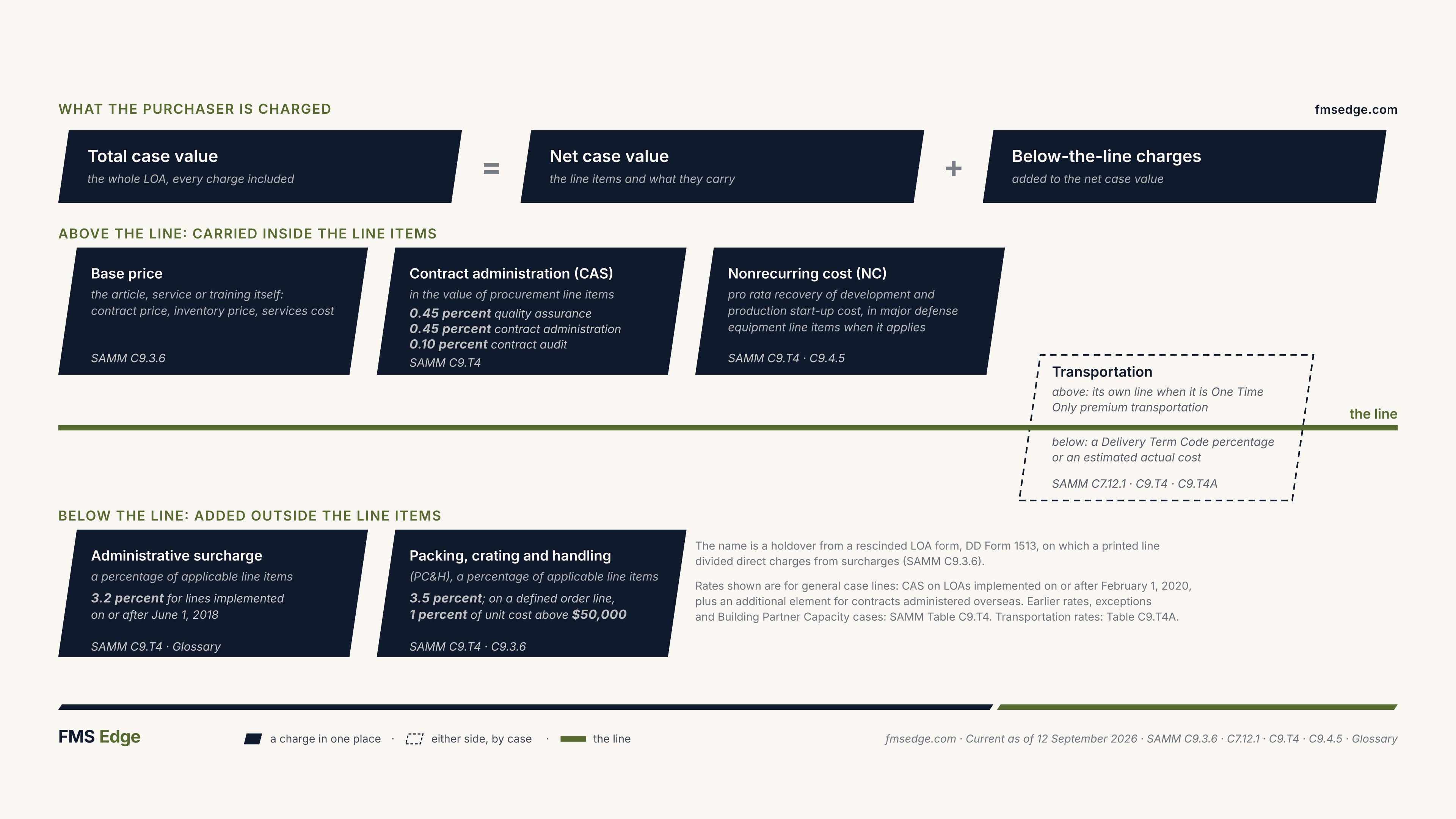
An LOA's total case value is its net case value (the line items) plus the charges added below them. The base price, contract administration services and nonrecurring cost on major defense equipment sit above the line; the administrative surcharge and packing, crating and handling sit below.
Why does Foreign Military Sales cost what it costs?
Every program expense is recovered from the purchaser, either through a direct charge included in the materiel or services cost or through an indirect (accessorial) charge or surcharge on the case, usually computed as a percentage of costs. Charges included within the materiel or services line may be called "above-the-line" charges. The term is left over from the rescinded form, DD Form 1513, on which a line separated the direct charges from the accessorial ones. Accessorials and surcharges outside a line item value may be called "below-the-line" charges, such as the transportation surcharge and packing, crating, and handling () [SAMM ].
The price of an item on an case depends on where it is supplied from, for example stock, new procurement or a Working Capital Fund (). It also depends on whether a similar or improved item is to replace it, or whether manpower or training is involved. Volume 15, Chapter 7 of the Financial Management Regulation () gives the detailed pricing policies [SAMM ].
The elements of the case material and/or service price can be combined into two major component categories: base price and authorized charges. The base price generally refers to the cost of the item or service (e.g., contract price, inventory price, services cost, training price). The authorized charges (see Table C9.T4. Table of Charges), on the other hand, relate to the application of a cost (often on a percentage or pro rata basis that is dependent to some degree on the value of a base price(s) or other pricing combinations) that the U.S. Government () charges to recover total costs for the applicable services performed.
Department of War (DoW) policy is to quote a single estimated unit price for each article offered under . If the purchaser wants it, a detailed description of the major cost components behind the estimated price may be provided with the as supplemental information or in a separate report, unless the information may be considered proprietary and not for release to the purchaser [SAMM ].
So that all costs are covered, the prices quoted for defense articles and services are estimates, and the final adjustments are made during case execution or after the articles or services are delivered. The states that its prices are estimates. Volume 15, Chapter 7 of the describes the instances in which firm prices may be quoted on an [SAMM ].
The prices entered on a document or are estimates of the expected costs of articles and/or services to be delivered sometime in the future. The objective of these estimates, developed using cost-analysis techniques, is to provide the international partner with the ’s best effort prediction of a future cost. Prices entered into the billing system eventually document the prices of the article at the time it is delivered/performed from a contractor or DoW stock inventory [SAMM ]. In the case of articles or services coming from new procurement, the initial prices reported may be those incurred for made to defense contractors on behalf of the international partner. However, the exact final cost of major procurements may not be determined until all the contracts for all systems obtained under such procurements are complete [SAMM , ]. Consequently, estimates can be entered into the billing system to be replaced by the actual costs when they are determined. The price on the is an estimate of what the believes its cost will be. The price reported in the billing system will eventually document the actual cost incurred once that cost is known and documented [SAMM ].
The case provides estimated prices and estimated payment schedules [SAMM , ]. The final price of an item or service generally will not be known until after it is delivered. The final price is determined by actual contract cost and other authorized charges applied under the provisions of U.S. laws and regulations [SAMM , ]. Not-to-exceed () or firm fixed prices are not normally provided; for items from procurement, prices may be included in the line by line, and a purchaser that requests them is charged the incremental cost of preparing the that way [SAMM ].
Try the tool: LOA cost estimator
References
SAMM
- SAMM C9.9.1.5: Payment Distribution.
- SAMM C9.9.1.3: Information Needed to Prepare the Payment Schedule.
- SAMM C5.3.1.3: Not-to-Exceed.
- SAMM C9.3.1: Sales from Stock.
- SAMM C9.3.6: Direct and/or Indirect Charges.
- SAMM C9.T4: Table of Charges
- SAMM C9.3.5: Letter of Offer and Acceptance Pricing.
- SAMM C9.3.7: Single Selling Price.
- SAMM C9.3.8: Use of Estimated Prices.
Public authorities
- LOA Standard Terms: Letter of Offer and Acceptance Standard Terms and Conditions
- AECA §36(b): Arms Export Control Act of 1976, as amended, §36(b) (22 U.S.C. §2776(b))
- DoD FMR Vol 15: DoD Financial Management Regulation 7000.14-R, Volume 15 (Security Cooperation Policy)
Facts referenced
- The pricing principle, what the FMS program must be managed to do (C9.3.1, the manual's own words): recover the full costs of defense articles and defense services (as of 5 October 2026; SAMM C9.3.1)
Related
Foreign Military Sales (FMS)
The part of U.S. security assistance, authorized by the Arms Export Control Act (AECA), in which eligible foreign governments and international organizations buy defense articles, services and training from the U.S. Government under formal government-to-government agreements.
The articles come either from Department of War stocks or from new procurement under contracts the Department manages [22 U.S.C. 2761, 22 U.S.C. 2762]. A sale is FMS whatever the source of the purchaser's financing.
FMS Edge glossary, as of 10 October 2026
Glossary entry →Open the manual’s entry → (opens in new tab)
Letter of Offer and Acceptance (LOA)
The legal instrument that lists the defense articles and services, including training, that the U.S. Government transfers to a foreign country or international organization, with their estimated costs and the terms and conditions. The benefitting partner does not sign a Building Partner Capacity (BPC) LOA.
The Letter of Offer and Acceptance (LOA) is the instrument the U.S. Government uses to sell under the Arms Export Control Act (AECA); signed LOAs and their later Amendments and Modifications are also called Foreign Military Sales (FMS) cases [SAMM C5.6.1].
FMS Edge glossary, as of 10 October 2026
Glossary entry →Open the manual’s entry → (opens in new tab)
FMS: Foreign Military Sale
SAMM Acronyms, as of 12 September 2026
SAMM: Security Assistance Management Manual
SAMM Acronyms, as of 12 September 2026
Glossary entry →Security Assistance Management Manual (SAMM) →
LOA: Letter of Offer and Acceptance
SAMM Acronyms, as of 12 September 2026
Price and Availability (P&A)
Preliminary pricing and availability estimates for articles or services that an Implementing Agency (IA) prepares at the request of a foreign government or international organization for an international competition, or of a U.S. Government requesting authority for building partner capacity.
Price and Availability (P&A) responses are estimates of cost and availability, not valid for preparing a Letter of Offer and Acceptance (LOA), and furnishing them does not commit the U.S. Government to offer the articles or services for sale [SAMM C5.5.2, C5.5.1].
FMS Edge glossary, as of 10 October 2026
Glossary entry →Open the manual’s entry → (opens in new tab)
Progress Payments
Payments made to a prime contractor during the life of a fixed-price type contract on the basis of a percentage of incurred total costs or total direct labor and material costs.
SAMM Glossary, as of 12 September 2026
Glossary entry →Open the manual’s entry → (opens in new tab)
SAMM C9.3.6: Direct and/or Indirect Charges.
“All FMS program expenses are recovered from the purchaser through direct charges (included in the materiel and/or services cost) or indirect (accessorial) charges and/or surcharges (usually computed as a percentage of costs) on the FMS case. Charges included within the materiel and/or services line may be referred to as “above-the-line” charges. This term is a holdover from the rescinded LOA …”
Security Assistance Management Manual, as of 11 September 2026
SAMM C9.3.5: Letter of Offer and Acceptance Pricing.
“When pricing FMS case items, the price depends on the source of supply (e.g., available from stock, ordered from procurement, Working Capital Fund (WCF)), and whether the item is to be replaced with a similar or improved item, or involves manpower or training. DoW FMR, Volume 15, Chapter 7, provides detailed information on pricing policies.”
Security Assistance Management Manual, as of 5 October 2026
SAMM C9.3.7: Single Selling Price.
“DoW policy is to provide a single unit estimated price for articles offered under FMS. If the purchaser desires, a detailed description of the major components of cost included in estimated prices may be provided with the LOA as supplemental information or via separate report, unless such information may be considered proprietary and not releasable to the purchaser.”
Security Assistance Management Manual, as of 5 October 2026
SAMM C9.3.8: Use of Estimated Prices.
“To assure that all costs are covered, quotations for defense articles/services are cited as estimated prices, with final adjustments established during case execution or after delivery of articles and/or services. The LOA indicates that prices for articles and/or services are estimates. See DoW FMR, Volume 15, Chapter 7, for details on those instances when firm prices may be quoted on …”
Security Assistance Management Manual, as of 5 October 2026
SAMM C9.9.1.5: Payment Distribution.
“Each deposit amount covers all costs to be incurred on the purchaser’s behalf during the next quarter, plus a reserve to cover Termination Liability (TL) (for sales from procurement). Costs may include such items as anticipated deliveries of services and stock items, and progress payments on contracts.”
Security Assistance Management Manual, as of 11 September 2026
SAMM C9.9.1.3: Information Needed to Prepare the Payment Schedule.
“The DSCA (IOPS/GEX/CWD) will use DSAMS to generate the payment schedule on the LOA. Payment schedules are prepared using pricing estimates and estimated dates for when purchasers will accept the LOA, the LOA will be implemented, requisitions will be initiated, contracts will be awarded, payments will be made to contractors, deliveries will occur, and personnel costs will be incurred. The …”
Security Assistance Management Manual, as of 11 September 2026
SAMM C5.3.1.3: Not-to-Exceed.
“NTE or Firm Fixed Price (FFP) responses will not normally be provided. Maximum use will be made of FFP sales from stock in accordance with DoW Financial Management Regulations (DoW FMR), Volume 15, Chapter 7, Section 070303 and consistent with the obligations of the purchaser to pay all costs even if in excess of LOA estimates. For items from procurement, …”
Security Assistance Management Manual, as of 5 October 2026