
Guide
Foreign Military Sales vs Direct Commercial Sales: which one, and who decides?
As a matter of policy the U.S. Government is neutral on whether a partner buys U.S. defense articles through or commercially, with one class of exceptions: the articles and services the Secretary of has designated Government-to-Government-Only, which may be transferred only through government channels. Within that boundary the purchaser decides; a U.S. company can ask the for a Direct Commercial Sales preference on a specific solicitation, valid for one year, and Foreign Military Financing may fund a commercial contract only where the partner meets the eligibility conditions in the annual Department of State appropriations language, which cover the countries originally authorized and all members and Major Non- Allies (as of 5 October 2026).
The same three parties stand at the corners of both triangles, and only the edges that carry the sale differ. Foreign Military Sales rides on the LOA and a Department of War contract. A Direct Commercial Sale rides on one commercial contract, made under a Department of State export license.
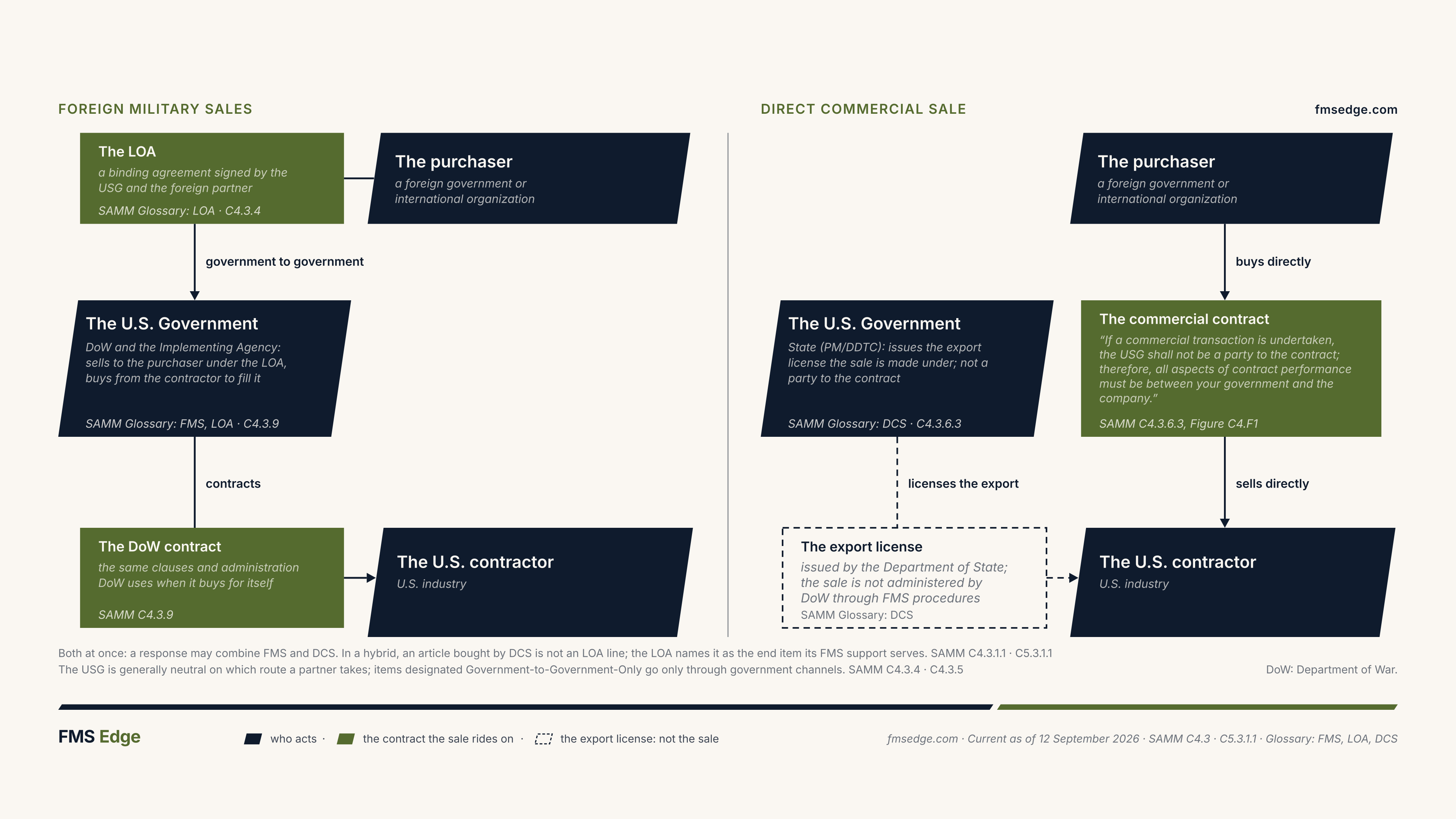
Foreign Military Sales vs Direct Commercial Sales: which one, and who decides?
In a comparison of the system with the Direct Commercial Sales () system, the decision rests with the international partner, and the U.S. Government () is generally neutral, aside from the Government-to-Government-Only (G2G-Only) list [SAMM , ]. Additionally, both and acquisitions offer various international partner participation options. In essence, the decision concerning procurement via or fundamentally involves a decision about the degree of procurement involvement the international partner desires to assume and what degree of procurement responsibility the international partner is willing to give to the Department of War (DoW).
The 's general neutrality is a matter of policy, and it covers U.S.-origin defense articles and services whether a partner buys them commercially or through government-to-government channels such as . By exception, the may determine that particular defense articles, services or technology be transferred on a government-to-government basis, to protect its most sensitive and sophisticated technologies [SAMM ].
Why partners buy U.S. systems, and why through FMS
When an international partner requires a military item or service, it needs a source to fulfill that requirement. From its national perspective, there are many economic and political factors that make acquisition from an indigenous source the preferred choice; however, in today’s high technology military environment, a substantial financial investment is usually needed to conduct the research, development, testing, and evaluation () and to build the manufacturing or production capability and capacity to field most major military systems. In addition to the financial investment, this process takes considerable time. Given these considerations, many nations fulfill certain military needs by procuring military systems from other governments, or from foreign commercial firms that have already developed and fielded a capable system, rather than developing a new, country-unique system.
The potential international partner first determines whether or not to acquire a U.S. system rather than developing an indigenous system or purchasing another country’s system. If the international partner selects a U.S. system, it next decides whether to purchase through the government-to-government process or make the purchase through the government-to-industry process.
The is generally neutral as to whether an international partner purchases through or [SAMM ]. Although officially neutral regarding the procurement method ( or ), the DoW does prefer that friendly nations choose U.S. systems. The reason for the U.S. preference relates to the political, military, and economic benefits resulting from the U.S. and its allies using the same military equipment.
The states that a primary reason why international partners choose to procure through is that the DoW arranges the purchase on the international partner’s behalf using the same procurement regulations and procedures that the DoW utilizes for its own procurements. As a result, international partners receive the same benefits and protections as the DoW [SAMM ].
Acquisition for purchasers must follow DoW regulations and the other applicable procedures. requirements may be combined with requirements or placed on a separate contract, whichever is more practical and cost-effective. The provisions that apply to the DoW also apply to procurements, as do all and Defense Supplement () clauses; Table C6.T1 lists selected sections that apply to in a unique way [SAMM ].
Typically, major system sales consist of weapon systems that the DoW has already developed, produced, and fielded for its own use.
that has not satisfactorily completed Operational Test and Evaluation (OT&E) carries additional requirements: the must include the OT&E Incomplete case note, and the must tell the partner of the risk associated with the procurement, early, in writing and with all pricing correspondence [SAMM , ]. The reason concerns future supportability and interoperability. Prior to successfully completing operational test and evaluation, there is the risk that the U.S. may decide not to produce the system. This would present an undesirable situation if the U.S. has an commitment to deliver a system to an international partner but decides not to deliver this same system to U.S. forces. The international partner would then possess a nonstandard system and have limited sustainment options. In addition, the international partner could potentially lack interoperability with U.S. forces and other allies [SAMM ]. The signed containing the case note is the official, legally binding record that the partner was told of the risk and accepted it [SAMM ].
To document that early notification of the risk took place, the will enter a comment in the Defense Management System () before it submits the case to the . The mandatory case note is the Appendix 6 note “OT&E Incomplete” [SAMM ].
References
SAMM
- SAMM C6.3.1: Compliance with Department of War Regulations and Procedures.
- SAMM C5.3.3: Operational Test and Evaluation Incomplete Sales Policy.
- SAMM C5.3.3.1: Early Risk Communication.
- SAMM C5.3.3.2: Recordkeeping.
- SAMM C4.3.4: Neutrality.
- SAMM C4.3.5: Government-to-Government Only Determinations.
- SAMM C4.3.6: Direct Commercial Sales Preference.
- SAMM C4.3.7: Concurrent Foreign Military Sales and Commercial Negotiations.
- SAMM C4.4.3: Logistics Support.
- SAMM C6.3: Case Execution - Acquisition.
- SAMM C1.3.2.6.2.1: Defense Contract Management Agency.
Public authorities
- AECA §36(b): Arms Export Control Act of 1976, as amended, §36(b) (22 U.S.C. §2776(b))
- WarU Acquipedia AINT 008: Warfighting Acquisition University (WarU), Acquipedia AINT 008: International Acquisition - Direct Commercial Sales (DCS)
Facts referenced
- Validity period of an approved Direct Commercial Sales preference: one year (as of 11 September 2026; SAMM C4.3.6.3)
- Partners eligible to use Foreign Military Financing for a direct commercial contract (current statutory scope): all NATO members and Major Non-NATO Allies (as of 5 October 2026; SAMM C9.7.3)
- Countries originally granted authority to use Foreign Military Financing for direct commercial contracts (FY 1989 Congressional Presentation): Israel, Egypt, Jordan, Morocco, Tunisia, the Republic of Turkiye, Portugal, Pakistan, Yemen, and Greece (as of 5 October 2026; SAMM C9.7.3)
Related
Foreign Military Sales (FMS)
The part of U.S. security assistance, authorized by the Arms Export Control Act (AECA), in which eligible foreign governments and international organizations buy defense articles, services and training from the U.S. Government under formal government-to-government agreements.
The articles come either from Department of War stocks or from new procurement under contracts the Department manages [22 U.S.C. 2761, 22 U.S.C. 2762]. A sale is FMS whatever the source of the purchaser's financing.
FMS Edge glossary, as of 10 October 2026
Glossary entry →Open the manual’s entry → (opens in new tab)
Defense Security Cooperation Agency (DSCA)
The Department of War agency that directs, administers and provides guidance to the Department's components and its representatives at U.S. missions for the execution of the security cooperation programs for which it is responsible [SAMM C1.3.2.2]. The agency also provides financial and technical assistance, arranges the transfer of defense materiel, training and services to international partners, and promotes military-to-military contacts.
FMS Edge glossary, as of 10 October 2026
Glossary entry →Open the manual’s entry → (opens in new tab)
OEM: Original Equipment Manufacturer
FMS: Foreign Military Sale
SAMM Acronyms, as of 12 September 2026
DCMA: Defense Contract Management Agency
SAMM Acronyms, as of 12 September 2026
DCS: Direct Commercial Sales
SAMM Acronyms, as of 12 September 2026
Federal Acquisition Regulation (FAR)
The FAR is the primary regulation for use by federal executive agencies for the acquisition of supplies and services with appropriated funds. The document, published in 1984, consolidated the major procurement regulations of various departments and agencies. The intent of the FAR is to standardize the content, decrease the volume of documents, and to achieve consistency throughout government. The principal agencies involved in putting together the FAR were DoD, the General Services Administration, and the National Aeronautics and Space Administration, the three largest buyers. The FAR is broader than just contracting and applies to all goods and services. It directs the defense program manager in many ways, including contract award procedures, acquisition planning, warranties, and establishing guidelines for competition. Besides the FAR, each agency has its supplement to describe its own particular way of doing business. The DoD supplement is called Defense FAR Supplement.
SAMM Glossary, as of 12 September 2026
Glossary entry →Open the manual’s entry → (opens in new tab)
RDT&E: Research, Development, Test, and Evaluation
SAMM Acronyms, as of 12 September 2026
Security Assistance Management Manual (SAMM)
DSCA Manual 5105.38-M required under DoD Directive 5105.65, "Defense Security Cooperation Agency" mandatory for use by all DoD Components. The SAMM provides DoD-wide guidance to the Office of the Secretary of Defense (OSD), the Military Departments (MILDEPs), the Office of the Chairman of the Joint Chiefs of Staff and the Joint Staff, the Combatant Commands, the Defense Agencies, the DoD Field Activities, the Security Cooperation Organizations (SCOs), and all other organizational entities within the DoD engaged in the management or implementation of DoD Security Assistance and Security Cooperation programs over which DSCA has responsibility.
SAMM Glossary, as of 12 September 2026
Glossary entry →Open the manual’s entry → (opens in new tab)
DFARS: Defense Federal Acquisition Regulation Supplement
SAMM Acronyms, as of 12 September 2026
Major Defense Equipment (MDE)
Any item of Significant Military Equipment on the U.S. Munitions List having a nonrecurring research and development cost of more than $50 million or a total production cost of more than $200 million. Also defined in section 47 (6), Arms Export Control Act.
SAMM Glossary, as of 12 September 2026
Glossary entry →Open the manual’s entry → (opens in new tab)
Letter of Offer and Acceptance (LOA)
The legal instrument that lists the defense articles and services, including training, that the U.S. Government transfers to a foreign country or international organization, with their estimated costs and the terms and conditions. The benefitting partner does not sign a Building Partner Capacity (BPC) LOA.
The Letter of Offer and Acceptance (LOA) is the instrument the U.S. Government uses to sell under the Arms Export Control Act (AECA); signed LOAs and their later Amendments and Modifications are also called Foreign Military Sales (FMS) cases [SAMM C5.6.1].
FMS Edge glossary, as of 10 October 2026
Glossary entry →Open the manual’s entry → (opens in new tab)
Implementing Agency (IA)
The military department or defense agency responsible for the execution of military assistance programs. With respect to FMS, the military department or defense agency assigned responsibility by the Defense Security Cooperation Agency to prepare an LOA and to implement an FMS case. The implementing agency is responsible for the overall management of the actions that will result in delivery of the materials or services set forth in the LOA that was accepted by a foreign country or international organization.
SAMM Glossary, as of 12 September 2026
Glossary entry →Open the manual’s entry → (opens in new tab)
LOA: Letter of Offer and Acceptance
SAMM Acronyms, as of 12 September 2026
Security Assistance (SA)
A group of programs authorized by federal statutes by which the United States provides defense articles, military training, and other defense-related services by grant, lease, loan, credit, or cash sales in furtherance of national policies and objectives, and those that are funded and authorized through the Department of State to be administered by Department of Defense/Defense Security Cooperation Agency, which are considered part of security cooperation.
SAMM Glossary, as of 12 September 2026
Glossary entry →Open the manual’s entry → (opens in new tab)
DSAMS: Defense Security Assistance Management System
SAMM Acronyms, as of 12 September 2026
Glossary entry →Defense Security Assistance Management Systems (DSAMS) →
SAMM C4.3.4: Neutrality.
“As a matter of policy, the USG is generally neutral as to whether a partner purchases U.S.-origin defense articles or services commercially or through Government-to-Government (G2G) channels (e.g. FMS). However, by exception the USG may determine that select defense articles, services, or technology be transferred on a G2G basis in order to protect its most sensitive and sophisticated technologies.”
Security Assistance Management Manual, as of 11 September 2026
SAMM C4.3.5: Government-to-Government Only Determinations.
“The Arms Export Control Act (AECA) (22 USC 2751) grants the President the authority to designate defense articles or services as transferable exclusively through G2G channels. The President delegated this authority to the Secretary of State. G2G-Only designated defense articles and services are consolidated into the G2G-Only List. DSCA coordinates and submits G2G-Only recommendations to State on behalf of the …”
Security Assistance Management Manual, as of 26 October 2026
SAMM C6.3.1: Compliance with Department of War Regulations and Procedures.
“Acquisition for Foreign Military Sales (FMS) purchasers must be in accordance with DoW regulations and other applicable USG procedures. This affords the foreign purchaser the same benefits and protection that apply to DoW procurement and is one of the principal reasons why foreign governments and international organizations prefer to procure through FMS channels. FMS requirements may be consolidated with USG …”
Security Assistance Management Manual, as of 26 October 2026
SAMM C5.3.3: Operational Test and Evaluation Incomplete Sales Policy.
“FMS cases with MDE that has not sufficiently completed U.S. Government testing and is not yet in full production (i.e., has not satisfactorily completed Operational Testing and Evaluation (OT&E) in accordance with DoD Instruction (DoDI) 5000.85) have additional requirements. LOAs require a case note (see Appendix 6 Operational Test and Evaluation (OT&E) Incomplete LOA Note). Additionally, the Implementing Agencies (IAs) …”
Security Assistance Management Manual, as of 5 October 2026
SAMM C5.3.3.1: Early Risk Communication.
“For Foreign Military Sales (FMS) cases containing MDE that has not satisfactorily completed OT&E in accordance with DoDI 5000.85, the IAs will communicate to the partner the risk associated with the procurement. This early communication is in addition to the required case note in the LOA. The IA must communicate the risk associated with the procurement with all pricing correspondence …”
Security Assistance Management Manual, as of 5 October 2026
SAMM C5.3.3.2: Recordkeeping.
“The signed LOA containing the mandatory case note (see Appendix 6 Operational Test and Evaluation (OT&E) Incomplete LOA Note) serves as the official, legally binding record of risk notification and partner acceptance. To document that early notification of the risk occurred, the IA will enter a comment in DSAMS prior to submitting the case to DSCA.”
Security Assistance Management Manual, as of 5 October 2026