
Stage 04 · conditional
Congressional Notification in Foreign Military Sales
A case at or above the statutory thresholds needs a numbered certification to Congress before its may be offered. Congress first reviews the sale informally in Tiered Review, then formally for a set period, and may prohibit it only by enacting a .
What happens
Section 36(b) of the requires a numbered certification to Congress before a that meets specific criteria may be offered [SAMM ] []. An , including Amendments and Modifications, may not be offered until all required Congressional Notifications () have been made and any formal review period has expired [SAMM ]. The Secretary of War implements Section 36(b), under authority the President delegated in 13637, in consultation with the Secretary of [SAMM ].
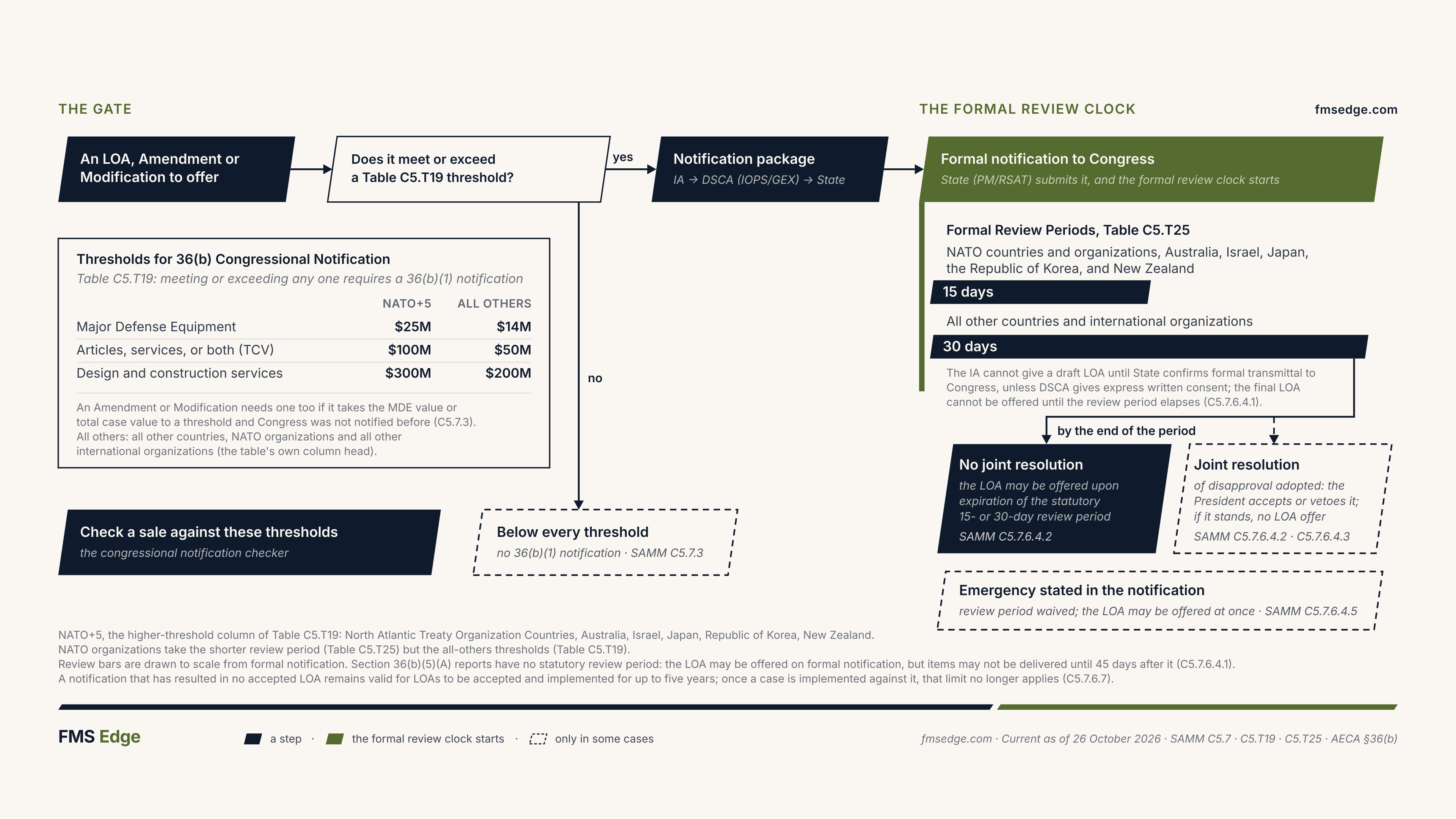
An LOA needs a Section 36(b)(1) notification to Congress when it meets or exceeds a threshold in SAMM Table C5.T19, set higher for NATO countries, Australia, Israel, Japan, the Republic of Korea and New Zealand. The formal review runs 15 days for that group and NATO organizations and 30 days for all other purchasers. The congressional notification checker in Tools tests a sale's own values.
What is notified, and when
A 36(b)(1) is required by law when an meets or exceeds one of the thresholds in Table C5.T19, and the thresholds vary by purchaser. An Amendment or Modification also needs a if it would raise the (TCV) or the value enough to meet or exceed a threshold in that table, and Congress has not been notified of the sale before [SAMM ].
The numbered certification that Section 36(b) requires goes to the Speaker of the House of Representatives, the House Foreign Affairs Committee () and the chairman of the Senate Foreign Relations Committee (). Congress reviews each such proposed sale. It may prohibit the transfer by enacting a before the prescribed review period ends, and if it does not, the document may be offered once the review period expires. In Chapter 5 of the , "36(b) congressional notifications" covers all three types of numbered certification that Section 36(b) describes, and Chapter 5 identifies where Section 36(b)(5)(C), 36(b)(5)(A) and 36(b)(1) congressional notifications are handled differently [SAMM ].
The President (delegated to the Secretary of War) shall submit a numbered certification (with justification, impact, etc.) to the Congress before issuing an to sell defense articles or services for $50M or more, or any design and construction services for $200M or more, or for $14M or more [SAMM , , ] []. The higher dollar thresholds for notification for North Atlantic Treaty Organization () countries, Japan, Australia, Republic of Korea, Israel, and New Zealand are $100M, $300M, and $25M respectively [SAMM ]. The Department of State reviews each proposed sale and authorizes its formal notification to Congress [SAMM ]. After formal notification, the submits the full text of each unclassified 36(b)(1) notification to the Federal Register, and publishes a web post for it [SAMM , ].
Preparing the notification
The prepares the initial notification package and submits it to (/GEX); it must first complete the releasability approvals the requires, so that they are in the package [SAMM ]. (/GEX) reviews the package, coordinates it within the Department of War (DoW) and submits it to the Department of State [SAMM ]. reviews it with the National Security Council where applicable and consults Congress informally in Tiered Review, whose timelines in Table C5.T24 are not binding [SAMM ].
can take a long time, because of the informal and statutory review periods and the coordination they need among the , , other DoW offices, , the National Security Council and other organizations outside the DoW. The total processing time varies with the type of , the purchaser, and the articles, services or both on offer. recommends submitting a well before the expected so that the offer is not delayed. Even then, delays can occur if the necessary technology releases are not complete, or if extensive interagency coordination is required [SAMM ].
Until a is formally notified to Congress, all of its documentation should be marked and handled as Controlled Unclassified Information () and as "PRE-DECISIONAL", unless or the Department of State's Bureau of Political-Military Affairs () specifically directs otherwise. Sections C5.7.5.1.1.3 and C5.7.5.1.1.4 cover the notification documents that need classified handling [SAMM ].
Under an earlier process, every unclassified was handled as Confidential until the Department of State approved handling at the For Official Use Only () level. That process no longer applies, except in rare circumstances (Section C5.7.5.1.1.4). Except in the situations that Section C5.7.5.1.1.4 describes, country masking codes are no longer required for initial processing [SAMM ].
The formal review period
Once Tiered Review is complete, submits the formal notification to Congress and will then notify that it has done so. Congress has the period in Table C5.T25 to review the formal notification and object or not object to the proposed sale [SAMM ].
Congress can stop the sale only by enacting a prohibiting it before the review period ends. If the President states that an emergency requires the sale, the review period is waived and the may be offered immediately [SAMM , ].
The review period is 15 days, not 30, for , member countries, Australia, Israel, Japan, the Republic of Korea and New Zealand [SAMM ].
The lets Congress reject a notified sale, export license, third-party transfer or lease of U.S. defense articles. The means is a prohibiting the proposed action, enacted within the review period [, , , ].
When Congress adopts a of disapproval against a proposed sale notified under Section 36(b)(1) or 36(b)(5)(C), the President will either accept the resolution or veto it, giving the Senate the chance to override the veto. Until that process ends, the cannot be offered to the prospective purchaser. If the President does not veto the resolution, or Congress overrides a veto, the may not be offered. Notifying the of any objections is the responsibility of (/GEX) [SAMM ].
Offering the LOA after notification
When the statutory review period for a Section 36(b)(1) or 36(b)(5)(C) notification expires without a of disapproval from Congress, the document may be offered to the purchaser [SAMM ].
For those two types of notification, the cannot give the purchaser a draft before the Department of State confirms that the has been formally transmitted to Congress, unless the Assistant Director for International Operations at gives express written consent. A final cannot be offered until the statutory review period has elapsed. A Section 36(b)(5)(A) notification has no statutory review period, so its may be offered immediately on formal notification. The defense articles it reports, however, may not be physically delivered to the partner, or transferred to it, until 45 days after formal notification [SAMM ].
At the start of the statutory notification period, the notification data becomes public domain information and is published. The full text of an unclassified notification appears in the Congressional Record. The full text of a Section 36(b)(1) or 36(b)(5)(C) notification is also posted in the Federal Register, except for a classified notification or a classified annex [SAMM ].
Key players at this stage
State Department
- State PM/RSATDepartment of State, Bureau of Political-Military Affairs (PM), Office of Regional Security and Arms Transfers (PM/RSAT)
DSCA
- DSCA Country Portfolio DirectorDefense Security Cooperation Agency: International Operations (IOPS) / Regional Execution (REX)
Service international affairs office
- Air Force: SAF/IA Country DirectorDeputy Under Secretary of the Air Force for International Affairs (SAF/IA), regional division (SAF/IAR)
- Army: DASA(DE&C) Regional Desk OfficerOffice of the Deputy Assistant Secretary of the Army: Defense Exports & Cooperation, under ASA(ALT)
- Navy: NIPO Country DirectorNavy International Programs Office (NIPO), Global Security Cooperation
Case manager
- Air Force: AFSAC Command Country ManagerAir Force Security Assistance & Cooperation Directorate (AFSAC), AFLCMC/WF
- Army: USASAC Country Program ManagerU.S. Army Security Assistance Command (USASAC), Regional Operations Directorate
- Navy: NIPO Country DirectorNavy International Programs Office (NIPO), Global Security Cooperation
Program office
- Weapon System Program OfficeMilitary Department program management office for the weapon system
Industry
- Industry Business DevelopmentU.S. defense contractor
Common pitfalls
- package transmitted with classified-unclassified boundary errors, forcing resubmission
- Committee staff inquiries surface late and are not addressed in the transmittal package
- Informal hold from a single committee member delays the case well past the formal review window
- Partner assumes 'notified' equals 'approved' and begins domestic approval prematurely
What to watch for
The Department of State reviews the notification package and coordinates it with the National Security Council where that applies, then submits it to Congress for the informal Tiered Review period. During Tiered Review, Congress reviews before they are formally submitted and asks for further information if it needs it. and Congress have agreed notional timelines for each tier, shown in Table C5.T24, but those timelines are not binding [SAMM ].
Tiered Review is complete only when has finished its consultations with Congress, which normally, but not always, means clearances from the Chairpersons and Ranking Members of the and the . In all, that is four clearances from the committees of jurisdiction. After that, may authorize to submit the formal notification to Congress [SAMM ].
Guides on this stage
References
SAMM
- SAMM C5.T24: Tiered Review Periods
- SAMM C5.7.1: Definition and Purpose.
- SAMM C5.7.3: 36(b) Congressional Notification Requirements.
- SAMM C5.7.4: Responsibilities for 36(b) Congressional Notification.
- SAMM C5.7.3.1: 36(b)(1) Congressional Notifications.
- SAMM C5.7.6.3: State Informal Notification Process (“Tiered Review”).
- SAMM C5.7.6.5: Federal Register.
- SAMM C5.7.6.6: Major Arms Sales.
- SAMM C5.T19: Thresholds for 36(b) Congressional Notification
- SAMM C5.7.6.2: The Defense Security Cooperation Agency Reviews, Coordinates, and Submits the Draft Notification to State.
- SAMM C5.7.6.1: Implementing Agencies Prepare and Submit Initial 36(b) Congressional Notification Package to the Defense Security Cooperation Agency.
- SAMM C5.7.6.1.1: Timelines.
- SAMM C5.7.5.1.1.1: Handling Prior to Notification.
- SAMM C5.7.6.4: Formal Notification.
- SAMM C5.7.6.4.5: Emergency Circumstances.
- SAMM C5.T25: Formal Review Periods
- SAMM C5.7.6.4.3: If Congress Adopts a Joint Resolution of Disapproval During Formal Review.
- SAMM C5.7.6.4.1: Rules for Offering Letters of Offer and Acceptance Following Notification.
- SAMM C5.7.5.1.1.2: Public Information.
- SAMM C5.7: Congressional Notification - Arms Export Control Act 36(b) for Security Assistance Programs.
- SAMM C5.7.5: 36(b) Congressional Notification Packages.
- SAMM C5.7.6.4.2: If Congress Does Not Adopt a Joint Resolution of Disapproval During Formal Review.
Public authorities
- AECA §36(c): Arms Export Control Act of 1976, as amended, §36(c) and (d) (22 U.S.C. §2776(c) and (d))
- AECA §3: Arms Export Control Act of 1976, as amended, §3 (22 U.S.C. §2753)
- AECA §63: Arms Export Control Act of 1976, as amended, §63 (22 U.S.C. §2796b), Legislative review procedures
- AECA §36(b): Arms Export Control Act of 1976, as amended, §36(b) (22 U.S.C. §2776(b))
- CRS R46337: Congressional Research Service, R46337, Transfer of Defense Articles: Sale and Export of U.S.-Made Arms to Foreign Countries
- EO 14268: Executive Order 14268, Reforming Foreign Defense Sales To Improve Speed and Accountability (April 9, 2025)
Facts referenced
- 36(b) statutory review period, all other countries and international organizations: 30 days (as of 11 September 2026; SAMM C5.7)
- 36(b) statutory review period, NATO members, Australia, Israel, Japan, Republic of Korea, New Zealand: 15 days (as of 11 September 2026; SAMM C5.7)
- 36(b)(1) total case value threshold, all other countries and international organizations: $50M (as of 26 October 2026; SAMM C5.T19)
- 36(b)(1) design and construction services threshold, all other countries and international organizations: $200M (as of 26 October 2026; SAMM C5.T19)
- 36(b)(1) MDE threshold, all other countries and international organizations: $14M (as of 26 October 2026; SAMM C5.T19)
- 36(b)(1) total case value threshold, NATO members, Australia, Israel, Japan, Republic of Korea, New Zealand: $100M (as of 26 October 2026; SAMM C5.T19)
- 36(b)(1) design and construction services threshold, NATO members, Australia, Israel, Japan, Republic of Korea, New Zealand: $300M (as of 26 October 2026; SAMM C5.T19)
- 36(b)(1) MDE threshold, NATO members, Australia, Israel, Japan, Republic of Korea, New Zealand: $25M (as of 26 October 2026; SAMM C5.T19)
- Formal congressional review period (Table C5.T25), NATO countries and organizations, Australia, Israel, Japan, Republic of Korea, New Zealand: 15 days (as of 26 October 2026; SAMM C5.T25)
- Formal congressional review period (Table C5.T25), all other countries and international organizations: 30 days (as of 26 October 2026; SAMM C5.T25)
- Days after formal notification before items offered under a Section 36(b)(5)(A) report may be delivered (the LOA itself may be offered immediately): 45 days (as of 5 October 2026; SAMM C5.7.6.4.1)
DSCA policy memoranda
- DSCA 24-29: 36(b) Congressional Notification Update [SAMM E-Change 483]
SAMM: Security Assistance Management Manual
SAMM Acronyms, as of 12 September 2026
Glossary entry →Security Assistance Management Manual (SAMM) →
Foreign Military Sales (FMS)
The part of U.S. security assistance, authorized by the Arms Export Control Act (AECA), in which eligible foreign governments and international organizations buy defense articles, services and training from the U.S. Government under formal government-to-government agreements.
The articles come either from Department of War stocks or from new procurement under contracts the Department manages [22 U.S.C. 2761, 22 U.S.C. 2762]. A sale is FMS whatever the source of the purchaser's financing.
FMS Edge glossary, as of 10 October 2026
Glossary entry →Open the manual’s entry → (opens in new tab)
Letter of Offer and Acceptance (LOA)
The legal instrument that lists the defense articles and services, including training, that the U.S. Government transfers to a foreign country or international organization, with their estimated costs and the terms and conditions. The benefitting partner does not sign a Building Partner Capacity (BPC) LOA.
The Letter of Offer and Acceptance (LOA) is the instrument the U.S. Government uses to sell under the Arms Export Control Act (AECA); signed LOAs and their later Amendments and Modifications are also called Foreign Military Sales (FMS) cases [SAMM C5.6.1].
FMS Edge glossary, as of 10 October 2026
Glossary entry →Open the manual’s entry → (opens in new tab)
Joint Resolution
A legislative resolution, designated H J Res (House) or S J Res (Senate) which requires the approval of both houses and the signature of the President, just as a bill does, and which has the force of law if approved. There is no practical difference between a bill and a joint resolution. A joint resolution generally is used to deal with a limited matter such as a single appropriation. Congressional rejection of a proposed arms transfer, lease, third country transfer, or a proposed international cooperative project takes the form of a joint resolution of disapproval.
SAMM Glossary, as of 12 September 2026
Glossary entry →Open the manual’s entry → (opens in new tab)
Arms Export Control Act (AECA)
The basic U.S. law providing the authority and general rules for the conduct of Foreign Military Sales and commercial sales of defense articles, defense services, and training. The Arms Export Control Act (AECA) came into existence with the passage of the Foreign Military Sales Act (FMSA) of 1968. An amendment in the International Security Assistance and AECA of 1976 changed the name of FMSA to the AECA.
SAMM Glossary, as of 12 September 2026
Glossary entry →Open the manual’s entry → (opens in new tab)
LOA: Letter of Offer and Acceptance
SAMM Acronyms, as of 12 September 2026
AECA: Arms Export Control Act
SAMM Acronyms, as of 12 September 2026
Executive Order (EO)
A numbered official document through which the President manages the operations of the Federal Government, normally used to create or change the organization or procedures of executive branch agencies; its authority rests on the Constitution or on powers that acts of Congress grant. The text of each executive order is published in the Federal Register once the President has signed it.
FMS Edge glossary, as of 10 October 2026
Glossary entry →Open the manual’s entry → (opens in new tab)
Total Case Value (Letter of Offer and Acceptance)
The total value of the Letter of Offer and Acceptance at the time of calculation, which includes the cost of the materiel, services, all Indirect Pricing Components, administrative charges, and all accessorial charges.
SAMM Glossary, as of 12 September 2026
Glossary entry →Open the manual’s entry → (opens in new tab)
Major Defense Equipment (MDE)
Any item of Significant Military Equipment on the U.S. Munitions List having a nonrecurring research and development cost of more than $50 million or a total production cost of more than $200 million. Also defined in section 47 (6), Arms Export Control Act.
SAMM Glossary, as of 12 September 2026
Glossary entry →Open the manual’s entry → (opens in new tab)
HFAC: House Foreign Affairs Committee
SFRC: Senate Foreign Relations Committee
Security Assistance Management Manual (SAMM)
DSCA Manual 5105.38-M required under DoD Directive 5105.65, "Defense Security Cooperation Agency" mandatory for use by all DoD Components. The SAMM provides DoD-wide guidance to the Office of the Secretary of Defense (OSD), the Military Departments (MILDEPs), the Office of the Chairman of the Joint Chiefs of Staff and the Joint Staff, the Combatant Commands, the Defense Agencies, the DoD Field Activities, the Security Cooperation Organizations (SCOs), and all other organizational entities within the DoD engaged in the management or implementation of DoD Security Assistance and Security Cooperation programs over which DSCA has responsibility.
SAMM Glossary, as of 12 September 2026
Glossary entry →Open the manual’s entry → (opens in new tab)
FMS: Foreign Military Sale
SAMM Acronyms, as of 12 September 2026
MDE: Major Defense Equipment
SAMM Acronyms, as of 12 September 2026
Defense Security Cooperation Agency (DSCA)
The Department of War agency that directs, administers and provides guidance to the Department's components and its representatives at U.S. missions for the execution of the security cooperation programs for which it is responsible [SAMM C1.3.2.2]. The agency also provides financial and technical assistance, arranges the transfer of defense materiel, training and services to international partners, and promotes military-to-military contacts.
FMS Edge glossary, as of 10 October 2026
Glossary entry →Open the manual’s entry → (opens in new tab)
Implementing Agency (IA)
The military department or defense agency responsible for the execution of military assistance programs. With respect to FMS, the military department or defense agency assigned responsibility by the Defense Security Cooperation Agency to prepare an LOA and to implement an FMS case. The implementing agency is responsible for the overall management of the actions that will result in delivery of the materials or services set forth in the LOA that was accepted by a foreign country or international organization.
SAMM Glossary, as of 12 September 2026
Glossary entry →Open the manual’s entry → (opens in new tab)
DSCA: Defense Security Cooperation Agency
SAMM Acronyms, as of 12 September 2026
Glossary entry →Defense Security Cooperation Agency (DSCA) →
Offer Date
The date which appears on the offer portion of an Letter of Offer and Acceptance and which indicates the date on which an Foreign Military Sales offer is made to a foreign buyer.
SAMM Glossary, as of 12 September 2026
Glossary entry →Open the manual’s entry → (opens in new tab)
State (PM): Department of State, Bureau of Political-Military Affairs
SAMM Acronyms, as of 12 September 2026
State (PM/RSAT): Department of State Bureau of Political-Military Affairs, Office of Regional Security and Arms Transfers
SAMM Acronyms, as of 12 September 2026
Direct Commercial Sale (DCS)
A sale of defense articles or defense services made under a Department of State issued license by U.S. industry directly to a foreign buyer, and which is not administered by DoD through Foreign Military Sales procedures.
SAMM Glossary, as of 12 September 2026
Glossary entry →Open the manual’s entry → (opens in new tab)
SAMM C5.7.1: Definition and Purpose.
“The Arms Export Control Act (AECA), Section 36(b) (22 U.S.C. 2776(b)), requires a numbered certification be submitted to the Speaker of the House of Representatives, the Committee on Foreign Affairs of the House of Representatives (HFAC), and the chairman of the Committee on Foreign Relations of the Senate (SFRC) before Letter of Offer and Acceptance (LOA) documents that meet specific …”
Security Assistance Management Manual, as of 11 September 2026
Arms Export Control Act of 1976, as amended, §36(b) (22 U.S.C. §2776(b))
AECA §36(b) · Statute
SAMM C5.7.3: 36(b) Congressional Notification Requirements.
“An LOA, including Amendments and Modifications, may not be offered to a purchaser until all required CNs have been made and the formal notification periods have expired (if applicable).”
Security Assistance Management Manual, as of 11 September 2026
SAMM C5.7.4: Responsibilities for 36(b) Congressional Notification.
“Under Executive Order (E.O.) 13637, the President has delegated the responsibility of implementing AECA Section 36(b) to the Secretary of War (SECWAR) in consultation with the Secretary of State (SECSTATE). 36(b) CN responsibilities are summarized in Table C5.T21. The Implementing Agency (IA) is responsible for leading and certifying completion of the releasability requirements summarized in Table C5.T22. before 36(b) CN …”
Security Assistance Management Manual, as of 26 October 2026
SAMM C5.7.3.1: 36(b)(1) Congressional Notifications.
“By law, a 36(b)(1) CN is required when an LOA meets or exceeds one of the thresholds identified in Table C5.T19. These thresholds vary by purchaser. A 36(b)(1) CN is also required if an LOA Amendment or Modification would increase the Major Defense Equipment (MDE) value or the total case value (TCV) such that it would meet or exceed the …”
Security Assistance Management Manual, as of 26 October 2026
SAMM C5.T19: Thresholds for 36(b) Congressional Notification
“Table C5.T19. Thresholds for 36(b) Congressional Notification North Atlantic Treaty Organization Countries, Australia, Israel, Japan, Republic of Korea, New Zealand All Other Countries, North Atlantic Treaty Organization Organizations, All Other International Organizations Major Defense Equipment $25M $14M Any Articles, Services, or Both (Total Case Value) $100M $50M Design and Construction Services $300M $200M”
Security Assistance Management Manual, as of 26 October 2026
SAMM C5.7.6.3: State Informal Notification Process (“Tiered Review”).
“State reviews and coordinates the package with the NSC (if applicable). State then submits the package to Congress for the informal Tiered Review period. During the Tiered Review period, Congress reviews CNs prior to formal submittal and to requests further information, if needed. Although State and Congress have agreed to notional timelines for Tiered Review (See Table C5.T24.), these timelines …”
Security Assistance Management Manual, as of 26 October 2026
SAMM C5.7.6.5: Federal Register.
“Following notification, DSCA submits the full text of unclassified AECA, Section 36(b)(1) (22 U.S.C. 2776(b)(1)) and AECA, Section 36(b)(5)(C) (22 U.S.C. 2776(b)(5)(C)) notifications to the Federal Register for publication, as required by AECA, Section 36(f) (22 U.S.C. 2776(f)). A Federal Register submittal is not required for AECA, Section 36(b)(5)(A) (22 U.S.C. 2776(b)(5)(A)) CNs.”
Security Assistance Management Manual, as of 5 October 2026
SAMM C5.7.6.6: Major Arms Sales.
“Following notification, State publishes a web post for each unclassified AECA, Section 36(b)(1) (22 U.S.C. 2776(b)(1)) CN on the State Arms Sales: Congressional Notifications website.”
Security Assistance Management Manual, as of 5 October 2026
SAMM C5.7.6.1: Implementing Agencies Prepare and Submit Initial 36(b) Congressional Notification Package to the Defense Security Cooperation Agency.
“The IA prepares and submits the data required for a CN to DSCA (IOPS/GEX). See Section C5.7.5. for required information and templates. The IA shall complete required releasability requirements per Table C5.T22., ensuring all approvals required prior to CN are complete and reflected in the CN package, and concurrently ensure any remaining releasability reviews are conducted, ensuring all required approvals …”
Security Assistance Management Manual, as of 26 October 2026
SAMM C5.7.6.2: The Defense Security Cooperation Agency Reviews, Coordinates, and Submits the Draft Notification to State.
“Upon receipt of the data, DSCA (IOPS/GEX) reviews the notification package and coordinates the package within DoW. Once DoW coordination is complete, DSCA (IOPS/GEX) officially submits the notification package to State.”
Security Assistance Management Manual, as of 5 October 2026
SAMM C5.7.6.1.1: Timelines.
“CNs can be a lengthy process due to the informal and statutory review times, as well as the coordination required between the IA, DSCA, other DoW offices, State, the NSC, and other non-DoW organizations. The total processing time varies by the type of CN, the purchaser involved, and the articles, services, or both being offered. DSCA recommends CNs be submitted …”
Security Assistance Management Manual, as of 5 October 2026
SAMM C5.7.5.1.1.1: Handling Prior to Notification.
“All CN documentation should be marked with and handled as Controlled Unclassified Information (CUI) and “PRE-DECISIONAL” until the CN is formally notified to Congress, unless specifically directed otherwise by DSCA or State (PM). See Section C5.7.5.1.1.3., Section C5.7.5.1.1.4., and Section C5.6.5.1.2. for notification documentation that requires classified handling. Note: The previous SAMM process requiring Confidential handling of all unclassified CNs …”
Security Assistance Management Manual, as of 11 September 2026
SAMM C5.7.6.4: Formal Notification.
“Once Tiered Review is complete (all four clearances received), State Bureau of Political-Military Affairs, Office of Regional Security and Arms Transfers (PM/RSAT) submits the formal notification to Congress, and will notify DSCA once notified. Congress has a prescribed period (Table C5.T25.) to formally review the notification and object or not object to the proposed sale. Table C5.T25. Formal Review Periods …”
Security Assistance Management Manual, as of 26 October 2026
SAMM C5.7.6.4.5: Emergency Circumstances.
“If the President states in the CN that an emergency exists that requires the proposed sale in support of U.S. national security interests, the formal review period is waived, and the LOA may be offered immediately upon notification. The SECSTATE (under authority delegated from the President) must provide a detailed justification for his or her determination, a description of the …”
Security Assistance Management Manual, as of 26 October 2026
SAMM C5.T25: Formal Review Periods
“Table C5.T25. Formal Review Periods Purchaser Days NATO Countries and Organizations, Australia, Israel, Japan, the Republic of Korea, and New Zealand 15 Days All Other Countries and International Organizations 30 Days”
Security Assistance Management Manual, as of 26 October 2026
Arms Export Control Act of 1976, as amended, §36(c) and (d) (22 U.S.C. §2776(c) and (d))
AECA §36(c) · Statute
Arms Export Control Act of 1976, as amended, §63 (22 U.S.C. §2796b), Legislative review procedures
AECA §63 · Statute
SAMM C5.7.6.4.3: If Congress Adopts a Joint Resolution of Disapproval During Formal Review.
“If Congress adopts a joint resolution of disapproval objecting to a proposed sale (for AECA, Section 36(b)(1) (22 U.S.C. 2776(b)(1)) and AECA, Section 36(b)(5)(C) (22 U.S.C. 2776(b)(5)(C))CNs), the President will accept the joint resolution or veto it and allow the Senate the opportunity to override the veto. The LOA cannot be offered to the prospective purchaser until this process is …”
Security Assistance Management Manual, as of 5 October 2026
SAMM C5.7.6.4.2: If Congress Does Not Adopt a Joint Resolution of Disapproval During Formal Review.
“If Congress does not adopt a joint resolution of disapproval, the LOA document may be offered to the purchaser upon expiration of the statutory 15- or 30-day review period (for AECA, Section 36(b)(1) (22 U.S.C. 2776(b)(1)) and AECA, Section 36(b)(5)(C) (22 U.S.C. 2776(b)(5)(C)) CNs).”
Security Assistance Management Manual, as of 5 October 2026
SAMM C5.7.6.4.1: Rules for Offering Letters of Offer and Acceptance Following Notification.
“For AECA, Section 36(b)(1) (22 U.S.C. 2776(b)(1)) and AECA, Section 36(b)(5)(C) (22 U.S.C. 2776(b)(5)(C)) notifications, the IA cannot provide a draft LOA to the purchaser until the Department of State confirms the CN has been formally transmitted to Congress or without the express written consent from the Assistant Director for International Operations at DSCA. Additionally, a final LOA cannot be …”
Security Assistance Management Manual, as of 5 October 2026
SAMM C5.7.5.1.1.2: Public Information.
“Following formal notification, the full text of the unclassified CN is published in the Congressional Record, which is available to the public online. With the exception of classified notifications and classified annexes, the full texts of 36(b)(1) and 36(b)(5)(C) CNs are also posted for the public in the Federal Register after notification and the details of 36(b)(1) notifications are published …”
Security Assistance Management Manual, as of 2 November 2026