
Embassy
Security Cooperation Organization Chief (Embassy)
The Senior Defense Official/Defense Attaché (/) is the chief of the in a U.S. embassy. The Department of War relies on the to work effectively with partner nation counterparts and leadership.
What they do
Two lines of authority reach the Security Cooperation Organization. The Chief of Mission directs and supervises it; the Combatant Commander commands and supervises it in matters outside the Chief of Mission's. Both meet at one desk, the Senior Defense Official/Defense Attaché.
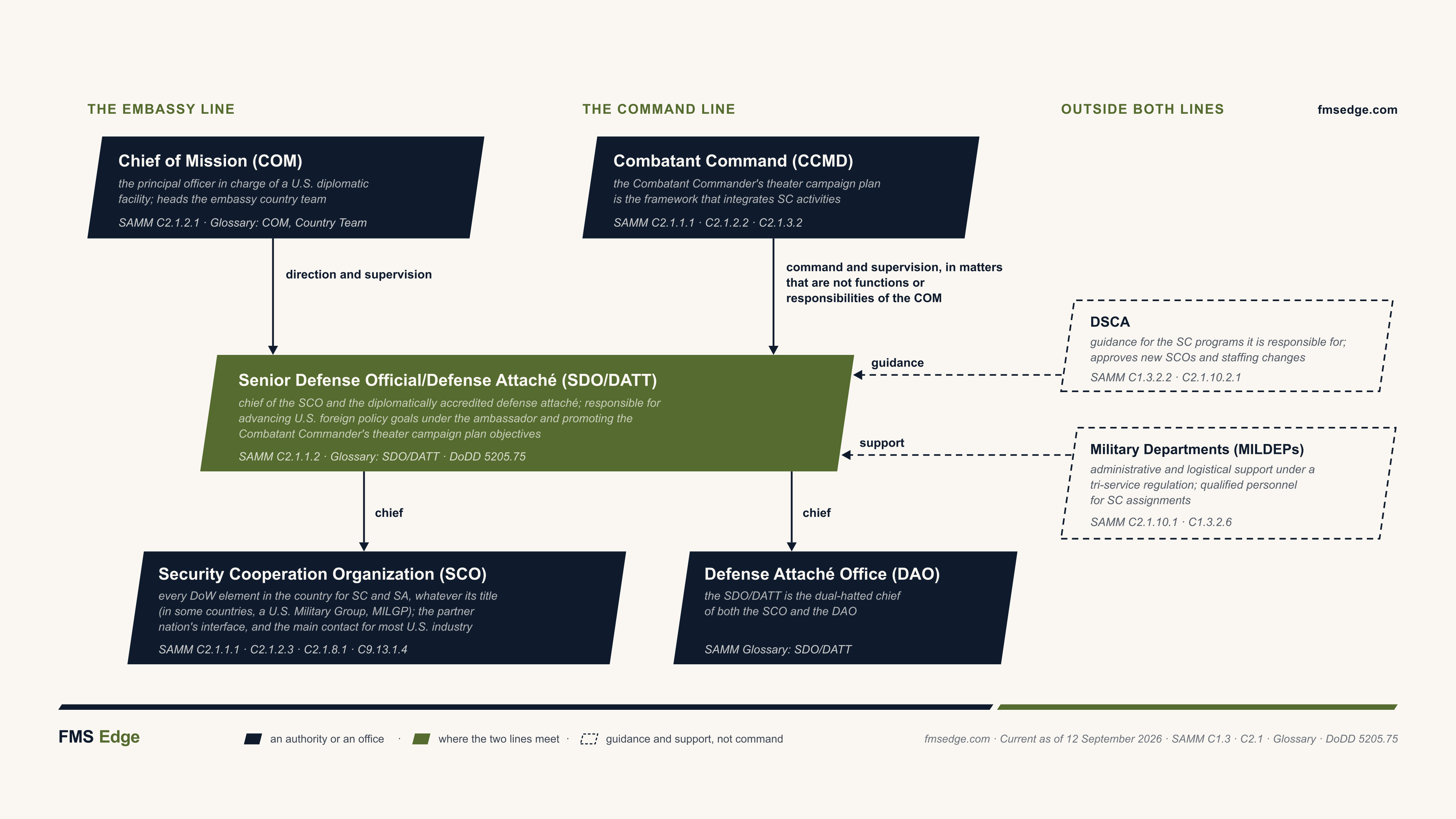
The Senior Defense Official/Defense Attaché (/) is the principal Department of War (DoW) official in a U.S. embassy, its diplomatically accredited defense attaché and the chief of the (; the U.S. Military Group, or , in some countries) [SAMM ]. The chief plays a central role in strategy development and program planning [SAMM ]. The chief also exercises administrative control over in-country Education and Training () teams and keeps the Combatant Commander () informed of their activities [SAMM ].
What the organization is
Section 515(a) of the Foreign Assistance Act of 1961 () allows the President to assign U.S. military personnel overseas to manage the programs the DoW administers [SAMM ] []. is the generic term for every DoW element in a foreign country, whatever its actual title, that carries out management functions for () and under the and the . The also manages DoW programs under the guidance of the [SAMM ].
The U.S. directs and supervises the . The chief's ability to build positive professional relationships with the and the other members of the embassy is critical to DoW success in aligning its priorities and efforts with those of other agencies [SAMM ].
In matters that are not the 's functions or responsibilities, the commands and supervises the . The / ensures that DoW and Department of State policies are compatible and promotes the complementary use of resources [SAMM ].
The performs its /cooperation management functions under the and the [SAMM ].
The / is the principal DoW representative and senior official in U.S. embassies, per Directive 5205.75. As such, the / serves concurrently as a diplomatically accredited defense attaché in charge of the and the chief of the [SAMM ].
In that role, and working under the ambassador, the / is responsible for advancing the goals of U.S. foreign policy and for promoting the objectives of the 's theater campaign plan. The / is also responsible for complying with Directive 5205.75 and with the instruction that implements it [SAMM ].
The functions the statute assigns
Section 515(a) of the lists the ’s functions []:
1. Equipment and services case management
2. Training management
3. Program monitoring
4. Evaluation and planning of the host government’s military capabilities and requirements
5. Administrative support
6. Promoting rationalization, standardization, interoperability (), and other defense cooperation measures
7. Liaison functions exclusive of advisory and training assistance
The serves as the intermediary between the , Foreign Military Financing (), and manager and the host nation to ensure that each case is both prepared and executed in accordance with U.S. Government () objectives and host nation desires. The may assist the host nation military with obtaining information on defense articles and services from DoW organizations, public sources, and U.S. vendors. The may assist the host nation in documenting its requirements and articulating its requests in terms that DoW organizations understand. The ensures that cases follow the concept as appropriate.
Before the Letter of Request, and the Country Team Assessment
often have the chance to give input to partner nation Letters of Request (), or to inform how they are developed in other ways. A clear and comprehensive can help the respond quickly to the partner nation's request with a . When learn that a partner nation plans to submit an , they should coordinate with the , the appropriate and the Component Commands. The aim is to find out about any known issues with the procurement being considered and to get information that may help the partner nation draft a thorough . Section C5.2 has more on , and Table C5.T4A gives the evaluation criteria [SAMM ].
Any that meets the criteria in Section C5.1.5 must be accompanied by a . The is responsible for drafting the , for coordinating it with the , and for sending it to the appropriate DoW Component and to the Country Portfolio Director () in the Office of International Operations, Regional Execution Directorate (/REX). Table C5.T1 describes the information a requires. Depending on the situation, the may forward the , the and any other relevant documents to the as one package, or send the later, after an that the or the partner nation has already transmitted [SAMM ].
When credible demand signals point to an for sensitive or classified articles, the should discuss with (/WPN) whether to develop a Pre- Assessment Request (). A requires a endorsement and lets and release determinations begin in time [SAMM , ].
Once the partner has identified the type of defense capability that will meet its requirements and asks for help identifying options, the should ask the relevant or for a detailed assessment of possible materiel or training solutions. and should bear in mind that some solutions may involve more than one . Where a potential solution includes Command, Control, Communications, Computers, Cyber, and Intelligence (C5I) equipment, the , the or both should seek guidance from the C5I team in the Weapons Directorate of 's Office of International Operations ( (/WPN)) [SAMM ].
Reaching out to the early helps ensure that a future will include the details a needs. When the contacts the , it should include the for awareness. The pre- phase has no prescribed timeframes, but should keep the relevant and the aware of discussions and planned milestones. may choose to end pre- discussions on the basis of feasibility assessments [SAMM ].
A presents senior U.S. Embassy leadership's coordinated position in support of the proposed sale, with the key information needed to evaluate and explain it [SAMM ].
When Section C5.1.5 requires a , the must include it in the initial notification package for a congressional notification. In general, a in that package must be dated within two years of the package's submission, unless asks for a newer one. Section C5.1.5 has more on . The is used for processing and is not part of what is transmitted to Congress [SAMM ].
If the sale would introduce a technology or capability to a country or region for the first time, the should include a endorsement with the . The endorsement is used for processing and does not go to Congress with the transmittal [SAMM ].
Relations with industry
The supports the marketing efforts of U.S. defense companies but stays strictly neutral between U.S. competitors. For most U.S. defense industry representatives marketing defense equipment, the is the principal point of contact in a U.S. mission, rather than the Commercial Attaché. The helps information on U.S. systems flow, subject to releasability and export licensing, and avoids advocating a program with a specific U.S. producer [SAMM ].
The chief should encourage U.S. contractors who visit to debrief the chief and other relevant mission staff on their experiences in the country. The chief answers industry representatives' follow-up questions about any reactions from host country officials, or about later marketing efforts by foreign competitors. The chief also alerts embassy staff to watch how host country officials react to U.S. defense industry marketing and, as appropriate, can pass those reactions on to the U.S. industry representatives [SAMM ].
The must, however, maintain strict neutrality in promoting different U.S. firms competing for the same potential sale and should not endorse one specific American product or vendor over another unless specifically directed by [SAMM , ]. On the other hand, in cases where it is clear that there is only one U.S. source for a certain product or service, the may generally endorse that American product to the host nation [SAMM ]. Assistance given to one vendor is offered or made available to the other U.S. competitors as well. While supporting U.S. industry, the also acts as an honest broker, considering both U.S. and host nation defense and policy interests.
If the believes that marketing efforts do not match overall U.S. defense interests, or could damage U.S. credibility and relations with the country, the should pass these concerns, with a request for guidance, to the and to the (/REX) [SAMM ].
After delivery: end-use monitoring
The assists the host country in its integration of U.S.-origin equipment, training, and services into its force structure; monitors the use and protection of them; and advises the host nation on potential third party transfers to include demilitarization and disposal. These duties relate to the function of program monitoring.
Program monitoring also demands that U.S. articles or technologies that are sold, granted, loaned, or leased to foreign countries be regularly accounted for, safeguarded, and used only for the purposes intended at the time of the transfer. It also ensures that the approves in advance any permanent or temporary transfer of such articles or technologies to other entities, and any disposal of them, once the original recipient no longer requires them [SAMM , , ].
Responsibility for in-country activities in support of Golden Sentry, the DoW end-use monitoring () program, is normally assigned to the . The Department of State manages a similar program, Blue Lantern, for items transferred through direct commercial sales. work with partner nation counterparts to ensure that requirements are complied with, and coordinate their activities with the in-country Blue Lantern program manager in the embassy. should be ready for an in-country Compliance Assessment Visit, led by , every 18 to 24 months. Table C8.T2 gives a comprehensive list of responsibilities [SAMM ].
Relations with headquarters
In coordination with the Chairman of the Joint Chiefs of Staff, approves joint manpower programs that involve setting up new or changing their manpower authorizations or organizational structure [SAMM ]. The supervise the in matters related to the execution of the Guidance for the Employment of the Force, and give them technical assistance and administrative support [SAMM ].
The Under Secretary of War for Policy (USW(P)) serves as the principal staff assistant and advisor to the Secretary of War on all matters across the Department. In that capacity, USW(P) disseminates DoW-wide strategies, policies, and guidance, and serves as the Department’s representative to the Secretary, the interagency, the media, and Congress to ensure the Department’s priorities are met. The USW(P)’s responsibilities include (but are not limited to) representing the DoW in all interagency, congressional, and media queries on matters; disseminating the Secretary’s strategies, policies, and guidance on all programs and activities across the Department; ensuring that the DoW Comptroller’s release of funds to implement approved programs occurs once Congress/Secretary approves; reviewing regional and functional campaign plans and assessments to ensure continuity with department and U.S. national interests; overseeing and advising DoW components on the development of campaign plans, campaign support plans, and resource allocation priorities; and providing annual reports and assessments to Congress as required by law. In addition to the above, the USW(P) will also direct and manage a centralized evaluation “E” program to meet the requirements of the assessment, monitoring, and evaluation (AM&E) instruction. See DoDI 5132.14, Assessment, Monitoring, and Evaluation Policy for the Enterprise, issued on January 13, 2017, for detailed guidance.
Under the Secretary of War's memorandum unifying the Department's arms transfer and enterprise, the Director reports to the Under Secretary of War for Acquisition and Sustainment (USW(A&S)). directs, administers, and provides guidance to the DoW components and DoW representatives to U.S. missions for the execution of DoW programs for which has responsibility. responsibilities include ensuring Secretary of War and USW(P) policy interests in matters are represented; identifying requirements, criteria, and procedures for the selection and training of personnel engaged in activities; communicating directly with the heads of the DoW components regarding matters over which has responsibility; leading periodic Program Management Reviews () for certain activities; and collecting information for the USW(P) on the status of programs for reporting purposes.
Relations with the host nation
The DoW relies on the to interface effectively with partner nation counterparts and leadership. personnel must understand the partner nation's national and military objectives and strategies, be familiar with its capabilities and requirements, and have access to the appropriate counterparts and leaders [SAMM ]. Whenever possible, the helps the partner nation with its strategic planning and informs the partner nation's decisions on procuring U.S. equipment, training and services [SAMM ].
For the , this is the raison d’etre. Building, maintaining, and improving relationships need careful planning, coordination, diplomacy and flexibility, and demand constant contact between the and key elements of host country defense and security establishments. personnel make a point of getting out of the office, meeting the chiefs of the military and security forces, trying to understand their perspectives on their capabilities and gaps, informing them about the process, and educating them on potential program solutions. If the has made a considerable commitment to an international partner, shares mutual defense/security interests, and remains on appropriate diplomatic terms, it is likely that the ’s relationship, accessibility, and credibility with the host nation’s military establishment will be good.
A good working relationship involves sharing interests and ideas. The / should recognize that there is a common foundation upon which to build rapport with host nation military counterparts, namely the universal brotherhood of arms. The problems of military doctrine, force structure, training, equipping, and logistical support are common to the armed forces of all nations. Successful personnel will take a sincere personal interest in the host nation’s culture, history, customs, and religion, and will cultivate both personal and professional relationships with local counterparts, which often form the basis of life-long contacts and friendships. Most importantly, however, the retains its integrity and identity as an official arm of the . Its members keep their close relationship with host nation counterparts from clouding their professional judgements or recommendations or compromising official U.S. policy.
Active pipeline stages
Where this role is most involved across the FMS pipeline:
Who they work with
The most frequent counterparts across an FMS case:
Cross-service terminology
C2.1.1.2 records that Directive 5205.75 establishes the Senior Defense Official/Defense Attaché (/) as the principal DoW official in a U.S. embassy, the diplomatically accredited defense attaché and the chief of the . Elsewhere, as in C2.1.2.4, the manual calls that role the Chief. Under C2.1.1.1, is a generic term for every DoW element in a foreign country that carries out and management, whatever its actual title. Names such as Office of Defense Cooperation () and Office of () are local titles for the , not titles of a separate chief.
Guides for this seat
References
SAMM
- SAMM C2.1.3.1: Participation in Development of Strategies and Plans.
- SAMM C10.22.11: United States Military Group Chief.
- SAMM C2.1.2.2: The Combatant Command.
- SAMM C2.1.4.1: Letters of Request.
- SAMM C2.1.4.2: Country Team Assessment.
- SAMM C3.1.2.2
- SAMM C5.1.2.1: Requirements Development.
- SAMM C5.7.5.3: Country Team Assessment.
- SAMM C5.7.5.4: Combatant Command Endorsement.
- SAMM C2.1.8.1: General.
- SAMM C2.1.8.7: Follow-Up.
- SAMM C2.1.8.5: United States' Competitors.
- SAMM C2.1.8.8: Exceptional Circumstances.
- SAMM C2.1.5.6: End Use Monitoring.
- SAMM C2.1.5.6.4: Change of End Use.
- SAMM C2.1.5.6.5: Third Party Transfers.
- SAMM C2.1.5.6.1: Golden Sentry.
- SAMM C1.3.2.2: Defense Security Cooperation Agency.
- SAMM C1.3.2.10: Combatant Commanders.
- SAMM C2.1.2.3: The Partner Nation.
- SAMM C2.1.3.6.1: Partner Nation Strategic Planning.
- SAMM C2.1.1.1: United States Military Group.
- SAMM C2.1.1.2: Senior Defense Official/Defense Attaché.
- SAMM C2.1.2.1
- SAMM C5.1.1
- SAMM C5.1.5: Country Team Assessment.
- SAMM C3.1.2: Pre-Letter of Request Assessment Requests for Classified and Advanced Technology Release Decisions in Support of Security Cooperation Initiatives and Competitions.
- SAMM C2.1.8: United States Military Group Support to Industry.
Public authorities
- 22 U.S.C. §2321i: Foreign Assistance Act of 1961, as amended, §515 (22 U.S.C. §2321i), Overseas management of assistance and sales programs
- DoDD 5205.75: DoD Directive 5205.75, DoD Operations at U.S. Embassies, 4 December 2013, incorporating Change 1, 22 May 2017
- SecWar memo, 7 Nov 2025: Secretary of War memorandum, 7 November 2025, "Unifying the Department's Arms Transfer and Security Cooperation Enterprise to Improve Efficiency and Enable Burden-Sharing"
- DoW release, 10 Feb 2026: Department of War release, 10 February 2026, "Department of War Finalizes Realignment of the Defense Security Cooperation Agency and the Defense Technology Security Administration"
Facts referenced
- Period before submittal of the 36(b) notification package within which a Country Team Assessment included in the package must, in general, be dated: two years (as of 11 September 2026; SAMM C5.7.5.3)
- Shorter end of the interval at which a Security Cooperation Organization should be prepared for a DSCA-led in-country Compliance Assessment Visit (CAV): 18 months (as of 26 October 2026; SAMM C2.1.5.6.1)
- Longer end of the interval at which a Security Cooperation Organization should be prepared for a DSCA-led in-country Compliance Assessment Visit (CAV): 24 months (as of 26 October 2026; SAMM C2.1.5.6.1)
Security Cooperation Organization (SCO)
A Department of Defense element that is part of the United States Diplomatic mission located in a foreign country to carry out security assistance and security cooperation management functions under the supervision and coordination authority of the senior defense official/defense attaché.
SAMM Glossary, as of 12 September 2026
Glossary entry →Open the manual’s entry → (opens in new tab)
Senior Defense Official (SDO) and Defense Attaché (DATT)
Principal DoD official in a U.S. embassy, as designated by the Secretary of Defense. The SDO or DATT is the Chief of Mission's principal military advisor on defense and national security issues, the senior diplomatically accredited DoD military officer assigned to a diplomatic mission, and the single point of contact for all DoD matters involving the embassy or DoD elements assigned to or working from the embassy. The SDO or DATT is considered the dual-hatted chief of both the Security Cooperation Organization and Defense Attaché Office in the embassy. This position was established by DoDD 5205.75, Department of Defense Operations at U.S. Embassies, December 21, 2007. The same document gives coordinating authority (see glossary definition) to the SDO or DATT for the purpose of ensuring that all DoD elements in a country are working in consonance with each other and under the guidance of the Chief of Mission. The SDO or DATT program replaces the now defunct U.S. Defense Representative model.
SAMM Glossary, as of 12 September 2026
Glossary entry →Open the manual’s entry → (opens in new tab)
SCO: Security Cooperation Organization
SAMM Acronyms, as of 12 September 2026
Security Assistance (SA)
A group of programs authorized by federal statutes by which the United States provides defense articles, military training, and other defense-related services by grant, lease, loan, credit, or cash sales in furtherance of national policies and objectives, and those that are funded and authorized through the Department of State to be administered by Department of Defense/Defense Security Cooperation Agency, which are considered part of security cooperation.
SAMM Glossary, as of 12 September 2026
Glossary entry →Open the manual’s entry → (opens in new tab)
Security Cooperation
Activities by which the Department of War encourages and enables international partners to cooperate with the United States toward strategic objectives, spanning every interaction with foreign defense and security establishments and every security assistance program the Department administers.
Under chapter 16 of Title 10, their purposes are to develop allied and friendly security capabilities for self-defense and multinational operations, to give U.S. forces peacetime and contingency access, and to build relationships promoting specific U.S. security interests [10 U.S.C. 301(7)].
FMS Edge glossary, as of 10 October 2026
Glossary entry →Open the manual’s entry → (opens in new tab)
SCET: Security Cooperation Education and Training
SAMM Acronyms, as of 12 September 2026
Arms Export Control Act (AECA)
The basic U.S. law providing the authority and general rules for the conduct of Foreign Military Sales and commercial sales of defense articles, defense services, and training. The Arms Export Control Act (AECA) came into existence with the passage of the Foreign Military Sales Act (FMSA) of 1968. An amendment in the International Security Assistance and AECA of 1976 changed the name of FMSA to the AECA.
SAMM Glossary, as of 12 September 2026
Glossary entry →Open the manual’s entry → (opens in new tab)
Combatant Command (CCMD)
A unified or specified command with a broad continuing mission under a single commander established and so designated by the President, through the Secretary of Defense and with the advice and assistance of the Chairman of the Joint Chiefs of Staff. Also called CCMD.
SAMM Glossary, as of 12 September 2026
Glossary entry →Open the manual’s entry → (opens in new tab)
Chief of Mission (COM)
The principal officer in charge of a diplomatic facility of the United States, including any individual temporarily assigned to be in charge of such a facility.
SAMM Glossary, as of 12 September 2026
Glossary entry →Open the manual’s entry → (opens in new tab)
Country Team
The senior coordinating and supervising body of a U.S. diplomatic mission, headed by the chief of mission (normally the ambassador) and made up of the senior representative of each U.S. department or agency at the post. Its members meet regularly to coordinate U.S. Government political, economic and military activities and policies in the host country.
FMS Edge glossary, as of 10 October 2026
Glossary entry →Open the manual’s entry → (opens in new tab)
AECA: Arms Export Control Act
SAMM Acronyms, as of 12 September 2026
Defense Attaché Office (DAO)
A DoD organization assigned to a U.S. diplomatic mission overseas for the purposes of overt gathering of military information, representing the U.S. DoD in the conduct of military liaison activities, and performing as a component of the U.S. country team. Several DAO's have been designated by the President as being responsible for security assistance functions in a host country.
SAMM Glossary, as of 12 September 2026
Glossary entry →Open the manual’s entry → (opens in new tab)
RSI: Rationalization, Standardization, and Interoperability
Glossary entry →Rationalization, Standardization And Interoperability →
Foreign Military Sales (FMS)
The part of U.S. security assistance, authorized by the Arms Export Control Act (AECA), in which eligible foreign governments and international organizations buy defense articles, services and training from the U.S. Government under formal government-to-government agreements.
The articles come either from Department of War stocks or from new procurement under contracts the Department manages [22 U.S.C. 2761, 22 U.S.C. 2762]. A sale is FMS whatever the source of the purchaser's financing.
FMS Edge glossary, as of 10 October 2026
Glossary entry →Open the manual’s entry → (opens in new tab)
Building Partner Capacity (BPC) Case
A U.S. Letter of Offer and Acceptance (LOA), and any subsequent Amendment, that is the legal instrument used by the USG to transfer defense articles and defense services (including training) to a foreign country or international organization under authorities provided in either Title 10 or Title 22 of the U.S. Code or in annual National Defense Authorization legislation and funded by an Appropriation Act. Modifications can only be executed on BPC cases for which DoD is not using the Semi-Permanent Security Cooperation Customer Codes. BPC LOAs are not signed by the Benefitting Partner, as the Benefitting Partner's commitment on end-use, security, and re-transfer assurances is provided through a signed Section 505 agreement. See also "BPC Programs" and "LOA."
SAMM Glossary, as of 12 September 2026
Glossary entry →Open the manual’s entry → (opens in new tab)
FMS: Foreign Military Sale
SAMM Acronyms, as of 12 September 2026
Total Package Approach (TPA)
A means of ensuring that Foreign Military Sales customers are aware of and are given the opportunity to plan for and obtain needed support items, training, and services from the USG contractors, or from within the foreign country's resources which are required to introduce and operationally sustain major items of equipment or systems.
SAMM Glossary, as of 12 September 2026
Glossary entry →Open the manual’s entry → (opens in new tab)
LOR: Letter of Request
SAMM Acronyms, as of 12 September 2026
Letter of Offer and Acceptance (LOA)
The legal instrument that lists the defense articles and services, including training, that the U.S. Government transfers to a foreign country or international organization, with their estimated costs and the terms and conditions. The benefitting partner does not sign a Building Partner Capacity (BPC) LOA.
The Letter of Offer and Acceptance (LOA) is the instrument the U.S. Government uses to sell under the Arms Export Control Act (AECA); signed LOAs and their later Amendments and Modifications are also called Foreign Military Sales (FMS) cases [SAMM C5.6.1].
FMS Edge glossary, as of 10 October 2026
Glossary entry →Open the manual’s entry → (opens in new tab)
Military Department (MILDEP)
One of the departments within the DoD created by the National Security Act of 1947, as amended. The Military Departments are: the Department of the Air Force, the Department of the Army, and the Department of the Navy.
SAMM Glossary, as of 12 September 2026
Glossary entry →Open the manual’s entry → (opens in new tab)
Country Team Assessment (CTA)
A USG coordinated position of senior U.S. embassy leadership that includes an assessment of a proposed transfer and provides key information necessary for USG evaluation. CTAs can be provided as published cables or dated memos on embassy letterhead and signed by a member of the country team.
SAMM Glossary, as of 12 September 2026
Glossary entry →Open the manual’s entry → (opens in new tab)
CTA: Country Team Assessment
SAMM Acronyms, as of 12 September 2026
Defense Security Cooperation Agency (DSCA)
The Department of War agency that directs, administers and provides guidance to the Department's components and its representatives at U.S. missions for the execution of the security cooperation programs for which it is responsible [SAMM C1.3.2.2]. The agency also provides financial and technical assistance, arranges the transfer of defense materiel, training and services to international partners, and promotes military-to-military contacts.
FMS Edge glossary, as of 10 October 2026
Glossary entry →Open the manual’s entry → (opens in new tab)
Implementing Agency (IA)
The military department or defense agency responsible for the execution of military assistance programs. With respect to FMS, the military department or defense agency assigned responsibility by the Defense Security Cooperation Agency to prepare an LOA and to implement an FMS case. The implementing agency is responsible for the overall management of the actions that will result in delivery of the materials or services set forth in the LOA that was accepted by a foreign country or international organization.
SAMM Glossary, as of 12 September 2026
Glossary entry →Open the manual’s entry → (opens in new tab)
DSCA: Defense Security Cooperation Agency
SAMM Acronyms, as of 12 September 2026
Glossary entry →Defense Security Cooperation Agency (DSCA) →
Technology Security
The comprehensive framework of policies, practices, and procedures designed to protect U.S. military and dual-use technologies from unauthorized access, transfer, or exploitation by adversaries.
SAMM Glossary, as of 26 October 2026
Foreign Disclosure
The authorized release or transfer of classified or controlled unclassified information (CUI) from the U.S. government to foreign governments, international organizations, or foreign nationals. This process is governed by strict policies and procedures to ensure that the release of information aligns with U.S. national security and foreign policy objectives.
SAMM Glossary, as of 26 October 2026
Glossary entry →Open the manual’s entry → (opens in new tab)
EUM: End Use Monitoring
SAMM Acronyms, as of 12 September 2026
PMR: Program Management Review
SAMM Acronyms, as of 12 September 2026
SAMM: Security Assistance Management Manual
SAMM Acronyms, as of 12 September 2026
Glossary entry →Security Assistance Management Manual (SAMM) →
ODC: Office of Defense Cooperation
OSC: Office of Security Cooperation
SAMM C2.1.1.2: Senior Defense Official/Defense Attaché.
“DoD (DoDD) 5205.75, DoW operations at U.S. embassies, creates the position of Senior Defense Official/Defense Attaché (SDO/DATT) as the principal DoW official in U.S. embassies and establishes the SDO/DATT as the diplomatically accredited defense attaché and chief of the MILGP. As such the SDO/DATT is responsible for advancing U.S. foreign policy goals under the ambassador, promoting the Combatant Commander’s (CCDR’s) …”
Security Assistance Management Manual, as of 26 October 2026
SAMM C2.1.3.1: Participation in Development of Strategies and Plans.
“The MILGP’s responsibility for evaluating partner nation capabilities and conducting necessary planning to meet requirements is specified in FAA Section 515(a) and is central to the military assistance planning and budget cycles of both DoW and State. The MILGP Chief plays a central role in SA strategy development and program planning and an important role in the development of all …”
Security Assistance Management Manual, as of 26 October 2026
SAMM C10.22.11: United States Military Group Chief.
“The MILGP Chief exercises administrative control over in-country SCET teams and is responsible for coordinating the team's activities to ensure compatibility with other DoW elements in or directly related to the U.S. diplomatic mission. The MILGP Chief ensures compliance with CCMD directives and keeps the CCDR informed of SCET team activities and progress.”
Security Assistance Management Manual, as of 26 October 2026
SAMM C2.1.1.1: United States Military Group.
“Foreign Assistance Act (FAA) of 1961, as amended, Section 515(a) (22 U.S.C. 2321i), authorizes the President to assign U.S. military personnel overseas to manage security assistance (SA) programs administered by the DoW. The generic term U.S. Military Group (MILGP) encompasses all DoW elements, regardless of actual title, located in a foreign country to carry out security cooperation (SC) and SA …”
Security Assistance Management Manual, as of 26 October 2026
Foreign Assistance Act of 1961, as amended, §515 (22 U.S.C. §2321i), Overseas management of assistance and sales programs
22 U.S.C. §2321i · Statute
SAMM C2.1.2.1
“The MILGP falls under the direction and supervision of the U.S. Chief of Mission (COM). The MILGP chief’s ability to form positive professional relationships with the COM and other members of the embassy country team is critical to DoW success in synchronizing priorities and efforts with other agencies.”
Security Assistance Management Manual, as of 26 October 2026
SAMM C2.1.2.2: The Combatant Command.
“The MILGP falls under the command and supervision of the CCDR in matters that are not functions or responsibilities of the COM. The SDO/DATT ensures compatibility of DoW and Department of State (State) policies and promotes complementary use of resources.”
Security Assistance Management Manual, as of 26 October 2026
SAMM C2.1.4.1: Letters of Request.
“MILGPs often have the opportunity to provide input to, or otherwise inform development of, partner nation Letters of Request (LORs). A clear and comprehensive LOR can help ensure the USG is able to rapidly respond to the partner nation request with a Letter of Offer and Acceptance (LOA). When made aware of partner nation plans to submit an LOR, MILGPs …”
Security Assistance Management Manual, as of 26 October 2026
SAMM C2.1.4.2: Country Team Assessment.
“A Country Team Assessment (CTA) must accompany any LORs that are within the criteria cited in Section C5.1.5. The MILGP is responsible for drafting the CTA, coordinating it with the country team, and transmitting the CTA to DSCA (Office of International Operations, Regional Execution Directorate (IOPS/REX)) Country Portfolio Director (CPD) and the appropriate DoW Component. See Table C5.T1. for a …”
Security Assistance Management Manual, as of 26 October 2026
SAMM C3.1.2: Pre-Letter of Request Assessment Requests for Classified and Advanced Technology Release Decisions in Support of Security Cooperation Initiatives and Competitions.
“When potential sales of sensitive or classified defense articles or information that will require inter-agency technology security and foreign disclosure (TSFD) release determinations are identified in the Foreign Military Sales (FMS) Sales Forecast within Categories of A or B, or when the U.S. Military Group (MILGP) becomes aware of credible demand signals (i.e., written or verbal statements from senior procurement …”
Security Assistance Management Manual, as of 5 October 2026
SAMM C3.1.2.2
“In the preparation of the PAR, the MILGP consults with the IAs, including their Foreign Disclosure Office for releasability and technical information, and the relevant Combatant Command (CCMD). When complete, the MILGP forwards the PAR to the CCMD. As the PAR is an extraordinary process, a CCMD endorsement is required in each case to support initiation of the TSFD release …”
Security Assistance Management Manual, as of 5 October 2026
SAMM C5.1.2.1: Requirements Development.
“Once the partner identifies the type of defense capability that will satisfy its requirements and requests assistance with identifying options, the MILGP should reach out to the relevant IA(s) to request a detailed assessment of potential materiel or training solutions. MILGPs and IAs should keep in mind that, in some cases, solutions may involve multiple IAs. If a potential solution …”
Security Assistance Management Manual, as of 5 October 2026
SAMM C5.1.5: Country Team Assessment.
“The Country Team Assessment (CTA) presents the coordinated position of senior U.S. Embassy leadership in support of a proposed sale and provides key information necessary to evaluate and explain it. See Chapter 2 for a description of the Country Team. CTAs can be published memos on embassy letterhead and signed by an authorized member of the U.S. country team, at …”
Security Assistance Management Manual, as of 5 October 2026
SAMM C5.7.5.3: Country Team Assessment.
“The IA must include a CTA when required in accordance with Section C5.1.5. In general, CTAs must be dated within two years of the notification package submittal, unless DSCA requests a newer CTA. See Section C5.1.5. for additional information regarding CTAs. The CTA is used for processing and is not included in the transmittal to Congress.”
Security Assistance Management Manual, as of 11 September 2026
SAMM C5.7.5.4: Combatant Command Endorsement.
“The IA should include a CCMD endorsement with the CTA if the sale includes the first introduction of a technology or capability to a country or region. This endorsement is used for processing and is not included in the transmittal to Congress.”
Security Assistance Management Manual, as of 11 September 2026
SAMM C2.1.8.1: General.
“The MILGP, rather than the Commercial Attaché, is the principal point of contact (POC) in U.S. missions for most U.S. defense industry representatives marketing defense equipment. MILGPs support the marketing efforts of U.S. companies while maintaining strict neutrality between U.S. competitors. The MILGP facilitates the flow of U.S. systems information, subject to releasability and export licensing considerations, while avoiding advocacy …”
Security Assistance Management Manual, as of 26 October 2026
SAMM C2.1.8.7: Follow-Up.
“The MILGP chief should encourage visiting U.S. contractors to debrief the MILGP chief and other relevant members of the mission staff on their experiences in country. The MILGP chief responds to follow-up inquiries from industry representatives with respect to any reactions from host country officials or subsequent marketing efforts by foreign competitors. The MILGP chief alerts embassy staff to observe …”
Security Assistance Management Manual, as of 26 October 2026
SAMM C2.1.8.5: United States' Competitors.
“Unlike most countries that sell defense equipment, the United States is likely to have more than one weapon system manufacturer. The MILGP must maintain neutrality between U.S. competitors. When more than one U.S. competitor is involved, the MILGP should explain to host country personnel why a U.S. system would be to the country’s advantage. If asked by a representative of …”
Security Assistance Management Manual, as of 26 October 2026
SAMM C2.1.8.8: Exceptional Circumstances.
“If the MILGP believes that the marketing efforts do not coincide with overall U.S. defense interests or have potential for damaging U.S. credibility and relations with the country, the MILGP should relay these concerns, along with a request for guidance, to the MILDEP and DSCA (IOPS/REX) CPD.”
Security Assistance Management Manual, as of 26 October 2026
SAMM C2.1.5.6: End Use Monitoring.
“The AECA requires a comprehensive End Use Monitoring (EUM) program for arms sales and transfers to verify a recipient’s compliance with USG export controls. Department of State, Bureau of Political-Military Affairs, Office of Regional Security and Arms Transfers (State (PM/RSAT)) monitors, reports, and addresses unauthorized arms transfers and diversions in accordance with the AECA, Section 3 (22 U.S.C. 2753). See …”
Security Assistance Management Manual, as of 11 September 2026
SAMM C2.1.5.6.4: Change of End Use.
“Examples of possible changes of end use include demilitarization and scrapping, disposal, use of U.S.-provided equipment as displays or targets, and transfer to civil government, police, or educational institutions. These change of end use actions all require prior approval from the USG, specifically, State (PM/RSAT). If the partner nation has been granted approval to dispose of materiel by State, its …”
Security Assistance Management Manual, as of 26 October 2026
SAMM C2.1.5.6.5: Third Party Transfers.
“Foreign governments may not transfer title or possession of U.S. origin defense articles or services to anyone not an officer, employee, or agent of that country without prior written consent from the USG. Requests for re-transfer are submitted to State (PM/RSAT). MILGPs are often called upon to explain U.S. third party transfer policies to partner nations and assist in submitting …”
Security Assistance Management Manual, as of 26 October 2026
SAMM C2.1.5.6.1: Golden Sentry.
“The MILGP is normally assigned responsibility for in-country activities in support of the DoW EUM program, called Golden Sentry. State manages a similar program, called Blue Lantern, for items transferred through the DCS process. MILGPs work with partner nation counterparts to ensure compliance with EUM requirements and coordinates activities with the in-country Blue Lantern program manager within the Embassy. MILGPs …”
Security Assistance Management Manual, as of 26 October 2026
SAMM C1.3.2.2: Defense Security Cooperation Agency.
“DSCA directs, administers, and provides guidance to the DoW Components and DoW representatives to U.S. missions, for the execution of DoW SC programs for which DSCA has responsibility. DSCA ensures SECWAR and USW(P) interests in SA matters are represented; identifies requirements, criteria, and procedures for the selection and training of personnel engaged in SA activities in DoW SC programs over …”
Security Assistance Management Manual, as of 26 October 2026
SAMM C1.3.2.10: Combatant Commanders.
“The CCDRs develop campaign plans to conduct SC programs and activities; coordinate on seam issues for CCMDs with geographic responsibility; coordinate on their individual functional responsibilities for CCMDs with a global focus; complete campaign plan and campaign support plan assessments, as appropriate; provide appropriate assistance as requested by the USW(P) or the Director, DSCA; and supervise the MILGPs in matters …”
Security Assistance Management Manual, as of 26 October 2026
SAMM C2.1.2.3: The Partner Nation.
“The DoW relies upon the MILGP to effectively interface with partner nation counterparts and leadership. MILGP personnel must understand partner nation national and military objectives and strategies, be familiar with partner nation capabilities and requirements, and have access to appropriate partner nation counterparts and leaders.”
Security Assistance Management Manual, as of 26 October 2026
SAMM C2.1.3.6.1: Partner Nation Strategic Planning.
“Whenever possible, the MILGP assists the partner nation in strategic planning and informs partner nation decision-making with regard to procurement of U.S. equipment, training, and services. MILGPs encourage pursuit of U.S. military equipment and training appropriate to the partner nation's strategic environment, technical capability, and ability to reasonably afford and maintain this equipment.”
Security Assistance Management Manual, as of 26 October 2026