
Guide
What is a Building Partner Capacity case?
A Building Partner Capacity case is a that the U.S. Government uses to transfer defense articles and services, including training, to a partner under Title 10 or Title 22 authorities, paid for with U.S. appropriations rather than the partner's own funds. It runs on the machinery, but the benefiting partner does not sign it.
A Building Partner Capacity case runs in six phases, and every one of them sits inside the life of the U.S. appropriation that pays for it. While the appropriation is current, its period of availability (for the Operations and Maintenance funds BPC authorities receive, one, two, or three fiscal years), the case can be implemented and new obligations made. When that period ends, at fiscal year end on September 30th unless legislation specifies otherwise, the appropriation expires: funds not yet obligated come off the case and go back to DSCA, and obligated funds can still be spent. Closure has to finish before the appropriation cancels: DSCA requires it no later than July 31st of the cancelling year. The Benefitting Partner signs nothing on the case; its representative signs only the Transfer and Receipt document when title passes.
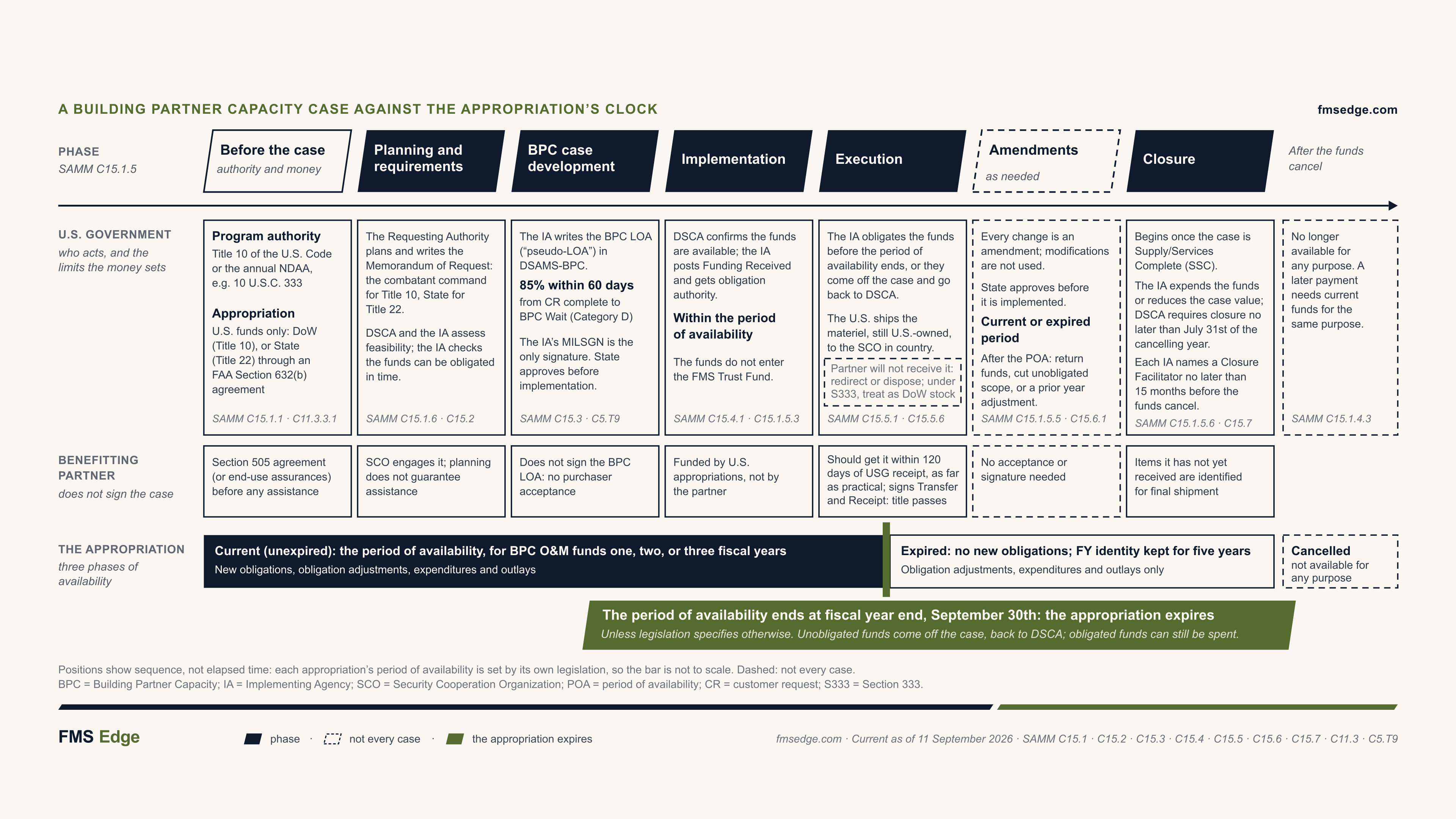
What is a Building Partner Capacity case?
programs use U.S. appropriated funds, under Title 10 or Title 22 authorities, to transfer defense articles and services, and are managed through processes.
Typically, these additional authorities allow the DoW and to focus on building capacities of the international partner security forces and enhancing their capabilities to conduct/support:
- Counterterrorism operations
- Counter drug operations
- Counterinsurgency operations
- U.S. military and stability operations
- Multilateral peace operations
These types of activities funded with U.S. Government appropriations are called and are administratively managed using the infrastructure. develop cases using established automated systems. It is important to note that has dedicated Chapter 15 of the as the source for comprehensive policy for case and guidance.
The case process starts with the submitting a pre-coordinated request or proposal to the and .
The request, called a , is similar to a traditional , and it will identify the required services, equipment, and the legal authority for the program. and the conduct a feasibility assessment to ensure such areas as requirements, definitions, transportation plans, technology/disclosure, special contracting issues, etc., are addressed and compliant with the program guidelines. The assessment will also verify that the requirements identified are actionable within the program budget constraints and obligation time lines.
Chapter 15 of the also includes specific operating guidelines required when developing and executing the programs:
- Congressional notification may be required.
- The case is not signed by the international partner receiving the articles and/or services. Once implemented, case documentation may be shared with the recipient (benefitting) international partner on a case-by-case basis in accordance with guidance.
- Transportation is typically provided by the to an in-country destination, and the is responsible for conducting an inventory before transferring possession of the materiel to the international partner.
- For programs where the title transfers, it transfers at the point of delivery vice the initial point of shipment. The is responsible for documenting the transfer to the benefitting national partner.
The and the play a significant role in the case. They must interface with the recipient international partner in order to translate the specific program objectives into detailed package requests. program requests should be linked to the international partner and theater planning documents. Since some cases have a short financial life cycle and are authorized only to counter immediate crisis situations, they generally do not contain sustainment support. Therefore, these sustainment support elements should be considered and funded through other programs such as or . The and should include these sustainment elements in their planning documents.
References
SAMM
- SAMM GLOSSARY/building-partner-capacity-bpc-case — Building Partner Capacity (BPC) Case
- SAMM C15.1.1.1 — Building Partner Capacity Program Execution Methods.
- SAMM C15.3.1 — General.
- SAMM C15.2.6.4 — Feasibility Assessment.
- SAMM C15.2.10.1 — Congressional Notification.
Related
Letter of Offer and Acceptance (LOA)
The legal instrument used by the USG to transfer itemized defense articles, defense services, and design and construction services to foreign partners.
When used under the authorities provided in the Arms Export Control Act for Foreign Military Sales, the LOA is a binding agreement signed by the USG and the foreign partner to transfer such articles and services.
When used under Building Partnership Capacity (BPC) authorities, the BPC LOA is not signed by the Benefitting Partner.
SAMM Glossary, as of 12 September 2026
Glossary entry →Open the manual’s entry → (opens in new tab)
Foreign Military Sales (FMS)
A process, authorized by the Arms Export Control Act, through which eligible foreign governments and international organizations may purchase defense articles, services, and training from the United States Government.
SAMM Glossary, as of 12 September 2026
Glossary entry →Open the manual’s entry → (opens in new tab)
Security Cooperation
Activities undertaken by the DoD to encourage and enable international partners to work with the United States to achieve strategic objectives. It includes all DoD interactions with foreign defense and security establishments, including all DoD-administered security assistance programs, that: build defense and security relationships that promote specific U.S. security interests, including all international armaments cooperation activities and security assistance activities; develop allied and friendly military capabilities for self-defense and multinational operations; and provide U.S. forces with peacetime and contingency access to host nations.
SAMM Glossary, as of 12 September 2026
Glossary entry →Open the manual’s entry → (opens in new tab)
LOA — Letter of Offer and Acceptance
SAMM Acronyms, as of 12 September 2026
Building Partner Capacity (BPC) Programs
Security cooperation and security assistance activities funded with USG appropriations (not including Foreign Military Sales Credit and Military Assistance Program/Merger).
SAMM Glossary, as of 12 September 2026
Glossary entry →Open the manual’s entry → (opens in new tab)
FMS — Foreign Military Sale
SAMM Acronyms, as of 12 September 2026
Implementing Agency (IA)
The military department or defense agency responsible for the execution of military assistance programs. With respect to FMS, the military department or defense agency assigned responsibility by the Defense Security Cooperation Agency to prepare an LOA and to implement an FMS case. The implementing agency is responsible for the overall management of the actions that will result in delivery of the materials or services set forth in the LOA that was accepted by a foreign country or international organization.
SAMM Glossary, as of 12 September 2026
Glossary entry →Open the manual’s entry → (opens in new tab)
Security Assistance (SA)
A group of programs authorized by federal statutes by which the United States provides defense articles, military training, and other defense-related services by grant, lease, loan, credit, or cash sales in furtherance of national policies and objectives, and those that are funded and authorized through the Department of State to be administered by Department of Defense/Defense Security Cooperation Agency, which are considered part of security cooperation.
SAMM Glossary, as of 12 September 2026
Glossary entry →Open the manual’s entry → (opens in new tab)
DSCA — Defense Security Cooperation Agency
SAMM Acronyms, as of 12 September 2026
Glossary entry →Defense Security Cooperation Agency (DSCA) →
SAMM — Security Assistance Management Manual
SAMM Acronyms, as of 12 September 2026
Glossary entry →Security Assistance Management Manual (SAMM) →
Memorandum of Request (MOR)
A document prepared and submitted by the Requesting Authority which identifies requirements and initiates the case development process under a Building Partner Capacity program.
SAMM Glossary, as of 12 September 2026
Glossary entry →Open the manual’s entry → (opens in new tab)
LOR — Letter of Request
SAMM Acronyms, as of 12 September 2026
SCO — Security Cooperation Organization
SAMM Acronyms, as of 12 September 2026
Security Cooperation Organization (SCO)
A Department of Defense element that is part of the United States Diplomatic mission located in a foreign country to carry out security assistance and security cooperation management functions under the supervision and coordination authority of the senior defense official/defense attaché.
SAMM Glossary, as of 12 September 2026
Glossary entry →Open the manual’s entry → (opens in new tab)
Security Cooperation Information Portal (SCIP)
A DSCA-managed web-based tool for international purchasers, purchaser agents (e.g., freight forwarders), and USG personnel with appropriate permissions that provides information on U.S. Foreign Military Sales Letters of Offer and Acceptance and other key Security Cooperation programs and processes. The data is sourced from Defense Security Assistance Management System and the Military Department's case execution systems.
SAMM Glossary, as of 12 September 2026
Glossary entry →Open the manual’s entry → (opens in new tab)
Combatant Command (CCMD)
A unified or specified command with a broad continuing mission under a single commander established and so designated by the President, through the Secretary of Defense and with the advice and assistance of the Chairman of the Joint Chiefs of Staff. Also called CCMD.
SAMM Glossary, as of 12 September 2026
Glossary entry →Open the manual’s entry → (opens in new tab)
IMET — International Military Education and Training
SAMM Acronyms, as of 12 September 2026