
Guide
How does repair and return work in Foreign Military Sales?
A purchaser can have unserviceable repairable items fixed in the U.S. repair system instead of building its own depot. Under it gets its own item back and pays the actual cost of the repair; under , or direct exchange, it gets a serviceable item from U.S. stocks at an exchange price.
Repair and return is a loop, drawn here unfolded: the unserviceable item leaves the purchaser's country, goes to the repair facility in the United States, and comes back. One Delivery Term Code on the repair line sets how much of both legs the Department of War carries, from nothing at all (code E) to the whole loop, inland point to inland destination (code F). If possible, the purchaser or its freight forwarder moves the item out; the purchaser's method drives the typical path. The wording of each code is the SAMM's own; no transportation rates are shown.
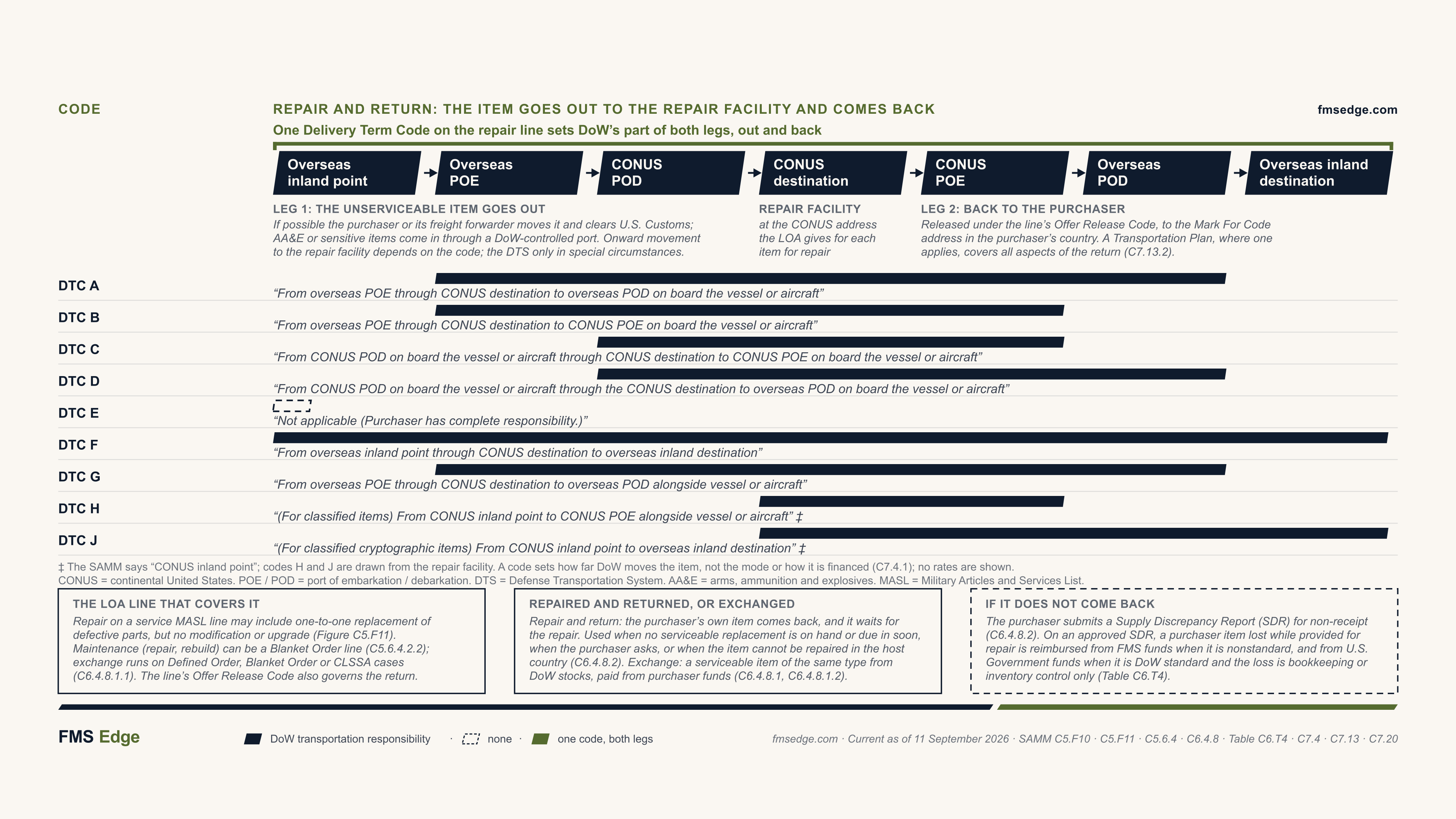
How does repair and return work in Foreign Military Sales?
Often, it is less expensive to repair items than it is to discard them and order new items. The U.S. military services make extensive use of returns from repairs; in some cases, returns from repairs are the only source of supply. The repairable program provides a country the means of obtaining repair services without the necessity of establishing an in-country capability, which can be a long-term and normally uneconomical investment because of a relatively small number of weapon systems in use. When an in-country capability does exist, the repairable program can supplement this capability when necessary.
Often, international partners will opt to return repair items to U.S. facilities for repair or modification. The scope of work performed under the repairable program is usually referred to as “depot-level repairs.” This means the repair, overhaul, or rebuild of unserviceable assets requires maintenance beyond the capability (equipment and/or skills) available in field- or organization-level activities. The repairs are accomplished by the service depots or by commercial firms under contract to the depots. The choice of this option is often based largely on economics. Rather than investing heavily in facilities, skills, tools, test equipment, etc., the international partner may find that U.S., or other external depot repair service, is more advantageous. When an international partner follows this course of action and uses cases for the repair of items, close coordination with and among the servicing depot facilities is required. The maintenance facility can determine when the item should be returned and estimate the cost of repairs. The coordinates repair services and instructs the international partner to send the item to the appropriate depot repair facility. The is responsible for procuring the needed repair parts, and for getting them to the depot assigned the overhaul/rebuilding task.
The country has certain basic responsibilities under the repairable program. The country must establish an case in order to get the items repaired.
The country should only return economically repairable items to the U.S. If the repair facility deems an item not economically repairable, it will not be repaired without specific authorization from the country.
The country normally moves the item to the United States itself or through its , and is responsible for port handling, broker fees and customs clearance; onward movement to the repair facility depends on the , and the can be used in special circumstances. International partners must understand that materiel being returned to the U.S. for repair, regardless of the type of repair program, must clear U.S. customs. International partners or their designated freight forwarders must cite International Traffic in Arms Regulations () exemption 22 CFR 123.4 (unclassified) with U.S. customs at the primary U.S. port of entry, along with a copy of the , which authorizes the materiel’s repair.
Two concepts are used in obtaining repairs under the repairable program: and .
To participate in the program, the international partner must establish an case for repair services with the MILDEP. This may be a blanket order or a . Under the concept, the country enters its unserviceable item into the U.S. repair cycle, and, upon completion of repairs, the same item is returned to the country. The U.S. Air Force and U.S. Army call this program “.” The U.S. Navy calls this program “Repair of Repairables” (RoR).
The repair program is normally limited to items for which the MILDEP has established a depot-level repair program. The international partner must request approval for repair through the from the inventory manager (IM) before shipping materiel to the U.S. for repair. After receiving approval and shipping instructions from the IM, the international partner ships the materiel to the designated repair facility where it is entered into the repair queue. After repairs are completed, the item is shipped back to the international partner.
In the or RoR program, the cost to the country is the actual cost of the repair in accordance with 7000.14-R, Financial Management Regulation (), Volume 15, Chapter 7.
Under the program, also known as direct exchange (), the unserviceable item is returned to the repair activity and, if it can be economically repaired or overhauled, a replacement item is issued from the U.S. military service’s stocks. The country’s unserviceable item is repaired or overhauled and returned to the U.S. military service’s stocks. Under this program, countries are charged the estimated average cost of repairs (also referred to as the net cost or exchange price). With the exception of the administrative and special requirements, i.e., packing, crating and handling, the same costs will be assessed to international partners as are charged to U.S. forces. The program is usually available through either a or as a .
The U.S. Navy’s program is called the replacement option. Under this program, international partners can draw directly from the U.S. Navy stock system (through a ) for specifically identified weapons replaceable assemblies, system replaceable assemblies, and other designated repairable spares that are managed and have been approved by NAVSUP Weapon Systems Support in conjunction with the U.S. Navy’s systems commands. If the requested materiel is available in the U.S. Navy’s stock system, it is shipped immediately upon request. Then, the international partner sends the failed item to a U.S. Navy designated receiving point for further transfer to a depot for repair. Upon completion of repairs to the returned item, it is returned to U.S. Navy stock. International partners are charged the difference between a condition “A” item and the value of the failed item carcass.
Under the U.S. Air Force’s program, international partners can draw directly from sources of supply (through a or ) for items listed on a preauthorized materiel repair requirements list (MRRL). International partners send their failed items to a designated receiving depot. Upon receipt at the depot, a replacement requisition is generated and the international partner is charged the average repair cost for that particular item (also known as the “exchange price”). If the carcass is determined to be non-repairable, then the international partner is charged the full price for a condition “A” item.
References
SAMM
- SAMM C7.20.1
- SAMM GLOSSARY/repair-and-return — Repair and Return
- SAMM C6.4.8.1.1
- SAMM C6.4.8.1.2
Related
Foreign Military Sales (FMS)
A process, authorized by the Arms Export Control Act, through which eligible foreign governments and international organizations may purchase defense articles, services, and training from the United States Government.
SAMM Glossary, as of 12 September 2026
Glossary entry →Open the manual’s entry → (opens in new tab)
Repair and Return
A service where eligible foreign countries return unserviceable repairable items for entry into the U.S. Military Department repair cycle. Upon completion of repairs, the same item is returned to the country and the actual cost of the repair is billed to the country.
SAMM Glossary, as of 12 September 2026
Glossary entry →Open the manual’s entry → (opens in new tab)
Repair and Replace (FMS)
Programs by which eligible Cooperative Logistics Supply Support Arrangement (CLSSA) customers return repairable carcasses to the United States and receive a serviceable item without awaiting the normal repair cycle time frame. The concept is that the replacement involves an exchange of CLSSA customer-owned stocks in the customer's hands and the CLSSA customer-owned stocks in the U.S. government inventory in the United States. Countries are initially charged the estimated repair cost, with adjustment to the actual repair cost upon completion of repair of the carcass.
SAMM Glossary, as of 12 September 2026
Glossary entry →Open the manual’s entry → (opens in new tab)
FMS — Foreign Military Sale
SAMM Acronyms, as of 12 September 2026
ILCO — International Logistics Control Office
SAMM Acronyms, as of 12 September 2026
Glossary entry →International Logistics Control Office (ILCO) →
ICP — Inventory Control Point
SAMM Acronyms, as of 12 September 2026
Freight Forwarder
A commercial import/export company registered with the Department of State, Bureau of Political-Military Affairs, Directorate of Defense Trade Controls and under contract to the Foreign Military Sales customer which arranges transportation of materiel from a point specified in the Letter of Offer and Acceptance to the final destination.
SAMM Glossary, as of 12 September 2026
Glossary entry →Open the manual’s entry → (opens in new tab)
Delivery Term Code (DTC)
A single character code that represents how far the USG is responsible for arranging transportation of defense articles going to an international customer.
SAMM Glossary, as of 12 September 2026
Glossary entry →Open the manual’s entry → (opens in new tab)
Defense Transportation System (DTS)
The portion of the worldwide transportation infrastructure that supports DoD transportation needs in peace and war. DTS consists of two major elements: military and commercial resources. These resources include aircraft, assets, services, and systems organic to, contracted for, or controlled by the DoD. DoD's infrastructure, including ports, airlift, sealift, railway, highway, in-transit visibility, information management systems, customs, and traffic management that the DoD maintains and exercises in peacetime, is a vital element of the DoD's capability to project power worldwide. It provides for responsive force projection and a seamless transition between peacetime and wartime operations.
SAMM Glossary, as of 12 September 2026
Glossary entry →Open the manual’s entry → (opens in new tab)
ITAR — International Traffic in Arms Regulations
SAMM Acronyms, as of 12 September 2026
Glossary entry →International Traffic in Arms Regulation (ITAR) →
LOA — Letter of Offer and Acceptance
SAMM Acronyms, as of 12 September 2026
Transportation Plan
A document that details the transportation and security arrangements for moving classified or sensitive material, and identifies individuals responsible for providing security at various points during transportation.
SAMM Glossary, as of 12 September 2026
Glossary entry →Open the manual’s entry → (opens in new tab)
Continental United States (CONUS)
U.S. territory, including the adjacent territorial waters, located within the North American continent between Canada and Mexico. Does not include Hawaii or Alaska.
SAMM Glossary, as of 12 September 2026
Glossary entry →Open the manual’s entry → (opens in new tab)
CONUS — Continental United States
SAMM Acronyms, as of 12 September 2026
Military Department (MILDEP)
One of the departments within the DoD created by the National Security Act of 1947, as amended. The Military Departments are: the Department of the Air Force, the Department of the Army, and the Department of the Navy.
SAMM Glossary, as of 12 September 2026
Glossary entry →Open the manual’s entry → (opens in new tab)
Defined Order Case
A Letter of Offer and Acceptance (LOA) that provides specific defense articles and/or defense services with definitive items, quantities, and/or Months of anticipated materiel delivery or performance of services on the LOA lines.
SAMM Glossary, as of 12 September 2026
Glossary entry →Open the manual’s entry → (opens in new tab)
Blanket Order Case (Foreign Military Sales)
A Foreign Military Sales Letter of Offer and Acceptance (LOA) that provides categories of defense articles and/or defense services with no definitive listing of items, quantities, or Months of anticipated materiel delivery or performance of services with the intent to use the lines on the LOA until funds are exhausted.
SAMM Glossary, as of 12 September 2026
Glossary entry →Open the manual’s entry → (opens in new tab)
CLSSA — Cooperative Logistics Supply Support Arrangement
SAMM Acronyms, as of 12 September 2026
Glossary entry →Cooperative Logistics Supply Support Arrangements (CLSSA) →
Repairable Item
An item of a durable nature that has been determined by the application of engineering, economic, and other factors to be the type of item feasible for restoration to a serviceable condition through regular repair procedures.
SAMM Glossary, as of 12 September 2026
Glossary entry →Open the manual’s entry → (opens in new tab)
AECA — Arms Export Control Act
SAMM Acronyms, as of 12 September 2026
End Item
The final production product when assembled, or completed, and ready for issue or deployment.
SAMM Glossary, as of 12 September 2026
Glossary entry →Open the manual’s entry → (opens in new tab)