
Guide
Who manages the procurement in a Foreign Military Sale?
Under the U.S. Government takes responsibility for the procurement and buys for the purchaser under Department of War regulations, which gives the purchaser the same benefits and protection as the department's own purchases. Under a the purchaser deals with the contractor directly and carries those functions itself, although it can buy from the .
Who holds a Foreign Military Sales procurement once the LOA is signed. The case manager, the program office, the procuring contracting officer and the administrative contracting officer each hold one lane, and the contract award passes the work from the officer who buys to the officer who administers.
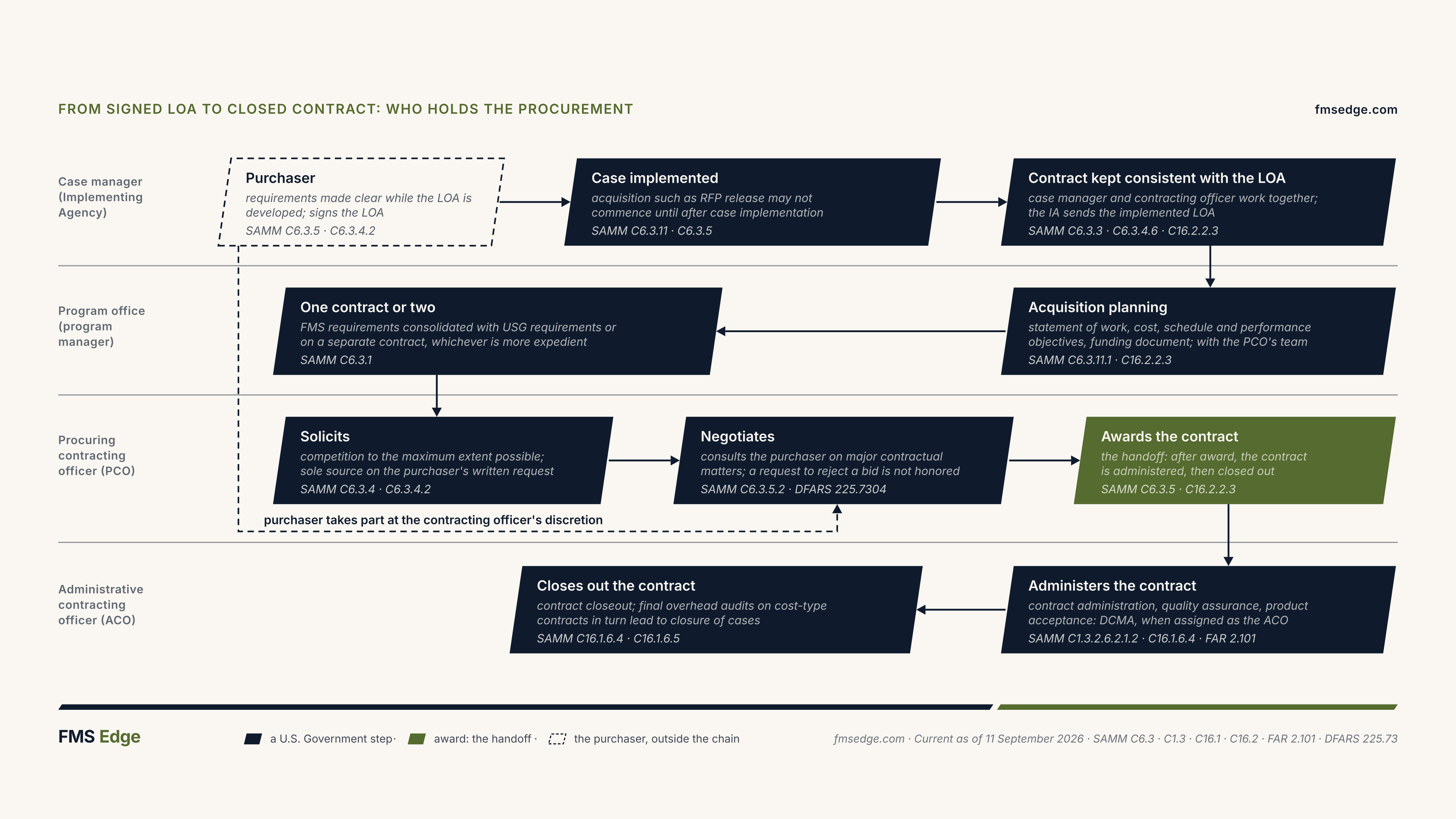
Who manages the procurement in a Foreign Military Sale?
Under the standard terms, the U.S. Government () will furnish the items from its own stocks and resources or will procure them for the purchaser under terms and conditions consistent with Department of War (DoW) regulations and procedures [SAMM ]. Procurement for a purchaser must follow DoW regulations and the other procedures that apply, which gives the purchaser the same benefits and protection as the DoW gets when it buys for itself. That is a leading reason why foreign governments and international organizations choose to buy through channels. The provisions that apply to the DoW apply to procurements as well, and so does every and Defense Supplement () clause. Table C6.T1 lists selected sections that apply to in particular ways [SAMM ].
Under traditional , the international partner initiates the process by submitting a to the . The will coordinate national security and foreign policy reviews (which include releasability reviews) during the development of the case. Following completion of these reviews, the will generate an . Following any necessary congressional notifications, the will forward the as an offer by the to sell the respective defense articles and/or services. If, upon review of the , the international partner decides to accept the , a foreign government representative will sign the and forward the to the Defense Finance and Accounting Service - Indianapolis (). At this point, the international partner and the have entered a formal sales agreement for the provision of defense articles and services.
If any situation arises that puts at risk the ’s ability to meet a commitment made to an international partner, or has an operational, political or readiness impact on the partner, the Case Manager is responsible for forwarding the matter through the appropriate or Defense Agency channel to alert the Country Portfolio Director and Country Finance Director in writing, so that the broader () enterprise can be informed in advance and a unified response can be provided. If the situation also poses an immediate safety risk to the partner’s use of delivered defense articles, the will instead tell the partner of the risk at once. The sends an information copy to the Country Portfolio Director and Country Finance Director and to the appropriate or Defense Agency channel [SAMM ]. If the does not intend to offer the requested capability in the , the will coordinate with .
The case standard terms and conditions define the nature of this sales relationship. Section 1.2 sets out the procurement responsibilities. The furnishes the items from its stocks or procures them under DoW regulations and procedures, and is solely responsible for negotiating the contracts. The DoW will conduct the procurement on behalf of the international partner using the same regulations and procedures that the DoW uses to procure for itself. Under traditional , the international partner is not responsible for any procurement actions after accepting the , except where the records a purchaser request that the DoW has agreed to [SAMM ]. Under the provisions of the case, the DoW takes responsibility for the following:
- Conducting the entire procurement process, to include contractor , and negotiating the contract terms and conditions
- , quality control, inspection, acceptance, and audit functions
As a broad generalization, the traditional process can be characterized as an international partner, by means of the case, employing the DoW to conduct defense procurement on its behalf. As such, the international partner entrusts the DoW to make decisions and take actions on its behalf. The international partner relies on the good faith commitment that the DoW makes to conduct procurement business in essentially the same manner that it conducts procurement business for itself.
Under the system, purchases for international partners are made by a well-established DoW contracting network. The DoW is committed to procuring defense articles and services under the same contractual provisions used for its own procurements. This system is designed to acquire the required quality items at the lowest price from qualified sources and to provide for . requirements may be consolidated with requirements or placed on a separate contract, whichever is more expedient and cost effective [SAMM ]. Although the DoW’s procurement process offers these benefits, the international partner will be charged an appropriate fee in the case, for the contracting and administrative services provided by the DoW.
In Direct Commercial Sales (), the international partner assumes contract negotiation and management responsibility. These activities represent overhead management costs to the international partner and the actual contract cost. Although it is not necessary for an international partner to fully duplicate the DoW contracting network to make an efficient commercial purchase, the size and skill of the international partner’s contracting staff may be a limiting factor in the quantity and complexity of procurements. Numerous contractors and subcontractors may be involved in supplying the entire package for a major . As a result, multiple contracts may be necessary to procure the total system.
The assumes responsibility for the procurement of items. It determines the contract type, selects the contract source, and negotiates prices and contract terms with individual contractors. These negotiations are conducted on the same basis as procurements for DoW purchasers. Under , the international partner trusts the to negotiate a contract that will meet the international partner’s needs.
procurements can be placed directly with the manufacturers of components rather than through a single prime contractor, which avoids the prime contractor’s mark-up on subcontracted items. Whether an international partner can do the same under depends on the size and skill of its own contracting staff.
The purchaser may ask in writing that a particular contractor be used or that competition be limited; the request should go in its , or separately with a reference to the [SAMM , ]. If the DoW accepts the request, the records that designation. Otherwise, the selects the contractor on the same basis it uses for its own requirements [SAMM ].
Under , are included as standard components of the overall price; they include contract quality assurance, inspection, and audit services.
For commercial contracts, the purchasing international partner bears the additional cost of resources needed to monitor production, evaluate modifications, provide for improvements, and ensure contract compliance. A large number of highly educated personnel well trained in international commerce, quality assurance, and audit processes may be required to perform such functions.
If the U.S. agrees to sell the system through , the acquisition will be accomplished with support by the same program management office that is managing the system for the DoW. The system program management office may acquire the requirements either as separate individual procurements or by consolidating the requirements with DoW requirements on the same U.S. contract.
International partners with extensive international procurement expertise may prefer to independently conduct their own defense procurements directly with U.S. industry. In a , the ’s main involvement is the export license decision under the and the International Traffic in Arms Regulations (), and the does not negotiate the contract. However, international partners should recognize they can purchase from the for their .
While the international partners’ government representatives may possess all the skills and abilities to negotiate a favorable contract with U.S. industry, the subsequent process for , quality control, inspection, acceptance, and audit functions may present both a logistical and financial barrier. The U.S. contractor may perform work at multiple geographically-dispersed locations. As such, it may be difficult and expensive for the international partners’ representatives to conduct these functions throughout the United States.
A partner may acquire from in support of a self-negotiated . Upon receipt of an , develops a case for the cost of its in support of the particular . Under the case, uses its existing infrastructure to perform on behalf of the international partner [SAMM ].
provides the DoW, other federal agencies and, where authorized in support of , foreign partners with and management, product acceptance, quality assurance and other acquisition services. It also provides Contingency (CCAS) forces to the military service responsible for carrying out the mission, and it prepares cases for services that support foreign partners' contracts and procurements. The Under Secretary of War for Acquisition and Sustainment has authority, direction and control over , which the Under Secretary exercises through the Assistant Secretary of War for Acquisition [SAMM ].
Traditional offers the international partner the greatest degree of direct involvement in their U.S.-sourced defense procurement. In , the international partner directly interfaces with the contractor on all elements of the contract without the DoW being an intermediary. Traditional provides a range of opportunities and places contract negotiation and management responsibility on the international partner.
References
SAMM
- SAMM C5.F9: Letter of Offer and Acceptance Standard Terms and Conditions
- SAMM C2.2.5
- SAMM C6.3.4: Requests for Other than Full and Open Competition.
- SAMM C6.3.4.2: Timing of Requests.
- SAMM C6.3.1: Compliance with Department of War Regulations and Procedures.
- SAMM C1.3.2.6.2.1.2: Roles.
Related
Foreign Military Sales (FMS)
The part of U.S. security assistance, authorized by the Arms Export Control Act (AECA), in which eligible foreign governments and international organizations buy defense articles, services and training from the U.S. Government under formal government-to-government agreements.
The articles come either from Department of War stocks or from new procurement under contracts the Department manages [22 U.S.C. 2761, 22 U.S.C. 2762]. A sale is FMS whatever the source of the purchaser's financing.
FMS Edge glossary, as of 10 October 2026
Glossary entry →Open the manual’s entry → (opens in new tab)
Direct Commercial Sale (DCS)
A sale of defense articles or defense services made under a Department of State issued license by U.S. industry directly to a foreign buyer, and which is not administered by DoD through Foreign Military Sales procedures.
SAMM Glossary, as of 12 September 2026
Glossary entry →Open the manual’s entry → (opens in new tab)
Contract Administration Services (CAS)
All those actions accomplished in or near a contractor's plant for the benefit of the U.S. government which are necessary to the performance of a contract or in support of the buying offices, system/project managers, and other organizations, including quality assurance, engineering support, production surveillance, pre-award surveys, mobilization planning, contract administration, property administration, industrial security, and safety.
SAMM Glossary, as of 12 September 2026
Glossary entry →Open the manual’s entry → (opens in new tab)
Defense Contract Management Agency (DCMA)
An agency under the direction of the Under Secretary of Defense for Acquisition and Sustainment, which provides contract administration services for the Department of Defense, other federal organizations and international partners, and is an essential part of the acquisition process from pre-award to sustainment and contract closeout.
SAMM Glossary, as of 12 September 2026
Glossary entry →Open the manual’s entry → (opens in new tab)
Letter of Offer and Acceptance (LOA)
The legal instrument that lists the defense articles and services, including training, that the U.S. Government transfers to a foreign country or international organization, with their estimated costs and the terms and conditions. The benefitting partner does not sign a Building Partner Capacity (BPC) LOA.
The Letter of Offer and Acceptance (LOA) is the instrument the U.S. Government uses to sell under the Arms Export Control Act (AECA); signed LOAs and their later Amendments and Modifications are also called Foreign Military Sales (FMS) cases [SAMM C5.6.1].
FMS Edge glossary, as of 10 October 2026
Glossary entry →Open the manual’s entry → (opens in new tab)
FMS: Foreign Military Sale
SAMM Acronyms, as of 12 September 2026
Federal Acquisition Regulation (FAR)
The FAR is the primary regulation for use by federal executive agencies for the acquisition of supplies and services with appropriated funds. The document, published in 1984, consolidated the major procurement regulations of various departments and agencies. The intent of the FAR is to standardize the content, decrease the volume of documents, and to achieve consistency throughout government. The principal agencies involved in putting together the FAR were DoD, the General Services Administration, and the National Aeronautics and Space Administration, the three largest buyers. The FAR is broader than just contracting and applies to all goods and services. It directs the defense program manager in many ways, including contract award procedures, acquisition planning, warranties, and establishing guidelines for competition. Besides the FAR, each agency has its supplement to describe its own particular way of doing business. The DoD supplement is called Defense FAR Supplement.
SAMM Glossary, as of 12 September 2026
Glossary entry →Open the manual’s entry → (opens in new tab)
DFARS: Defense Federal Acquisition Regulation Supplement
SAMM Acronyms, as of 12 September 2026
Letter of Request (LOR)
The term used to identify a request from an eligible FMS participant country for the purchase of U.S. defense articles and services. The request may be in message or letter format.
SAMM Glossary, as of 12 September 2026
Glossary entry →Open the manual’s entry → (opens in new tab)
Implementing Agency (IA)
The military department or defense agency responsible for the execution of military assistance programs. With respect to FMS, the military department or defense agency assigned responsibility by the Defense Security Cooperation Agency to prepare an LOA and to implement an FMS case. The implementing agency is responsible for the overall management of the actions that will result in delivery of the materials or services set forth in the LOA that was accepted by a foreign country or international organization.
SAMM Glossary, as of 12 September 2026
Glossary entry →Open the manual’s entry → (opens in new tab)
LOA: Letter of Offer and Acceptance
SAMM Acronyms, as of 12 September 2026
Initial Deposit
The payment a Foreign Military Sales (FMS) purchaser sends when it accepts a Letter of Offer and Acceptance (LOA), as full or partial payment for the articles, services or training it has agreed to buy.
Each LOA includes an initial deposit that covers the nonrecurring cost payment and the outlays or deliveries expected before the purchaser's first quarterly payment arrives [SAMM C9.9.1.5.1].
FMS Edge glossary, as of 10 October 2026
Glossary entry →Open the manual’s entry → (opens in new tab)
DFAS-IN: Defense Finance and Accounting Service - Indianapolis
SAMM Acronyms, as of 12 September 2026
Military Department (MILDEP)
One of the departments within the DoD created by the National Security Act of 1947, as amended. The Military Departments are: the Department of the Air Force, the Department of the Army, and the Department of the Navy.
SAMM Glossary, as of 12 September 2026
Glossary entry →Open the manual’s entry → (opens in new tab)
Defense Security Cooperation Agency (DSCA)
The Department of War agency that directs, administers and provides guidance to the Department's components and its representatives at U.S. missions for the execution of the security cooperation programs for which it is responsible [SAMM C1.3.2.2]. The agency also provides financial and technical assistance, arranges the transfer of defense materiel, training and services to international partners, and promotes military-to-military contacts.
FMS Edge glossary, as of 10 October 2026
Glossary entry →Open the manual’s entry → (opens in new tab)
Security Cooperation
Activities by which the Department of War encourages and enables international partners to cooperate with the United States toward strategic objectives, spanning every interaction with foreign defense and security establishments and every security assistance program the Department administers.
Under chapter 16 of Title 10, their purposes are to develop allied and friendly security capabilities for self-defense and multinational operations, to give U.S. forces peacetime and contingency access, and to build relationships promoting specific U.S. security interests [10 U.S.C. 301(7)].
FMS Edge glossary, as of 10 October 2026
Glossary entry →Open the manual’s entry → (opens in new tab)
DSCA: Defense Security Cooperation Agency
SAMM Acronyms, as of 12 September 2026
Glossary entry →Defense Security Cooperation Agency (DSCA) →
LOR: Letter of Request
SAMM Acronyms, as of 12 September 2026
Source Selection
The process wherein the requirements, facts, recommendations, and government policy relevant to an award decision in a competitive procurement of a system/project are examined and the decision made.
SAMM Glossary, as of 12 September 2026
Glossary entry →Open the manual’s entry → (opens in new tab)
Contract Administration
All the activities associated with the performance of a contract, from pre-award to closeout.
SAMM Glossary, as of 12 September 2026
Glossary entry →Open the manual’s entry → (opens in new tab)
DCS: Direct Commercial Sales
SAMM Acronyms, as of 12 September 2026
Weapon System
A combination of one or more weapons with all related equipment, materials, services, personnel, and means of delivery and deployment (if applicable) required for self-sufficiency.
SAMM Glossary, as of 12 September 2026
Glossary entry →Open the manual’s entry → (opens in new tab)
Arms Export Control Act (AECA)
The basic U.S. law providing the authority and general rules for the conduct of Foreign Military Sales and commercial sales of defense articles, defense services, and training. The Arms Export Control Act (AECA) came into existence with the passage of the Foreign Military Sales Act (FMSA) of 1968. An amendment in the International Security Assistance and AECA of 1976 changed the name of FMSA to the AECA.
SAMM Glossary, as of 12 September 2026
Glossary entry →Open the manual’s entry → (opens in new tab)
ITAR: International Traffic in Arms Regulations
SAMM Acronyms, as of 12 September 2026
Glossary entry →International Traffic in Arms Regulation (ITAR) →
DCMA: Defense Contract Management Agency
SAMM Acronyms, as of 12 September 2026
SAMM C5.F9: Letter of Offer and Acceptance Standard Terms and Conditions
“… 1.2. The USG will furnish the items from its stocks and resources, or will procure them under terms and conditions consistent with DoW regulations and procedures. When procuring for the Purchaser, DoW will, in general, employ the same contract clauses, the same contract administration, and the same quality and audit inspection procedures as would be used in procuring for itself; …”
Security Assistance Management Manual, as of 11 September 2026
SAMM C6.3.1: Compliance with Department of War Regulations and Procedures.
“Acquisition for Foreign Military Sales (FMS) purchasers must be in accordance with DoW regulations and other applicable USG procedures. This affords the foreign purchaser the same benefits and protection that apply to DoW procurement and is one of the principal reasons why foreign governments and international organizations prefer to procure through FMS channels. FMS requirements may be consolidated with USG …”
Security Assistance Management Manual, as of 26 October 2026
SAMM C2.2.5
“If any situation arises that puts at risk the USG’s ability to meet a commitment made to an international partner or that results in an operational, political, or readiness impact to the international partner or CCMD priority case, the CM is responsible to forward the matter through the appropriate MILDEP/Defense Agency FMS channel to alert the DSCA (Office of International …”
Security Assistance Management Manual, as of 11 September 2026
SAMM C6.3.4: Requests for Other than Full and Open Competition.
“The competitive procurement process is used to the maximum extent possible when procuring articles or services. The Competition in Contracting Act (CICA) (10 U.S.C. 3204), however, provides certain limited circumstances in which the contracting activity can consider FMS purchaser requests for procurement using other than full and open competition (commonly referred to as “sole source”) when the contract to be …”
Security Assistance Management Manual, as of 26 October 2026
SAMM C6.3.4.2: Timing of Requests.
“Official written direction to use other than full and open competition should be submitted in the Letter of Request (LOR), or it can be submitted separately with a reference to the LOR. The designation of a procurement to be conducted using other than full and open competition for an LOA that has already been accepted by the partner nation and …”
Security Assistance Management Manual, as of 26 October 2026
SAMM C1.3.2.6.2.1.2: Roles.
“DCMA performs contract administration and management, quality assurance, product acceptance, and other acquisition services for the DoW, other federal agencies, and foreign partners as authorized in support of SC. DCMA also serves as a Contingency Contract Administration Services (CCAS) force provider to the military service responsible for executing the mission. DCMA prepares FMS cases for services in support of foreign …”
Security Assistance Management Manual, as of 26 October 2026