
Stage 01
Letter of Request Submission in Foreign Military Sales
The partner asks in writing to buy defense articles or services through . The goes through the U.S. Embassy's or through the partner's own authorized representatives.
What happens
A partner's request to buy defense articles or services through is a , whatever form it takes [SAMM ]. Certain Department of War (DoW) components are the Implementing Agencies () authorized to receive and respond to , and Tables C5.T3A and C5.T3B list them [SAMM ].
The should state whether the partner wants data, a , an Amendment or a Modification. Partners are strongly encouraged to work with the so that the covers the items on the Generic Checklist in Figure C5.F3 [SAMM ].
A Letter of Request has no set format, but it must be in writing. Where it goes depends on who sends it and what it asks for, and DSCA is an addressee on every route.
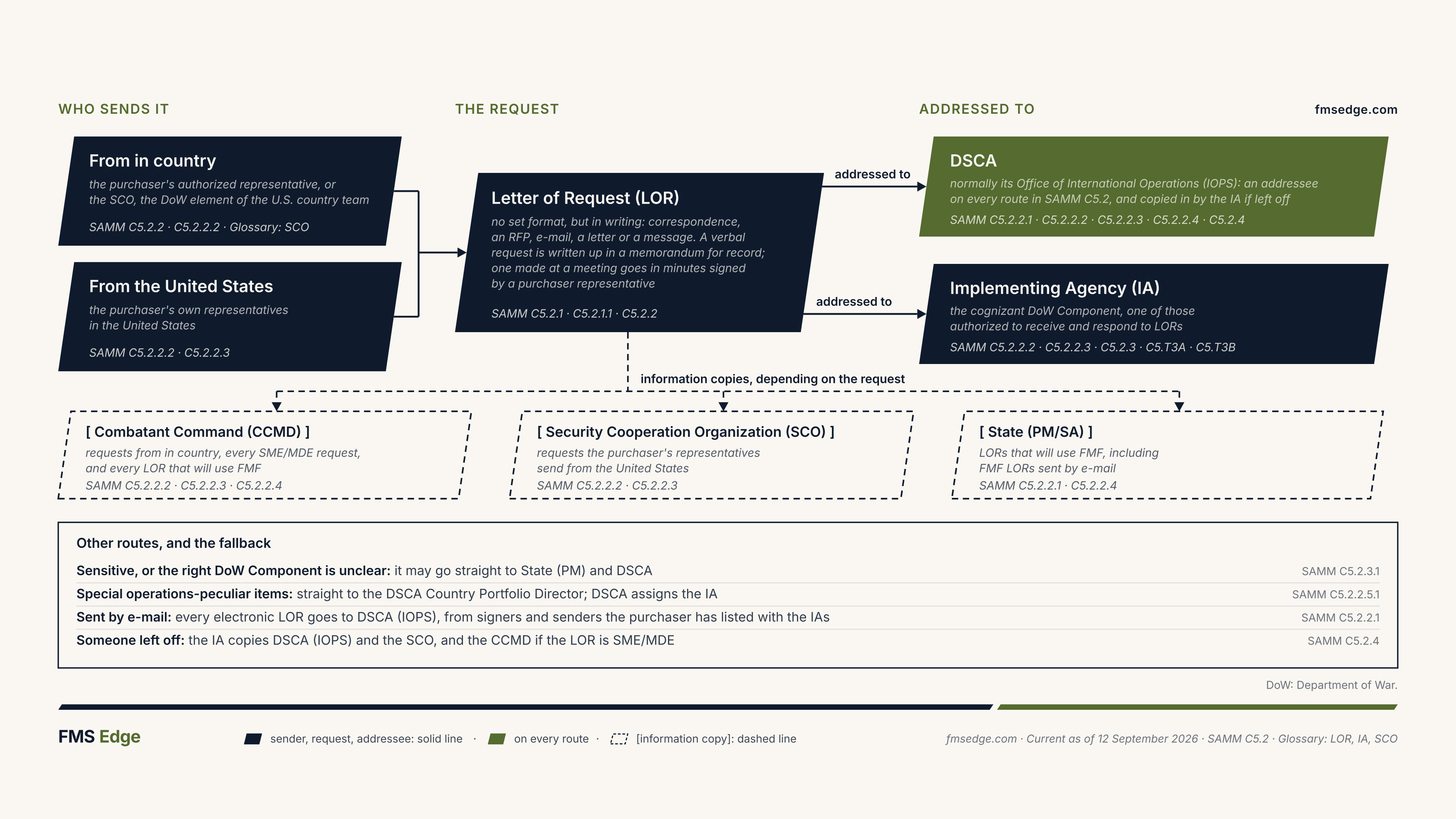
The request
Upon identifying U.S. systems and/or services to meet defense requirements, the international partner may submit an to the United States Government (). No specific format is required for an , but it must be in writing [SAMM ]. If an is received verbally, a memorandum for record () must document the conversation, and written confirmation should be obtained from the purchaser; if it is received during a meeting or conference, the minutes should document the request and be signed by an appropriate purchaser representative [SAMM ]. An can be communicated through formal correspondence (such as a letter or message), email, a or discussions [SAMM ].
are directed to develop system-specific checklists where appropriate. The checklists are meant to help purchasers write that are readily actionable (Section C5.2.5.2.3), with requirements fully defined for the and also for the logistics, construction, training and support services that a complete and sustainable capability needs. The generic checklist in Figure C5.F3 is the basis for those checklists, and it may also serve on its own for a that has no system-specific checklist. To the extent possible, should post their system-specific checklists on public websites where customers can reach them easily. Partner nations are encouraged to use the generic checklist and whichever system-specific checklists are available, since that cover the items in them will receive timelier responses. For Service and agency checklists, the manual links to resources from the U.S. Army, the U.S. Navy, the U.S. Air Force and the Defense Logistics Agency () [SAMM ].
In addition to the checklists, international partners and can contact the headquarters’ offices to request assistance (if needed) with preparation. The financial or logistical success of an program can hinge on clear and comprehensive information.
International partner involvement early in the development process is essential to ensure that the final document best satisfies the partner’s requirements [SAMM ].
Channels of submission
A request for non-Significant Military Equipment (non-) that originates in the partner's country must be transmitted to the Office of International Operations at the ( ()) and the appropriate DoW Component. It must be transmitted either by the purchaser's authorized representative or by the DoW element of the U.S. . Information copies go to the geographic . A request from the purchaser's foreign representatives in the United States must go to () and the appropriate DoW Component, and an information copy goes to the (the U.S. Military Group, or , in some countries). If the appears not to be on distribution for a request, the DoW Component must furnish copies to the and the as quickly as possible [SAMM ].
A request for or that originates in the partner's country must name () and the cognizant DoW Component as addressees, and information copies go to the . An request from the purchaser's representatives in the United States must be addressed to the same addressees, with information copies to the and the . If the appears not to be on distribution, the DoW Component must furnish it a copy as quickly as possible [SAMM ].
Section 47 of the defines the terms “” and “” []. The United States () enumerates certain defense articles and services, and an asterisk on the marks those designated as . Any counts as when its nonrecurring research and development cost is more than $50 million or its total production cost is more than $200 million, and Appendix 1 sets out the Nonrecurring Cost () recoupment charges for identified [SAMM ].
Total production cost here includes the DoW's expenditures on special test equipment, rate and special tooling, preproduction engineering, product improvement, production engineering, destructive testing, license costs, and pilot model production, testing and evaluation. It also includes the costs of any engineering change proposals initiated before the date on which the recoupment charge is calculated. Volume 15, Chapter 7, Section 15.5.3 of the Financial Management Regulation () defines each of these categories. Production line shutdown costs are not in the nonrecurring production cost pool as the defines it, so neither those costs nor any allocation of them is included in the pool when the nonrecurring cost charge is calculated [SAMM ].
may be submitted directly to the Department of State's Bureau of Political-Military Affairs () and if the U.S. Embassy in the country, or the purchaser's representative in the United States, believes that the request is sensitive and requires a higher-level policy determination. They may also go directly to and if the purchaser, or the , the U.S. Embassy or both, cannot determine the appropriate DoW Component [SAMM ].
The Country Team Assessment
A presents senior U.S. Embassy leadership's coordinated position in support of the proposed sale, with the key information needed to evaluate and explain it [SAMM ]. The is responsible for preparing the , coordinating it with the , and sending it to the Country Portfolio Director and the appropriate DoW Component [SAMM ].
A is required if any of the following circumstances apply [SAMM ]:
- The is likely to result in a Congressional Notification pursuant to AECA section 36(b) (22 U.S.C. 2776) (See Section C5.7.) based on its cost.
- Regardless of cost, that the would result in first introduction of a new capability for the country.
- The requests defense articles or services of a sensitive nature (See Section C5.1.5.2.).
- The is requested by (Office of International Operations, Regional Execution Directorate (/REX)).
The Combatant Commander's concurrence is required as well when the would be the first introduction of the system or capability to the recipient or the region [SAMM ]. If the concurrence is provided separately, the cites its reference where one is available [SAMM ].
All must address certain factors pertaining to the proposed sale of defense articles/services [SAMM ]. These factors include the planned end use, contribution to the defense/security goals of the U.S. and the recipient nation, impact on the recipient’s military capabilities, source of financing and economic impact on the recipient nation, the recipient’s ability to account for and safeguard sensitive technology, and the recipient’s human rights, terrorism, and proliferation record.
An additional required element addresses the efforts to reduce the risk of national or coalition operations causing civilian harm. The must include information addressing any additional training or support necessary to reduce the risk that the recipient will inadvertently cause civilian harm during operations [SAMM ].
A for a or service of a sensitive nature listed in Table C5.T1A requires further elements beyond these common ones. For each specific sensitive item listed in C5.T1A, there is a separate table identifying the supplemental information required in the (see Tables C5.T1B through C5.T1G). Some of these tables call for input from the appropriate Combatant Commander [SAMM ].
Key players at this stage
Partner nation
- Foreign Liaison Officer (FLO)Partner nation military or civilian representative stationed in the United States, often at a U.S. Implementing Agency (AFSAC, USASAC, NAVSUP WSS, or a SYSCOM)
Embassy — Security Cooperation Organization
- Security Cooperation Organization Chief (Embassy)U.S. Embassy Security Cooperation Organization, whose chief is the Senior Defense Official/Defense Attaché (SDO/DATT)
DSCA
- DSCA Country Portfolio DirectorDefense Security Cooperation Agency: International Operations (IOPS) / Regional Execution (REX)
Service international affairs office
- Air Force: SAF/IA Country DirectorDeputy Under Secretary of the Air Force for International Affairs (SAF/IA), regional division (SAF/IAR)
- Army: DASA(DE&C) Regional Desk OfficerOffice of the Deputy Assistant Secretary of the Army: Defense Exports & Cooperation, under ASA(ALT)
- Navy: NIPO Country DirectorNavy International Programs Office (NIPO), Global Security Cooperation
Case manager
- Air Force: AFSAC Command Country ManagerAir Force Security Assistance & Cooperation Directorate (AFSAC), AFLCMC/WF
- Army: USASAC Country Program ManagerU.S. Army Security Assistance Command (USASAC), Regional Operations Directorate
- Navy: NIPO Country DirectorNavy International Programs Office (NIPO), Global Security Cooperation
- Navy: NAVSUP WSS Case ManagerNaval Supply Systems Command Weapon Systems Support (NAVSUP WSS)
Program office
- Weapon System Program OfficeMilitary Department program management office for the weapon system
Industry
- Industry Business DevelopmentU.S. defense contractor
Common pitfalls
- type ( vs vs Amendment) unclear; sends clarification back
- missing mandatory actionable criteria, triggering an RFI cycle
- Partner submits to the wrong
- not copied or not engaged, losing the Embassy policy view
- A sole-source designation left out of the has to be submitted separately and referenced to it
What to watch for
If an falls short of the mandatory requirements in Table C5.T4A, it is considered insufficient. No case development activity can be started until more information has been obtained or clarified with the purchaser, and Requests for Information will be sent to the purchaser for whatever is needed first. The “ Insufficient” date is the date the assessment process determines that the fails the Table C5.T4A criteria. The tells the purchaser promptly of that finding, records the date of the notice in the Defense Management System () and logs the reason with a code based on the Table C5.T4A criteria [SAMM ].
Any official written direction to procure using other than should be submitted in the , or separately with a reference to the . Designating a procurement for other than on an that the partner nation has already accepted and that has been implemented would be an , subject to the 's acceptance. In that case, the may be amended to include the designation. A Modification may take the place of an Amendment if the request comes from the official who requested the , from that official's replacement, or from an official known to have authority equal to or greater than that of the official who signed the [SAMM ].
Guides on this stage
References
SAMM
- SAMM C5.2.1: Letter of Request Format and Information Requirements.
- SAMM C5.2.2: Letter of Request Submission Procedures.
- SAMM C5.2.1.1
- SAMM C5.6.5.2: Purchaser Participation in the Letter of Offer and Acceptance Preparation Process.
- SAMM C2.1.4.2: Country Team Assessment.
- SAMM C5.1.5.1
- SAMM C5.1.5.2
- SAMM C5.2.5.2.2: Letter of Request Insufficient.
- SAMM C5.1.5: Country Team Assessment.
- SAMM C5.2: Letter of Request Submissions.
- SAMM C6.3.4.2: Timing of Requests.
- SAMM C5.F3: Generic Letter of Request Checklist
- SAMM C5.2.3: The Department of War Components Authorized to Receive Letters of Request.
- SAMM C5.2.2.2: Non-Significant Military Equipment Requests.
- SAMM C5.2.2.3: Significant Military Equipment and Major Defense Equipment Requests.
- SAMM C5.T2: Letter of Request Submissions Guidelines
- SAMM C5.T3A: Military Department Organizations Authorized to Receive Letters of Request
- SAMM C3.1.2: Pre-Letter of Request Assessment Requests for Classified and Advanced Technology Release Decisions in Support of Security Cooperation Initiatives and Competitions.
- SAMM C5.2.1.2
- SAMM C5.2.3.1: Exceptions.
- SAMM C5.T1: Country Team Assessment - Common Required Elements
- SAMM C5.T1A: Defense Articles that Require Additional Country Team Assessment Elements
- SAMM C5.T3B: Other Department of War Implementing Agencies Authorized to Receive Letters of Request
Public authorities
- AECA §47: Arms Export Control Act of 1976, as amended, §47 (22 U.S.C. §2794), Definitions
Facts referenced
- Nonrecurring research and development cost above which Significant Military Equipment is Major Defense Equipment (AECA section 47): $50 million (as of 5 October 2026; SAMM C5.2.2.3)
- Total production cost above which Significant Military Equipment is Major Defense Equipment (AECA section 47): $200 million (as of 5 October 2026; SAMM C5.2.2.3)
Foreign Military Sales (FMS)
The part of U.S. security assistance, authorized by the Arms Export Control Act (AECA), in which eligible foreign governments and international organizations buy defense articles, services and training from the U.S. Government under formal government-to-government agreements.
The articles come either from Department of War stocks or from new procurement under contracts the Department manages [22 U.S.C. 2761, 22 U.S.C. 2762]. A sale is FMS whatever the source of the purchaser's financing.
FMS Edge glossary, as of 10 October 2026
Glossary entry →Open the manual’s entry → (opens in new tab)
Letter of Request (LOR)
The term used to identify a request from an eligible FMS participant country for the purchase of U.S. defense articles and services. The request may be in message or letter format.
SAMM Glossary, as of 12 September 2026
Glossary entry →Open the manual’s entry → (opens in new tab)
Security Cooperation Organization (SCO)
A Department of Defense element that is part of the United States Diplomatic mission located in a foreign country to carry out security assistance and security cooperation management functions under the supervision and coordination authority of the senior defense official/defense attaché.
SAMM Glossary, as of 12 September 2026
Glossary entry →Open the manual’s entry → (opens in new tab)
Implementing Agency (IA)
The military department or defense agency responsible for the execution of military assistance programs. With respect to FMS, the military department or defense agency assigned responsibility by the Defense Security Cooperation Agency to prepare an LOA and to implement an FMS case. The implementing agency is responsible for the overall management of the actions that will result in delivery of the materials or services set forth in the LOA that was accepted by a foreign country or international organization.
SAMM Glossary, as of 12 September 2026
Glossary entry →Open the manual’s entry → (opens in new tab)
LOR: Letter of Request
SAMM Acronyms, as of 12 September 2026
Price and Availability (P&A)
Preliminary pricing and availability estimates for articles or services that an Implementing Agency (IA) prepares at the request of a foreign government or international organization for an international competition, or of a U.S. Government requesting authority for building partner capacity.
Price and Availability (P&A) responses are estimates of cost and availability, not valid for preparing a Letter of Offer and Acceptance (LOA), and furnishing them does not commit the U.S. Government to offer the articles or services for sale [SAMM C5.5.2, C5.5.1].
FMS Edge glossary, as of 10 October 2026
Glossary entry →Open the manual’s entry → (opens in new tab)
Letter of Offer and Acceptance (LOA)
The legal instrument that lists the defense articles and services, including training, that the U.S. Government transfers to a foreign country or international organization, with their estimated costs and the terms and conditions. The benefitting partner does not sign a Building Partner Capacity (BPC) LOA.
The Letter of Offer and Acceptance (LOA) is the instrument the U.S. Government uses to sell under the Arms Export Control Act (AECA); signed LOAs and their later Amendments and Modifications are also called Foreign Military Sales (FMS) cases [SAMM C5.6.1].
FMS Edge glossary, as of 10 October 2026
Glossary entry →Open the manual’s entry → (opens in new tab)
Request for Proposal (RFP)
A solicitation used in negotiated acquisitions to communicate government requirements to prospective contractors and to solicit a proposal.
SAMM Glossary, as of 12 September 2026
Glossary entry →Open the manual’s entry → (opens in new tab)
LOA: Letter of Offer and Acceptance
SAMM Acronyms, as of 12 September 2026
Total Case Value (Letter of Offer and Acceptance)
The total value of the Letter of Offer and Acceptance at the time of calculation, which includes the cost of the materiel, services, all Indirect Pricing Components, administrative charges, and all accessorial charges.
SAMM Glossary, as of 12 September 2026
Glossary entry →Open the manual’s entry → (opens in new tab)
Military Department (MILDEP)
One of the departments within the DoD created by the National Security Act of 1947, as amended. The Military Departments are: the Department of the Air Force, the Department of the Army, and the Department of the Navy.
SAMM Glossary, as of 12 September 2026
Glossary entry →Open the manual’s entry → (opens in new tab)
Excess Defense Articles (EDA)
Defense articles owned by the USG which are neither procured in anticipation of military assistance or sales requirements, nor procured pursuant to a military assistance or sales order. EDA are items (except construction equipment) that are in excess of the Approved Force Acquisition Objective and Approved Force Retention Stock of all DoD components at the time such articles are dropped from inventory by the supplying agency for delivery to countries or international organizations.
SAMM Glossary, as of 12 September 2026
Glossary entry →Open the manual’s entry → (opens in new tab)
Leahy Vetting
The U.S. government process to assess whether there is credible information that a specific individual or a specific security force unit has committed a gross violation of human rights.
SAMM Glossary, as of 12 September 2026
Glossary entry →Open the manual’s entry → (opens in new tab)
Security Assistance (SA)
A group of programs authorized by federal statutes by which the United States provides defense articles, military training, and other defense-related services by grant, lease, loan, credit, or cash sales in furtherance of national policies and objectives, and those that are funded and authorized through the Department of State to be administered by Department of Defense/Defense Security Cooperation Agency, which are considered part of security cooperation.
SAMM Glossary, as of 12 September 2026
Glossary entry →Open the manual’s entry → (opens in new tab)
DSAMS: Defense Security Assistance Management System
SAMM Acronyms, as of 12 September 2026
Glossary entry →Defense Security Assistance Management Systems (DSAMS) →
EDA: Excess Defense Articles
SAMM Acronyms, as of 12 September 2026
Leahy Law
Term refers to either a statutory restriction imposed by Title 10 U.S.C. § 362 (DoD Leahy Law) or Section 620M of the Foreign Assistance Act of 1961 (DOS Leahy Law) that prohibits assistance to a foreign security force unit if there is credible information that unit has committed a gross violation of human rights. Both the DOS and DoD Leahy laws allow for the remediation of tainted units.
SAMM Glossary, as of 12 September 2026
Glossary entry →Open the manual’s entry → (opens in new tab)
Weapon System
A combination of one or more weapons with all related equipment, materials, services, personnel, and means of delivery and deployment (if applicable) required for self-sufficiency.
SAMM Glossary, as of 12 September 2026
Glossary entry →Open the manual’s entry → (opens in new tab)
Defense Article (Foreign Assistance Act; Arms Export Control Act, not including commercial sales subject to the International Traffic in Arms Regulation)
Any weapon, weapon system, munition, aircraft, vessel or other implement of war, together with the property, equipment, tooling, components and parts used to furnish military assistance or sales or to make, maintain or use such items; the International Traffic in Arms Regulations (ITAR) define the term separately for commercial exports.
Section 47 of the Arms Export Control Act (AECA) defines the term, and the U.S. Munitions List designates the specific items that fall within it [SAMM C4.4] [22 U.S.C. 2794].
FMS Edge glossary, as of 10 October 2026
Glossary entry →Open the manual’s entry → (opens in new tab)
Defense Logistics Agency
The Department of War agency that is the item manager for consumable, stock-funded secondary items. Its supply centers work with the military departments to fill Foreign Military Sales (FMS) requisitions, process supply discrepancy reports and repair and return items, and close cases when supply is complete, and it prepares FMS cases for cataloging services and excess defense articles [SAMM C1.3.2.6.2.3.2].
FMS Edge glossary, as of 10 October 2026
SCO: Security Cooperation Organization
SAMM Acronyms, as of 12 September 2026
FMS: Foreign Military Sale
SAMM Acronyms, as of 12 September 2026
Significant Military Equipment (SME)
Defense articles for which special export controls are warranted because of the capacity of such articles for substantial military utility or capability. These items are identified on the U.S. Munitions List in the International Traffic in Arms Regulations by an asterisk preceding the item category listing.
SAMM Glossary, as of 12 September 2026
Glossary entry →Open the manual’s entry → (opens in new tab)
Defense Security Cooperation Agency (DSCA)
The Department of War agency that directs, administers and provides guidance to the Department's components and its representatives at U.S. missions for the execution of the security cooperation programs for which it is responsible [SAMM C1.3.2.2]. The agency also provides financial and technical assistance, arranges the transfer of defense materiel, training and services to international partners, and promotes military-to-military contacts.
FMS Edge glossary, as of 10 October 2026
Glossary entry →Open the manual’s entry → (opens in new tab)
DSCA: Defense Security Cooperation Agency
SAMM Acronyms, as of 12 September 2026
Glossary entry →Defense Security Cooperation Agency (DSCA) →
Country Team
The senior coordinating and supervising body of a U.S. diplomatic mission, headed by the chief of mission (normally the ambassador) and made up of the senior representative of each U.S. department or agency at the post. Its members meet regularly to coordinate U.S. Government political, economic and military activities and policies in the host country.
FMS Edge glossary, as of 10 October 2026
Glossary entry →Open the manual’s entry → (opens in new tab)
Combatant Command (CCMD)
A unified or specified command with a broad continuing mission under a single commander established and so designated by the President, through the Secretary of Defense and with the advice and assistance of the Chairman of the Joint Chiefs of Staff. Also called CCMD.
SAMM Glossary, as of 12 September 2026
Glossary entry →Open the manual’s entry → (opens in new tab)
Major Defense Equipment (MDE)
Any item of Significant Military Equipment on the U.S. Munitions List having a nonrecurring research and development cost of more than $50 million or a total production cost of more than $200 million. Also defined in section 47 (6), Arms Export Control Act.
SAMM Glossary, as of 12 September 2026
Glossary entry →Open the manual’s entry → (opens in new tab)
Arms Export Control Act (AECA)
The basic U.S. law providing the authority and general rules for the conduct of Foreign Military Sales and commercial sales of defense articles, defense services, and training. The Arms Export Control Act (AECA) came into existence with the passage of the Foreign Military Sales Act (FMSA) of 1968. An amendment in the International Security Assistance and AECA of 1976 changed the name of FMSA to the AECA.
SAMM Glossary, as of 12 September 2026
Glossary entry →Open the manual’s entry → (opens in new tab)
Defense Service (Foreign Assistance Act (FAA); Arms Export Control Act (AECA))
Any service, test, inspection, repair, training or publication, any defense information, and any technical or other assistance used to furnish military assistance or sales. The term excludes military education and training under the Foreign Assistance Act (FAA), and design and construction services provided under section 29 of the Arms Export Control Act (AECA). Under the International Traffic in Arms Regulations (ITAR) the term also covers help given to foreign persons in designing, producing, maintaining, operating or using defense articles, and the furnishing of controlled technical data.
Section 47 of the AECA defines the term [SAMM C4.4].
FMS Edge glossary, as of 10 October 2026
Glossary entry →Open the manual’s entry → (opens in new tab)
Munitions List
The list, in Part 121 of the International Traffic in Arms Regulations (ITAR), of the defense articles and defense services, related technical data included, that the Department of State controls for export and temporary import.
The U.S. Munitions List (USML) designates the specific items that are defense articles and defense services under Section 47 of the Arms Export Control Act (AECA), and marks Significant Military Equipment (SME) with an asterisk [SAMM C4.4] [22 U.S.C. 2794].
FMS Edge glossary, as of 10 October 2026
Glossary entry →Open the manual’s entry → (opens in new tab)
MDE: Major Defense Equipment
SAMM Acronyms, as of 12 September 2026
Nonrecurring Costs (NC)
Costs funded by a Research, Development, Test, and Evaluation appropriation to develop or improve a product or technology either through contract or in-house effort. NC also includes one-time costs incurred in support of previous production of a specified model and costs incurred in support of a total projected production run. See "Nonrecurring Production Costs" and "Nonrecurring Research, Development, Test, and Evaluation Costs."
SAMM Glossary, as of 12 September 2026
Glossary entry →Open the manual’s entry → (opens in new tab)
State (PM): Department of State, Bureau of Political-Military Affairs
SAMM Acronyms, as of 12 September 2026
Country Team Assessment (CTA)
A USG coordinated position of senior U.S. embassy leadership that includes an assessment of a proposed transfer and provides key information necessary for USG evaluation. CTAs can be provided as published cables or dated memos on embassy letterhead and signed by a member of the country team.
SAMM Glossary, as of 12 September 2026
Glossary entry →Open the manual’s entry → (opens in new tab)
CTA: Country Team Assessment
SAMM Acronyms, as of 12 September 2026
SAMM: Security Assistance Management Manual
SAMM Acronyms, as of 12 September 2026
Glossary entry →Security Assistance Management Manual (SAMM) →
P&A: Price and Availability
SAMM Acronyms, as of 12 September 2026
Full And Open Competition
When used with respect to a contract action, means that all responsible sources are permitted to compete.
SAMM Glossary, as of 12 September 2026
Glossary entry →Open the manual’s entry → (opens in new tab)
Exception to Policy (ETP) (SAMM)
Exception to SAMM policy. Does not include exceptions outside of SAMM purview.
SAMM Glossary, as of 12 September 2026
Glossary entry →Open the manual’s entry → (opens in new tab)
SAMM C5.2.1: Letter of Request Format and Information Requirements.
“Requests are generally referred to as Letters of Request (LORs), whether provided through formal correspondence, requests for proposal (RFPs), discussions, electronic mail (e-mail), letters, or messages.”
Security Assistance Management Manual, as of 11 September 2026
SAMM C5.2.3: The Department of War Components Authorized to Receive Letters of Request.
“Certain DoW Components are IAs authorized to receive and respond to LORs. Table C5.T3A. identifies MILDEP organizations authorized to receive LORs and their addresses. Table C5.T3B. identifies other DoW IAs authorized to receive LORs and their addresses. Army Table C5.T3A. Military Department Organizations Authorized to Receive Letters of Request Implementing Agency Code Military Department Organization with Security Cooperation Responsibilities Applicability …”
Security Assistance Management Manual, as of 2 November 2026
SAMM C5.2.1.1
“Although no specific format is required for an LOR, it must be in writing and partner nations are strongly encouraged to work with MILGPs to ensure LORs address the items identified using the Generic Letter of Request Checklist in Figure C5.F3. to avoid delays during the development of the Letter of Offer and Acceptance (LOA) document. Partner nations should ensure …”
Security Assistance Management Manual, as of 5 October 2026
SAMM C5.2.2: Letter of Request Submission Procedures.
“If the request is received verbally, a memorandum for record (MFR) must document the conversation and outline the required information. Written confirmation should be obtained from the purchaser. If the request is received during a meeting or conference, the minutes should document the request and be signed by an appropriate purchaser representative. LORs transmitted by U.S. Embassies or MILGPs should …”
Security Assistance Management Manual, as of 5 October 2026
SAMM C5.2.1.2
“To assist purchasers to develop readily actionable LORs in accordance to Section C5.2.5.2.3., IAs are directed to develop, where appropriate, system-specific checklists designed to help ensure that requirements are fully defined, to account not only for weapon systems but also for the logistics, construction, training, and support services needed to deliver a complete and sustainable capability to the FMS purchaser. …”
Security Assistance Management Manual, as of 26 October 2026
SAMM C5.6.5.2: Purchaser Participation in the Letter of Offer and Acceptance Preparation Process.
“Purchaser involvement early in the LOA development process is essential to ensure the final document best satisfies its requirements. Purchasers should be encouraged to attend meetings and receive correspondence designed to clarify LOR information. As the development of the LOA progresses, there are many instances where purchaser participation and input are necessary (e.g., the purchaser should help identify unique requirements …”
Security Assistance Management Manual, as of 11 September 2026
SAMM C5.2.2.2: Non-Significant Military Equipment Requests.
“Non-Significant Military Equipment (Non-SME) requests that originate in-country must be transmitted either by the purchaser's authorized representative or the DoW element of the U.S. country team to DSCA (Office of International Operations (IOPS)) and the appropriate DoW Component with information copies to the geographic Combatant Command (CCMD). Requests originated by foreign representatives of the purchaser in the United States must …”
Security Assistance Management Manual, as of 5 October 2026
SAMM C5.2.2.3: Significant Military Equipment and Major Defense Equipment Requests.
“Significant Military Equipment (SME) and Major Defense Equipment (MDE) requests that originate in-country must be addressed to DSCA (IOPS) and the cognizant DoW Component with information copies to the CCMD. Requests regarding SME that originate with purchaser representatives in the United States must be addressed to DSCA (IOPS) and the cognizant DoW Component with information copies to the CCMD and …”
Security Assistance Management Manual, as of 5 October 2026
Arms Export Control Act of 1976, as amended, §47 (22 U.S.C. §2794), Definitions
AECA §47 · Statute
SAMM C5.2.3.1: Exceptions.
“LORs may be submitted directly to State (PM) and DSCA if the U.S. Embassy in-country or the purchaser’s representative in the United States believes the request is sensitive and requires a higher-level policy determination, or if the purchaser or the MILGP and/or U.S. Embassy cannot determine the appropriate DoW Component.”
Security Assistance Management Manual, as of 5 October 2026
SAMM C5.1.5: Country Team Assessment.
“The Country Team Assessment (CTA) presents the coordinated position of senior U.S. Embassy leadership in support of a proposed sale and provides key information necessary to evaluate and explain it. See Chapter 2 for a description of the Country Team. CTAs can be published memos on embassy letterhead and signed by an authorized member of the U.S. country team, at …”
Security Assistance Management Manual, as of 5 October 2026
SAMM C2.1.4.2: Country Team Assessment.
“A Country Team Assessment (CTA) must accompany any LORs that are within the criteria cited in Section C5.1.5. The MILGP is responsible for drafting the CTA, coordinating it with the country team, and transmitting the CTA to DSCA (Office of International Operations, Regional Execution Directorate (IOPS/REX)) Country Portfolio Director (CPD) and the appropriate DoW Component. See Table C5.T1. for a …”
Security Assistance Management Manual, as of 26 October 2026
SAMM C5.1.5.1
“All CTAs must address the following common elements: Table C5.T1. Country Team Assessment - Common Required Elements # Required Element 1 Reason the purchaser desires the defense articles or services and description of how the country or organization intends to use them. 2 Appropriateness of the proposed sale in responding to legitimate recipient security needs. 3 Impact of the proposed …”
Security Assistance Management Manual, as of 5 October 2026
SAMM C5.T1: Country Team Assessment - Common Required Elements
“Table C5.T1. Country Team Assessment - Common Required Elements # Required Element 1 Reason the purchaser desires the defense articles or services and description of how the country or organization intends to use them. 2 Appropriateness of the proposed sale in responding to legitimate recipient security needs. 3 Impact of the proposed sale on the military capabilities of the proposed …”
Security Assistance Management Manual, as of 5 October 2026
SAMM C5.1.5.2
“Additional elements are required for CTAs in support of defense articles or services identified below as being of a sensitive nature. Table C5.T1A. Defense Articles that Require Additional Country Team Assessment Elements # Required Element 1 Command, Control, Communications, Computer, Intelligence, Surveillance and Reconnaissance (C4ISR) Table C5.T1B. 2 Defense Articles and Services Containing Geospatial Intelligence (GEOINT) Table C5.T1C. 3 Night …”
Security Assistance Management Manual, as of 26 October 2026
SAMM C5.2.5.2.2: Letter of Request Insufficient.
“If an LOR does not meet the mandatory requirements found on Table C5.T4A., it is considered insufficient, and case development activities cannot be started until more information is obtained or clarified with the purchaser. The "LOR Insufficient" date is defined as the date that the LOR Assessment process has determined that the LOR does not meet the mandatory actionable criteria …”
Security Assistance Management Manual, as of 26 October 2026
SAMM C6.3.4.2: Timing of Requests.
“Official written direction to use other than full and open competition should be submitted in the Letter of Request (LOR), or it can be submitted separately with a reference to the LOR. The designation of a procurement to be conducted using other than full and open competition for an LOA that has already been accepted by the partner nation and …”
Security Assistance Management Manual, as of 26 October 2026