
Guide
How does the Department of War buy what a Foreign Military Sales case orders?
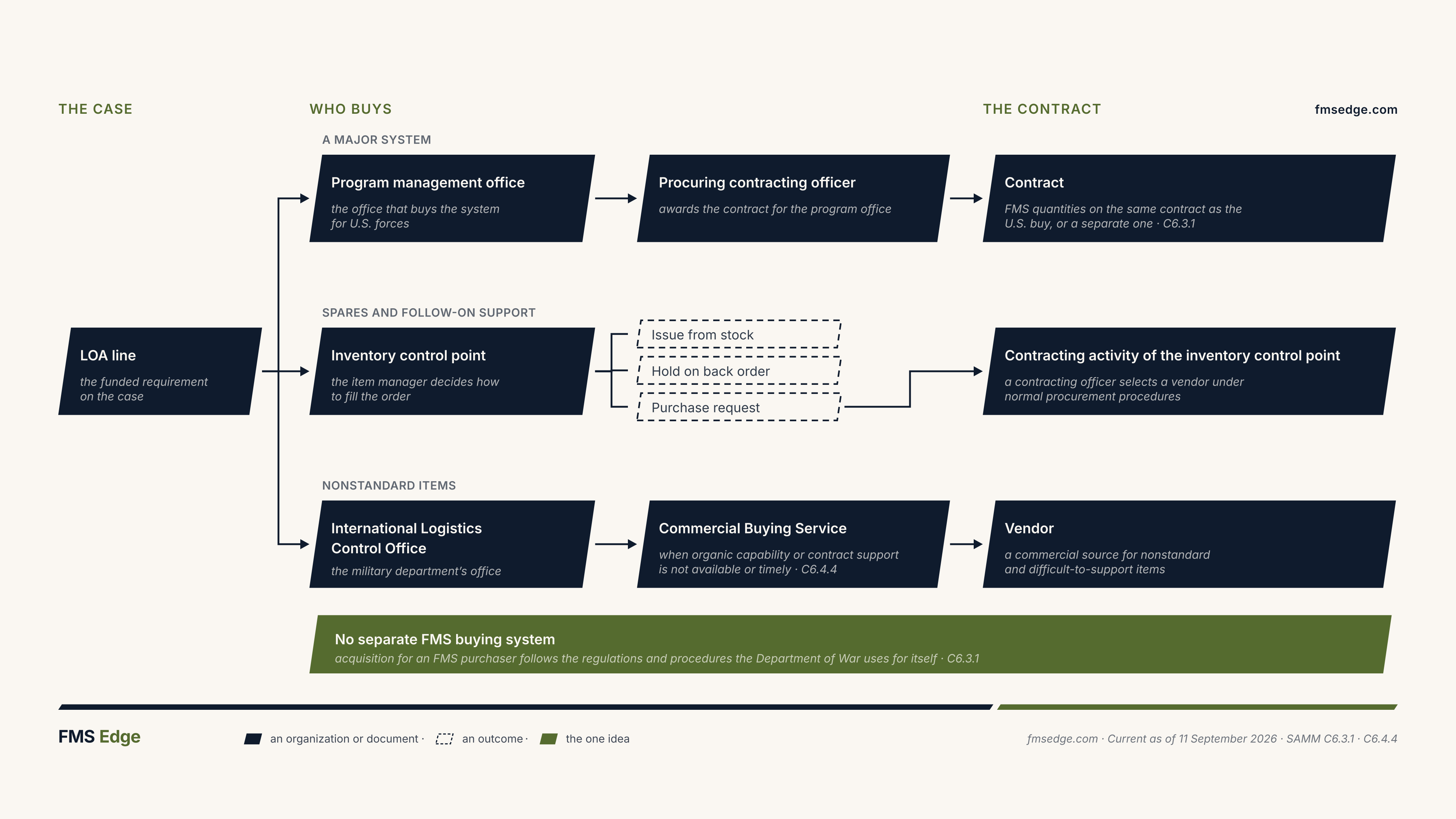
The Department of War (DoW) keeps no separate buying system for . Where the DoW buys an item for U.S. forces, the same organization buys it for the purchaser, under the same regulations and procedures. A program management office buys a major , an buys spares and follow-on support, and, for nonstandard items, the may use a commercial buying service.
The Department of War buys what a Foreign Military Sales case orders through the organization that buys the same kind of item for U.S. forces. There is no separate FMS buying system.
Does the Department of War keep a separate buying system for Foreign Military Sales?
The Department of War (DoW) does not maintain a separate acquisition infrastructure solely for . Rather, the DoW supports by exercising the same acquisition infrastructure already established to support its own requirements. The DoW organizations with acquisition responsibility for the required items or services perform the -related acquisition activities in addition to their other DoW workloads. This means that the same organizations that procure the same or similar type item or service for the DoW will also be procuring in support of .
Acquisition for purchasers must follow DoW regulations and other applicable U.S. Government procedures. This gives the foreign purchaser the same protections and benefits as DoW procurement, and it is one of the main reasons foreign governments and international organizations prefer to buy through channels. requirements may be consolidated with U.S. Government requirements or placed on a separate contract, whichever is more expedient and cost effective. The provisions that apply to the DoW also apply to procurements, and Table C6.T1 lists selected sections with a unique application to [SAMM ].
The permits from both DoW stocks and by DoW contracting to procure the materiel or services from industry for the international partner [SAMM ]. Generally, DoW inventory levels are established to support the DoW’s own operations and to provide a contingency reserve of materiel. Under normal circumstances, the Implementing Agencies meet the requirements of a from production, first in, first out. To meet a high-priority requirement, items may be diverted from production or from U.S. forces, but a diversion or withdrawal must not significantly reduce the readiness of U.S. forces, as the DoW Component determines [SAMM ]. As a result, it may be necessary for the DoW to procure the required item by contracting with industry, rather than supplying the item from stock.
In addition, the Secretary of War determines whether the DoW provides items on an expedited basis and whether the impact on readiness is significant [SAMM ]. A sale that could have a significant adverse effect on the combat readiness of U.S. forces requires a report by the President to Congress [SAMM ].
The Defense Supplement () implements the within the DoW and supplements it to meet the DoW’s specific needs. Each of the Military Departments () and their subordinate commands have, in turn, issued further supplements to the , to aid contracting personnel in implementing the and . Under the , an agency acquisition regulation does not unnecessarily restate material in the or a higher-level agency acquisition regulation, and, except as required by law or as provided in Subpart 1.4, it is not inconsistent with the .
201.104 states that the and the also apply to purchases and contracts by DoW contracting activities made in support of []. All and clauses apply to procurements [SAMM ].
Who buys a major system for a partner?
The Program Management (PM) office that oversees the DoW acquisition of a major also supports the partner’s acquisition of it, and the supporting that office awards the contract. The system PM office may acquire quantities either as individual procurements or by consolidating requirements with the DoW’s requirements on the same U.S. contract [SAMM ]. The is the official with authority to enter into the contract on behalf of the U.S. Government (), supported by the PM office team in establishing criteria, evaluating offers, and negotiating the terms and pricing of the contract.
For major weapon systems, the establish PM offices responsible for the following:
- Developing and acquiring the initial system
- Managing all technical aspects of the systems delivered to U.S. forces
- Procuring any additional quantities for the DoW
- Engineering improved or modified configurations
An Integrated Product Team (IPT) typically consists of a program manager, supported by personnel from several functional disciplines (program management, engineering, testing, contracting, logistics, and financial management).
In order to accomplish successful program execution, major system sales may require program office services beyond those provided by the Administrative Surcharge. Additional management services will be funded by a well-defined services line on the . The tailored line item note for each services line must describe exactly what services will be provided and how long they will be performed [SAMM , ].
Who buys spares and follow-on support?
For standard follow-on support, the same DoW functional organizations that purchase the respective item for the DoW will also be responsible for purchases. requirements from the will be routed to the applicable DoW managing the item for the DoW. assign an the responsibility of managing inventory levels for a range of specific standard items.
The IM responsible for the requisitioned item will decide whether the order should be supported from on-hand stock, held on back order for support from materiel due into stock, or placed on a purchase request (PR) for procurement. If procurement is required, the IM will initiate a PR identifying items to be procured and the appropriate funding source to finance the procurement [SAMM , ]. The PR, containing a fund cite from the applicable , will be routed to the ’s . A will follow normal DoW procurement processes to select a vendor and award a contract to fulfill the requirement.
Manpower for this case-related work is funded from the Administrative Surcharge or from case lines [SAMM ].
Who buys items the Department of War does not manage?
A ’s may buy nonstandard and difficult-to-support standard items through a Commercial Buying Service () when DoW organic capability or contract support is not available or timely [SAMM ]. The existing options include the Parts and Repair Ordering System () and the [SAMM ].
When a system is to be phased out of the DoW inventory, the countries that bought it under are given the opportunity to determine their item requirements and place final orders to maintain the system through its service life. These final orders are consolidated so that the buys are economic [SAMM ].
DoW policy is to take reasonable steps to support systems that U.S. forces no longer use, when mutually satisfactory arrangements are made with the international partner and supply sources are available [SAMM ].
When the DoW stops using a system, some of its components may move from standard to nonstandard items. For a soon to be obsolete to U.S. forces and not supported under a Supply Support Arrangement (), the responsible and the Defense Logistics Agency () identify the purchasers that have the system. The and advise those purchasers of its phase-out. The purchaser should have a minimum of two years to place a final order for secondary items to support the system for its remaining useful life [SAMM ].
After that minimum period, the following are authorized:
- Items that have had no demand for four years, counting the period, may be processed for disposal [SAMM ]
- Items that had demand during the same period may be kept and managed in support of requirements [SAMM ]
Nonstandard requirements are, by definition, items not actively managed in the DoW supply system for U.S. forces. Nonstandard requirements have historically been difficult to support, since no supporting management or acquisition infrastructure exists within the DoW.
References
SAMM
- SAMM C4.4.1: Source of Supply.
- SAMM C6.4.6.1: Operational Readiness Impact.
- SAMM C6.4.6.1.4
- SAMM C6.4.6.1.3: Report to Congress - Diversions.
- SAMM C9.4.2.3: Foreign Military Sales Program Management Services.
- SAMM C9.4.2.3.1: Cases “Accepted” After August 1, 2006.
- SAMM C6.4.3.1: Standard Requisitions.
- SAMM C6.4.3.1.3
- SAMM C9.4.2.5: Manpower Funding Sources.
- SAMM C4.4.3.1
- SAMM C4.4.3.2
- SAMM C6.4.7.1
- SAMM C6.4.7.2
- SAMM C6.3.1: Compliance with Department of War Regulations and Procedures.
- SAMM C6.4.4: Commercial Buying Service.
- SAMM C6.4.7: System Support Buyout.
Public authorities
- DFARS 201.104: Defense Federal Acquisition Regulation Supplement 201.104, Applicability
Facts referenced
- Minimum period a purchaser should have to place a final order for secondary items in a system support buyout, once the MILDEP and DLA advise it of the system's phase-out: two years (as of 26 October 2026; SAMM C6.4.7)
- Period without demand, counting the buyout period, after which an item in a system support buyout may be processed for disposal: four years (as of 26 October 2026; SAMM C6.4.7.1)
Related
Foreign Military Sales (FMS)
The part of U.S. security assistance, authorized by the Arms Export Control Act (AECA), in which eligible foreign governments and international organizations buy defense articles, services and training from the U.S. Government under formal government-to-government agreements.
The articles come either from Department of War stocks or from new procurement under contracts the Department manages [22 U.S.C. 2761, 22 U.S.C. 2762]. A sale is FMS whatever the source of the purchaser's financing.
FMS Edge glossary, as of 10 October 2026
Glossary entry →Open the manual’s entry → (opens in new tab)
FMS: Foreign Military Sale
SAMM Acronyms, as of 12 September 2026
Weapon System
A combination of one or more weapons with all related equipment, materials, services, personnel, and means of delivery and deployment (if applicable) required for self-sufficiency.
SAMM Glossary, as of 12 September 2026
Glossary entry →Open the manual’s entry → (opens in new tab)
Inventory Control Point (ICP)
The organization within a Department of War supply system that manages a group of items for one Military Service or for the whole Department, computing requirements, starting procurement or disposal actions, managing distribution and directing rebuild.
The inventory control point that processes a standard requisition generally issues the assets down to the item's reorder point level [SAMM C6.4.3.1].
FMS Edge glossary, as of 10 October 2026
Glossary entry →Open the manual’s entry → (opens in new tab)
Military Department (MILDEP)
One of the departments within the DoD created by the National Security Act of 1947, as amended. The Military Departments are: the Department of the Air Force, the Department of the Army, and the Department of the Navy.
SAMM Glossary, as of 12 September 2026
Glossary entry →Open the manual’s entry → (opens in new tab)
Federal Acquisition Regulation (FAR)
The FAR is the primary regulation for use by federal executive agencies for the acquisition of supplies and services with appropriated funds. The document, published in 1984, consolidated the major procurement regulations of various departments and agencies. The intent of the FAR is to standardize the content, decrease the volume of documents, and to achieve consistency throughout government. The principal agencies involved in putting together the FAR were DoD, the General Services Administration, and the National Aeronautics and Space Administration, the three largest buyers. The FAR is broader than just contracting and applies to all goods and services. It directs the defense program manager in many ways, including contract award procedures, acquisition planning, warranties, and establishing guidelines for competition. Besides the FAR, each agency has its supplement to describe its own particular way of doing business. The DoD supplement is called Defense FAR Supplement.
SAMM Glossary, as of 12 September 2026
Glossary entry →Open the manual’s entry → (opens in new tab)
Arms Export Control Act (AECA)
The basic U.S. law providing the authority and general rules for the conduct of Foreign Military Sales and commercial sales of defense articles, defense services, and training. The Arms Export Control Act (AECA) came into existence with the passage of the Foreign Military Sales Act (FMSA) of 1968. An amendment in the International Security Assistance and AECA of 1976 changed the name of FMSA to the AECA.
SAMM Glossary, as of 12 September 2026
Glossary entry →Open the manual’s entry → (opens in new tab)
Letter of Offer and Acceptance (LOA)
The legal instrument that lists the defense articles and services, including training, that the U.S. Government transfers to a foreign country or international organization, with their estimated costs and the terms and conditions. The benefitting partner does not sign a Building Partner Capacity (BPC) LOA.
The Letter of Offer and Acceptance (LOA) is the instrument the U.S. Government uses to sell under the Arms Export Control Act (AECA); signed LOAs and their later Amendments and Modifications are also called Foreign Military Sales (FMS) cases [SAMM C5.6.1].
FMS Edge glossary, as of 10 October 2026
Glossary entry →Open the manual’s entry → (opens in new tab)
DFARS: Defense Federal Acquisition Regulation Supplement
SAMM Acronyms, as of 12 September 2026
Procuring Contracting Officer (PCO)
The individual authorized to enter into contracts for supplies and services on behalf of the government by detailed bids or negotiations and who is responsible for overall procurement under such contracts.
SAMM Glossary, as of 12 September 2026
Glossary entry →Open the manual’s entry → (opens in new tab)
Source Selection
The process wherein the requirements, facts, recommendations, and government policy relevant to an award decision in a competitive procurement of a system/project are examined and the decision made.
SAMM Glossary, as of 12 September 2026
Glossary entry →Open the manual’s entry → (opens in new tab)
LOA: Letter of Offer and Acceptance
SAMM Acronyms, as of 12 September 2026
ICP: Inventory Control Point
SAMM Acronyms, as of 12 September 2026
Item Manager (IM)
An individual within the organization of an inventory control point or other such organization assigned management responsibility for one or more specific items of materiel.
SAMM Glossary, as of 12 September 2026
Glossary entry →Open the manual’s entry → (opens in new tab)
Contracting Activity
Each service designates certain commands as contracting activities. The subordinate command is that in which a principal contracting office is located. It may include the program office, related functional support offices, and contracting offices. Defense Finance Acquisition Regulation Supplement 202.101 lists the contracting activities. The Head of the contracting activity has certain approval and authority responsibilities.
SAMM Glossary, as of 12 September 2026
Glossary entry →Open the manual’s entry → (opens in new tab)
International Logistics Control Office (ILCO)
The office in each Military Department that manages the logistics support programs and transactions of Foreign Military Sales (FMS) and other security cooperation programs, and the central point in the continental United States for monitoring purchasers' requisitions.
A purchaser reports a valid supply discrepancy to the International Logistics Control Office (ILCO) of the Military Department concerned [SAMM C2.1.5.4.3].
FMS Edge glossary, as of 10 October 2026
Glossary entry →Open the manual’s entry → (opens in new tab)
Simplified Non-Standard Acquisition Program (SNAP)
U.S. Army Security Assistance Command's logistics program that provides an accelerated acquisition process for Foreign Military Sales partners to obtain non-standard items such as obsolete or unique items not available through the U.S. Army supply channels using Simplified Acquisition Procedures.
SAMM Glossary, as of 12 September 2026
Glossary entry →Open the manual’s entry → (opens in new tab)
Cooperative Logistics
The logistics support provided a foreign government/agency through its participation in a U.S. DoD logistics system, with reimbursement paid to the USG for the support provided.
SAMM Glossary, as of 12 September 2026
Glossary entry →Open the manual’s entry → (opens in new tab)
CLSSA: Cooperative Logistics Supply Support Arrangement
SAMM Acronyms, as of 12 September 2026
Glossary entry →Cooperative Logistics Supply Support Arrangements (CLSSA) →
Defense Logistics Agency
The Department of War agency that is the item manager for consumable, stock-funded secondary items. Its supply centers work with the military departments to fill Foreign Military Sales (FMS) requisitions, process supply discrepancy reports and repair and return items, and close cases when supply is complete, and it prepares FMS cases for cataloging services and excess defense articles [SAMM C1.3.2.6.2.3.2].
FMS Edge glossary, as of 10 October 2026
System Support Buyout
An opportunity for international partners to make a final purchase of major items and associated spares and support equipment of a major system that is being terminated in the DoD inventory, prior to the contracts or production being discontinued.
SAMM Glossary, as of 12 September 2026
Glossary entry →Open the manual’s entry → (opens in new tab)
Security Assistance (SA)
A group of programs authorized by federal statutes by which the United States provides defense articles, military training, and other defense-related services by grant, lease, loan, credit, or cash sales in furtherance of national policies and objectives, and those that are funded and authorized through the Department of State to be administered by Department of Defense/Defense Security Cooperation Agency, which are considered part of security cooperation.
SAMM Glossary, as of 12 September 2026
Glossary entry →Open the manual’s entry → (opens in new tab)
SAMM C6.3.1: Compliance with Department of War Regulations and Procedures.
“Acquisition for Foreign Military Sales (FMS) purchasers must be in accordance with DoW regulations and other applicable USG procedures. This affords the foreign purchaser the same benefits and protection that apply to DoW procurement and is one of the principal reasons why foreign governments and international organizations prefer to procure through FMS channels. FMS requirements may be consolidated with USG …”
Security Assistance Management Manual, as of 26 October 2026
SAMM C4.4.1: Source of Supply.
“Defense articles or services may be sold from DoW stocks, or the DoW may enter into contracts to procure defense articles or services on behalf of eligible foreign countries or international organizations. DoW procurements for FMS use standard Federal Acquisition Regulation (FAR) contract clauses and contract administration practices except where deviations for FMS are authorized in the Defense Federal Acquisition …”
Security Assistance Management Manual, as of 26 October 2026
SAMM C6.4.6.1: Operational Readiness Impact.
“Under normal circumstances, IAs fill FMS requirements from production on a first-in, first-out basis. National security considerations and foreign policy objectives may require deviation from this DoW policy in order to expedite equipment delivery to a purchaser. Items may be diverted from production or from U.S. Forces to meet high priority FMS requirements. While the language of 10 U.S.C. 2390 …”
Security Assistance Management Manual, as of 26 October 2026
SAMM C6.4.6.1.4
“The SECWAR determines whether DoW provides items on an expedited basis and whether the impact of doing so is significant within the meaning of AECA, Section 21(i) (22 U.S.C. 2761(i)).”
Security Assistance Management Manual, as of 26 October 2026
SAMM C6.4.6.1.3: Report to Congress - Diversions.
“The AECA requires a report by the President to Congress when a sale could have significant adverse effect on the combat readiness of the U.S. Armed Forces. There may be instances when the MILDEP Secretary determines that a proposed supply action warrants SECWAR’s review but does not constitute a significant adverse impact on DoW requiring a Presidential report to Congress. …”
Security Assistance Management Manual, as of 26 October 2026
Defense Federal Acquisition Regulation Supplement 201.104, Applicability
DFARS 201.104 · Regulation
SAMM C9.4.2.3: Foreign Military Sales Program Management Services.
“The Implementing Agency (IA) may determine that USG program management services are necessary for successful program implementation and execution in accordance with the Foreign Military Sales Case-Related Manpower Functions and Funding Source Matrix in Table C9.T2A.”
Security Assistance Management Manual, as of 11 September 2026
SAMM C9.4.2.3.1: Cases “Accepted” After August 1, 2006.
“For LOAs or case line items “accepted” after August 1, 2006, any program management services will be included on well-defined, services line items on the case. The tailored line item description note for each of these line items must include details describing exactly what services will be provided and the length of time they will be performed.”
Security Assistance Management Manual, as of 11 September 2026
SAMM C6.4.3.1: Standard Requisitions.
“For standard requisitions (requisitions that are not associated with Cooperative Logistics Supply Support Arrangements (CLSSAs)), the Inventory Control Point (ICP) processing the requisition generally issues the assets down to the item’s reorder point level. To the extent authorized by the Type of Assistance (TA) and Source of Supply (SOS) codes assigned to the LOA line item, requirements that cannot be …”
Security Assistance Management Manual, as of 26 October 2026
SAMM C6.4.3.1.3
“The item manager may initiate an immediate procurement action.”
Security Assistance Management Manual, as of 26 October 2026
SAMM C9.4.2.5: Manpower Funding Sources.
“Manpower for FMS case-related programs is funded from one of two sources: the FMS Administrative Surcharge or FMS case lines. See Table C9.T2A. for a description of case-related manpower functions and how each function should be funded. Manpower for Title 10 funded BPC case-related programs is funded from one of three sources: Title 10 funded BPC Program Support Costs, Performing …”
Security Assistance Management Manual, as of 11 September 2026
SAMM C6.4.4: Commercial Buying Service.
“The International Logistics Control Office (ILCO) is authorized to use a Commercial Buying Service (CBS) to support FMS purchaser requirements for nonstandard and difficult to support standard items when DoW organic capability or contractual supportability is not available or timely. Existing CBS options include Parts and Repair Ordering System (PROS) and Simplified Non-Standard Acquisition Program (SNAP).”
Security Assistance Management Manual, as of 26 October 2026
SAMM C4.4.3.1
“When a system is to be phased out of the DoW inventory, countries that have acquired the system under FMS are given the opportunity to determine item requirements and to place final orders designed to maintain system capability through its service life. These orders are consolidated to ensure economic buys. See Section C6.4.7.”
Security Assistance Management Manual, as of 26 October 2026
SAMM C4.4.3.2
“DoW will take reasonable steps to support systems that are not used by U.S. Forces including items that were never adopted by U.S. Forces. Support is provided for these items when mutually satisfactory arrangements are made with the country involved and supply sources are available. Effort is made to support non-standard items, whether acquired commercially or through FMS, when this …”
Security Assistance Management Manual, as of 26 October 2026
SAMM C6.4.7: System Support Buyout.
“For weapons systems soon to be obsolete to U.S. Forces and not supported under a CLSSA, the responsible MILDEP must identify the unique and common items associated with the system to DLA and provide the close out date for U.S. use of the item. The MILDEP and DLA identify purchasers that have this system and associated unique spare parts and …”
Security Assistance Management Manual, as of 26 October 2026
SAMM C6.4.7.1
“Items with no demand for four years, including the system support buyout period, may be processed for disposal.”
Security Assistance Management Manual, as of 26 October 2026
SAMM C6.4.7.2
“Items with demand during the four-year period may be retained and managed in support of SA requirements.”
Security Assistance Management Manual, as of 26 October 2026