
Guide
Freight forwarder or Defense Transportation System: how does a Foreign Military Sales purchaser ship its materiel?
The purchaser is responsible for moving its own materiel and typically hires a , a private firm under contract to the purchaser that receives, consolidates and stages the materiel in the United States and ships it onward. The purchaser can instead pay to use the , and some materiel, such as explosives and some classified items, moves through it as a rule.
Two typical paths, not the only ones: the purchaser chooses how its materiel moves. Through its own freight forwarder, the Department of War either ships to the forwarder (Delivery Term Code 5) or moves nothing (code 4); through the Defense Transportation System it carries the shipment to the port, the overseas port or the destination (codes 8, 9 and 7). The olive marks show where the purchaser or its agent takes custody. The Implementing Agency assigns each LOA line's code during case development and changes it by amendment as required.
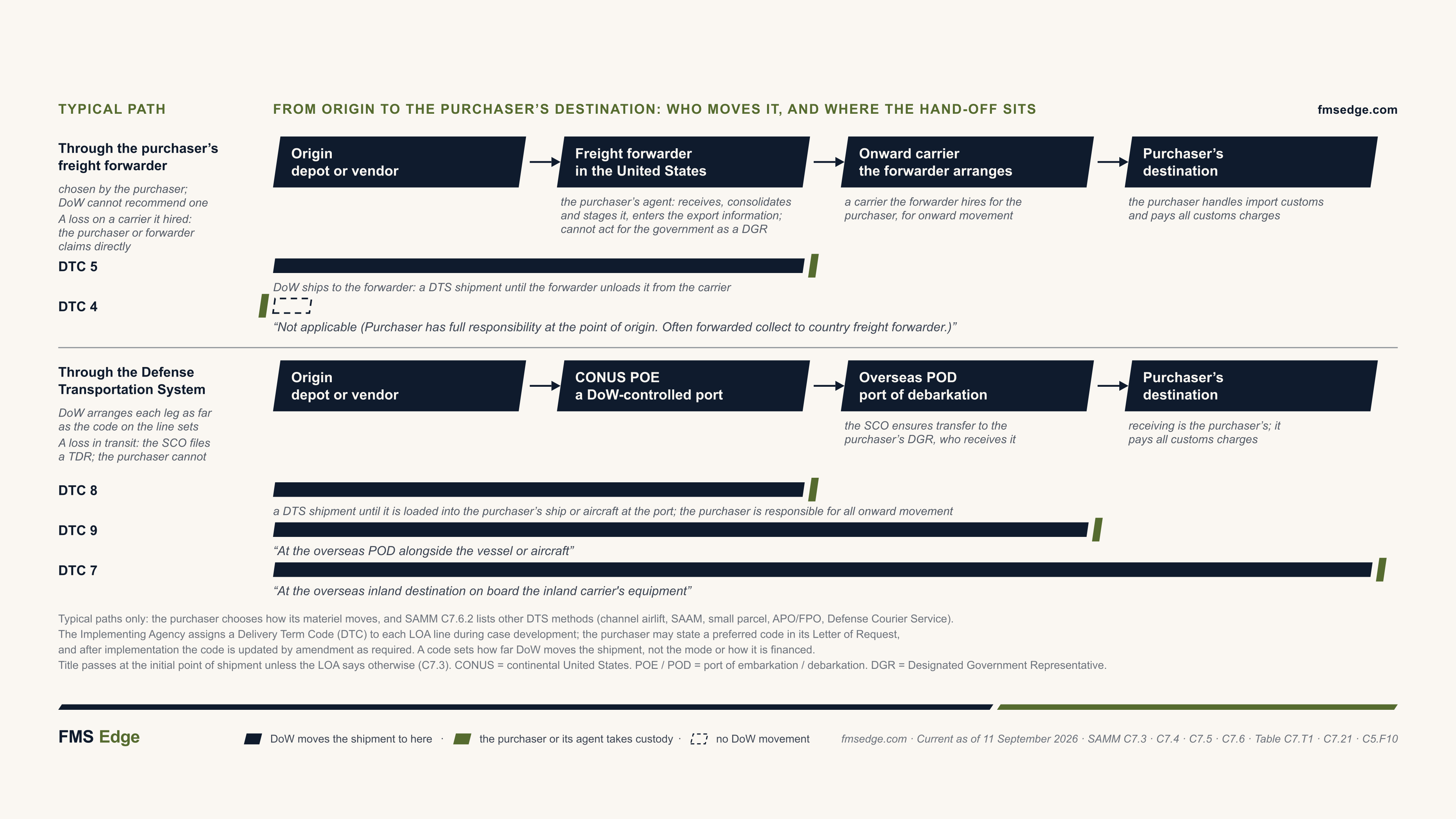
Should a Foreign Military Sales purchaser use a freight forwarder or the Defense Transportation System?
Historically, transportation policy has been a policy of purchaser self-sufficiency whereby each purchaser is normally responsible for the transportation and delivery of its own materiel. In the application of this policy, and within the framework of U.S. laws, regulations, and policies, the purchaser typically employs an agent, such as a . The manages transportation and delivery from the ’s facility in the U.S. to the purchaser’s desired destination.
The Defense Transportation System
The DoW encourages customers to make a best value movement decision in the shipment of their materiel. All transportation arrangements from the point of origin should be made by the customer, however, the DoW recognizes that not all customers have the resources to perform their own transportation or to hire their own . Additionally, not all categories of materiel are eligible to be transported through commercial channels. For these reasons, the DoW arranges transportation for the customer using the .
The prime movers within the are the Service Components of the U.S. Transportation Command (USTRANSCOM): the Air Mobility Command (), the U.S. Army Transportation Command () and the Military Sealift Command (). The manages DoW air terminals and the onward movement of cargo and passengers booked on military airlift. The provides worldwide ocean transportation for the DoW. arranges surface movement within the , and vessels it charters are part of the .
When materiel is shipped through the , the customer is charged for the cost of transportation.
Generally, firearms, explosives, lethal chemicals, other hazardous materiel, and, occasionally, classified materiels, are moved within the or other -arranged transportation on a /GBL to the . The onward movement of these items will be by purchaser-owned or controlled aircraft or purchaser-owned, operated, or controlled surface vessels. materiel, which requires exceptional movement procedures, such as sensitive and certain hazardous materiel as defined in 4500.9-R, Defense Transportation Regulation () Volume 2, part II, “Cargo Movement,” will be shipped through water or aerial port facilities controlled by the DoW. Air cargo that exceeds commercial capability can also be delivered through .
Freight forwarders
The purchaser is responsible for transporting its own -furnished materiel beyond the point of delivery its sets, which is often the U.S. . The purchaser may choose to hire a commercial to arrange for the receipt, processing, export, and import of materiel. The purchaser must clearly define his requirements in a contract with the . do not participate in contract negotiations between a country and a .
Purchasing countries are encouraged to hire a commercial because freight forwarders can provide transportation services for routine cargo that are faster and less expensive than the . The is a private firm under contract to the customer to receive, consolidate, and stage materiel within the U.S. and arrange for its onward movement. As such, the ’s responsibilities must be specified in the contract.
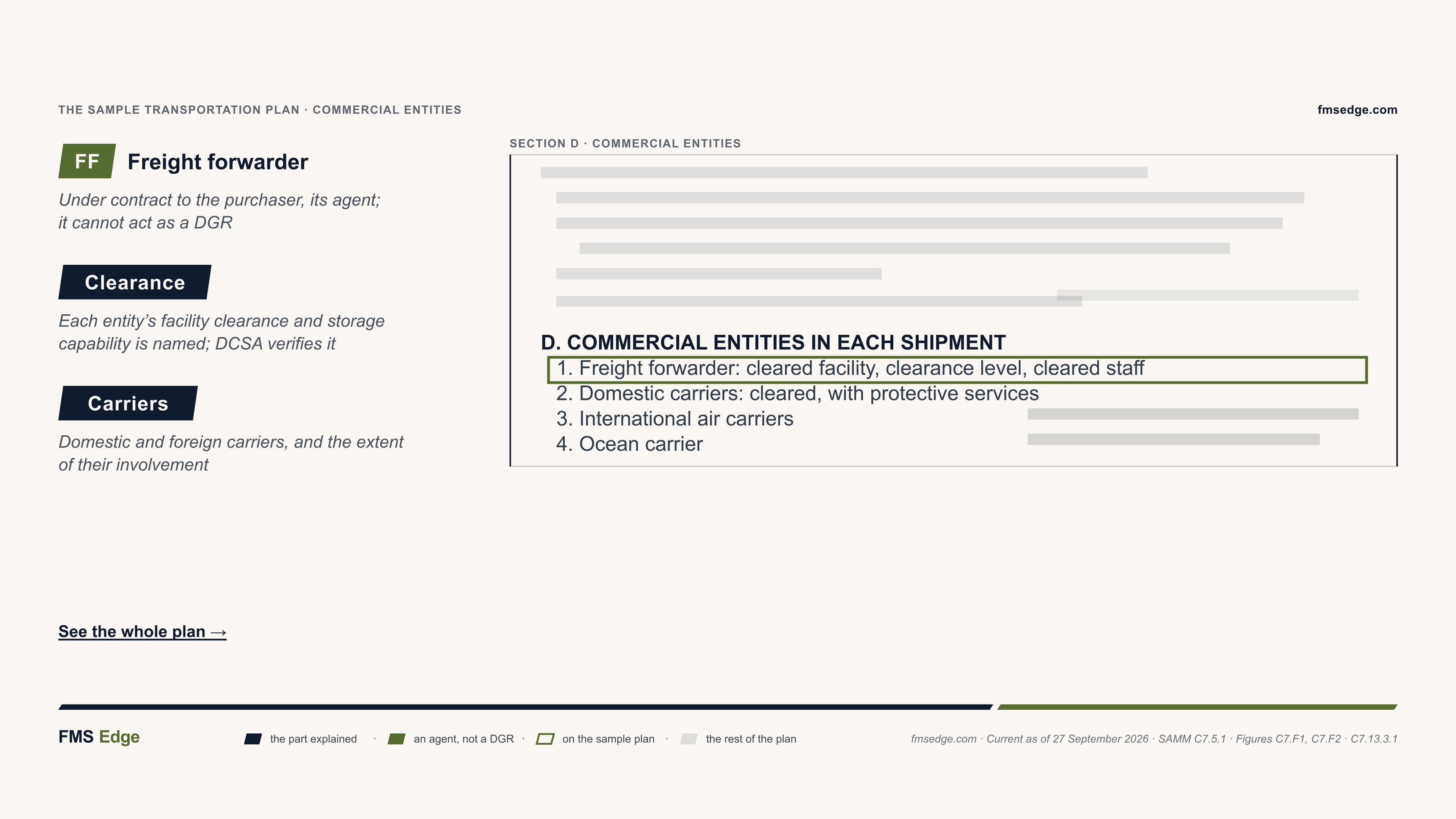
The commercial entities on the sample Transportation Plan for a classified and sensitive shipment. Bandaria is the manual's fictional training country; the figure is a training example, not a real case. The plan names the freight forwarder and each carrier with its security clearance; the freight forwarder is the purchaser's agent, not its government representative.
References
SAMM
- SAMM C7.1.1
- SAMM C7.12.1 — Defense Transportation System Costs.
- SAMM C7.6.1 — Definition.
- SAMM C7.5.1 — Definition.
- SAMM C7.5.2 — Selection of a Foreign Military Sales Freight Forwarder.
- SAMM C7.5.3.1
- SAMM C7.5.3.2
- SAMM C7.6.2.1 — Military (Organic).
Related
Foreign Military Sales (FMS)
A process, authorized by the Arms Export Control Act, through which eligible foreign governments and international organizations may purchase defense articles, services, and training from the United States Government.
SAMM Glossary, as of 12 September 2026
Glossary entry →Open the manual’s entry → (opens in new tab)
Freight Forwarder
A commercial import/export company registered with the Department of State, Bureau of Political-Military Affairs, Directorate of Defense Trade Controls and under contract to the Foreign Military Sales customer which arranges transportation of materiel from a point specified in the Letter of Offer and Acceptance to the final destination.
SAMM Glossary, as of 12 September 2026
Glossary entry →Open the manual’s entry → (opens in new tab)
Defense Transportation System (DTS)
The portion of the worldwide transportation infrastructure that supports DoD transportation needs in peace and war. DTS consists of two major elements: military and commercial resources. These resources include aircraft, assets, services, and systems organic to, contracted for, or controlled by the DoD. DoD's infrastructure, including ports, airlift, sealift, railway, highway, in-transit visibility, information management systems, customs, and traffic management that the DoD maintains and exercises in peacetime, is a vital element of the DoD's capability to project power worldwide. It provides for responsive force projection and a seamless transition between peacetime and wartime operations.
SAMM Glossary, as of 12 September 2026
Glossary entry →Open the manual’s entry → (opens in new tab)
FMS — Foreign Military Sale
SAMM Acronyms, as of 12 September 2026
Continental United States (CONUS)
U.S. territory, including the adjacent territorial waters, located within the North American continent between Canada and Mexico. Does not include Hawaii or Alaska.
SAMM Glossary, as of 12 September 2026
Glossary entry →Open the manual’s entry → (opens in new tab)
Security Cooperation
Activities undertaken by the DoD to encourage and enable international partners to work with the United States to achieve strategic objectives. It includes all DoD interactions with foreign defense and security establishments, including all DoD-administered security assistance programs, that: build defense and security relationships that promote specific U.S. security interests, including all international armaments cooperation activities and security assistance activities; develop allied and friendly military capabilities for self-defense and multinational operations; and provide U.S. forces with peacetime and contingency access to host nations.
SAMM Glossary, as of 12 September 2026
Glossary entry →Open the manual’s entry → (opens in new tab)
Building Partner Capacity (BPC) Programs
Security cooperation and security assistance activities funded with USG appropriations (not including Foreign Military Sales Credit and Military Assistance Program/Merger).
SAMM Glossary, as of 12 September 2026
Glossary entry →Open the manual’s entry → (opens in new tab)
DTS — Defense Transportation System
SAMM Acronyms, as of 12 September 2026
ARTRANS — United States Army Transportation Command
SAMM Acronyms, as of 12 September 2026
Letter of Offer and Acceptance (LOA)
The legal instrument used by the USG to transfer itemized defense articles, defense services, and design and construction services to foreign partners.
When used under the authorities provided in the Arms Export Control Act for Foreign Military Sales, the LOA is a binding agreement signed by the USG and the foreign partner to transfer such articles and services.
When used under Building Partnership Capacity (BPC) authorities, the BPC LOA is not signed by the Benefitting Partner.
SAMM Glossary, as of 12 September 2026
Glossary entry →Open the manual’s entry → (opens in new tab)
Delivery Term Code (DTC)
A single character code that represents how far the USG is responsible for arranging transportation of defense articles going to an international customer.
SAMM Glossary, as of 12 September 2026
Glossary entry →Open the manual’s entry → (opens in new tab)
LOA — Letter of Offer and Acceptance
SAMM Acronyms, as of 12 September 2026
Foreign Military Sales (FMS) Trust Fund
A single account that is authorized to be credited with receipts that may be obligated and expended in accordance with the Arms Export Control Act (AECA). Foreign Military Sales (FMS) Trust Fund receipts must be apportioned prior to obligation and expenditure; however, an official, designated under 31 U.S.C. 1513 (as per 31 U.S.C. 1516), may exempt trust funds from apportionment. The FMS Trust Fund is managed as a single cash entity, regardless of the source of the deposits. All FMS Trust Fund deposits are accounted for at purchaser and FMS case level by source of financing. Examples of funds include Foreign Military Financing (FMF) (FMS Credit and FMS Credit (nonrepayable)) and the Military Assistance Program (MAP) Merger. Examples of other types of funds are a purchaser's national funds, which include third-party funds, and other DoD appropriated funds.
SAMM Glossary, as of 12 September 2026
Glossary entry →Open the manual’s entry → (opens in new tab)
Cost Clearing Account
An account used when standard rates are employed. The actual expenses are debited to the cost clearing account and the amounts billed to customers are credited to the account. At the end of the fiscal year, the account is closed with analysis performed to determine if rates require adjustment.
SAMM Glossary, as of 12 September 2026
Glossary entry →Open the manual’s entry → (opens in new tab)
Special Assignment Airlift Mission (SAAM)
A dedicated U.S. military aircraft, chartered to deliver sensitive, classified or explosive defense articles to a specific customer location when no commercial delivery capability exists.
SAMM Glossary, as of 12 September 2026
Glossary entry →Open the manual’s entry → (opens in new tab)
SAAM — Special Assignment Airlift Mission
SAMM Acronyms, as of 12 September 2026
Service Contract
A contract that calls directly for a contractor's time and effort rather than for a physical end product.
SAMM Glossary, as of 12 September 2026
Glossary entry →Open the manual’s entry → (opens in new tab)
CONUS — Continental United States
SAMM Acronyms, as of 12 September 2026
POE — Port of Embarkation
SAMM Acronyms, as of 12 September 2026
Port of Embarkation (POE)
A military or commercial air or ocean port at which a carrier begins the journey to deliver materiel to the consignee. This is also referred to as the Port of Exit.
SAMM Glossary, as of 12 September 2026
Glossary entry →Open the manual’s entry → (opens in new tab)
Security Assistance (SA)
A group of programs authorized by federal statutes by which the United States provides defense articles, military training, and other defense-related services by grant, lease, loan, credit, or cash sales in furtherance of national policies and objectives, and those that are funded and authorized through the Department of State to be administered by Department of Defense/Defense Security Cooperation Agency, which are considered part of security cooperation.
SAMM Glossary, as of 12 September 2026
Glossary entry →Open the manual’s entry → (opens in new tab)
Designated Government Representative (DGR)
A person or persons duly authorized by a foreign government to act on behalf of that government to negotiate, commit, sign contractual agreements, and/or accept delivery of materiel.
SAMM Glossary, as of 12 September 2026
Glossary entry →Open the manual’s entry → (opens in new tab)
State (PM/DDTC) — Department of State, Bureau of Political-Military Affairs, Directorate of Defense Trade Controls
SAMM Acronyms, as of 12 September 2026