
Guide
What is the U.S. embassy country team?
The is the ambassador's instrument for coordinating every U.S. agency in a partner country. The Senior Defense Official/Defense Attaché represents the Department on it and directs the , which works under the .
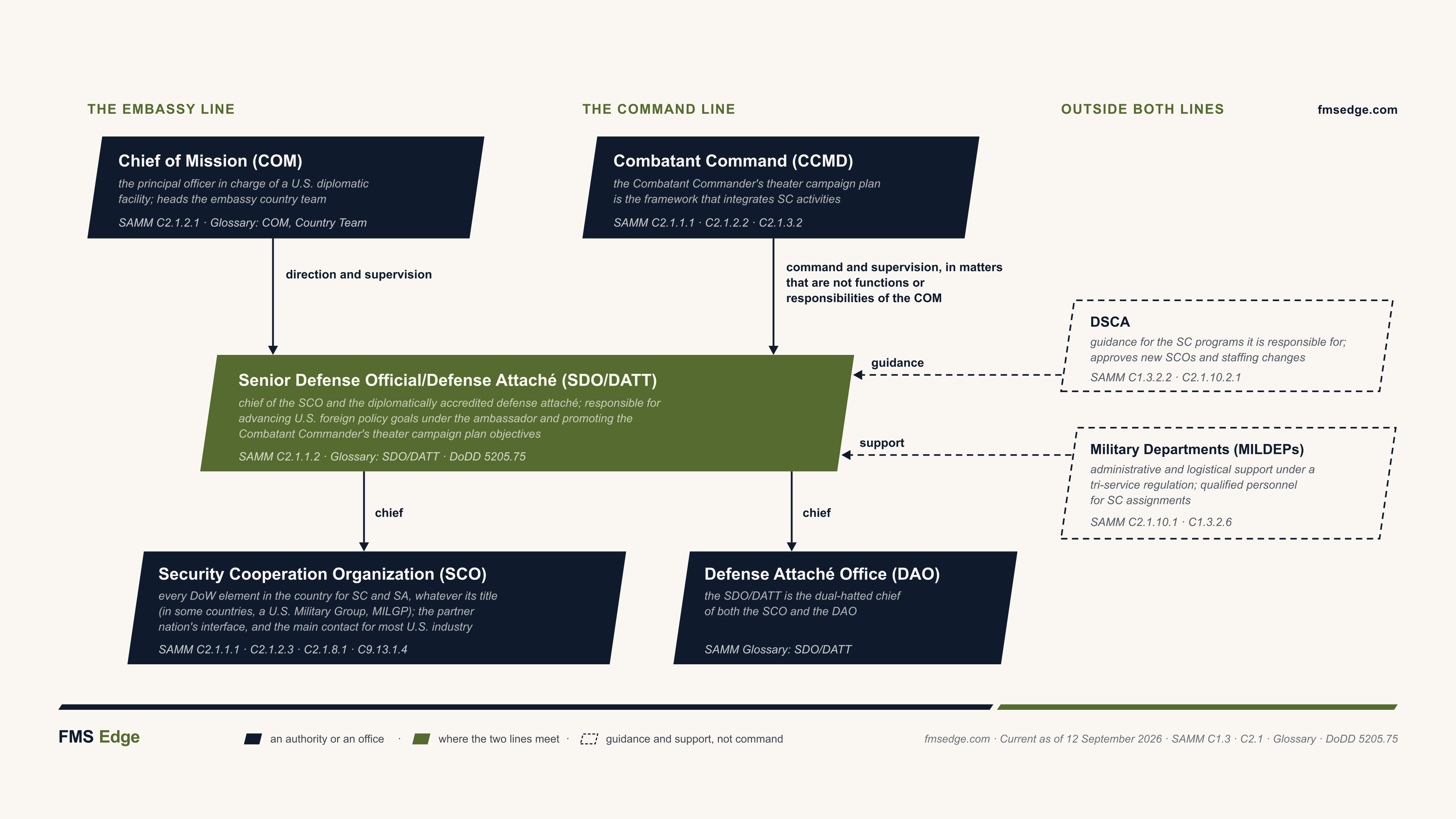
Two lines of authority reach the Security Cooperation Organization: it falls under the direction and supervision of the Chief of Mission, and under the command and supervision of the Combatant Commander in matters that are not the Chief of Mission's. Both lines meet at one desk, the Senior Defense Official/Defense Attaché, chief of both the SCO and the Defense Attaché Office. DSCA and the Military Departments reach that desk through program guidance and administrative support, outside both lines.
What is the U.S. embassy country team?
The is the principal organizational instrument used by to integrate interagency staff functions and achieve the cohesive, coordinated execution of U.S. foreign policy. In its broadest sense, the team includes all elements and all employees of the American mission in a foreign country. However, this term may also refer more narrowly to a subset of the mission and, more specifically, a select council of senior officers or heads of agencies and major sections in the mission, which meets regularly with the to provide advice, share information, and receive guidance and taskings. The has no legal standing, and its composition and functions are not specifically delineated in any formal document; instead, the determines the type of team that best suits the needs of the moment.
The U.S. ambassador, as the personal representative of the President, is the sole head of the or, in other words, the . The ambassador uses the team as a tool for assembling information, ideas, and opinions from all officials in country and to execute country-related U.S. foreign policy objectives. The entire staff must work as a cohesive unit with a common sense of purpose and direction. The ambassador, or a replacement in his/her absence, must manage and support all U.S. official interests and activities in the host country. The ambassador must consider and balance all proposed courses of action and decide what is best for American interests as a whole.
In practice, the makeup of the embassy varies widely, depending not only on the ambassador’s management style but also on the country situation, the number and type of American programs carried out in the country, and the backgrounds of the senior officers of the different agencies attached to the diplomatic mission. In some posts, there may be no defined membership; team composition may vary according to the kind of problem being considered. However, at most posts, the following positions are included on a more or less permanent basis: the Ambassador; the DCM; the chiefs of the political, economic, and management sections of the embassy; the /; the regional security officer; and the consul general. The may also include representatives from other embassy agencies as the ambassador desires.
The coordinates with and advises the on the full range of issues and events facing the U.S. mission at any given time. Informal consultation among members occurs frequently and continually on issues and problems as they arise. Weekly meetings of the team, chaired by the Ambassador, are the norm. The is also an executive body that, under the Ambassador’s leadership, divides the tasks to be done, and supervises their accomplishment. It typically sees that jobs are assigned to those agency representatives that can best execute them, based on resources and expertise. Finally, the is the planning body that analyzes the situation in the partner country, formulates plans and strategies for executing U.S. foreign policy (e.g., through an “integrated country strategy” or ICS), and recommends policy to Washington, DC. Close teamwork is critical, especially when time-sensitive issues are at stake. Officials of all agencies must work together at all levels to speak with one voice and to accomplish the tasks at hand. The formal is thus an advisory body, a forum for consultation, and a means of promoting a coordinated effort.
Quite often, will be called to participate in “modified ” meetings. These are generally held for visiting officials (e.g., congressional delegations). This is an opportunity for the to succinctly enumerate some of the recent successes and ongoing projects in country, ranging from major in progress to recently completed projects.
The / represents all of DoW on the , including the , , and the Defense Intelligence Agency (). In accordance with DODD 5205.75, the / is the ’s principal advisor on defense issues and the senior diplomatically accredited DoW military officer assigned to a U.S. diplomatic mission.
All DoW elements under authority are under the coordinating authority of the /, except for the Marine security guard detachment. Coordinating authority is the power to compel different DoW agencies and activities to keep the / informed on their activities and to consult and coordinate with one another in order to ensure the cohesive planning and execution of DoW operations. All DoW units and personnel in a foreign country who are not specifically under the command of a U.S. area military commander automatically come under authority while operating in a given country. Moreover, the / may be given special, temporary, emergency authority to act directly on behalf of the GCC during certain crises in a foreign country, especially those requiring evacuation or other force protection measures. also exercise direct and full supervisory authority over the DAO and , directing the operations of these organizations, rating and counseling personnel, etc.
Since the works for the /, it is critical that good communication and routine cooperation exist between the DAO and the . The unique role and authority of the /, in charge of both organizations, should ensure that DoW’s interests and objectives are smoothly integrated under the and effectively and efficiently coordinated with the host nation.
References
SAMM
- SAMM GLOSSARY/country-team — Country Team
- SAMM C2.1.2.1
- SAMM C2.1.1.2 — Senior Defense Official/Defense Attaché.
Related
Country Team
The senior, in-country, U.S. coordinating and supervising body, headed by the chief of the U.S. diplomatic mission, and composed of the senior member of each represented U.S. department or agency, as desired by the chief of the U.S. diplomatic mission.
SAMM Glossary, as of 12 September 2026
Glossary entry →Open the manual’s entry → (opens in new tab)
Security Cooperation Organization (SCO)
A Department of Defense element that is part of the United States Diplomatic mission located in a foreign country to carry out security assistance and security cooperation management functions under the supervision and coordination authority of the senior defense official/defense attaché.
SAMM Glossary, as of 12 September 2026
Glossary entry →Open the manual’s entry → (opens in new tab)
Chief of Mission (COM)
The principal officer in charge of a diplomatic facility of the United States, including any individual temporarily assigned to be in charge of such a facility.
SAMM Glossary, as of 12 September 2026
Glossary entry →Open the manual’s entry → (opens in new tab)
COM — Chief of Mission
SAMM Acronyms, as of 12 September 2026
Senior Defense Official (SDO) and Defense Attaché (DATT)
Principal DoD official in a U.S. embassy, as designated by the Secretary of Defense. The SDO or DATT is the Chief of Mission's principal military advisor on defense and national security issues, the senior diplomatically accredited DoD military officer assigned to a diplomatic mission, and the single point of contact for all DoD matters involving the embassy or DoD elements assigned to or working from the embassy. The SDO or DATT is considered the dual-hatted chief of both the Security Cooperation Organization and Defense Attaché Office in the embassy. This position was established by DoDD 5205.75, Department of Defense Operations at U.S. Embassies, December 21, 2007. The same document gives coordinating authority (see glossary definition) to the SDO or DATT for the purpose of ensuring that all DoD elements in a country are working in consonance with each other and under the guidance of the Chief of Mission. The SDO or DATT program replaces the now defunct U.S. Defense Representative model.
SAMM Glossary, as of 12 September 2026
Glossary entry →Open the manual’s entry → (opens in new tab)
SCO — Security Cooperation Organization
SAMM Acronyms, as of 12 September 2026
Foreign Military Sales (FMS)
A process, authorized by the Arms Export Control Act, through which eligible foreign governments and international organizations may purchase defense articles, services, and training from the United States Government.
SAMM Glossary, as of 12 September 2026
Glossary entry →Open the manual’s entry → (opens in new tab)
Humanitarian Assistance (HA)
DoD security cooperation activities with partner nation civilian government authorities, which support partner nation efforts to provide essential human services to civilian populations or to directly relieve or reduce human privation in support of national security priorities. DoD humanitarian assistance activities may be authorized under 10 U.S.C. 166a, 182, 401, 402, 404, 407, 2557, 2561, the Asia Pacific Regional Initiative, the Pacific Deterrence Initiative, the Ukraine Supplemental Appropriations Act, Presidential Drawdown Authority, certain Defense Health Programs, certain Global Health Engagements, and other DoD programs.
SAMM Glossary, as of 12 September 2026
Glossary entry →Open the manual’s entry → (opens in new tab)
Combatant Command (CCMD)
A unified or specified command with a broad continuing mission under a single commander established and so designated by the President, through the Secretary of Defense and with the advice and assistance of the Chairman of the Joint Chiefs of Staff. Also called CCMD.
SAMM Glossary, as of 12 September 2026
Glossary entry →Open the manual’s entry → (opens in new tab)
DSCA — Defense Security Cooperation Agency
SAMM Acronyms, as of 12 September 2026
Glossary entry →Defense Security Cooperation Agency (DSCA) →
SDO/DATTs — Senior Defense Official/Defense Attaché
SAMM Acronyms, as of 12 September 2026