
Guide
How is international armaments cooperation different from Foreign Military Sales?
is the U.S. Government working with other countries and international organizations to research, develop, acquire and sustain military systems, mostly in the earlier phases of a system's life cycle. normally comes later, once a system is developed and in production. Armaments cooperation answers to a different under secretary and runs on negotiated international agreements rather than Letters of Offer and Acceptance.
Foreign Military Sales usually sells a system the Department has already developed, produced and fielded, but a partner does not have to come last. A partner can pay to develop a system the United States later buys, as with the F-15SA that led to the Air Force's F-15EX and the Wedgetail the Air Force chose as its E-7; it can work with the United States through every phase under an international agreement, as Japan did on the SM-3 Block IIA; or it can buy a fielded system through FMS, paying a share of U.S. development costs. The E-7 line is current as of September 2026.
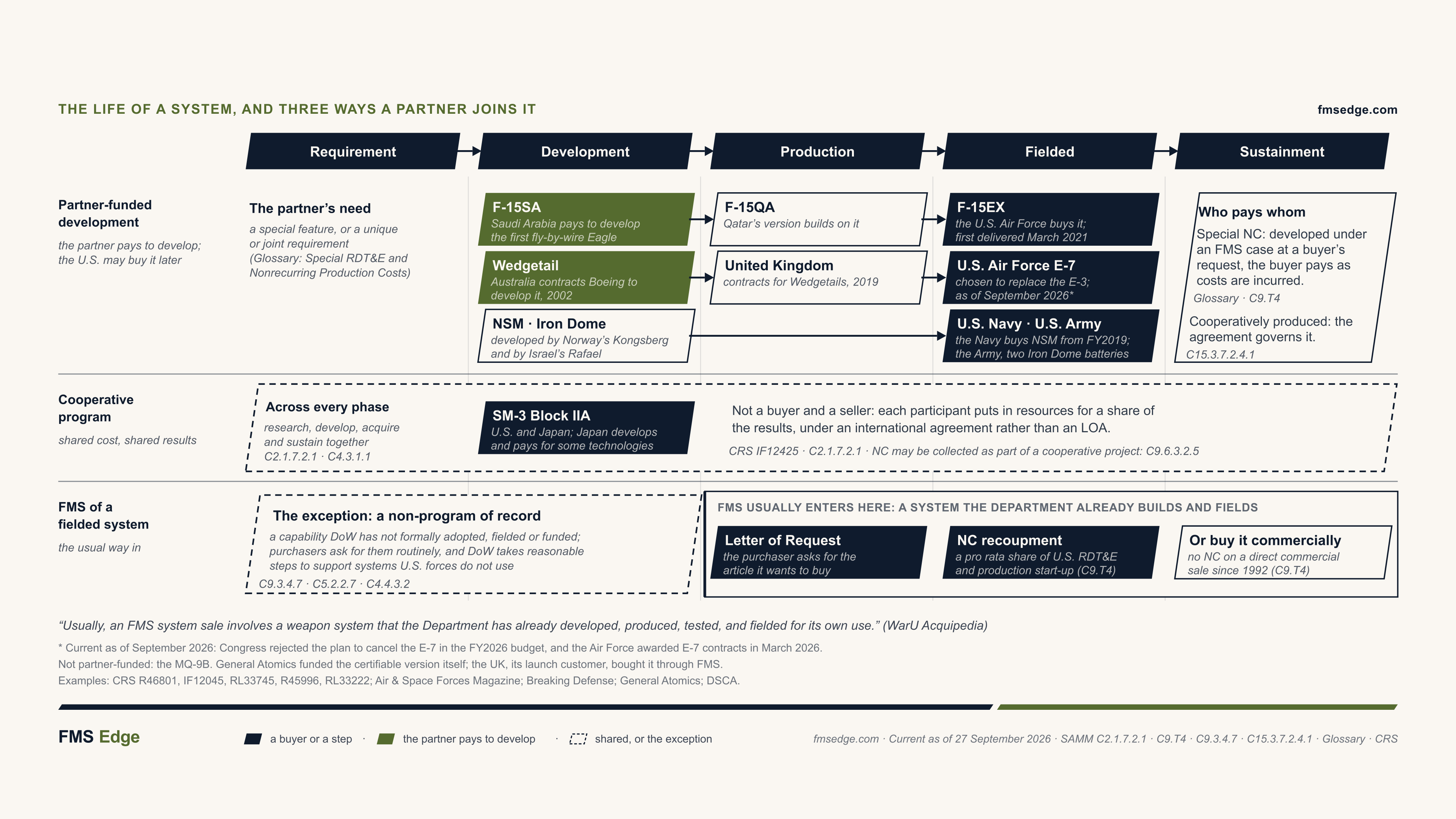
How is international armaments cooperation different from Foreign Military Sales?
When doing activities, the U.S. may work with friends and allies across the entire system acquisition life cycle. normally (unless a policy exception is approved) occurs later in the life cycle after the system has already been fully developed and placed into production. primarily represents opportunities to cooperatively work with other countries in the earlier developmental phases of a system’s life cycle.
is generally conducted with nations that have solid political and economic ties with the U.S., similar military requirements, and a reasonably robust defense, science and technology base. Although some countries may be quite important from a political, economic, or military standpoint, if they have different military requirements or lack a substantial defense , there may be little potential for successful activity.
What armaments cooperation is for
The core objectives of typically include the following:
- Operational: increase military effectiveness through interoperability and partnership with allies and coalition partners
- Economic: reduce weapons acquisition cost by sharing costs, economies of scale and avoiding duplication of development efforts with our allies and friends
- Technical: access the best defense technology worldwide and help minimize the capabilities gap with allies and coalition partners
- Political: strengthen alliances and relationships with other friendly countries
- Industrial: bolster domestic and allied defense industrial bases
Who oversees it
The established the Office of International Cooperation (IC) to oversee activities. The has a supporting role in IC by reviewing international agreements for foreign policy considerations.
Support in the partner country
In addition to the sponsored overseas offices, the DoW assigns dedicated personnel within countries that conduct a significant volume of activity with the U.S. These dedicated armaments cooperation personnel assigned overseas serve as the in-country liaison for the . They assist the host government obtain information on U.S. equipment and programs as well as help DoW acquisition organizations obtain information on host nation equipment, requirements and programs in support of . This function extends to assisting industry in gaining access to the other nation’s defense markets and in developing cooperative programs.
International agreements instead of Letters of Offer and Acceptance
/IC programs use international agreements as the official government-to-government document rather than Letters of Offer and Acceptance (). Under one or more of the /IC authorities, the U.S. and one or more countries are agreeing to cooperate in research, development, acquisition, or sustainment activity. The international agreement serves as the basis to define the extent and methods for the cooperative activity. Fundamentally, the participants must agree on how the work will be performed, how any costs will be shared and the extent of rights to utilize the results of the cooperative activities. International agreements may be referred to as Memorandums of Understanding () or Memorandums of Agreement (). Unlike , international agreements constitute a binding commitment subject to international law. Instruction 5530.03, International Agreements, governs the international agreements process.
Unlike , international agreements are developed through a process of negotiation. To assist in developing armaments cooperation international agreements, the DoW created the international agreements generator. This software permits draft agreements to be quickly developed while ensuring they conform to relevant U.S. law, regulations, and policies as well as the generally accepted international agreement formats and norms used by foreign nations.
References
Related
International Armaments Cooperation (IAC)
Pursuant to 22 USC 2767, authorizes and facilitates the identification, advancement, and implementation of DoD's:
Cooperative research, development, testing, and evaluation of defense technologies, systems, or equipment;
Joint production, sustainment and follow-on development of defense articles; and
Procurement of foreign technology, equipment, systems or logistics support solutions that uniquely meet U.S. needs.
SAMM Glossary, as of 12 September 2026
Glossary entry →Open the manual’s entry → (opens in new tab)
Foreign Military Sales (FMS)
A process, authorized by the Arms Export Control Act, through which eligible foreign governments and international organizations may purchase defense articles, services, and training from the United States Government.
SAMM Glossary, as of 12 September 2026
Glossary entry →Open the manual’s entry → (opens in new tab)
FMS — Foreign Military Sale
SAMM Acronyms, as of 12 September 2026
IAC — International Armaments Cooperation
SAMM Acronyms, as of 12 September 2026
ESEP — Engineer and Scientist Exchange Program
SAMM Acronyms, as of 12 September 2026
Cooperative Logistics
The logistics support provided a foreign government/agency through its participation in a U.S. DoD logistics system, with reimbursement paid to the USG for the support provided.
SAMM Glossary, as of 12 September 2026
Glossary entry →Open the manual’s entry → (opens in new tab)
Industrial Base
The capability of U.S. industry to respond to the needs of and produce end items for DoD. Also, that part of the total privately-owned and government-owned industrial production and maintenance capacity located in Canada expected to be available during emergencies to manufacture and repair items required by the U.S. military services.
SAMM Glossary, as of 12 September 2026
Glossary entry →Open the manual’s entry → (opens in new tab)
Security Assistance (SA)
A group of programs authorized by federal statutes by which the United States provides defense articles, military training, and other defense-related services by grant, lease, loan, credit, or cash sales in furtherance of national policies and objectives, and those that are funded and authorized through the Department of State to be administered by Department of Defense/Defense Security Cooperation Agency, which are considered part of security cooperation.
SAMM Glossary, as of 12 September 2026
Glossary entry →Open the manual’s entry → (opens in new tab)
USD(P) — Under Secretary of Defense for Policy
SAMM Acronyms, as of 12 September 2026
USD(A&S) — Under Secretary of Defense for Acquisition and Sustainment (USD(A&S))
SAMM Acronyms, as of 12 September 2026
Military Department (MILDEP)
One of the departments within the DoD created by the National Security Act of 1947, as amended. The Military Departments are: the Department of the Air Force, the Department of the Army, and the Department of the Navy.
SAMM Glossary, as of 12 September 2026
Glossary entry →Open the manual’s entry → (opens in new tab)
SCO — Security Cooperation Organization
SAMM Acronyms, as of 12 September 2026
Senior Defense Official (SDO) and Defense Attaché (DATT)
Principal DoD official in a U.S. embassy, as designated by the Secretary of Defense. The SDO or DATT is the Chief of Mission's principal military advisor on defense and national security issues, the senior diplomatically accredited DoD military officer assigned to a diplomatic mission, and the single point of contact for all DoD matters involving the embassy or DoD elements assigned to or working from the embassy. The SDO or DATT is considered the dual-hatted chief of both the Security Cooperation Organization and Defense Attaché Office in the embassy. This position was established by DoDD 5205.75, Department of Defense Operations at U.S. Embassies, December 21, 2007. The same document gives coordinating authority (see glossary definition) to the SDO or DATT for the purpose of ensuring that all DoD elements in a country are working in consonance with each other and under the guidance of the Chief of Mission. The SDO or DATT program replaces the now defunct U.S. Defense Representative model.
SAMM Glossary, as of 12 September 2026
Glossary entry →Open the manual’s entry → (opens in new tab)
LOA — Letter of Offer and Acceptance
SAMM Acronyms, as of 12 September 2026
MOU — Memorandum of Understanding
SAMM Acronyms, as of 12 September 2026
MOA — Memorandum of Agreement
SAMM Acronyms, as of 12 September 2026