
Guide
Who can submit a Letter of Request in Foreign Military Sales, and to whom?
A goes to two action addressees, the and the . A request for items other than that originates in-country must be sent by the purchaser's authorized representative or by the 's Department of War element. Information copies depend on where a request starts, what it asks for and how it is funded, and a sensitive request may go directly to and the .
A Letter of Request has no set format, but it must be in writing. Where it goes depends on who sends it and what it asks for, and DSCA is an addressee on every route.
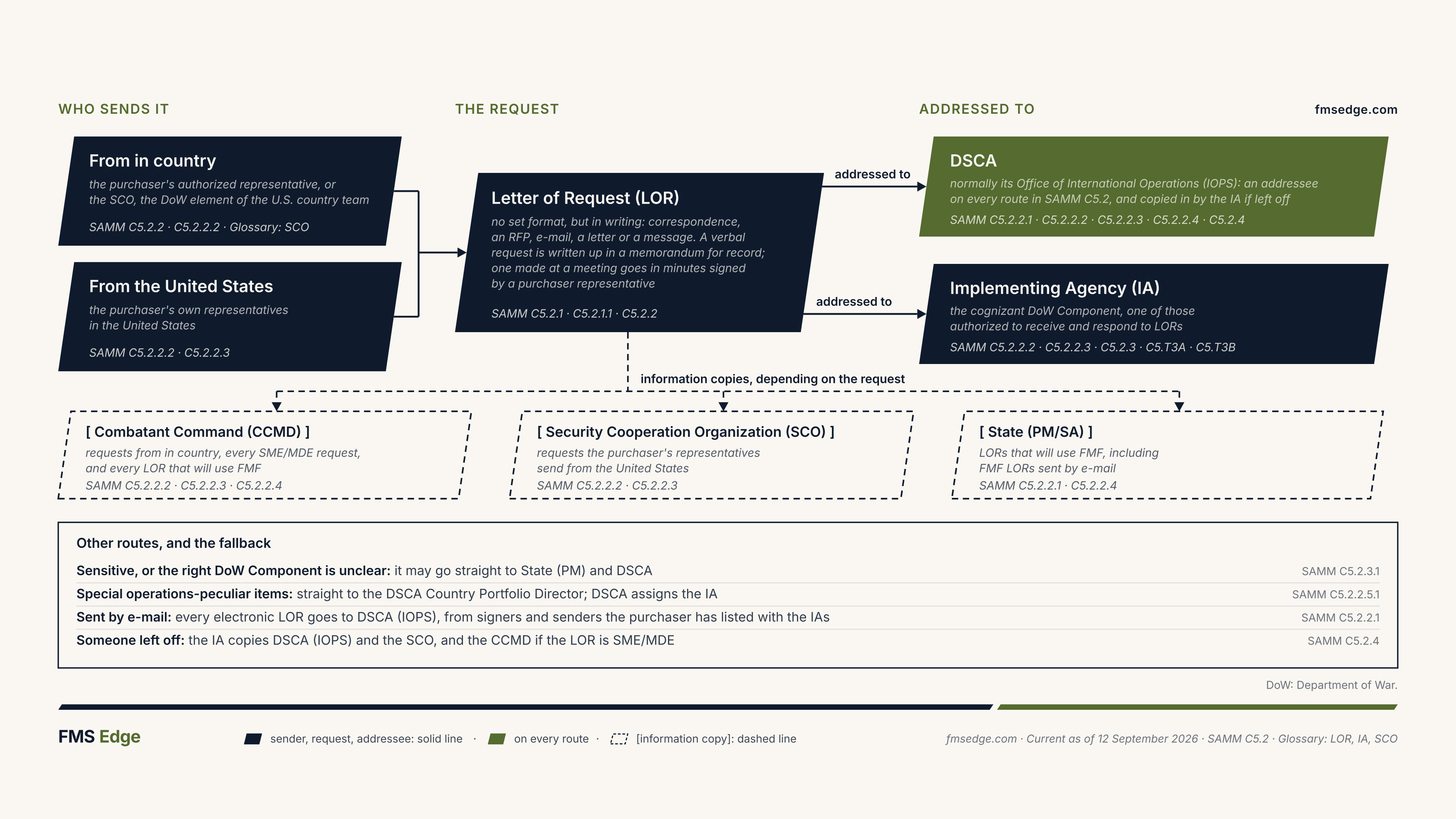
Who can submit a Letter of Request, and to whom?
A comes from a source with authority to submit requests for the purchasing country or international organization, and it is normally addressed to the and the [SAMM , ]. A request for items other than that originates in country must be transmitted by the purchaser's authorized representative or by the Department of War element of the U.S. , and requests can also come from the purchaser's representatives in the United States [SAMM ]. The information copies depend on where a request starts, what it asks for and how it is funded [SAMM , , ].
The action addressees for a are normally the and the . The is the U.S. Government () organization authorized to receive and process . Tables C5.T3A and C5.T3B in the list the authorized and provide addresses and routing information for each . An can originate from in-country or from the international partner representatives in the U.S. Which offices receive information copies depends on where the originates, what it requests and how it is funded. An may go directly to and in two cases: when the purchaser's representative in the United States or the U.S. Embassy in-country believes the request is sensitive and needs a higher-level policy determination, or when the purchaser, the U.S. Military Group () or the U.S. Embassy cannot determine the appropriate Department of War (DoW) Component [SAMM , , , , ].
A request for items other than that originates in-country must be sent either by the purchaser's authorized representative or by the DoW element of the U.S. . It must go to 's Office of International Operations () and the appropriate DoW Component, and be copied for information to the geographic . A non- request from the purchaser's foreign representatives in the United States must go to () and the appropriate DoW Component, and be copied for information to the . If the appears to be missing from the distribution of a purchaser's request, the DoW Component must get copies to the and the as quickly as possible [SAMM ].
Requests for and that originate in-country must be addressed to the cognizant DoW Component and to (), and copied for information to the . An request that originates with purchaser representatives in the United States must be addressed to the same two offices and copied for information to both the and the . If the appears to be missing from the distribution, the DoW Component must get a copy to it as quickly as possible [SAMM ].
Section 47 of the defines the terms "" and "", and the United States () enumerates certain defense articles and services, with those designated marked by an asterisk. is considered if its nonrecurring research and development cost is over $50 million or its total production cost is over $200 million, and Appendix 1 lists the Nonrecurring Cost () recoupment charges for identified [SAMM ].
The total production cost includes DoW expenditures for special test equipment, rate and special tooling, preproduction engineering, product improvement, production engineering, pilot model production, testing and evaluation, destructive testing, and license costs. It also includes the cost of any initiated before the date on which the recoupment charge is calculated. 7000.14-R, the Financial Management Regulation, defines each category in detail in Volume 15, Chapter 7, Section 15.5.3. Production line shutdown costs are not part of the nonrecurring production cost pool as defined there, so neither those costs nor any allocation of them is to be included in the pool when the nonrecurring cost charge is calculated [SAMM ].
An that will use Foreign Military Financing () should go to () and the appropriate DoW Components, and the and the Department's Office of in the Bureau of Political-Military Affairs ( (PM/SA)) should receive information copies [SAMM ].
To send electronically, purchasers must give the a list of authorized signers and senders, and submitted electronically must go through appropriate channels. A purchaser that wants to submit electronically should ask the identified recipients whether a file naming convention should be used, and an e-mail with the signed attached is the preferred means of transmission. Every electronic must go to () at the address the manual gives, and information copies of electronic that show will be used should also go to (PM/SA) [SAMM ].
Try the tool: Draft a Letter of Request
References
SAMM
- SAMM C5.T4A: Mandatory Criteria Before Letter of Request Actionable (Before Case Development Activities)
- SAMM C5.2.3: The Department of War Components Authorized to Receive Letters of Request.
- SAMM C5.2.2.2: Non-Significant Military Equipment Requests.
- SAMM C5.2.2.3: Significant Military Equipment and Major Defense Equipment Requests.
- SAMM C5.2.2.4: Letters of Request Funded with Foreign Military Financing.
- SAMM C5.2.2.1: Letters of Request Submitted by Electronic Mail.
- SAMM C5.2.3.1: Exceptions.
Facts referenced
- Nonrecurring research and development cost above which Significant Military Equipment is Major Defense Equipment (AECA section 47): $50 million (as of 5 October 2026; SAMM C5.2.2.3)
- Total production cost above which Significant Military Equipment is Major Defense Equipment (AECA section 47): $200 million (as of 5 October 2026; SAMM C5.2.2.3)
Related
Letter of Request (LOR)
The term used to identify a request from an eligible FMS participant country for the purchase of U.S. defense articles and services. The request may be in message or letter format.
SAMM Glossary, as of 12 September 2026
Glossary entry →Open the manual’s entry → (opens in new tab)
Implementing Agency (IA)
The military department or defense agency responsible for the execution of military assistance programs. With respect to FMS, the military department or defense agency assigned responsibility by the Defense Security Cooperation Agency to prepare an LOA and to implement an FMS case. The implementing agency is responsible for the overall management of the actions that will result in delivery of the materials or services set forth in the LOA that was accepted by a foreign country or international organization.
SAMM Glossary, as of 12 September 2026
Glossary entry →Open the manual’s entry → (opens in new tab)
Defense Security Cooperation Agency (DSCA)
The Department of War agency that directs, administers and provides guidance to the Department's components and its representatives at U.S. missions for the execution of the security cooperation programs for which it is responsible [SAMM C1.3.2.2]. The agency also provides financial and technical assistance, arranges the transfer of defense materiel, training and services to international partners, and promotes military-to-military contacts.
FMS Edge glossary, as of 10 October 2026
Glossary entry →Open the manual’s entry → (opens in new tab)
Significant Military Equipment (SME)
Defense articles for which special export controls are warranted because of the capacity of such articles for substantial military utility or capability. These items are identified on the U.S. Munitions List in the International Traffic in Arms Regulations by an asterisk preceding the item category listing.
SAMM Glossary, as of 12 September 2026
Glossary entry →Open the manual’s entry → (opens in new tab)
Country Team
The senior coordinating and supervising body of a U.S. diplomatic mission, headed by the chief of mission (normally the ambassador) and made up of the senior representative of each U.S. department or agency at the post. Its members meet regularly to coordinate U.S. Government political, economic and military activities and policies in the host country.
FMS Edge glossary, as of 10 October 2026
Glossary entry →Open the manual’s entry → (opens in new tab)
LOR: Letter of Request
SAMM Acronyms, as of 12 September 2026
Security Assistance Management Manual (SAMM)
DSCA Manual 5105.38-M required under DoD Directive 5105.65, "Defense Security Cooperation Agency" mandatory for use by all DoD Components. The SAMM provides DoD-wide guidance to the Office of the Secretary of Defense (OSD), the Military Departments (MILDEPs), the Office of the Chairman of the Joint Chiefs of Staff and the Joint Staff, the Combatant Commands, the Defense Agencies, the DoD Field Activities, the Security Cooperation Organizations (SCOs), and all other organizational entities within the DoD engaged in the management or implementation of DoD Security Assistance and Security Cooperation programs over which DSCA has responsibility.
SAMM Glossary, as of 12 September 2026
Glossary entry →Open the manual’s entry → (opens in new tab)
State (PM): Department of State, Bureau of Political-Military Affairs
SAMM Acronyms, as of 12 September 2026
DSCA: Defense Security Cooperation Agency
SAMM Acronyms, as of 12 September 2026
Glossary entry →Defense Security Cooperation Agency (DSCA) →
Combatant Command (CCMD)
A unified or specified command with a broad continuing mission under a single commander established and so designated by the President, through the Secretary of Defense and with the advice and assistance of the Chairman of the Joint Chiefs of Staff. Also called CCMD.
SAMM Glossary, as of 12 September 2026
Glossary entry →Open the manual’s entry → (opens in new tab)
Major Defense Equipment (MDE)
Any item of Significant Military Equipment on the U.S. Munitions List having a nonrecurring research and development cost of more than $50 million or a total production cost of more than $200 million. Also defined in section 47 (6), Arms Export Control Act.
SAMM Glossary, as of 12 September 2026
Glossary entry →Open the manual’s entry → (opens in new tab)
Arms Export Control Act (AECA)
The basic U.S. law providing the authority and general rules for the conduct of Foreign Military Sales and commercial sales of defense articles, defense services, and training. The Arms Export Control Act (AECA) came into existence with the passage of the Foreign Military Sales Act (FMSA) of 1968. An amendment in the International Security Assistance and AECA of 1976 changed the name of FMSA to the AECA.
SAMM Glossary, as of 12 September 2026
Glossary entry →Open the manual’s entry → (opens in new tab)
Defense Article (Foreign Assistance Act; Arms Export Control Act, not including commercial sales subject to the International Traffic in Arms Regulation)
Any weapon, weapon system, munition, aircraft, vessel or other implement of war, together with the property, equipment, tooling, components and parts used to furnish military assistance or sales or to make, maintain or use such items; the International Traffic in Arms Regulations (ITAR) define the term separately for commercial exports.
Section 47 of the Arms Export Control Act (AECA) defines the term, and the U.S. Munitions List designates the specific items that fall within it [SAMM C4.4] [22 U.S.C. 2794].
FMS Edge glossary, as of 10 October 2026
Glossary entry →Open the manual’s entry → (opens in new tab)
Defense Service (Foreign Assistance Act (FAA); Arms Export Control Act (AECA))
Any service, test, inspection, repair, training or publication, any defense information, and any technical or other assistance used to furnish military assistance or sales. The term excludes military education and training under the Foreign Assistance Act (FAA), and design and construction services provided under section 29 of the Arms Export Control Act (AECA). Under the International Traffic in Arms Regulations (ITAR) the term also covers help given to foreign persons in designing, producing, maintaining, operating or using defense articles, and the furnishing of controlled technical data.
Section 47 of the AECA defines the term [SAMM C4.4].
FMS Edge glossary, as of 10 October 2026
Glossary entry →Open the manual’s entry → (opens in new tab)
Munitions List
The list, in Part 121 of the International Traffic in Arms Regulations (ITAR), of the defense articles and defense services, related technical data included, that the Department of State controls for export and temporary import.
The U.S. Munitions List (USML) designates the specific items that are defense articles and defense services under Section 47 of the Arms Export Control Act (AECA), and marks Significant Military Equipment (SME) with an asterisk [SAMM C4.4] [22 U.S.C. 2794].
FMS Edge glossary, as of 10 October 2026
Glossary entry →Open the manual’s entry → (opens in new tab)
MDE: Major Defense Equipment
SAMM Acronyms, as of 12 September 2026
Nonrecurring Costs (NC)
Costs funded by a Research, Development, Test, and Evaluation appropriation to develop or improve a product or technology either through contract or in-house effort. NC also includes one-time costs incurred in support of previous production of a specified model and costs incurred in support of a total projected production run. See "Nonrecurring Production Costs" and "Nonrecurring Research, Development, Test, and Evaluation Costs."
SAMM Glossary, as of 12 September 2026
Glossary entry →Open the manual’s entry → (opens in new tab)
Engineering Change Proposal
A proposal to a responsible authority recommending that a change to an original item of equipment be considered, and the design or engineering change be incorporated into the article to modify, add to, delete, or supersede original parts.
SAMM Glossary, as of 12 September 2026
Glossary entry →Open the manual’s entry → (opens in new tab)
Security Assistance (SA)
A group of programs authorized by federal statutes by which the United States provides defense articles, military training, and other defense-related services by grant, lease, loan, credit, or cash sales in furtherance of national policies and objectives, and those that are funded and authorized through the Department of State to be administered by Department of Defense/Defense Security Cooperation Agency, which are considered part of security cooperation.
SAMM Glossary, as of 12 September 2026
Glossary entry →Open the manual’s entry → (opens in new tab)
SAMM C5.T4A: Mandatory Criteria Before Letter of Request Actionable (Before Case Development Activities)
“Table C5.T4A. Mandatory Criteria Before Letter of Request Actionable (Before Case Development Activities) # Criteria 1 Potential purchaser is an eligible FMS recipient. See Section C4.1. 2 The defense article or defense service sought may be sold. See Section C4.4. and Section C4.5. 3 The request was submitted and received through proper channels. See Section C5.2.2. 4 No sanctions exist …”
Security Assistance Management Manual, as of 26 October 2026
SAMM C5.2.2.2: Non-Significant Military Equipment Requests.
“Non-Significant Military Equipment (Non-SME) requests that originate in-country must be transmitted either by the purchaser's authorized representative or the DoW element of the U.S. country team to DSCA (Office of International Operations (IOPS)) and the appropriate DoW Component with information copies to the geographic Combatant Command (CCMD). Requests originated by foreign representatives of the purchaser in the United States must …”
Security Assistance Management Manual, as of 5 October 2026
SAMM C5.2.2.3: Significant Military Equipment and Major Defense Equipment Requests.
“Significant Military Equipment (SME) and Major Defense Equipment (MDE) requests that originate in-country must be addressed to DSCA (IOPS) and the cognizant DoW Component with information copies to the CCMD. Requests regarding SME that originate with purchaser representatives in the United States must be addressed to DSCA (IOPS) and the cognizant DoW Component with information copies to the CCMD and …”
Security Assistance Management Manual, as of 5 October 2026
SAMM C5.2.2.4: Letters of Request Funded with Foreign Military Financing.
“All LORs that will use FMF should be addressed to DSCA (IOPS) and the appropriate DoW Components with information copies to the State Bureau of Political-Military Affairs, Office of Security Assistance (State (PM/SA)) and the CCMD.”
Security Assistance Management Manual, as of 5 October 2026
SAMM C5.2.3: The Department of War Components Authorized to Receive Letters of Request.
“Certain DoW Components are IAs authorized to receive and respond to LORs. Table C5.T3A. identifies MILDEP organizations authorized to receive LORs and their addresses. Table C5.T3B. identifies other DoW IAs authorized to receive LORs and their addresses. Army Table C5.T3A. Military Department Organizations Authorized to Receive Letters of Request Implementing Agency Code Military Department Organization with Security Cooperation Responsibilities Applicability …”
Security Assistance Management Manual, as of 2 November 2026
SAMM C5.2.3.1: Exceptions.
“LORs may be submitted directly to State (PM) and DSCA if the U.S. Embassy in-country or the purchaser’s representative in the United States believes the request is sensitive and requires a higher-level policy determination, or if the purchaser or the MILGP and/or U.S. Embassy cannot determine the appropriate DoW Component.”
Security Assistance Management Manual, as of 5 October 2026
SAMM C5.2.2.1: Letters of Request Submitted by Electronic Mail.
“To send LORs via electronic means, purchasers must provide a list of authorized signers and senders to the IAs. LORs submitted using electronic means must be submitted through appropriate channels. Purchasers that wish to submit LORs electronically should contact the identified recipients to determine whether a file naming convention should be used. E-mail attaching the signed LOR is the preferred …”
Security Assistance Management Manual, as of 5 October 2026