
Guide
What is a third-party transfer in Foreign Military Sales?
A purchaser may not hand over, resell or change the use of U.S. defense articles bought through without prior written consent from the U.S. Government. The Department of State decides each request, and some transfers go to Congress first.
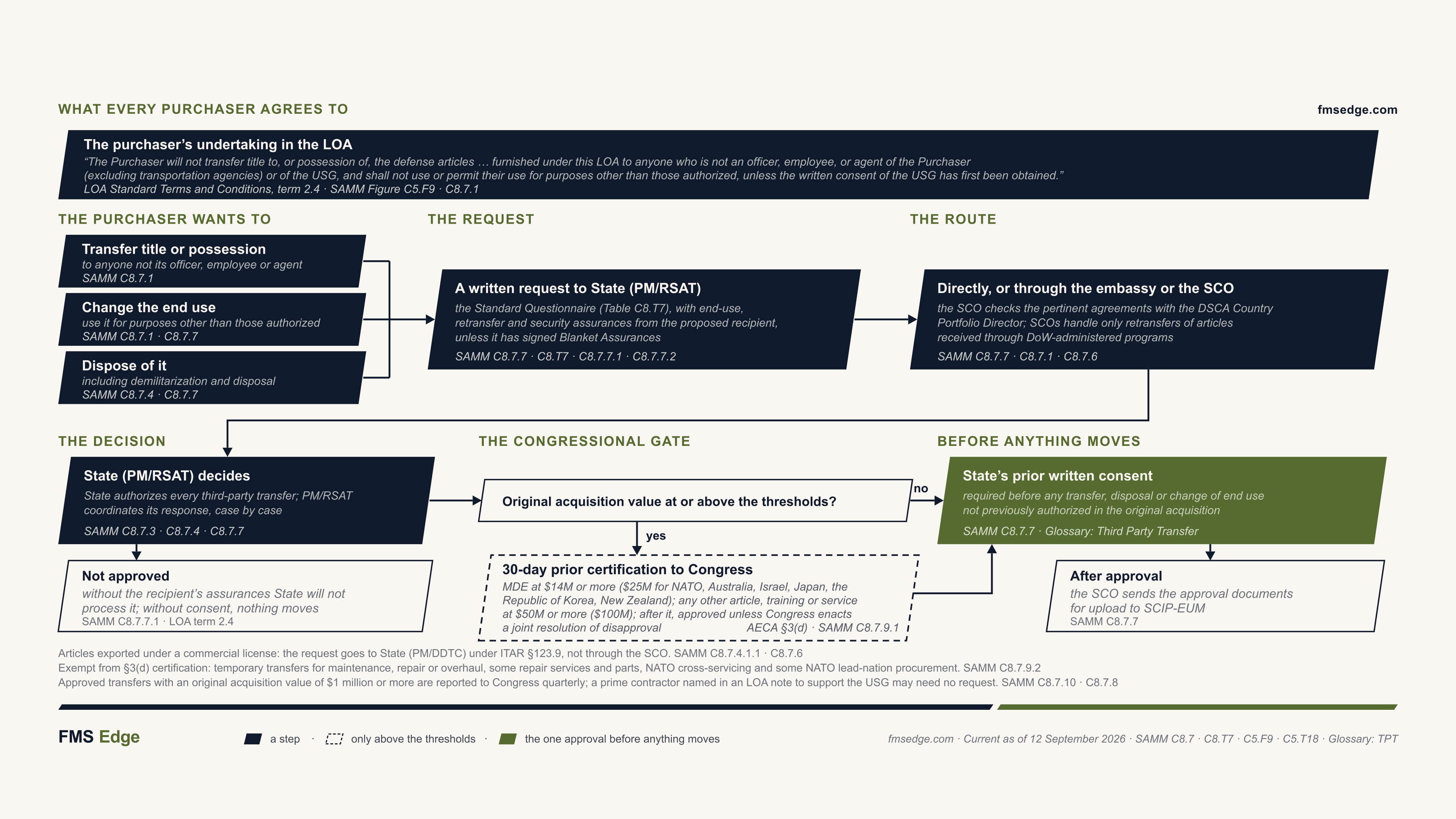
Every purchaser agrees in the LOA not to transfer title to or possession of what it bought, and not to use it for other purposes, unless the U.S. Government's written consent has first been obtained. A purchaser that wants to transfer an article, change its end use or dispose of it sends a written request to the Department of State's Office of Regional Security and Arms Transfers, with end-use, retransfer and security assurances from the proposed recipient, directly or through its embassy or the security cooperation office. State decides each request case by case; where the original acquisition value reaches the Arms Export Control Act Section 3(d) thresholds, Congress receives a prior certification first, and approval is granted after the 30-day period unless Congress enacts a joint resolution of disapproval. State's prior written consent is the one approval that must exist before anything moves.
What is a third-party transfer in Foreign Military Sales?
A third-party transfer (TPT) is any retransfer of title, physical possession or control of defense articles, training or acquired under authorized transfer programs from the original authorized recipient to any person or organization not an employee, officer or agent of that recipient country (or international organization). Note that a change in end use is considered a third-party transfer. While it is the receiving partner's responsibility to properly request a third-party transfer, the routinely assist in processing these requests.
What counts as a change in end use?
Change of end-use is defined as any change in the usage of transferred defense articles, services, or technology that deviates from the original purposes for which they were provided. Since is a “cradle-to-grave” activity, disposal also constitutes a change in end-use for which prior consent from the DOS is required for non-consumable items. Cannibalization is viewed as disposal only if the parts being removed will no longer be under the control of the ministry or agency that received them from the , or will be used for purposes other than for national defense. Examples of possible changes (not an exhaustive list) of end use include:
- Withdrawal of military end items from the operational inventory for display at a government- run museum
- Use of unserviceable/non-repairable vehicles as targets on a firing range
- Transfer of demilitarized military end items or machinery from the armed forces to civil government or educational institutions
- Transfer of a U.S.-origin military vehicle from an operational military unit to be used as a police vehicle assigned to a non-military law enforcement agency
- Demilitarization and redistribution of defense articles among several host government agencies outside of the military/ministry of defense
- Scrapping U.S.-origin end items in order to reclaim and sell their components (e.g., copper wires, titanium)
Who approves a third-party transfer?
In accordance with the FAA, Section 505 (22 U.S.C. 2314), in considering a request for approval to retransfer any implement of war to another country, the Department will not agree to the transfer unless the itself would transfer the under consideration to that country. In addition, the DOS will not consent to the retransfer of any significant on the United States () unless the item is demilitarized prior to transfer, or the proposed recipient foreign country commits in writing to provide appropriate security and transfer assurances.
How does a purchaser ask for approval?
The transferring government sends a written request to the Team at the Department of State's Office of Regional Security and (PM/RSAT), directly, through its embassy, or through the .
For articles exported commercially, the request goes to 's Directorate of Defense Trade Controls (PM/DDTC) under ITAR Section 123.9.
Any request to retransfer a or technology must be supported by end-use and retransfer assurances from the proposed recipient. If the initial recipient is not the final end user, the final end user must be identified, and appropriate end-use and retransfer assurances must be provided by both the intermediate and final recipients. If the proposed recipients are unable or unwilling to identify the final end user and end-use of the articles or data, the transfer will not be approved. In addition, if brokers are involved as intermediaries in the transfer, they must be clearly identified in the transfer request, and they must be registered with the DOS PM/DDTC as brokers.
Does Congress review a third-party transfer?
The following are exceptions to this congressional review process for third-party transfers:
- The President states in the certification submitted that an emergency exists, which requires that consent to the proposed transfer becomes effective immediately
- Transfers of maintenance, repairs, or overhaul defense services or repair parts if such transfers will not result in any increase in military capabilities
- Temporary transfers of defense articles for the sole purpose of receiving maintenance, repair, or overhaul
- Cooperative cross-servicing arrangements or lead-nation procurement among members. Note, however, that Section 36(b) notifications must identify the transferees on whose behalf the lead-nation procurement is proposed
References
SAMM
- SAMM C8.7.1 — Third Party Transfer.
- SAMM C8.7.3 — Department of State.
- SAMM C8.7.6 — Department of War - Security Cooperation Organizations.
- SAMM C8.7.7.1 — End Use, Retransfer, and Security Assurances.
- SAMM C8.7.7.2 — Blanket Assurances.
- SAMM C8.7.9.1 — Congressional Notification.
- SAMM C8.7.10 — Congressional Reporting.
Related
Foreign Military Sales (FMS)
A process, authorized by the Arms Export Control Act, through which eligible foreign governments and international organizations may purchase defense articles, services, and training from the United States Government.
SAMM Glossary, as of 12 September 2026
Glossary entry →Open the manual’s entry → (opens in new tab)
Letter of Offer and Acceptance (LOA)
The legal instrument used by the USG to transfer itemized defense articles, defense services, and design and construction services to foreign partners.
When used under the authorities provided in the Arms Export Control Act for Foreign Military Sales, the LOA is a binding agreement signed by the USG and the foreign partner to transfer such articles and services.
When used under Building Partnership Capacity (BPC) authorities, the BPC LOA is not signed by the Benefitting Partner.
SAMM Glossary, as of 12 September 2026
Glossary entry →Open the manual’s entry → (opens in new tab)
Freight Forwarder
A commercial import/export company registered with the Department of State, Bureau of Political-Military Affairs, Directorate of Defense Trade Controls and under contract to the Foreign Military Sales customer which arranges transportation of materiel from a point specified in the Letter of Offer and Acceptance to the final destination.
SAMM Glossary, as of 12 September 2026
Glossary entry →Open the manual’s entry → (opens in new tab)
Security Cooperation
Activities undertaken by the DoD to encourage and enable international partners to work with the United States to achieve strategic objectives. It includes all DoD interactions with foreign defense and security establishments, including all DoD-administered security assistance programs, that: build defense and security relationships that promote specific U.S. security interests, including all international armaments cooperation activities and security assistance activities; develop allied and friendly military capabilities for self-defense and multinational operations; and provide U.S. forces with peacetime and contingency access to host nations.
SAMM Glossary, as of 12 September 2026
Glossary entry →Open the manual’s entry → (opens in new tab)
SCO — Security Cooperation Organization
SAMM Acronyms, as of 12 September 2026
DSCA — Defense Security Cooperation Agency
SAMM Acronyms, as of 12 September 2026
Glossary entry →Defense Security Cooperation Agency (DSCA) →
Technical Data
Recorded information of a scientific or technical nature, regardless of form or characteristic. Examples of technical data packages include research and engineering drawings and associated lists, specifications, standards, process sheets, manuals, technical reports, catalog item identifications, and related information and computer software documentation.
SAMM Glossary, as of 12 September 2026
Glossary entry →Open the manual’s entry → (opens in new tab)
EUM — End Use Monitoring
SAMM Acronyms, as of 12 September 2026
Defense Article (Foreign Assistance Act; Arms Export Control Act, not including commercial sales subject to the International Traffic in Arms Regulation)
Any weapon, weapons system, munition, aircraft, vessel, boat, or other implement of war;
SAMM Glossary, as of 12 September 2026
Munitions List
The U.S. Munitions List is an enumeration of defense articles and defense services and is published in the Department of State's International Traffic in Arms Regulations.
SAMM Glossary, as of 12 September 2026
Glossary entry →Open the manual’s entry → (opens in new tab)
State (PM/DDTC) — Department of State, Bureau of Political-Military Affairs, Directorate of Defense Trade Controls
SAMM Acronyms, as of 12 September 2026
Third Party Transfer (TPT)
The USG requires recipients of U.S.-origin defense articles, services, training, or technical data to obtain written consent from the Department of State prior to transfer, disposal, or change of end-use of its U.S.-origin articles, services, training, or data. Such approval is required for all transfer, change of end-use or destination not previously authorized in the original acquisition. Included are defense articles and technical data obtained through the USG Foreign Military Sales (FMS) Program or Grants (i.e. Military Assistance Program or Excess Defense Article).
SAMM Glossary, as of 12 September 2026
Glossary entry →Open the manual’s entry → (opens in new tab)
Arms Transfers
The sale, lease, loan, or other transfer of defense articles and defense services such as arms, ammunition, and implements of war, including components thereof, and the training, manufacturing licenses, technical assistance, and technical data related thereto, provided by the USG under the authority of the Foreign Assistance Act of 1961, as amended, or the Arms Export Control Act, as amended, or other statutory authority, or directly by commercial firms to foreign countries, foreign private firms, or to international organizations. See also conventional arms transfers.
SAMM Glossary, as of 12 September 2026
Glossary entry →Open the manual’s entry → (opens in new tab)
State (PM/RSAT) — Department of State Bureau of Political-Military Affairs, Office of Regional Security and Arms Transfers
SAMM Acronyms, as of 12 September 2026
FMS — Foreign Military Sale
SAMM Acronyms, as of 12 September 2026
Major Defense Equipment (MDE)
Any item of Significant Military Equipment on the U.S. Munitions List having a nonrecurring research and development cost of more than $50 million or a total production cost of more than $200 million. Also defined in section 47 (6), Arms Export Control Act.
SAMM Glossary, as of 12 September 2026
Glossary entry →Open the manual’s entry → (opens in new tab)
Defense Service (Foreign Assistance Act (FAA); Arms Export Control Act (AECA))
Any service, test, inspection, repair, training, publication, technical or other assistance, or defense information used for the purpose of furnishing military assistance or sales of the United States, but does not include military education and training activities under section 2347 of the FAA (22 U.S.C 2347) or design and construction services under section 29 of the AECA.
SAMM Glossary, as of 12 September 2026
Glossary entry →Open the manual’s entry → (opens in new tab)
Joint Resolution
A legislative resolution, designated H J Res (House) or S J Res (Senate) which requires the approval of both houses and the signature of the President, just as a bill does, and which has the force of law if approved. There is no practical difference between a bill and a joint resolution. A joint resolution generally is used to deal with a limited matter such as a single appropriation. Congressional rejection of a proposed arms transfer, lease, third country transfer, or a proposed international cooperative project takes the form of a joint resolution of disapproval.
SAMM Glossary, as of 12 September 2026
Glossary entry →Open the manual’s entry → (opens in new tab)