
Guide
What is an end-use monitoring compliance assessment visit (CAV)?
A compliance assessment visit () is the review the makes in country under the Golden Sentry end-use monitoring program. It checks the 's compliance with end-use monitoring policy and the partner's compliance with the security and accountability terms of its transfer agreements. can run the same review remotely as a virtual compliance assessment, and it plans the visits two years ahead.
DSCA plans end-use monitoring compliance assessment visits two years ahead. Before each visit the manual sets a countdown in calendar days, from DSCA confirming the articles to be assessed to the security cooperation office's final arrangements with the partner.
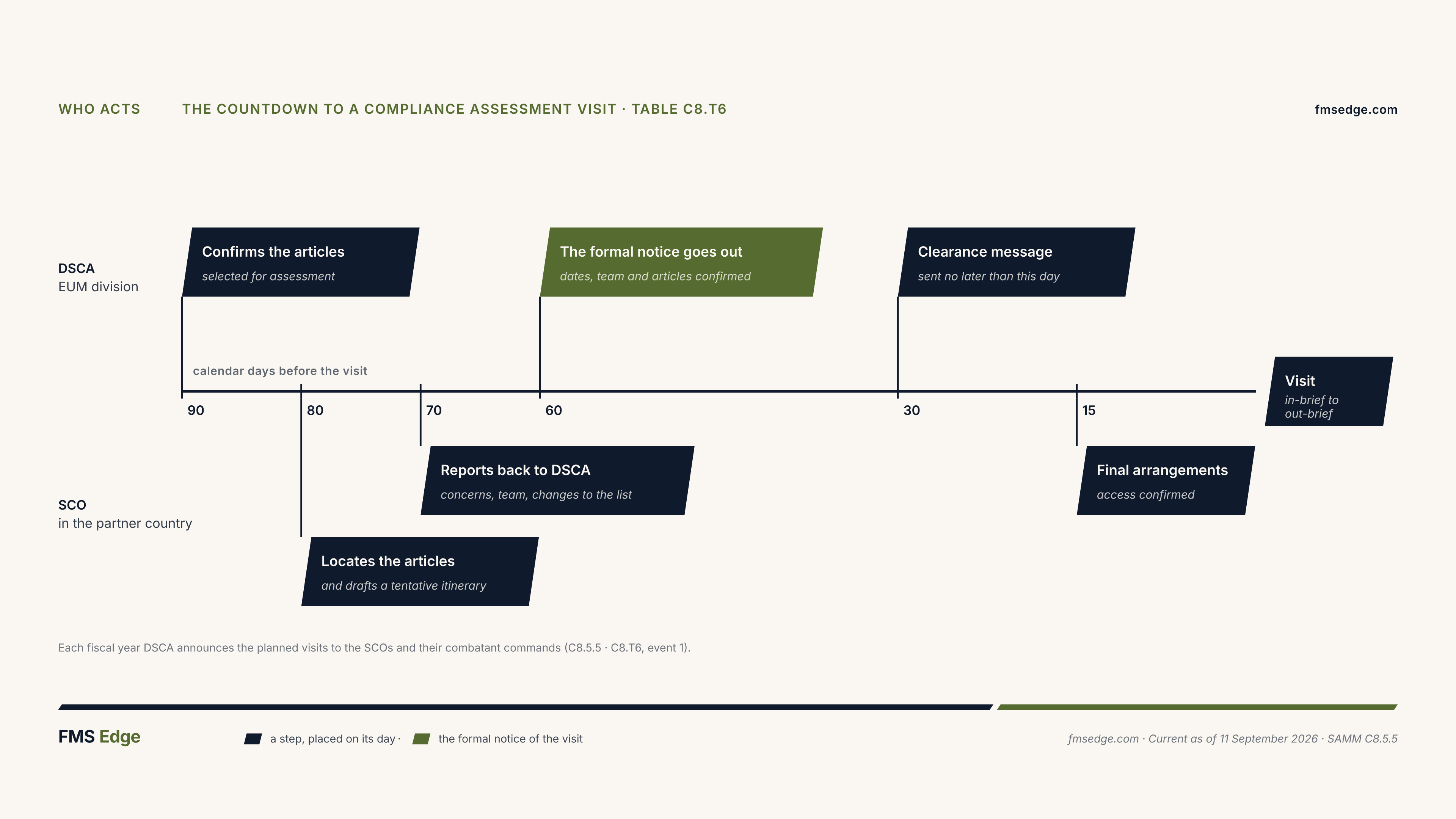
What is an end-use monitoring compliance assessment visit?
A Compliance Assessment Visit () is the in-country review in which the evaluates a 's () compliance with Golden Sentry end-use monitoring () policy and procedures [SAMM , ]. The same visit assesses the partner's compliance with specific physical security and accountability requirements and other terms of its transfer agreements, such as the . An organization or office equivalent to an is assessed in the same way [SAMM ].
The Golden Sentry program includes in-country visits. There are three types of visits, which involve the and the international partner: Familiarization and Assistance Visits (), Compliance Assessment Visits () or Virtual Compliance Assessments (VCA), and Focused Verification Assessments (FEVA) [SAMM ]:
1. Familiarization and Assistance Visit (): The purpose of the is to assist the international partner, the , and the in developing an effective compliance program. The can be requested by the , the partner, or the and can be used to validate existing programs or to help establish a new program or revise an existing one to accommodate new types of equipment or other new circumstances [SAMM ].
2. Compliance Assessment Visit (): The reviews and evaluates the 's compliance with Golden Sentry policy and procedures and the partner's compliance with the physical security and accountability requirements and other terms of the transfer agreements [SAMM ]. and timelines and requirements are set out in two tables of the manual [SAMM , ].
3. may elect to conduct virtual compliance assessments (VCAs). VCAs are conducted similarly to , but remotely and without travel by personnel. may conduct a VCA when circumstances impede travel or other limitations lead to deem a VCA necessary. Detailed guidance on conducting VCAs is in the VCA Guidance Plan within the ()-EUM database [SAMM ].
4. Focused Verification Assessment (FEVA): FEVAs are ad hoc assessments directed at the discretion of the Director, , of select types of U.S.-origin defense articles which normally occur when concerns arise regarding their use, transfer, or physical security. FEVAs provide the Director, , with greater visibility and real-time situational awareness on the status, disposition, and treatment of U.S.-origin defense articles, and a way to assess and possibly resolve issues that could lead to significant end-use violations [SAMM ].
review and evaluate the compliance of and other U.S. Government () organizations with the Golden Sentry Program and related laws, policies, and regulations, and the international partner’s compliance with the terms and conditions for the transfer of defense articles and services, including specific physical security and accountability provisos pertaining to sensitive technologies.
A or VCA measures the 's compliance against Table C8.T2, using the checklist available in the SCIP-EUM database. Its activities may include storage site visits, reviews of records and documentation, reviews of Routine () and enhanced policies and procedures, and inventories of U.S.-provided defense articles. Each or VCA is coordinated in advance with the , the and the partner so that the assessment succeeds [SAMM ].
To make the most of resources and keep disruption down, site visits should be timed to coincide with the partner's scheduled inventory dates whenever possible. Table C8.T6 sets the timeline and the formal requirements for a well-coordinated and documented or VCA, and informal correspondence may take place before those actions. If the or VCA team cannot obtain proper entry credentials from the partner, unfavorable reports will result [SAMM ].
Like a , a VCA reviews and evaluates the 's compliance with Golden Sentry policy and the partner's compliance with the specific physical security and accountability agreements, provisos and other terms in its transfer agreements. A VCA does not, however, provide the same degree of assessment as a . Table C8.T6 sets out the VCA's timeline and requirements [SAMM ].
sends an annual message to all and listing the countries that are subject to a in the following two year period. The two-year plan is revalidated or revised annually as necessary through coordination between , the , and the [SAMM , ].
The Community ( >Support > Resources) in has checklists to assist the in conducting self-assessments, to help prepare the international partner to receive Enhanced () defense articles, and to prepare for upcoming .
Compliance with the policies and procedures of the Golden Sentry Program and the ’s responsibilities stated in Table C8.T2 [SAMM ] are what a or VCA assesses [SAMM ]; the ratings for a or VCA are Outstanding, Satisfactory, Needs Improvement or Unsatisfactory [SAMM ].
The checklist in the SCIP-EUM database sets out the 's responsibilities. As Table C8.T2 shows, the information in checklists covers the following [SAMM ]:
- Timely physical security and accountability assessments of all -designated defense articles, in accordance with Department of War Golden Sentry checklists
- Implementation of the physical security and accountability plan(s), the Night Vision Device () Control Plan, for protecting, storing, using and accounting for
- Accuracy and timeliness in reporting losses, expenditures and destruction of -designated defense articles
- Implementation of written standard operating procedures for performing and
- Use of the SCIP-EUM database to track inventories and keep an accurate disposition of -designated defense articles
- Maintenance of records assessing and defense articles
- Verification of the demilitarization, disposal or destruction of -designated defense articles, and proper coordination of it with the Office of Regional Security and in the Department of State's Bureau of Political-Military Affairs ()
- Proper coordination with on third-party transfer requests and approvals
- Accuracy of the partner's baseline of -designated defense articles, as reported in the Reconciliation Report in the SCIP-EUM database
The partner's compliance with the conditions of its transfer agreements is assessed in the same or VCA [SAMM ].
The partner's responsibilities are stated in the terms of its transfer agreements for U.S.-provided defense articles and services. They include [SAMM ]:
- Cooperation and coordination with officials in setting up and keeping a viable program for and , including the , VCAs and FEVAs that or authorized personnel conduct
- Implementation of the physical security and accountability plan(s), the Control Plan, as required
- Mitigation or resolution of any potential end-use violations found in the assessments or reported earlier by the
- Implementation of physical security and accountability measures at storage sites that hold -designated defense articles under the terms of the or other transfer agreements
- Reporting of losses of -designated defense articles and of the actions taken to prevent future losses (as appropriate), and transparency in the reporting history
- Accurate and timely requests for, and reports of, the loss, expenditure, demilitarization, disposal, destruction or other change of end use of -provided defense articles
References
SAMM
- SAMM C2.1.5.6.1: Golden Sentry.
- SAMM C8.5.2: End Use Monitoring Familiarization and Assistance Visits Guidance.
- SAMM C8.T5: End Use Monitoring Familiarization and Assistance Visits Timeline and Requirements
- SAMM C8.T6: End Use Monitoring Compliance Assessment Visit Timeline and Requirements
- SAMM C8.5.8: Focused End Use Monitoring Verification Assessments.
- SAMM C8.5.5: Compliance Assessment Visit / Virtual Compliance Assessment Planning.
- SAMM C8.T2: Department of War End Use Monitoring Responsibilities
- SAMM C8.5.6: Compliance Assessment Visit Rating Criteria.
- SAMM C8.5.1: End Use Monitoring Visit Guidance.
- SAMM C8.5.3: End Use Monitoring Compliance Assessment Visit Guidance.
- SAMM C8.5.4: End Use Monitoring Virtual Compliance Assessments Guidance.
- SAMM C8.5.6.1: United States Military Group Compliance Assessment.
- SAMM C8.5.7: Partner Compliance Assessment.
Related
Defense Security Cooperation Agency (DSCA)
The Department of War agency that directs, administers and provides guidance to the Department's components and its representatives at U.S. missions for the execution of the security cooperation programs for which it is responsible [SAMM C1.3.2.2]. The agency also provides financial and technical assistance, arranges the transfer of defense materiel, training and services to international partners, and promotes military-to-military contacts.
FMS Edge glossary, as of 10 October 2026
Glossary entry →Open the manual’s entry → (opens in new tab)
Security Cooperation Organization (SCO)
A Department of Defense element that is part of the United States Diplomatic mission located in a foreign country to carry out security assistance and security cooperation management functions under the supervision and coordination authority of the senior defense official/defense attaché.
SAMM Glossary, as of 12 September 2026
Glossary entry →Open the manual’s entry → (opens in new tab)
DSCA: Defense Security Cooperation Agency
SAMM Acronyms, as of 12 September 2026
Glossary entry →Defense Security Cooperation Agency (DSCA) →
SCO: Security Cooperation Organization
SAMM Acronyms, as of 12 September 2026
EUM: End Use Monitoring
SAMM Acronyms, as of 12 September 2026
Letter of Offer and Acceptance (LOA)
The legal instrument that lists the defense articles and services, including training, that the U.S. Government transfers to a foreign country or international organization, with their estimated costs and the terms and conditions. The benefitting partner does not sign a Building Partner Capacity (BPC) LOA.
The Letter of Offer and Acceptance (LOA) is the instrument the U.S. Government uses to sell under the Arms Export Control Act (AECA); signed LOAs and their later Amendments and Modifications are also called Foreign Military Sales (FMS) cases [SAMM C5.6.1].
FMS Edge glossary, as of 10 October 2026
Glossary entry →Open the manual’s entry → (opens in new tab)
Combatant Command (CCMD)
A unified or specified command with a broad continuing mission under a single commander established and so designated by the President, through the Secretary of Defense and with the advice and assistance of the Chairman of the Joint Chiefs of Staff. Also called CCMD.
SAMM Glossary, as of 12 September 2026
Glossary entry →Open the manual’s entry → (opens in new tab)
Security Cooperation Information Portal (SCIP)
A web-based tool, managed by the Defense Security Cooperation Agency (DSCA), that gives international purchasers, their agents such as freight forwarders, and authorized U.S. Government personnel information on Foreign Military Sales (FMS) cases and other security cooperation programs.
It covers case, line, requisition and supply data, supply transactions and end-use monitoring information, drawn from the Defense Security Assistance Management System (DSAMS) and the Military Departments' case execution systems.
FMS Edge glossary, as of 10 October 2026
Glossary entry →Open the manual’s entry → (opens in new tab)
SCIP: Security Cooperation Information Portal
SAMM Acronyms, as of 12 September 2026
Glossary entry →Security Cooperation Information Portal (SCIP) →
Defense Article (Foreign Assistance Act; Arms Export Control Act, not including commercial sales subject to the International Traffic in Arms Regulation)
Any weapon, weapon system, munition, aircraft, vessel or other implement of war, together with the property, equipment, tooling, components and parts used to furnish military assistance or sales or to make, maintain or use such items; the International Traffic in Arms Regulations (ITAR) define the term separately for commercial exports.
Section 47 of the Arms Export Control Act (AECA) defines the term, and the U.S. Munitions List designates the specific items that fall within it [SAMM C4.4] [22 U.S.C. 2794].
FMS Edge glossary, as of 10 October 2026
Glossary entry →Open the manual’s entry → (opens in new tab)
Arms Transfers
The sale, lease, loan, or other transfer of defense articles and defense services such as arms, ammunition, and implements of war, including components thereof, and the training, manufacturing licenses, technical assistance, and technical data related thereto, provided by the USG under the authority of the Foreign Assistance Act of 1961, as amended, or the Arms Export Control Act, as amended, or other statutory authority, or directly by commercial firms to foreign countries, foreign private firms, or to international organizations. See also conventional arms transfers.
SAMM Glossary, as of 12 September 2026
Glossary entry →Open the manual’s entry → (opens in new tab)
State (PM/RSAT): Department of State Bureau of Political-Military Affairs, Office of Regional Security and Arms Transfers
SAMM Acronyms, as of 12 September 2026
LOA: Letter of Offer and Acceptance
SAMM Acronyms, as of 12 September 2026
SAMM C8.5.3: End Use Monitoring Compliance Assessment Visit Guidance.
“The purpose of a CAV or VCA is to review and evaluate the MILGP's (or equivalent organization/office) compliance with Golden Sentry EUM policy and procedures in accordance with Table C8.T2., by using the MILGP checklist (available in the Security Cooperation Information Portal (SCIP)-EUM database), and the partner's compliance with specific physical security and accountability requirements, as well as other terms …”
Security Assistance Management Manual, as of 26 October 2026
SAMM C2.1.5.6.1: Golden Sentry.
“The MILGP is normally assigned responsibility for in-country activities in support of the DoW EUM program, called Golden Sentry. State manages a similar program, called Blue Lantern, for items transferred through the DCS process. MILGPs work with partner nation counterparts to ensure compliance with EUM requirements and coordinates activities with the in-country Blue Lantern program manager within the Embassy. MILGPs …”
Security Assistance Management Manual, as of 26 October 2026
SAMM C8.5.1: End Use Monitoring Visit Guidance.
“The Golden Sentry End Use Monitoring (EUM) program includes in-country visits. There are three types of EUM visits. Familiarization and Assistance Visits (FAV) Compliance Assessment Visits (CAV) or Virtual Compliance Assessments (VCA) Focused EUM Verification Assessments (FEVA)”
Security Assistance Management Manual, as of 11 September 2026
SAMM C8.5.2: End Use Monitoring Familiarization and Assistance Visits Guidance.
“The purpose of an EUM FAV is to assist the partner, the MILGP (or equivalent organization/office), and the Combatant Command (CCMD) in developing an effective EUM compliance program. It also provides an opportunity for the DSCA EUM representative to determine the requirements for conducting potential future EUM visits. A FAV may be prompted by a request from the partner, MILGP, …”
Security Assistance Management Manual, as of 26 October 2026
SAMM C8.T5: End Use Monitoring Familiarization and Assistance Visits Timeline and Requirements
“Table C8.T5. End Use Monitoring Familiarization and Assistance Visits Timeline and Requirements Event No. Timeframe Description 1 Not later than 30 calendar days prior to visit DSCA transmits a Country/Theater Clearance Message in accordance with DoW Foreign Clearance Guide (FCG) (USG Access Only) that identifies major topics to be discussed. 2 Upon receipt of Country/Theater clearance message MILGP acknowledges receipt …”
Security Assistance Management Manual, as of 26 October 2026
SAMM C8.T6: End Use Monitoring Compliance Assessment Visit Timeline and Requirements
“Table C8.T6. End Use Monitoring Compliance Assessment Visit Timeline and Requirements Event No. Timeframe Description 1 Initial Notification Annually by Fiscal Year (FY) DSCA (IOPS) transmits an EUM CAV Message to the MILGPs and their respective CCMDs to notify them of the EUM CAV schedule for the fiscal year. The annual CAV plan provides the CAV criteria and lists the …”
Security Assistance Management Manual, as of 26 October 2026
SAMM C8.5.4: End Use Monitoring Virtual Compliance Assessments Guidance.
“A VCA is conducted similar to a CAV (See Section C8.5.3.); however, conducted remotely and without travel by DSCA personnel. DSCA may conduct a VCA when circumstances exist that impede travel or other limitations where DSCA deems a VCA necessary. A VCA consists of reviewing and evaluating MILGP compliance with Golden Sentry EUM Policy and partners' compliance with specific physical …”
Security Assistance Management Manual, as of 26 October 2026
SAMM C8.5.8: Focused End Use Monitoring Verification Assessments.
“The purpose of a FEVA is to examine possible violations of AECA Section 3 (22 U.S.C. 2753), Foreign Assistance Act (FAA) Section 505 (22 U.S.C. 2314), and any applicable diplomatic notes or agreements regarding U.S. provided defense articles and services. A FEVA may be prompted by intelligence reports and/or other sources that indicate a partner may be using U.S.-provided defense …”
Security Assistance Management Manual, as of 11 September 2026
SAMM C8.5.5: Compliance Assessment Visit / Virtual Compliance Assessment Planning.
“To assist in planning and coordination with the partner, a two-year CAV plan has been institutionalized through formal message notifications to the CCMDs and MILGPs. The two-year plan is published at the beginning of each fiscal year and provides an anticipated quarterly CAV or VCA schedule by CCMD and partner. DSCA may, in coordination with the appropriate CCMD, perform additional …”
Security Assistance Management Manual, as of 26 October 2026
SAMM C8.T2: Department of War End Use Monitoring Responsibilities
“Table C8.T2. Department of War End Use Monitoring Responsibilities Organization Responsibility DSCA (IOPS/GEX/EUM) Manage and provide oversight to the DoW's Golden Sentry EUM program and provide subject matter expertise for all EUM-related issues. Develop and promulgate EUM policy guidance within DoW and the interagency. Draft and submit an annual report to Congress through the Department of State (State) describing the …”
Security Assistance Management Manual, as of 26 October 2026
SAMM C8.5.6: Compliance Assessment Visit Rating Criteria.
“The CAV or VCA ratings are Outstanding, Satisfactory, Needs Improvement, and Unsatisfactory.”
Security Assistance Management Manual, as of 11 September 2026
SAMM C8.5.6.1: United States Military Group Compliance Assessment.
“MILGP responsibilities are stated in the MILGP checklist published in the SCIP-EUM database. Table C8.T2. depicts the type of information contained within MILGP checklists: Implementation of written Standard Operating Procedures (SOP) to perform REUM and EEUM; Implementation of physical security and accountability plan(s) (Night Vision Device (NVD) Control Plan) for the protection, storage, use and accountability of NVDs; Maintenance of …”
Security Assistance Management Manual, as of 26 October 2026
SAMM C8.5.7: Partner Compliance Assessment.
“Partner responsibilities are stated in the terms of the transfer agreements for U.S.-provided defense articles and services, including: Cooperation and coordination with USG officials to implement and maintain a viable EUM program for REUM and EEUM, including CAVs, VCAs, and FEVAs conducted by DSCA or authorized USG personnel; Mitigation or resolution of potential end use violations found during the assessments …”
Security Assistance Management Manual, as of 26 October 2026