
Guide
What is International Military Education and Training (IMET)?
International Military Education and Training () is a Department of State program, managed jointly with the , that pays for military education and training for foreign military and related civilian personnel, mostly at U.S. military schoolhouses. Technical training is generally funded through a case, and under it should stay a minimal part of the program.
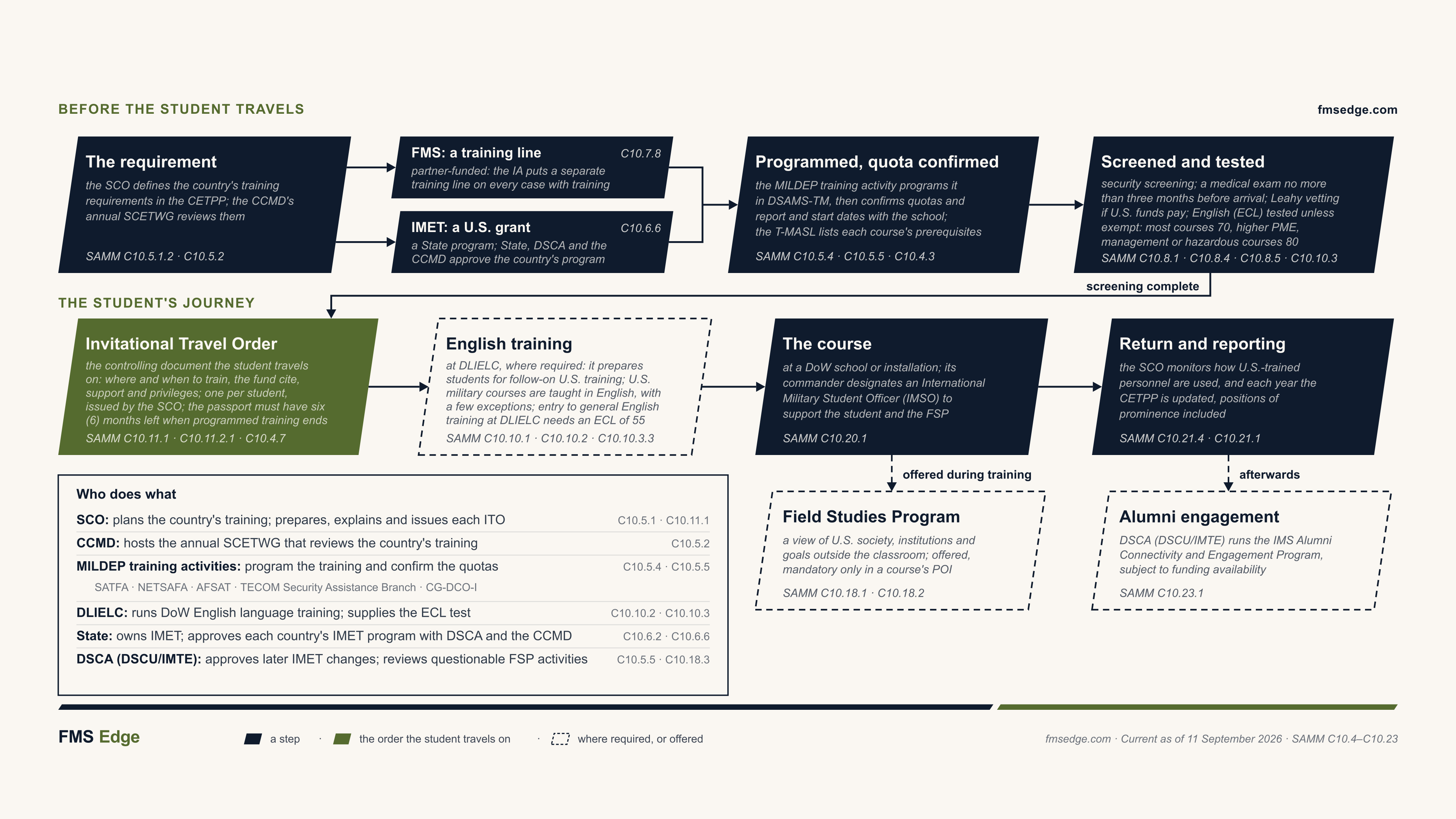
An international military student reaches a U.S. course through a chain of plans and paperwork, from the Security Cooperation Organization's requirement to a seat confirmed by the Military Department's training activity. The student travels on an Invitational Travel Order.
What is International Military Education and Training (IMET)?
International Military Education and Training () is a Department of State program that pays for military education and training courses for international military personnel and related civilian personnel of foreign countries. The Department of State and the manage it jointly [SAMM ].
The program is authorized by the Foreign Assistance Act (), and the Military Departments () are reimbursed from the Department of State’s () annual foreign operations appropriations [SAMM ].
The program provides grant financial assistance for training in the U.S. and, in some cases, in overseas facilities to selected foreign military and civilian personnel. The and the Department of State jointly manage this appropriated program [SAMM ]. In earlier years, grant aid training of foreign military personnel was funded as part of the appropriation. Starting in fiscal year () 1976, a separate authorization for was established in Section 541, .
The , Chapter 10, explains that the program is a key component of (), promoting regional stability and defense capabilities through professional military and technical courses and specialized instruction [SAMM ]. Technical training can be provided under , but it should be a minimal component of the overall program [SAMM ]. courses are provided primarily at military schoolhouses in the U.S., exposing the to the U.S. culture, military students, practices, standards, and professionalism [SAMM ].
-funded training has the following objectives [SAMM ]:
- Encouraging effective, mutually beneficial relations and greater understanding between the United States and foreign countries, furthering the goals of international peace and security
- Developing rapport, understanding and communication links
- Developing the host nation's self-sufficiency in training
- Improving the host nation's ability to manage its defense establishment
- Developing the skills to operate and maintain U.S.-origin equipment
Complete guidance on developing an program can be found in the Department of State’s Grant-Military Assistance Guide (G-MAG).
Under Section 21(a)(1)(C), , training sold through to a purchaser concurrently receiving , or to a high-income foreign country, is priced at only the additional costs the U.S. Government () incurs in furnishing it [SAMM ] []. Section 644(m)(5), , was amended in 1980 to authorize tuition costing in terms of the additional costs incurred by the in furnishing such assistance.
What is Expanded IMET?
The program is not a separate program from the program but a special category of training and education within the authority [SAMM ]. Through the program, a broader eligibility of students may attend courses that qualify as meeting objectives. Civilians who work in the country’s non-defense ministries, legislators, and individuals who are not members of the government can attend courses that qualify as an course, using funds [SAMM ].
Civilian and military personnel who work in the country's Ministry of Defense (MoD) are eligible for training. may also be used to train foreign government personnel of ministries other than the MoD, legislators, and people outside the government, where the training would contribute to the objectives [SAMM ].
Training is also authorized where its express purpose is for defense civilians to teach, develop or manage in-country English Language Training () programs. may also train defense civilians who work in counternarcotics-related areas. Maritime law enforcement and other maritime skills training is authorized for personnel of non-defense ministries or agencies that perform a maritime law enforcement mission [SAMM ].
began as a congressional initiative for courses for foreign officers. Congress later allowed it to include civilian managers and administrators of defense establishments. Such training focuses on developing professional-level management skills, with emphasis on military justice systems, codes of conduct, and the protection of human rights. Congress amended Section 541, , to permit non-Ministry of Defense civilian government personnel to be eligible for this program if such military education and training would do the following:
- Contribute to responsible defense resource management
- Foster greater respect for and understanding of the principle of civilian control of the military
- Contribute to cooperation between military and law enforcement personnel with respect to counter-narcotics law enforcement efforts
- Improve military justice systems and procedures in accordance with internationally recognized human rights
In 1993, Congress further extended the program to include participation by national legislators responsible for oversight and management of the military. Through P.L. 104-164, Congress again amended the in 1996 to include non-governmental organization personnel.
courses include resident courses in the and courses conducted by Mobile Education Teams (). In order to qualify as an course, over 50 percent of the course’s curriculum must cover one or more of the objectives. , with the Department of State where appropriate, determines whether a course qualifies as an course or not [SAMM , ].
A course may be certified as an course when it meets one or all of the objectives in Section C10.6.3.2. Certification rests on a determination of curriculum content by 's International Military Training and Education Division (/IMTE) at the Defense University, made where appropriate with the Office of in 's Bureau of Political-Military Affairs ( (PM/SA)) [SAMM ].
Figure C10.F3 details the process for requesting certification or recertification of a course or program, and the templates are under the "Forms" tab of the . The list of approved courses is on the Web (SANweb)/ [SAMM ].
What does Expanded IMET teach about civilian control and military justice?
trains military and civilian personnel in managing and administering military establishments and budgets, and in promoting civilian control of the military. It also trains them to create and maintain effective military justice systems and military codes of conduct that are in accordance with internationally recognized human rights [SAMM ].
Civilian control of the military generally means that:
- The armed forces do not dominate government or impose their unique values upon civilian institutions and organizations
- The armed forces have no independent access to sources of military funding
- The armed forces’ policies on the recruitment, pay, education, training, treatment, promotion, and use of personnel are not inconsistent with basic civil liberties and individual beliefs, with some compromises for military discipline and combat effectiveness
- The use of military force, either for or against military action, is not determined by the values of the military establishment itself
Military justice relates to legal systems within each nation that govern order and discipline of members of their armed forces. For example, U.S. armed forces members are subject to the Uniform Code of Military Justice (). The following military justice-related topics are especially complementary to the overall framework of human rights:
- The rights and responsibilities of military personnel
- The role of the military commander in military justice
- Effective military justice systems and how they ensure accountability for and deterrence from human rights abuses by military personnel
An -certified course will be reviewed at five-year intervals. When the curriculum of an existing course or program changes substantively, the schoolhouse is responsible for resubmitting it for review and certification [SAMM ].
When law or policy restricts a country to assistance only, and its support, such as language labs, count as an course. Military personnel and related civilians from countries whose programs are limited to may only do the following [SAMM ]:
- Receive English language support through the program
- Take part in stand-alone
- Take part in preparatory associated with other courses
The , which each updates no later than 30 days before the annual , carries, in its human rights appendix, the following questions [SAMM , ]: (1) Does the country generally receive poor marks on human rights from internationally recognized organizations like Freedom House? (2) If “yes” to question 1 above, to what degree is the military part of the rationale for the poor marks? (3) If the country receives poor marks, how does -provided training planned for this country address human rights, civil-military relations, etc.?
What training can IMET not provide?
C10.6.3 provides information on the types of training that can be provided under the program. Some types of training require a waiver approved by both the and [SAMM , ].
Certain types of training are prohibited under the program such as sniper training and foreign language training [SAMM ]. For a complete list of types of training not provided by see C10.T4. In addition, Section 660, , prohibits using to provide police training to military or civilian police if they perform a civilian law enforcement function [SAMM ] [].
Military Police (MP) training funded by is permitted for MP and non-police personnel and units. It requires that an appropriate host nation official certify that the students apply the skills learned in MP training as part of their military function, rather than in civilian law enforcement [SAMM ]. The must also certify to (PM/SA) that each student does not currently conduct civilian law enforcement functions and will not take part in civilian law enforcement activities for two years after returning from training [SAMM ]. The certification is signed by an appropriate host nation official; a copy must reach (PM/SA), and the before the student is sent to training, and the must keep it on file for at least three years [SAMM ].
Does IMET pay for training on equipment bought through Foreign Military Sales?
Generally, technical training is funded through an case, and although can be used for it, it should be a minimal component of the overall program [SAMM ].
can be used for technical training needed to support significant host-country military deficiencies, for training that helps the country become self-sufficient in training instructors, and for training that gives the the skills needed to take part in peace support operations. Where technical training would be more than a small component of the overall program, (/IMTE) is the contact for questions about using funds for it [SAMM ].
Which regulations govern IMET training?
In carrying out training management, the , specifically Chapter 10, is used for overall general guidance, although references to international training management can be found throughout other chapters in the .
The Joint Education and Training () Regulation (AR 12-15; SECNAVINST 4950.4B; AFI 16-105), published jointly by the military services, provides further direction in carrying out policies identified in the [SAMM ]. Each chapter of the opens with sections that apply across the military departments, and chapters 2 through 13 then set out separate instructions for the Army, the Navy (with the Marine Corps and Coast Guard) and the Air Force [].
References
SAMM
- SAMM C10.6.2.1
- SAMM C10.T1: Legislation for International Education and Training
- SAMM C10.6.3.2: Expanded International Military Education and Training.
- SAMM C10.F3: Request for Certification or Re-Certification of Expanded International Military Education and Training Courses
- SAMM C10.6.3.2.2
- SAMM C10.6.3.2.3
- SAMM C10.5.1.2.1
- SAMM C10.F1: Sample Combined Education and Training Program Plan
- SAMM C10.6.5: Types of Training that May Not Be Provided under the International Military Education and Training Program.
- SAMM C10.6.7: Requests for International Military Education and Training Policy Waivers.
- SAMM C10.T4: Types of Training Not Provided Under IMET
- SAMM C10.6.4.4: Training of Police Forces.
- SAMM C10.6.4.4.2: Certification.
- SAMM C10.1.3
- SAMM C10.6.1
- SAMM C10.6.3.1: International Military Education and Training Program.
- SAMM C10.6.4.3.2: Expanded International Military Education and Training.
- SAMM C10.6.3.9: Technical Training.
- SAMM C10.6.3.2.1
- SAMM C10.6.4.4.1: Military Police Training.
Public authorities
- AECA §21: Arms Export Control Act of 1976, as amended, §21 (22 U.S.C. §2761)
- FAA §660: Foreign Assistance Act of 1961, as amended, §660 (22 U.S.C. §2420), Police training prohibition
- AR 12-15: Joint Security Cooperation Education and Training (JSCET), Army Regulation 12-15, also issued as SECNAVINST 4950.4B and AFI 16-105 (3 January 2011; administrative revision 18 March 2025)
Facts referenced
- Share of a course's curriculum content that must meet the E-IMET objectives for DSCA to categorize the course as E-IMET: 50 percent (as of 11 September 2026; SAMM C10.F3)
- Interval at which courses certified as Expanded IMET are reviewed: five-year (as of 11 September 2026; SAMM C10.6.3.2.2)
- Days before the combatant command's annual Security Cooperation Education and Training Working Group by which SCOs must update their Combined Education and Training Program Plan (unless the CCMD directs otherwise): 30 days (as of 26 October 2026; SAMM C10.5.1.2.1)
- Years after return from U.S.-funded IMET training during which a military police student must not be involved in civilian law enforcement, per the SCO's certification to State: two (as of 26 October 2026; SAMM C10.6.4.4.2)
- Minimum years the SCO keeps a military police training certification on file: three (as of 26 October 2026; SAMM C10.6.4.4.2)
Related
IMET: International Military Education and Training
SAMM Acronyms, as of 12 September 2026
Defense Security Cooperation Agency (DSCA)
The Department of War agency that directs, administers and provides guidance to the Department's components and its representatives at U.S. missions for the execution of the security cooperation programs for which it is responsible [SAMM C1.3.2.2]. The agency also provides financial and technical assistance, arranges the transfer of defense materiel, training and services to international partners, and promotes military-to-military contacts.
FMS Edge glossary, as of 10 October 2026
Glossary entry →Open the manual’s entry → (opens in new tab)
Foreign Military Sales (FMS)
The part of U.S. security assistance, authorized by the Arms Export Control Act (AECA), in which eligible foreign governments and international organizations buy defense articles, services and training from the U.S. Government under formal government-to-government agreements.
The articles come either from Department of War stocks or from new procurement under contracts the Department manages [22 U.S.C. 2761, 22 U.S.C. 2762]. A sale is FMS whatever the source of the purchaser's financing.
FMS Edge glossary, as of 10 October 2026
Glossary entry →Open the manual’s entry → (opens in new tab)
Military Department (MILDEP)
One of the departments within the DoD created by the National Security Act of 1947, as amended. The Military Departments are: the Department of the Air Force, the Department of the Army, and the Department of the Navy.
SAMM Glossary, as of 12 September 2026
Glossary entry →Open the manual’s entry → (opens in new tab)
Military Assistance Program (MAP)
That portion of the United States Security Assistance program authorized by the Foreign Assistance Act of 1961, as amended, which once provided defense articles and services to recipients on a nonreimbursable (grant) basis. Funding for MAP was consolidated under the Foreign Military Financing program beginning in Fiscal Year 1990.
SAMM Glossary, as of 12 September 2026
Glossary entry →Open the manual’s entry → (opens in new tab)
Fiscal Year (FY)
The USG’s accounting period. It begins on October 1 and ends on September 30 and is designated by the calendar year in which it ends.
SAMM Glossary, as of 12 September 2026
Glossary entry →Open the manual’s entry → (opens in new tab)
Security Assistance Management Manual (SAMM)
DSCA Manual 5105.38-M required under DoD Directive 5105.65, "Defense Security Cooperation Agency" mandatory for use by all DoD Components. The SAMM provides DoD-wide guidance to the Office of the Secretary of Defense (OSD), the Military Departments (MILDEPs), the Office of the Chairman of the Joint Chiefs of Staff and the Joint Staff, the Combatant Commands, the Defense Agencies, the DoD Field Activities, the Security Cooperation Organizations (SCOs), and all other organizational entities within the DoD engaged in the management or implementation of DoD Security Assistance and Security Cooperation programs over which DSCA has responsibility.
SAMM Glossary, as of 12 September 2026
Glossary entry →Open the manual’s entry → (opens in new tab)
Security Cooperation
Activities by which the Department of War encourages and enables international partners to cooperate with the United States toward strategic objectives, spanning every interaction with foreign defense and security establishments and every security assistance program the Department administers.
Under chapter 16 of Title 10, their purposes are to develop allied and friendly security capabilities for self-defense and multinational operations, to give U.S. forces peacetime and contingency access, and to build relationships promoting specific U.S. security interests [10 U.S.C. 301(7)].
FMS Edge glossary, as of 10 October 2026
Glossary entry →Open the manual’s entry → (opens in new tab)
International Military Student (IMS)
A national of a foreign government, with military or civilian status of that government, who is receiving education or training or is touring USG activities under the sponsorship of the security assistance training program.
SAMM Glossary, as of 12 September 2026
Glossary entry →Open the manual’s entry → (opens in new tab)
Arms Export Control Act (AECA)
The basic U.S. law providing the authority and general rules for the conduct of Foreign Military Sales and commercial sales of defense articles, defense services, and training. The Arms Export Control Act (AECA) came into existence with the passage of the Foreign Military Sales Act (FMSA) of 1968. An amendment in the International Security Assistance and AECA of 1976 changed the name of FMSA to the AECA.
SAMM Glossary, as of 12 September 2026
Glossary entry →Open the manual’s entry → (opens in new tab)
Expanded IMET (E-IMET)
Training funded under the International Military Education and Training (IMET) program to the following four objectives: proper management of defense resources, improving military justice systems in accordance with internationally recognized human rights, understanding the principle of civilian control of the military, and contributing to the cooperation between police and military forces for counternarcotics law enforcement [sec.541, Foreign Assistance Act].
SAMM Glossary, as of 12 September 2026
Glossary entry →Open the manual’s entry → (opens in new tab)
Continental United States (CONUS)
U.S. territory, including the adjacent territorial waters, located within the North American continent between Canada and Mexico. Does not include Hawaii or Alaska.
SAMM Glossary, as of 12 September 2026
Glossary entry →Open the manual’s entry → (opens in new tab)
Mobile Education Team (MET)
A team of Department of War personnel on temporary duty in a partner country to educate its personnel in professional subjects such as resource management, acquisition, civilian control of the military, internationally recognized human rights, and policy and doctrine development. Such teams are normally funded with International Military Education and Training (IMET) or Expanded IMET funds.
FMS Edge glossary, as of 10 October 2026
Glossary entry →Open the manual’s entry → (opens in new tab)
DSCA: Defense Security Cooperation Agency
SAMM Acronyms, as of 12 September 2026
Glossary entry →Defense Security Cooperation Agency (DSCA) →
Security Assistance (SA)
A group of programs authorized by federal statutes by which the United States provides defense articles, military training, and other defense-related services by grant, lease, loan, credit, or cash sales in furtherance of national policies and objectives, and those that are funded and authorized through the Department of State to be administered by Department of Defense/Defense Security Cooperation Agency, which are considered part of security cooperation.
SAMM Glossary, as of 12 September 2026
Glossary entry →Open the manual’s entry → (opens in new tab)
Security Cooperation Training Management System (SC-TMS)
A data system within Security Assistance Network Web used primarily by Security Cooperation Organizations and International Military Student Offices to manage the Security Cooperation training program for the foreign partner. SC-TMS produces International Military Education and Training and Foreign Military Sales management reports, invitational travel orders, and other training management documents.
SAMM Glossary, as of 12 September 2026
Glossary entry →Open the manual’s entry → (opens in new tab)
Security Assistance Network (SAN)
A web-based system, also called SANweb, that hosts security cooperation applications, chiefly for international training management and its budget, planning and programming data, together with a library for sharing documents and tools to manage user accounts and access.
Its counterpart, the International SAN (ISAN), gives partner countries limited access, and its one application is the Partner Security Cooperation Training Management System.
FMS Edge glossary, as of 10 October 2026
Glossary entry →Open the manual’s entry → (opens in new tab)
SC-TMS: Security Cooperation-Training Management System
SAMM Acronyms, as of 12 September 2026
Glossary entry →Security Cooperation Training Management System (SC-TMS) →
Combined Education and Training Program Plan (CETPP)
A plan each Security Cooperation Organization (SCO) prepares with host-country counterparts that consolidates the partner's training needs, with the program objectives and justifications used to set country allocations of grant-funded training.
It includes all of the SCO's training requirements for a three-year period: the current year, the budget year and the planning year [SAMM C10.22.7.2].
FMS Edge glossary, as of 10 October 2026
Glossary entry →Open the manual’s entry → (opens in new tab)
Security Cooperation Organization (SCO)
A Department of Defense element that is part of the United States Diplomatic mission located in a foreign country to carry out security assistance and security cooperation management functions under the supervision and coordination authority of the senior defense official/defense attaché.
SAMM Glossary, as of 12 September 2026
Glossary entry →Open the manual’s entry → (opens in new tab)
Security Cooperation Education and Training Working Group (SCETWG)
An annual combatant command conference that sets the security assistance and security cooperation training program for each eligible partner country in the command's area of responsibility.
Security Cooperation Organizations (SCOs) submit their education and training requests there, drawn from each country's Combined Education and Training Program Plan (CETPP) [SAMM C10.22.7.3].
FMS Edge glossary, as of 10 October 2026
Glossary entry →Open the manual’s entry → (opens in new tab)
SAMM: Security Assistance Management Manual
SAMM Acronyms, as of 12 September 2026
Glossary entry →Security Assistance Management Manual (SAMM) →
Combatant Command (CCMD)
A unified or specified command with a broad continuing mission under a single commander established and so designated by the President, through the Secretary of Defense and with the advice and assistance of the Chairman of the Joint Chiefs of Staff. Also called CCMD.
SAMM Glossary, as of 12 September 2026
Glossary entry →Open the manual’s entry → (opens in new tab)
SCO: Security Cooperation Organization
SAMM Acronyms, as of 12 September 2026
FMS: Foreign Military Sale
SAMM Acronyms, as of 12 September 2026
Joint Security Cooperation Education and Training Regulation (JSCET)
Regulation that prescribes policies, responsibilities, procedures, and administration for the education and training of International Military Students by the Departments of the Army, Navy and Air Force as authorized by U.S. Security Assistance legislation. Regulation is also applicable to the Marine Corps and Coast Guard.
SAMM Glossary, as of 12 September 2026
Glossary entry →Open the manual’s entry → (opens in new tab)
SAMM C10.6.1
“The International Military Education and Training (IMET) program is a Department of State (State) program, jointly managed by DSCA and State, that funds military education and training courses for international military, and related civilian personnel of foreign countries. It is a key component of security cooperation (SC), promoting regional stability and defense capabilities through professional military and technical courses and …”
Security Assistance Management Manual, as of 11 September 2026
SAMM C10.6.2.1
“State has overall responsibility for the IMET program. Congress appropriates IMET funds each year under the Foreign Assistance Act (FAA), and country allocations are justified and documented in the Congressional Budget Justification (CBJ) for Foreign Operations. Based on Congressional guidance and State approved country allocations, DSCA (Defense Security Cooperation University (DSCU)) and DSCA (Office of Business Operations (OBO)) manages and …”
Security Assistance Management Manual, as of 11 September 2026
SAMM C10.6.3.9: Technical Training.
“Although technical training can be accomplished under IMET, it should be a minimal component of the overall program. IMET can be used for: technical training necessary to support significant host-country military deficiencies; training that promotes in-country sufficiency of training instructors; and training to enable the IMS to acquire skills necessary to participate in peace support operations. Generally, this type of …”
Security Assistance Management Manual, as of 26 September 2026
SAMM C10.6.3.1: International Military Education and Training Program.
“The objectives of IMET-funded training are to encourage effective and mutually beneficial relations and increased understanding between the United States and foreign countries in furtherance of the goals of international peace and security, develop rapport, understanding, and communication links; develop host nation training self-sufficiency; improve host nation ability to manage its defense establishment; and develop skills to operate and maintain …”
Security Assistance Management Manual, as of 11 September 2026
SAMM C10.T1: Legislation for International Education and Training
“Table C10.T1. Legislation for International Education and Training Legislation Subject Arms Export Control Act (AECA), Section 21(a)(1)(C) (22 U.S.C 2761(a)(1)(C)) Foreign Military Sales (FMS) for defense training Pricing criteria (“full costs” or “additional costs” incurred by the United States) AECA, Section 30(a) (22 U.S.C. 2770(a)) Exchanges of training and related support AECA Section 42(c) (22 U.S.C. 2791(c)) Offshore Procurement with …”
Security Assistance Management Manual, as of 26 October 2026
Arms Export Control Act of 1976, as amended, §21 (22 U.S.C. §2761)
AECA §21 · Statute
SAMM C10.6.3.2: Expanded International Military Education and Training.
“Expanded IMET (E-IMET) is a special category of training and education within the IMET authority. Under the authorization for E-IMET, military and civilian personnel are trained in managing and administering military establishments and budgets; in promoting civilian control of the military; and in creating and maintaining effective military justice systems and military codes of conduct in accordance with internationally recognized …”
Security Assistance Management Manual, as of 11 September 2026
SAMM C10.6.4.3.2: Expanded International Military Education and Training.
“Civilians and military personnel who work in the country’s MoD are eligible for training under E-IMET. E-IMET may also be used to train foreign governmental personnel of ministries other than the MoD, legislators, and individuals who are not members of the government, when the military education and training would contribute to the E-IMET objectives. Training of defense civilians for the …”
Security Assistance Management Manual, as of 11 September 2026
SAMM C10.6.3.2.1
“Based on a determination of curriculum content by DSCA (DSCU/IMTE), in collaboration with Department of State, Bureau of Political-Military Affairs, Office of Security Assistance (State (PM/SA)) where appropriate, courses that meet one or all of the objectives in Section C10.6.3.2., may be certified as an E-IMET course. The process to request certification or recertification of E-IMET courses or programs are …”
Security Assistance Management Manual, as of 11 September 2026
SAMM C10.F3: Request for Certification or Re-Certification of Expanded International Military Education and Training Courses
“… Eligibility is based on DSCA’s determination that greater than 50 percent of the curriculum content meet the listed objectives: Contribute to responsible defense resource management and administering military establishments and budgets; Fostering Greater Respect for and Understanding of the Principle of Civilian Control of the Military (CCM); contribute to cooperation between military and law enforcement personnel with respect to counter-narcotics …”
Security Assistance Management Manual, as of 11 September 2026
SAMM C10.6.3.2.2
“Courses that are certified as E-IMET will be reviewed at five-year intervals. If the curriculum of an existing E-IMET course/program substantively changes, it is the responsibility of the schoolhouse to resubmit that program for E-IMET review/certification.”
Security Assistance Management Manual, as of 11 September 2026
SAMM C10.6.3.2.3
“When countries are restricted by law or policy to E-IMET assistance only, English Language Training (ELT) and support, such as language labs, qualify as an E-IMET course. Military and related civilian personnel from countries whose IMET programs are restricted to E-IMET may only: Participate in stand-alone ELT,, Receive English language support through the IMET program, or Participate in preparatory ELT …”
Security Assistance Management Manual, as of 11 September 2026
SAMM C10.5.1.2.1
“MILGPs, in coordination with partner nation counterparts, must update their CETPP for planning use by the Military Services no later than 30 days before their CCMD annual Security Cooperation Education and Training Working Group (SCETWG) or as directed by the CCMD.”
Security Assistance Management Manual, as of 26 October 2026
SAMM C10.F1: Sample Combined Education and Training Program Plan
“… Does the country generally receive poor marks on human rights from internationally recognized organizations like Freedom House? If YES, to what degree is the military part of the rationale for the poor marks? If the country receives poor marks, how does IMET-provided training planned for this country address human rights, civil-military relations, etc.? Are there any areas where more detailed …”
Security Assistance Management Manual, as of 26 October 2026
SAMM C10.6.5: Types of Training that May Not Be Provided under the International Military Education and Training Program.
“Table C10.T4. illustrates the types of training that cannot be provided under the IMET program. These restrictions apply only to training funded through the IMET program and will be adjusted to reflect the current language in the State IMET Grant-Military Assistance Guide (G-MAG). Any request for exception must be submitted through the CCMD to DSCA (DSCU/IMTE). Table C10.T4. Types of …”
Security Assistance Management Manual, as of 26 October 2026
SAMM C10.6.7: Requests for International Military Education and Training Policy Waivers.
“Policy waiver requests will be reviewed and considered during the program review portion at the CCMD’s SCETWG. Requests include complete justification and MILGP Chief’s concurrence. Requests submitted outside the SCETWG are addressed by the MILGP to the CCMD with an information copy to DSCA (DSCU/IMTE) and the appropriate IA. DSCA (DSCU/IMTE) and the CCMD jointly respond to the MILGP request …”
Security Assistance Management Manual, as of 26 October 2026
SAMM C10.T4: Types of Training Not Provided Under IMET
“Table C10.T4. Types of Training Not Provided Under IMET # Types Of Training Not Provided Under IMET 1 Training not related to accomplishment of the objectives of the IMET program; 2 Initial or technical training in support of FMS-purchased equipment (provided under an FMS case) (See Section C10.6.3.10.) 3 Training of non-career military personnel 4 Training in skills normally available …”
Security Assistance Management Manual, as of 26 October 2026
SAMM C10.6.4.4: Training of Police Forces.
“FAA, Section 660 (22 U.S.C. 2420) does not permit training of police forces or law enforcement forces although there may be limited exceptions; contact DSCA (DSCU/IMTE) for questions regarding exceptions. Neither the name given to a unit by the foreign government nor the ministerial authority under which it operates is sufficient to determine whether a particular force is a “police …”
Security Assistance Management Manual, as of 26 October 2026
Foreign Assistance Act of 1961, as amended, §660 (22 U.S.C. §2420), Police training prohibition
FAA §660 · Statute
SAMM C10.6.4.4.1: Military Police Training.
“IMET funded Military Police (MP) training for MP and non-police personnel and units is permitted but requires that an appropriate host nation official certify that the skills learned in MP training programs are applied as part of the student’s military function, rather than in a civilian law enforcement function. See certification requirements in Section C10.6.4.4.2.”
Security Assistance Management Manual, as of 11 September 2026
SAMM C10.6.4.4.2: Certification.
“MILGPs must certify to State (PM/SA) that an individual attending MP training: 1) does not currently conduct civilian law enforcement functions; and 2) will not be involved in any civilian law enforcement activities for a period of two years following return from U.S. funded IMET training. Certifications must be accompanied by an English translation if in a language other than …”
Security Assistance Management Manual, as of 26 October 2026
SAMM C10.1.3
“Training is an integral part of a total package approach (TPA) to building partner capability or capacity, and training must be considered when estimating delivery dates of equipment or resourcing any capacity building programs. Adjustments to deliveries may be necessary to ensure that foreign personnel have the training and skills to meet operational requirements. Training programs must consider the absorption …”
Security Assistance Management Manual, as of 11 September 2026
Joint Security Cooperation Education and Training (JSCET), Army Regulation 12-15, also issued as SECNAVINST 4950.4B and AFI 16-105 (3 January 2011; administrative revision 18 March 2025)
AR 12-15 · Regulation