
Guide
What is end-use monitoring in Foreign Military Sales?
End-use monitoring is how the U.S. Government verifies that defense articles transferred to partners are used, protected and kept as the transfer agreement requires. Every purchaser agrees to it in the ; the program is called Golden Sentry.
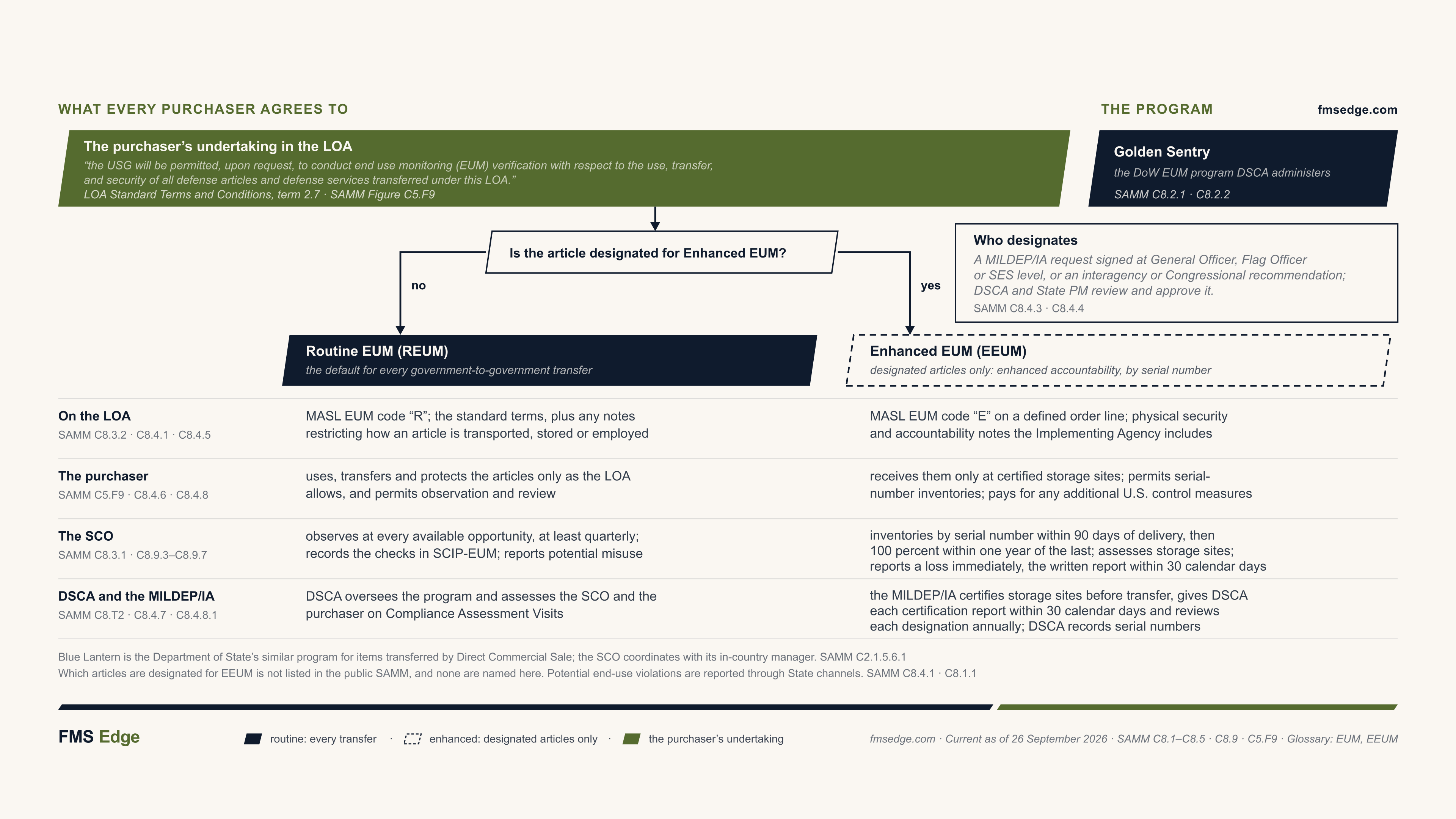
Every purchaser agrees in the LOA that the U.S. Government may verify how the articles it buys are used, transferred and secured; end-use monitoring under Golden Sentry, the DoW program DSCA administers, is how that verification is done. Routine end-use monitoring applies to every government-to-government transfer unless an article is designated for Enhanced EUM, which adds serial-number inventories, certified storage sites and security and accountability notes in the LOA. A designation starts with a MILDEP or Implementing Agency request, or an interagency or Congressional recommendation, and DSCA and State PM review and approve it; which articles are designated is not listed in the public SAMM, and none are named here.
What is end-use monitoring in Foreign Military Sales?
AECA Section 40A (22 U.S.C. 2785) requires the President to establish an program to improve accountability with respect to defense articles sold, leased, or exported under the or the of 1961, as amended. The Director, , has been delegated authority by the Secretary of War and Under Secretary of War for Policy (USW(P)) to administer the DoW program, known as Golden Sentry, to comply with Section 40A of the .
The program is designed to provide reasonable assurances that the recipient of U.S. defense articles is complying with the requirements imposed by the regarding the transfer, use, and protection of U.S.-origin defense articles and technology in the possession of international partners.
The decision to transfer or not hinges to a great extent on the recipient’s willingness to comply with the following three conditions:
1. Transfer: Will not transfer title or possession to anyone who is not an officer, employee, or agent of the purchaser unless given prior consent to do so by the ;
2. Use: Will not use defense articles for purposes other than those authorized by the ;
3. Protection: Will furnish substantially the same degree of security or protection that the would provide for the same article or information received.
In addition, the recipient must permit verification of the security measures and end use by representatives of the , typically the members of the .
These requirements are specified in the , Chapters 5 and 8, and the standard terms and conditions of every , and they will be included in any document authorizing the transfer of U.S.-origin defense articles and services.
Monitoring the use of U.S.-origin items is a joint responsibility of the receiving partner country or international organization (e.g., ) and the . representatives have full responsibility for monitoring defense articles until title is transferred to the partner. The partner country or international organization assumes monitoring responsibility based on the terms under which the transfer is made, including any restrictions on physical security and accountability. representatives retain a continuing responsibility under Golden Sentry to assist in verifying the appropriate end use and security of U.S.-origin defense articles and defense services sold or otherwise transferred on a government-to-government basis.
There are two levels of which may need to be carried out by the and the recipient country or organization: routine and enhanced.
Unless an article is designated for enhanced monitoring, Routine (REUM) is required for all defense articles and services provided through government-to-government programs. Articles and information subject to REUM are typically less sensitive or unclassified in comparison to items/data subject to enhanced end-use monitoring, and there are normally no special or additional security, use, or handling requirements specified in the . Every must conduct REUM observations at least quarterly and record them in the SCIP-EUM database. should perform these REUM checks in conjunction with other duties, using opportunities such as visits to partner installations, training or exercise observation, etc., or, credible reports provided by local media sources or other embassy, , or contract personnel.
Enhanced (), based on the principle of trust with verification, is required for specific kinds of defense articles and services and certain individual transfers of articles or technology otherwise subject to REUM. These "individual transfers" may be designated for by MILDEP export policies, stipulations imposed by interagency release approvals, or through special conditions imposed on these particular transfers by DoW, DOS, or Congress. All -designated defense articles are required to be sold on defined order lines using an -coded Military Articles and Services Listing () and are accompanied by specialized physical security and accountability notes found in the or other document governing these transfers.
References
SAMM
- SAMM GLOSSARY/end-use-monitoring-eum — End Use Monitoring (EUM)
- SAMM C8.3.2 — Articles or Services Requiring Additional Controls on End Use.
- SAMM C8.5.1 — End Use Monitoring Visit Guidance.
- SAMM C8.3.1 — Routine End Use Monitoring.
Public authorities
- Secretary of War memorandum, 7 November 2025, "Unifying the Department's Arms Transfer and Security Cooperation Enterprise to Improve Efficiency and Enable Burden-Sharing" — SecWar memo, 7 Nov 2025
- Department of War release, 10 February 2026, "Department of War Finalizes Realignment of the Defense Security Cooperation Agency and the Defense Technology Security Administration" — DoW release, 10 Feb 2026
Related
Letter of Offer and Acceptance (LOA)
The legal instrument used by the USG to transfer itemized defense articles, defense services, and design and construction services to foreign partners.
When used under the authorities provided in the Arms Export Control Act for Foreign Military Sales, the LOA is a binding agreement signed by the USG and the foreign partner to transfer such articles and services.
When used under Building Partnership Capacity (BPC) authorities, the BPC LOA is not signed by the Benefitting Partner.
SAMM Glossary, as of 12 September 2026
Glossary entry →Open the manual’s entry → (opens in new tab)
Arms Export Control Act (AECA)
The basic U.S. law providing the authority and general rules for the conduct of Foreign Military Sales and commercial sales of defense articles, defense services, and training. The Arms Export Control Act (AECA) came into existence with the passage of the Foreign Military Sales Act (FMSA) of 1968. An amendment in the International Security Assistance and AECA of 1976 changed the name of FMSA to the AECA.
SAMM Glossary, as of 12 September 2026
Glossary entry →Open the manual’s entry → (opens in new tab)
Security Assistance (SA)
A group of programs authorized by federal statutes by which the United States provides defense articles, military training, and other defense-related services by grant, lease, loan, credit, or cash sales in furtherance of national policies and objectives, and those that are funded and authorized through the Department of State to be administered by Department of Defense/Defense Security Cooperation Agency, which are considered part of security cooperation.
SAMM Glossary, as of 12 September 2026
Glossary entry →Open the manual’s entry → (opens in new tab)
AECA — Arms Export Control Act
SAMM Acronyms, as of 12 September 2026
EUM — End Use Monitoring
SAMM Acronyms, as of 12 September 2026
Defense Security Cooperation Agency (DSCA)
An agency, under the authority, direction, and control of the Under Secretary of Defense for Policy (USD(P)), that directs, administers, and provides DoD-wide guidance to the DoD Components and DoD representatives to U.S. missions abroad for the execution of DoD security assistance and security cooperation programs over which DSCA has responsibility, in accordance with Chapter 32 and Chapter 39 of title 22 U.S.C., DoD Directive (DoDD) 5132.03, other laws, and DoDD 5105.65.
SAMM Glossary, as of 12 September 2026
Glossary entry →Open the manual’s entry → (opens in new tab)
DSCA — Defense Security Cooperation Agency
SAMM Acronyms, as of 12 September 2026
Glossary entry →Defense Security Cooperation Agency (DSCA) →
Security Cooperation Organization (SCO)
A Department of Defense element that is part of the United States Diplomatic mission located in a foreign country to carry out security assistance and security cooperation management functions under the supervision and coordination authority of the senior defense official/defense attaché.
SAMM Glossary, as of 12 September 2026
Glossary entry →Open the manual’s entry → (opens in new tab)
SAMM — Security Assistance Management Manual
SAMM Acronyms, as of 12 September 2026
Glossary entry →Security Assistance Management Manual (SAMM) →
SCO — Security Cooperation Organization
SAMM Acronyms, as of 12 September 2026
LOA — Letter of Offer and Acceptance
SAMM Acronyms, as of 12 September 2026
MASL — Military Articles and Services List
SAMM Acronyms, as of 12 September 2026
Glossary entry →Military Articles And Services List (MASL) →
End Use Monitoring (EUM)
Mandated by Section 40A of the Arms Export Control Act (AECA) (22 U.S.C. 2785), activities undertaken by the U.S. Government to ensure that defense articles and defense services transferred to foreign partners under security assistance/cooperation authorities are monitored and used according to the terms and conditions specified in Letters of Offer and Acceptance and other transfer agreements, and as required by the AECA or the Foreign Assistance Act of 1961.
SAMM Glossary, as of 12 September 2026
Glossary entry →Open the manual’s entry → (opens in new tab)