
Guide
What is Foreign Military Sales case reconciliation?
Reconciliation is the financial and logistical work that keeps a case's accounting, data, schedules and reporting accurate. It starts when the case is implemented, continues through execution to Supply/Services Complete, and does not end until the case is final closed.
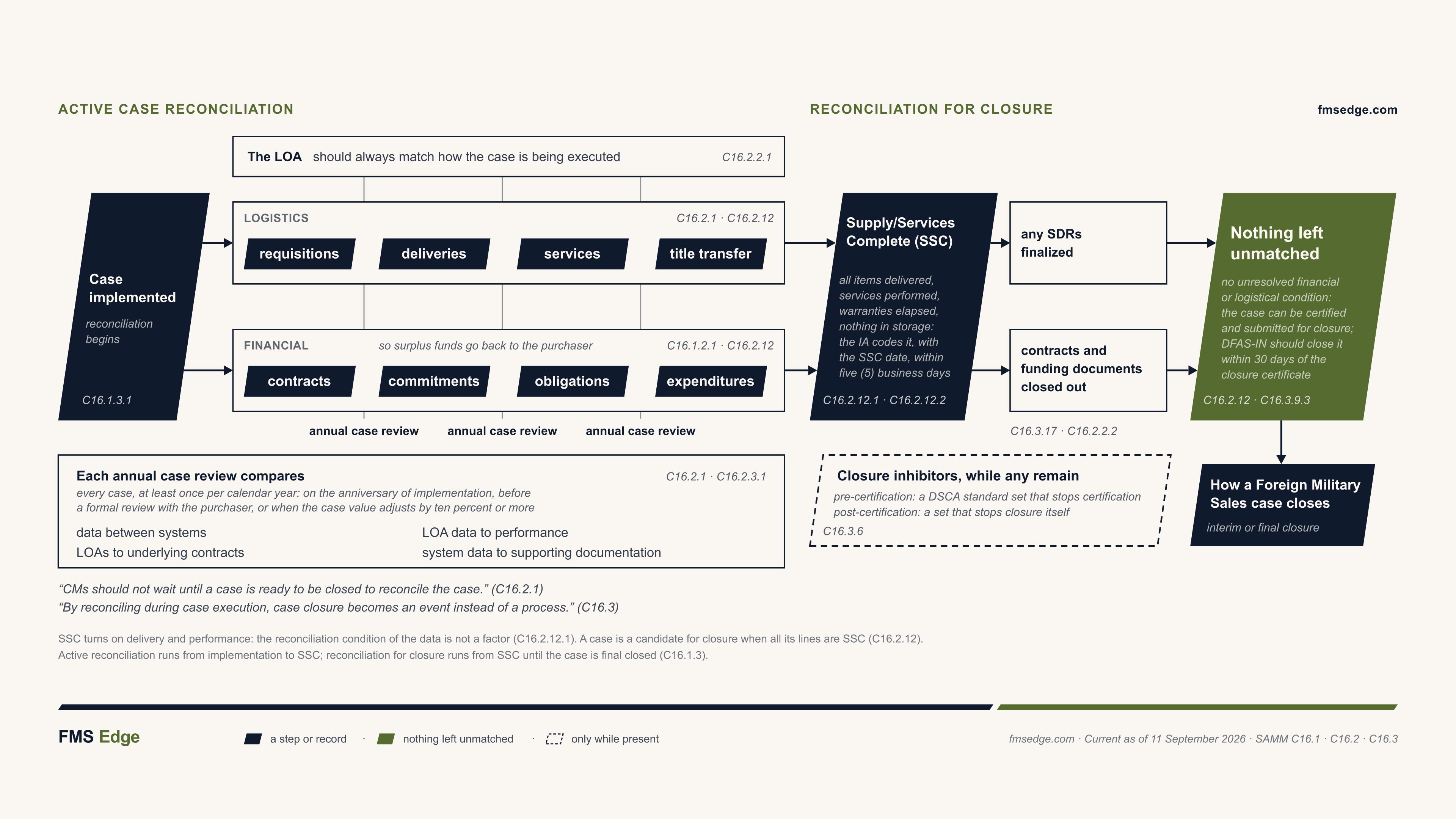
Reconciliation starts when a case is implemented, not when it is ready to close: logistics and financial records are reconciled as material is delivered and services are performed, and each annual case review checks them against the LOA. A case becomes Supply/Services Complete (SSC) when everything is delivered and performed; reconciliation for closure then runs until nothing is left unmatched, and only then can the case be certified and submitted for closure. What follows is shown in How a Foreign Military Sales case closes, on the Reconciliation & Closure stage.
What is Foreign Military Sales case reconciliation?
Reconciliation refers to the financial and logistical actions that ensure proper accounting, accuracy and thoroughness of data, currency of schedules, and timeliness and completeness of reporting. In turn, successful reconciliation throughout the life of a case expedites case closure. Case reconciliation is not a single action; rather, it is a series of actions (beginning with case implementation) identifying and resolving discrepancies among logistics and financial transactions throughout the life of a case. Reconciliation commences with the implementation of a case and does not end until the case is “final” closed. Reconciliation for closure involves extensive communication between various logistics, financial, and contract organizations to ensure associated closure transactions are completed. It is imperative that case and line reconciliation be initiated upon implementation of the case to make the closure process timely and easier. By reconciling during case execution, case closure becomes an event instead of a process. consolidated the case reconciliation and closure policies in Chapter 16. The policies in that chapter apply to both and cases.
Active case reconciliation
Active case review and reconciliation, extending from case implementation until the case is Supply/Service Complete (), are critical components of effective case management. It is mandatory that each case manager performs an annual case and review and/or reconciliation on each case, which includes comparing data between systems, comparing case data to performance, comparing cases to underlying contracts and comparing systemic data to hardcopy or electronic supporting documentation. Case managers are responsible for the timely reconciliation and closure certification of cases, regardless of how these activities are delegated within the responsible . Case managers should not wait until a case is ready to be closed to reconcile the case. Case managers should reconcile and close lines of accounting, requisitions, funding documents, and other program documents as material is delivered and services are performed. Several important reconciliation actions facilitate case closure. These include:
- Continuous, periodic reconciliation of essential financial data to allow for error detection, correction, and future actions at the earliest possible point in the case life cycle
- Establishing a comprehensive file of all transactions pertaining to the case. For some cases, this file could be quite large, filling several rooms if the files are maintained in their original form. However, large files may be reduced by the use of electronic media. The data files must also be filed and accessible to case managers and those responsible for final case reconciliation
- Recording case data with objective evidence. This simply means that every financial transaction, every cost, must be recorded. The recording of financial data in source documents will provide an audit trail, which can ensure the safeguarding of international partner and funds
- Ensuring case identifiers are recorded in all financial transactions. When the DoW accepts a case, it also accepts a fiduciary responsibility, which is completed once final reconciliation is accomplished.
Supply/services complete
Eventually, an active line or case transitions into Supply/Service Complete () status. A process exists (refer to , Appendix 7, RCG Figures AP7.C2.F15 and AP7.C2.F16) for deciding that a case or line is . The reconciliation condition of data (other than that which is preventing item delivery or actual completion of services), the allocation of resources (funding and/or manpower), or the distribution/transfer of workload are not factors in determining when occurs. The declares a case or line is when the following events occur by updating the status in the system (to include Date) and informing the international partner: [ C16.2.12.1]
- Verification that all items are delivered; title has transferred
- Verification that all services have been performed
- Training: Verification that all courses, Mobile Training Teams () and Extended Training Service Specialist/Language Training Detachments are completed, all Temporary Duties (TDYs) are finished, and all case-funded salary positions have expired.
- Period of performance for all other services has elapsed
- Program Management Line (PML): The end point may vary, but may be no later than 12 months after final delivery and/or performance of last non-PML service for the related case(s). Like any other service, the duration of PML must be linked to the period of performance
- All warranty periods have elapsed
- No items are in storage
- If the country is under suspensions and/or sanctions, there are no deliveries pending, and no future deliveries shall occur once sanctions are lifted
References
SAMM
- SAMM C16.2.12.2 — Supply/Services Complete Status Application.
- SAMM C16.2.13.2 — To Be Kept Open List.
Related
Foreign Military Sales (FMS)
A process, authorized by the Arms Export Control Act, through which eligible foreign governments and international organizations may purchase defense articles, services, and training from the United States Government.
SAMM Glossary, as of 12 September 2026
Glossary entry →Open the manual’s entry → (opens in new tab)
DSCA — Defense Security Cooperation Agency
SAMM Acronyms, as of 12 September 2026
Glossary entry →Defense Security Cooperation Agency (DSCA) →
SAMM — Security Assistance Management Manual
SAMM Acronyms, as of 12 September 2026
Glossary entry →Security Assistance Management Manual (SAMM) →
FMS — Foreign Military Sale
SAMM Acronyms, as of 12 September 2026
Payment Schedule
List of dollar amounts and when they are due from the foreign customer. The payment schedule is included in the Letter of Offer and Acceptance (LOA) presented to the customer. After acceptance of the LOA, the payment schedule generally serves as the basis for billing to the customer. Changes in the estimated costs of an Foreign Military Sales case may require changes in the accompanying payment schedule.
SAMM Glossary, as of 12 September 2026
Glossary entry →Open the manual’s entry → (opens in new tab)
Implementing Agency (IA)
The military department or defense agency responsible for the execution of military assistance programs. With respect to FMS, the military department or defense agency assigned responsibility by the Defense Security Cooperation Agency to prepare an LOA and to implement an FMS case. The implementing agency is responsible for the overall management of the actions that will result in delivery of the materials or services set forth in the LOA that was accepted by a foreign country or international organization.
SAMM Glossary, as of 12 September 2026
Glossary entry →Open the manual’s entry → (opens in new tab)
MTT — Mobile Training Team
SAMM Acronyms, as of 12 September 2026
Security Cooperation
Activities undertaken by the DoD to encourage and enable international partners to work with the United States to achieve strategic objectives. It includes all DoD interactions with foreign defense and security establishments, including all DoD-administered security assistance programs, that: build defense and security relationships that promote specific U.S. security interests, including all international armaments cooperation activities and security assistance activities; develop allied and friendly military capabilities for self-defense and multinational operations; and provide U.S. forces with peacetime and contingency access to host nations.
SAMM Glossary, as of 12 September 2026
Glossary entry →Open the manual’s entry → (opens in new tab)
Blanket Order Case (Foreign Military Sales)
A Foreign Military Sales Letter of Offer and Acceptance (LOA) that provides categories of defense articles and/or defense services with no definitive listing of items, quantities, or Months of anticipated materiel delivery or performance of services with the intent to use the lines on the LOA until funds are exhausted.
SAMM Glossary, as of 12 September 2026
Glossary entry →Open the manual’s entry → (opens in new tab)
Security Assistance (SA)
A group of programs authorized by federal statutes by which the United States provides defense articles, military training, and other defense-related services by grant, lease, loan, credit, or cash sales in furtherance of national policies and objectives, and those that are funded and authorized through the Department of State to be administered by Department of Defense/Defense Security Cooperation Agency, which are considered part of security cooperation.
SAMM Glossary, as of 12 September 2026
Glossary entry →Open the manual’s entry → (opens in new tab)
DSAMS — Defense Security Assistance Management System
SAMM Acronyms, as of 12 September 2026
Glossary entry →Defense Security Assistance Management Systems (DSAMS) →
LOA — Letter of Offer and Acceptance
SAMM Acronyms, as of 12 September 2026
Holding Account
An account established for each Foreign Military Sales country/international organization for the purpose of recording and safeguarding unidentified and certain earmarked funds for future use
SAMM Glossary, as of 12 September 2026
Glossary entry →Open the manual’s entry → (opens in new tab)
Unliquidated Obligation (ULO)
The amount of obligations that have not been liquidated by payments (disbursements).
SAMM Glossary, as of 12 September 2026
Glossary entry →Open the manual’s entry → (opens in new tab)