
Guide
What is a Delivery Term Code in Foreign Military Sales?
The on a line of a marks how far the U.S. Government moves a shipment before the purchaser takes over. The assigns a code to each line while it develops the case, and an assigned code can be updated by amendment after the case is implemented. On many lines the code's percentage prices the transportation; other lines carry it in the item's price, on a separate line, or not at all, because the purchaser moves the materiel itself.
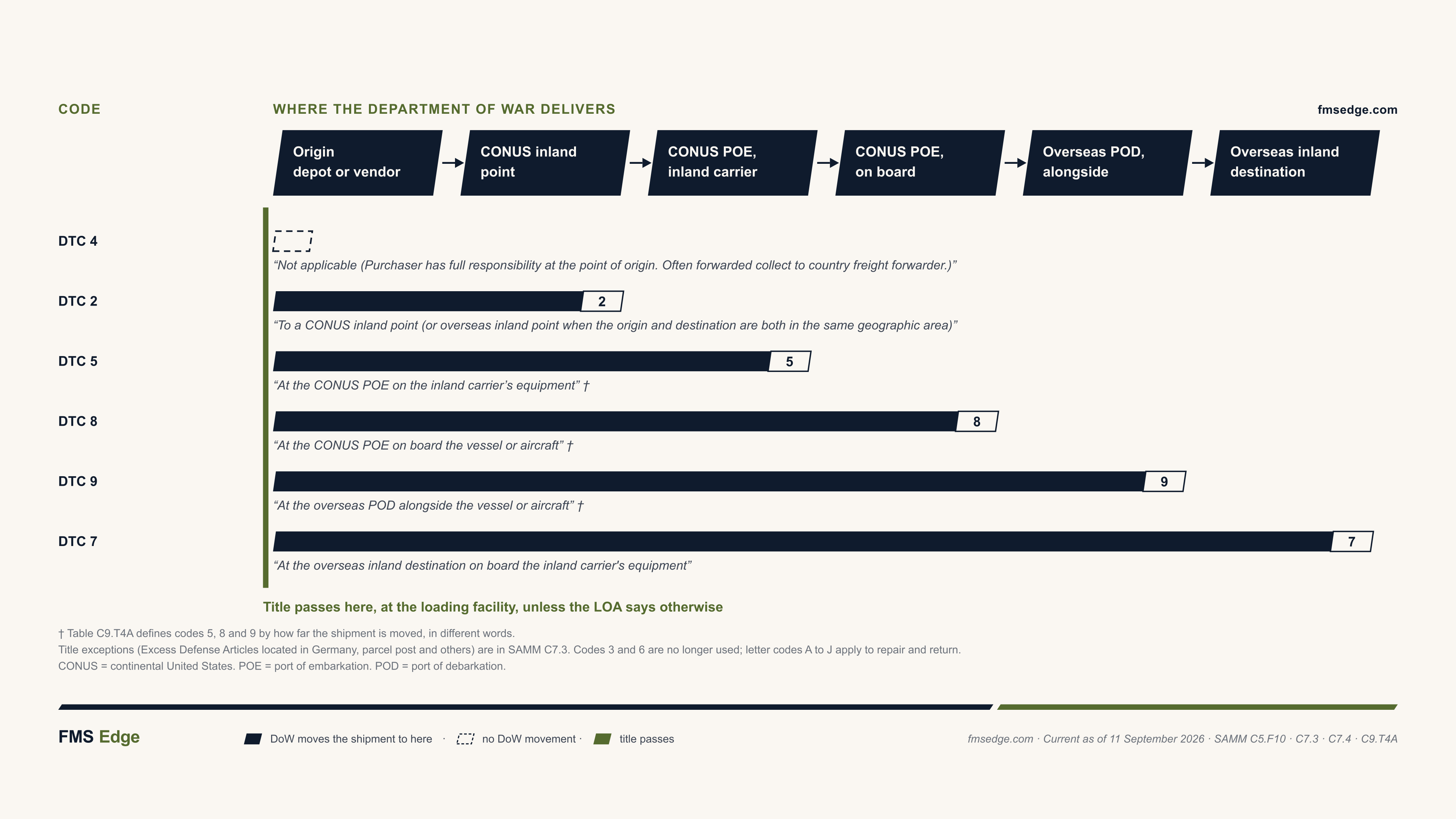
Each numeric Delivery Term Code sets where the Department of War delivers a shipment, from no movement at all (code 4) to the overseas inland destination (code 7). Title passes much earlier, at the loading facility where the shipment starts, unless the LOA says otherwise. The wording is the SAMM's own; no transportation rates are shown.
What is a Delivery Term Code?
The point of delivery is where responsibility for the physical movement of an shipment passes from the DoW to the purchaser. The point of delivery is identified on the by the . The point of delivery is generally a commercial airport or seaport and it can also be the ’s facility. However, there are numerous situations when the point of delivery may be at a military on board the purchaser’s carrier or at an overseas POD or final destination.
The indicates the point in the transportation cycle where responsibility for the physical movement of an shipment passes from the U.S. DoW to the purchaser. The normally specifies a delivery location for every line included in the case. The specifies to what point the U.S. will provide transportation, and, from that point onward, the purchaser provides the transportation. 5 indicates that the will sponsor transportation to the . This is normally the . 8 indicates pickup of items by at the point of origin and movement to a DoW-controlled port, where the materiel is loaded aboard the purchaser’s own ship or aircraft.
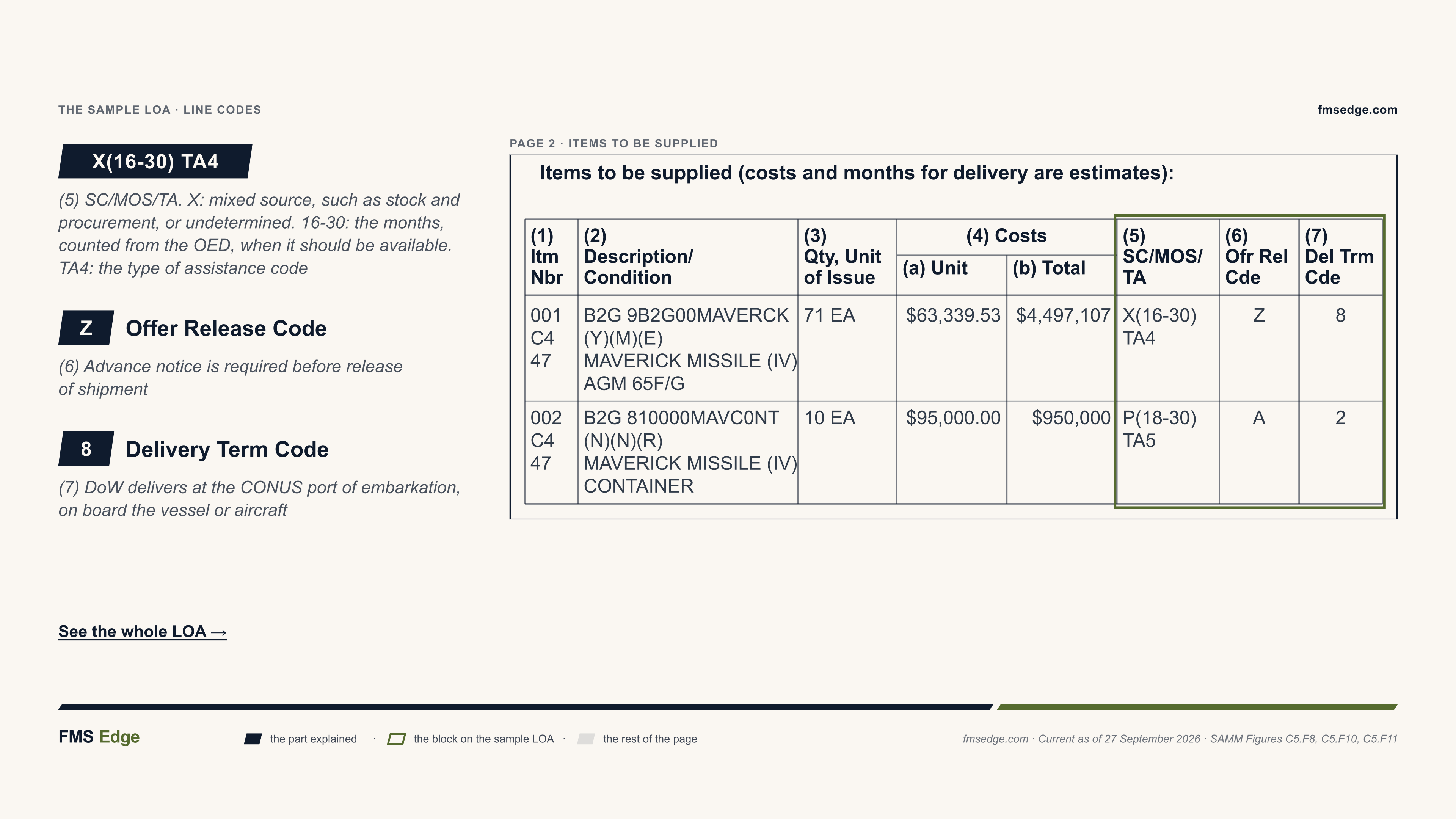
The source, months and type of assistance, offer release and delivery term codes on the first line of the sample LOA in SAMM Figure C5.F8. Bandaria is the manual's fictional training country; the figures are the SAMM's example, not a real case. Line 001 reads X(16-30) TA4, Z and 8: a mixed-source line, released only after advance notice, delivered at the U.S. port of embarkation.
Where the code travels
There are three major elements involved in the delivery of materiel to the proper purchasing country address. These elements are the , the requisition, and the system.
During the pre- planning and processing of the , various transportation blocks are completed, which identify how items will be shipped, when shipments will be released, where responsibility for physical movement of an shipment passes to the purchaser, and which accessorial charges are applicable. The serves as the authority to export. It is necessary, therefore, that the has a copy of the and all applicable amendments and modifications to the to facilitate shipments to the customer’s country. The purchaser should provide the and any amendments or modifications to the .
The second major element in the delivery of materiel and related documentation is the requisition. Once an case has been established and funded, applicable transportation/supply codes are copied from the into supply requisitions. For example, the offer/release code, , mark-for code, and code are embedded in requisitions to describe shipping information.
How the code prices transportation
When customers use the , a percentage is applied to the line to compute an estimated amount for these costs on the . percentages are based on the transportation provided (e.g., port-to-port or depot-to-in-country destination) and the rate area where articles are being delivered.
There are several methods of computing the cost of transportation based on the source of the materiel. Transportation costs may be included on the line price of the materiel being shipped, or it may be collected as a separate transportation line on the , or it may be computed as a percentage based on the item value and the . For major systems and components, transportation costs may be computed from estimated actual shipping costs identified in Appendix 2, “Transportation Cost Lookup Table.” For materiel returns and repairs, actual transportation costs may be assessed against the .
Codes that keep the Defense Transportation System in charge
For freight shipped surface via the with door-to-door delivery terms ( 7), the DoW is responsible for transportation, including trans-ocean and overseas inland movement from the point of origin to a specified inland location. The customer is responsible for unloading the shipment from the inland carrier at the specified location and for all subsequent onward movement. Any expenses the DoW incurs in the movement of materiel must be charged to the purchaser through the .
References
SAMM
- SAMM C7.4.1 — Delivery Term Code.
- SAMM C7.4.2
- SAMM C9.T4A — Table of Delivery Term Codes and Percentage
- SAMM C7.6.2.7 — Shipments by the U.S. Government to a Freight Forwarder or Embassy (DTC 5).
- SAMM C7.6.2.8 — Delivery on Board a Purchaser-Controlled Ship or Aircraft at a Department of Defense Port of Embarkation (DTC 8).
- SAMM C5.F10 — Letter of Offer and Acceptance Information
- SAMM C5.F11 — Instructions for Preparing a Letter of Offer and Acceptance
- SAMM C6.T7 — Modification for Foreign Military Sales Cases
Related
Delivery Term Code (DTC)
A single character code that represents how far the USG is responsible for arranging transportation of defense articles going to an international customer.
SAMM Glossary, as of 12 September 2026
Glossary entry →Open the manual’s entry → (opens in new tab)
Letter of Offer and Acceptance (LOA)
The legal instrument used by the USG to transfer itemized defense articles, defense services, and design and construction services to foreign partners.
When used under the authorities provided in the Arms Export Control Act for Foreign Military Sales, the LOA is a binding agreement signed by the USG and the foreign partner to transfer such articles and services.
When used under Building Partnership Capacity (BPC) authorities, the BPC LOA is not signed by the Benefitting Partner.
SAMM Glossary, as of 12 September 2026
Glossary entry →Open the manual’s entry → (opens in new tab)
Foreign Military Sales (FMS)
A process, authorized by the Arms Export Control Act, through which eligible foreign governments and international organizations may purchase defense articles, services, and training from the United States Government.
SAMM Glossary, as of 12 September 2026
Glossary entry →Open the manual’s entry → (opens in new tab)
Implementing Agency (IA)
The military department or defense agency responsible for the execution of military assistance programs. With respect to FMS, the military department or defense agency assigned responsibility by the Defense Security Cooperation Agency to prepare an LOA and to implement an FMS case. The implementing agency is responsible for the overall management of the actions that will result in delivery of the materials or services set forth in the LOA that was accepted by a foreign country or international organization.
SAMM Glossary, as of 12 September 2026
Glossary entry →Open the manual’s entry → (opens in new tab)
FMS — Foreign Military Sale
SAMM Acronyms, as of 12 September 2026
LOA — Letter of Offer and Acceptance
SAMM Acronyms, as of 12 September 2026
CONUS — Continental United States
SAMM Acronyms, as of 12 September 2026
Freight Forwarder
A commercial import/export company registered with the Department of State, Bureau of Political-Military Affairs, Directorate of Defense Trade Controls and under contract to the Foreign Military Sales customer which arranges transportation of materiel from a point specified in the Letter of Offer and Acceptance to the final destination.
SAMM Glossary, as of 12 September 2026
Glossary entry →Open the manual’s entry → (opens in new tab)
POE — Port of Embarkation
SAMM Acronyms, as of 12 September 2026
DTC — Delivery Term Code
SAMM Acronyms, as of 12 September 2026
Port of Embarkation (POE)
A military or commercial air or ocean port at which a carrier begins the journey to deliver materiel to the consignee. This is also referred to as the Port of Exit.
SAMM Glossary, as of 12 September 2026
Glossary entry →Open the manual’s entry → (opens in new tab)
DTS — Defense Transportation System
SAMM Acronyms, as of 12 September 2026
Letter of Request (LOR)
The term used to identify a request from an eligible FMS participant country for the purchase of U.S. defense articles and services. The request may be in message or letter format.
SAMM Glossary, as of 12 September 2026
Glossary entry →Open the manual’s entry → (opens in new tab)
Continental United States (CONUS)
U.S. territory, including the adjacent territorial waters, located within the North American continent between Canada and Mexico. Does not include Hawaii or Alaska.
SAMM Glossary, as of 12 September 2026
Glossary entry →Open the manual’s entry → (opens in new tab)
LOR — Letter of Request
SAMM Acronyms, as of 12 September 2026
SAMM — Security Assistance Management Manual
SAMM Acronyms, as of 12 September 2026
Glossary entry →Security Assistance Management Manual (SAMM) →
Security Cooperation
Activities undertaken by the DoD to encourage and enable international partners to work with the United States to achieve strategic objectives. It includes all DoD interactions with foreign defense and security establishments, including all DoD-administered security assistance programs, that: build defense and security relationships that promote specific U.S. security interests, including all international armaments cooperation activities and security assistance activities; develop allied and friendly military capabilities for self-defense and multinational operations; and provide U.S. forces with peacetime and contingency access to host nations.
SAMM Glossary, as of 12 September 2026
Glossary entry →Open the manual’s entry → (opens in new tab)
MILSTRIP — Military Standard Requisitioning and Issue Procedures
SAMM Acronyms, as of 12 September 2026
Glossary entry →Military Standard Requisitioning And Issue Procedures (MILSTRIP) →
MAPAD — Military Assistance Program Address Directory
SAMM Acronyms, as of 12 September 2026
Glossary entry →Military Assistance Program Address Directory (MAPAD) →
Special Assignment Airlift Mission (SAAM)
A dedicated U.S. military aircraft, chartered to deliver sensitive, classified or explosive defense articles to a specific customer location when no commercial delivery capability exists.
SAMM Glossary, as of 12 September 2026
Glossary entry →Open the manual’s entry → (opens in new tab)
SAAM — Special Assignment Airlift Mission
SAMM Acronyms, as of 12 September 2026
Port of Debarkation (POD)
A military or commercial air or ocean port at which materiel is offloaded. Also referred to as the Port of Discharge.
SAMM Glossary, as of 12 September 2026
Glossary entry →Open the manual’s entry → (opens in new tab)