
Guide
How do you read a Foreign Military Sales case identifier?
A is the six-digit string that appears on every page of a : a two-letter country code for the purchaser, a one-letter code for the that prepared the case (B for the Army, P for the Navy, D for the Air Force) and a three-letter case designator that agency assigns, whose first letter usually signals the category of what is being sold.
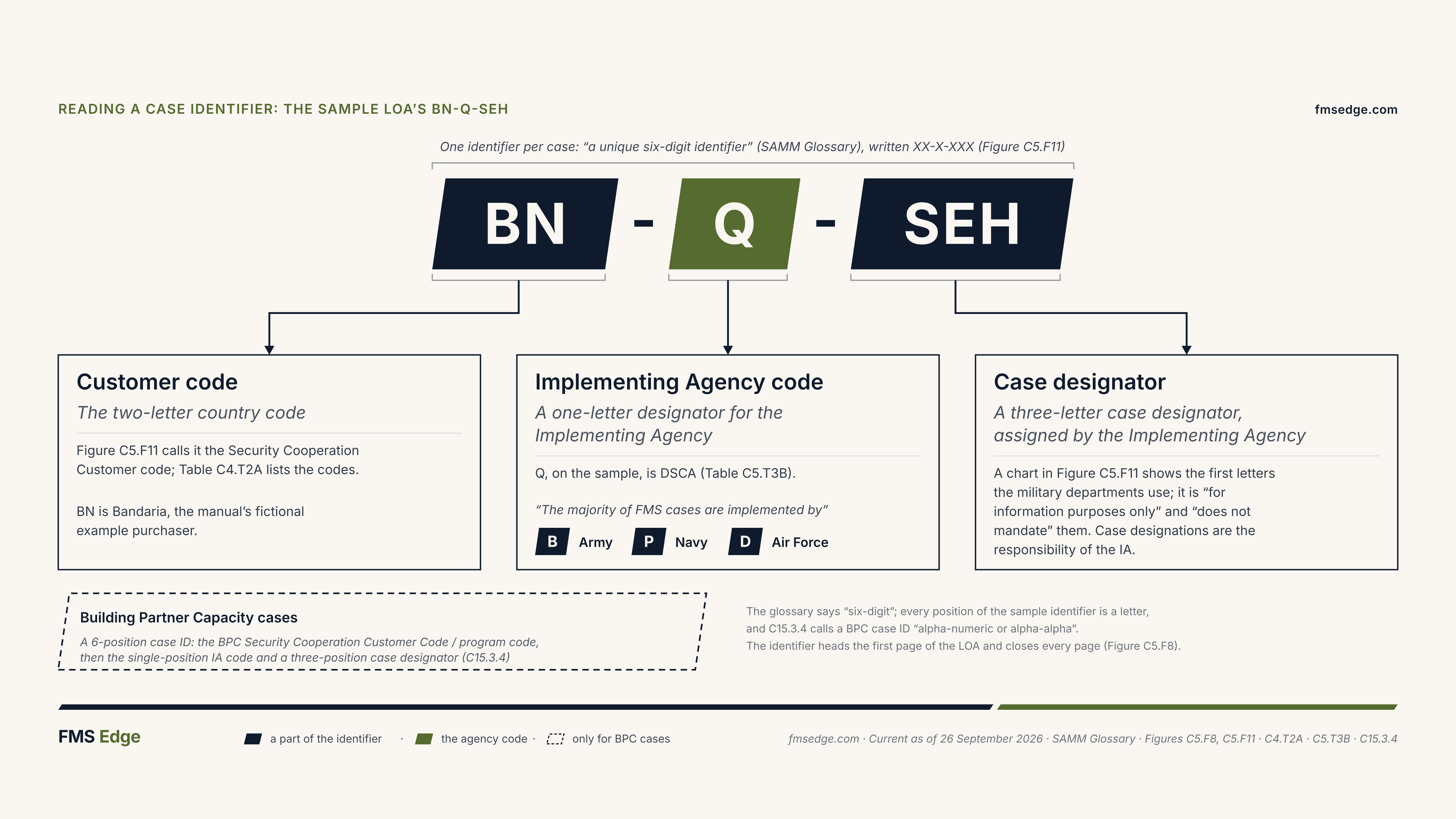
A case identifier read as its three parts, using BN-Q-SEH from the sample LOA in SAMM Figure C5.F8. Bandaria is the manual's fictional training country; the figures are the SAMM's example, not a real case. The parts are a two-letter country code, a one-letter designator for the Implementing Agency and a three-letter case designator.
What is a Foreign Military Sales case identifier?
A identifier is a unique six-digit code assigned to an case so that each can be identified, accounted for and processed as data. Its three parts are the two-letter country code, the one-letter code of the and the three-letter case designator.
Each case is assigned a unique . This is assigned by the and should be provided to the international partner as soon as possible after receipt of the . Where a sale must be notified to Congress and needs confidential handling, the case is entered in the Defense Management System () under a masked country code until notification. The is found on every page of every case.
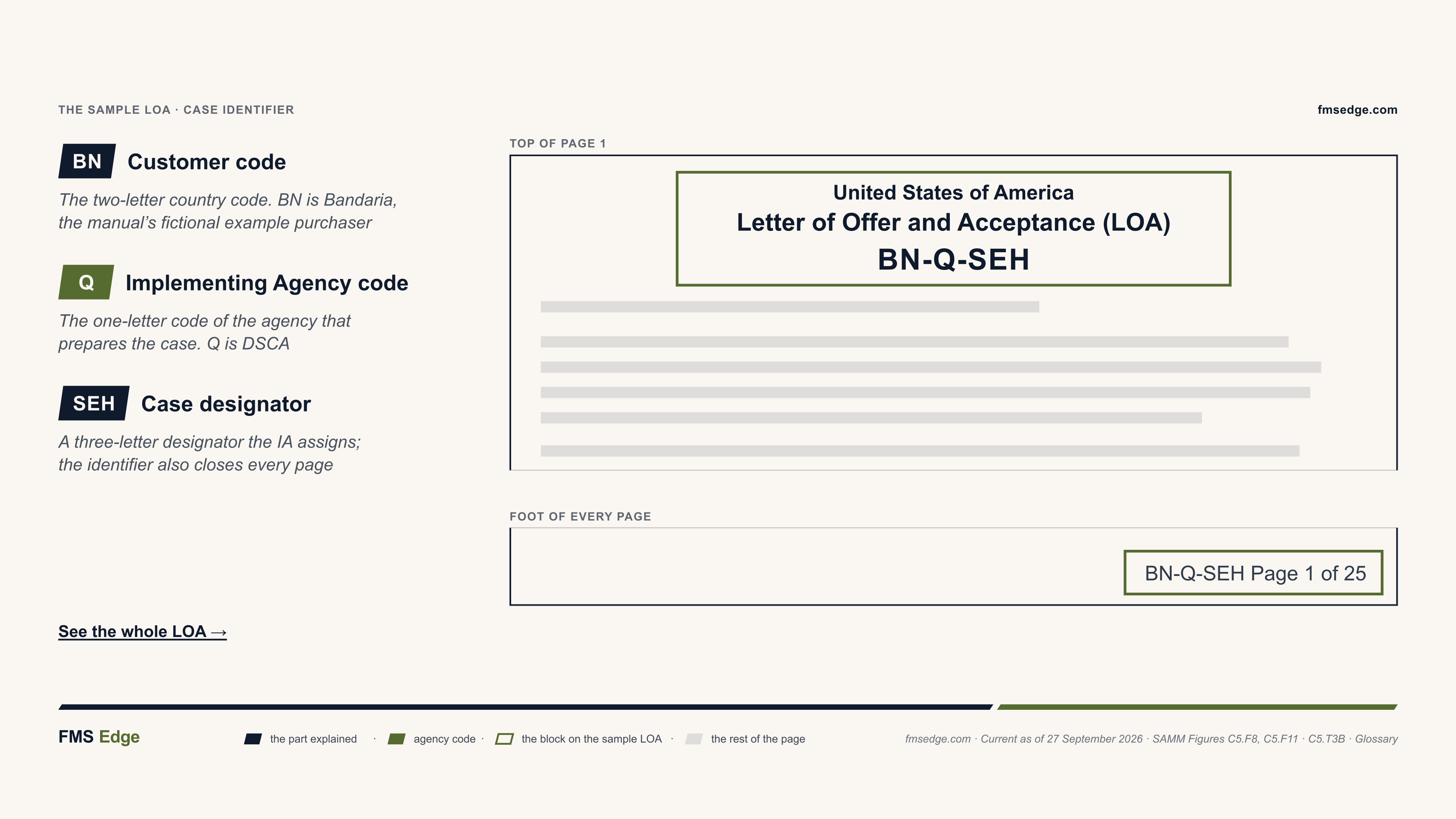
The case identifier on the sample LOA in SAMM Figure C5.F8, BN-Q-SEH, read as its three parts. Bandaria is the manual's fictional training country; the figures are the SAMM's example, not a real case. It heads the first page and closes every page.
The country code
() Customer Code: A two-position code representing the international partner. A list of Department of War (DoW) country/activity codes is found in the , Table C4.T2A. For Building Partner Capacity () cases, the partner code is replaced by a Program Code that represents the U.S. program authorizing the transfer. Program codes are listed in Appendix 8, summarized in Table AP8.T2.
The Implementing Agency code
(or service) Code: A single alpha code that identifies the U.S. or other that manages the item or system requested and prepares the on behalf of the U.S. Government (). The codes of the three are “B” for Army, “D” for Air Force, and “P” for Navy.
The manual's glossary calls this position the , a single alphabetic character for the U.S. or agency that negotiated or facilitated the case on the 's behalf. Most cases are implemented by the Army (B), the Navy (P) or the Air Force (D). A second glossary entry, , describes a single-digit code in a case designator that stands for the responsible for managing the .
The has assigned each of the a one-letter code that identifies the responsible organization for a given case. This code is reflected in the middle position of the . For example, a case may be identified by the BN-B-ULY. The “B” in the middle position of the is called the Code. Below is a list of active codes. Tables C5.T3A and C5.T3B include a comprehensive list of , along with applicable codes, email, and mailing addresses, authorized to receive and prepare cases.
Implementing Agency Codes
Code Organization
B Department of the Army
C Defense Information Systems Agency ()
D Department of the Air Force
F
I Missile Defense Agency (MDA)
M National Security Agency ()
P Department of the Navy
Q
R Defense Logistics Agency ()
U National Geospatial-Intelligence Agency ()
Z Defense Threat Reduction Agency ()
The case designator
In the glossary, the is the final code within a , assigned by the responsible for managing the .
Case Designator: A three-position alpha code assigned by the to identify a specific offer to an international partner. The first position of the case designator generally identifies the category of item or service to be provided to the national partner. The meaning of this first position code varies by and is not dictated by policy. See Figure C5.F11 of the for general guidelines used by the in determining the first position of a case designator. The second and third positions are typically assigned sequentially to distinguish among a country’s separate cases for that same category of item or service.
Reading the examples: BN-D-EZY and BN-B-BAB
As an illustration, the is BN-D-EZY. For this example, “BN” is the Customer Code for a fictional international partner. The code is “D” for U.S. Air Force, and case designator “EZY” indicates that this is likely one of several cases that the U.S. Air Force has prepared for that partner in the “E” equipment category. The should be used on all documentation relating to the case, including amendments and modifications, as well as logistical and financial transactions. It is used to track the status of the case and is perpetuated in case directives, documents, billing documents, and the 1200 computer system.
When the country code is masked
When an unclassified case needs Confidential handling, its documents will be entered into under a that uses a masked country code, such as “XX”, so that the prospective purchaser is not identified. Unclassified case information, item descriptions included, is entered into under that identifier. The masked identifier lets most of the case information go in and helps case developers keep working before the notification. The purchaser cannot be named in the notes or in any other supporting data, so that the information stays unclassified [SAMM ].
The user must take care when entering data under a masked country code. holds many pricing waivers and restrictions under each specific country, and under a masked code these waivers are not applied automatically, so the user must apply each one individually as appropriate. Specific pricing in could also reveal the purchaser; for example, a specific waiver percentage, once entered, could identify a list of potential purchasers. In those instances the pricing is worked out separately, and only the line's total price should be entered [SAMM ].
Building Partner Capacity cases: a program code instead of a country
On a case, a program code takes the place of the country code. The manual's glossary calls it the , a Customer Code used on the cases of to tell efforts apart by , by appropriation and by the availability and expiration of their funds.
program implementation and the execution of appropriated funds must comply with the authorizing legislation. Because Customer Codes (SCCCs) are in short supply, decided that one code has to serve more than one yearly appropriation, consolidated or supplemental, under a given , such as 10 U.S.C. 333 or the Ukraine Initiative (). therefore assigns each applicable appropriation of a a unique two-digit semi-permanent SCCC, alphanumeric or alpha-alpha and also called a program code, so that the funds behind each specific authorization are tracked accurately [SAMM ].
Each code will be used until its case designators are no longer available, which is why it is semi-permanent. It is not tied to a single appropriation authority, but it still identifies the overall program. When none are left, a new semi-permanent code will be set up for the same [SAMM ].
Table C11.T2 lists each and Department of State program that administers. The authority and program code listings are in Section 8 of each program in Appendix 8, and Table AP8.T2, and Code Listing, summarizes them. For each program, that table's Fund Source column gives the source of funding for each code and shows whether the funds come from a DoW agency or another agency, and whether they were provided through an Interagency Agreement under Section 632(b) of the Foreign Assistance Act. Its Appropriation Authority, Expiration Date and Cancelling fiscal year columns show the fiscal year in which the appropriation was signed into law, and its timeline [SAMM ].
Each case is assigned a unique , composed of an customer code, code, and case designator. The is used for all managerial tasks associated with the case, such as financial and logistics tracking. case identifiers contain a unique program code assigned by .
Try the tool: Case identifier decoder
References
SAMM
- SAMM C4.1.2: Purchasers Currently Eligible.
- SAMM C4.T2A: Security Cooperation Customer and Regional Codes and Foreign Military Sales Eligibility
- SAMM C5.2.3: The Department of War Components Authorized to Receive Letters of Request.
- SAMM C5.T3A: Military Department Organizations Authorized to Receive Letters of Request
- SAMM C5.T3B: Other Department of War Implementing Agencies Authorized to Receive Letters of Request
- SAMM C5.F11: Instructions for Preparing a Letter of Offer and Acceptance
- SAMM C5.7.5.1.1.4.1: Initial Entry into Defense Security Assistance Management System.
- SAMM C15.2.4: Building Partner Capacity Security Cooperation Customer Codes.
- SAMM C15.3.4: Initiating a Building Partner Capacity Case or Training Grant.
Facts referenced
- Length of a Foreign Military Sales case identifier, as the SAMM glossary states it: six-digit (as of 12 September 2026; SAMM GLOSSARY/case-identifier)
- Length of the country code in a case identifier: two-letter (as of 12 September 2026; SAMM GLOSSARY/case-identifier)
- Length of the Implementing Agency designator in a case identifier: one-letter (as of 12 September 2026; SAMM GLOSSARY/case-identifier)
- Implementing Agency code, Department of the Army: B (as of 12 September 2026; SAMM GLOSSARY/security-cooperation-implementing-agency-code)
- Implementing Agency code, Department of the Navy: P (as of 12 September 2026; SAMM GLOSSARY/security-cooperation-implementing-agency-code)
- Implementing Agency code, Department of the Air Force: D (as of 12 September 2026; SAMM GLOSSARY/security-cooperation-implementing-agency-code)
- Length of the case designator in a case identifier: three-letter (as of 12 September 2026; SAMM GLOSSARY/case-identifier)
- Length of the semi-permanent Security Cooperation Customer Code (program code) DSCA assigns to a Building Partner Capacity program authority's appropriation: two-digit (as of 5 October 2026; SAMM C15.2.4)
- Length of a Building Partner Capacity case identifier: 6-position (as of 5 October 2026; SAMM C15.3.4)
Related
Foreign Military Sales (FMS)
The part of U.S. security assistance, authorized by the Arms Export Control Act (AECA), in which eligible foreign governments and international organizations buy defense articles, services and training from the U.S. Government under formal government-to-government agreements.
The articles come either from Department of War stocks or from new procurement under contracts the Department manages [22 U.S.C. 2761, 22 U.S.C. 2762]. A sale is FMS whatever the source of the purchaser's financing.
FMS Edge glossary, as of 10 October 2026
Glossary entry →Open the manual’s entry → (opens in new tab)
Case Identifier
A unique six-digit identifier assigned to an Foreign Military Sales case for the purpose of identification, accounting, and data processing of each Letter of Offer and Acceptance. The case identifier consists of the two-letter country code, a one-letter designator for the Implementing Agency, and a three-letter case designator.
SAMM Glossary, as of 12 September 2026
Glossary entry →Open the manual’s entry → (opens in new tab)
Letter of Offer and Acceptance (LOA)
The legal instrument that lists the defense articles and services, including training, that the U.S. Government transfers to a foreign country or international organization, with their estimated costs and the terms and conditions. The benefitting partner does not sign a Building Partner Capacity (BPC) LOA.
The Letter of Offer and Acceptance (LOA) is the instrument the U.S. Government uses to sell under the Arms Export Control Act (AECA); signed LOAs and their later Amendments and Modifications are also called Foreign Military Sales (FMS) cases [SAMM C5.6.1].
FMS Edge glossary, as of 10 October 2026
Glossary entry →Open the manual’s entry → (opens in new tab)
Implementing Agency (IA)
The military department or defense agency responsible for the execution of military assistance programs. With respect to FMS, the military department or defense agency assigned responsibility by the Defense Security Cooperation Agency to prepare an LOA and to implement an FMS case. The implementing agency is responsible for the overall management of the actions that will result in delivery of the materials or services set forth in the LOA that was accepted by a foreign country or international organization.
SAMM Glossary, as of 12 September 2026
Glossary entry →Open the manual’s entry → (opens in new tab)
Foreign Military Sales (FMS) Case
A Letter of Offer and Acceptance (LOA) that the purchaser has accepted, together with every Amendment and Modification later made to it: the agreement under which the U.S. Government transfers defense articles and services in the Foreign Military Sales (FMS) program.
FMS Edge glossary, as of 10 October 2026
Glossary entry →Open the manual’s entry → (opens in new tab)
FMS: Foreign Military Sale
SAMM Acronyms, as of 12 September 2026
Letter of Request (LOR)
The term used to identify a request from an eligible FMS participant country for the purchase of U.S. defense articles and services. The request may be in message or letter format.
SAMM Glossary, as of 12 September 2026
Glossary entry →Open the manual’s entry → (opens in new tab)
Security Assistance (SA)
A group of programs authorized by federal statutes by which the United States provides defense articles, military training, and other defense-related services by grant, lease, loan, credit, or cash sales in furtherance of national policies and objectives, and those that are funded and authorized through the Department of State to be administered by Department of Defense/Defense Security Cooperation Agency, which are considered part of security cooperation.
SAMM Glossary, as of 12 September 2026
Glossary entry →Open the manual’s entry → (opens in new tab)
DSAMS: Defense Security Assistance Management System
SAMM Acronyms, as of 12 September 2026
Glossary entry →Defense Security Assistance Management Systems (DSAMS) →
Security Cooperation
Activities by which the Department of War encourages and enables international partners to cooperate with the United States toward strategic objectives, spanning every interaction with foreign defense and security establishments and every security assistance program the Department administers.
Under chapter 16 of Title 10, their purposes are to develop allied and friendly security capabilities for self-defense and multinational operations, to give U.S. forces peacetime and contingency access, and to build relationships promoting specific U.S. security interests [10 U.S.C. 301(7)].
FMS Edge glossary, as of 10 October 2026
Glossary entry →Open the manual’s entry → (opens in new tab)
Security Assistance Management Manual (SAMM)
DSCA Manual 5105.38-M required under DoD Directive 5105.65, "Defense Security Cooperation Agency" mandatory for use by all DoD Components. The SAMM provides DoD-wide guidance to the Office of the Secretary of Defense (OSD), the Military Departments (MILDEPs), the Office of the Chairman of the Joint Chiefs of Staff and the Joint Staff, the Combatant Commands, the Defense Agencies, the DoD Field Activities, the Security Cooperation Organizations (SCOs), and all other organizational entities within the DoD engaged in the management or implementation of DoD Security Assistance and Security Cooperation programs over which DSCA has responsibility.
SAMM Glossary, as of 12 September 2026
Glossary entry →Open the manual’s entry → (opens in new tab)
SAMM: Security Assistance Management Manual
SAMM Acronyms, as of 12 September 2026
Glossary entry →Security Assistance Management Manual (SAMM) →
Military Department (MILDEP)
One of the departments within the DoD created by the National Security Act of 1947, as amended. The Military Departments are: the Department of the Air Force, the Department of the Army, and the Department of the Navy.
SAMM Glossary, as of 12 September 2026
Glossary entry →Open the manual’s entry → (opens in new tab)
Security Cooperation Implementing Agency Code
A single character alpha code that identifies the U.S. Military Department or Agency that has negotiated or facilitated a Foreign Military Sales (FMS) case on behalf of the US Government. The majority of FMS cases are implemented by the Army (IA Code B), Navy (IA Code P), or Air Force (IA Code D).
SAMM Glossary, as of 12 September 2026
Glossary entry →Open the manual’s entry → (opens in new tab)
Implementing Agency Code (Letter of Offer and Acceptance (LOA))
A single-digit code in a case designator that represents the implementing agency responsible for management of the LOA.
SAMM Glossary, as of 12 September 2026
Glossary entry →Open the manual’s entry → (opens in new tab)
LOA: Letter of Offer and Acceptance
SAMM Acronyms, as of 12 September 2026
Defense Security Cooperation Agency (DSCA)
The Department of War agency that directs, administers and provides guidance to the Department's components and its representatives at U.S. missions for the execution of the security cooperation programs for which it is responsible [SAMM C1.3.2.2]. The agency also provides financial and technical assistance, arranges the transfer of defense materiel, training and services to international partners, and promotes military-to-military contacts.
FMS Edge glossary, as of 10 October 2026
Glossary entry →Open the manual’s entry → (opens in new tab)
LOR: Letter of Request
SAMM Acronyms, as of 12 September 2026
Defense Contract Management Agency (DCMA)
An agency under the direction of the Under Secretary of Defense for Acquisition and Sustainment, which provides contract administration services for the Department of Defense, other federal organizations and international partners, and is an essential part of the acquisition process from pre-award to sustainment and contract closeout.
SAMM Glossary, as of 12 September 2026
Glossary entry →Open the manual’s entry → (opens in new tab)
Defense Logistics Agency
The Department of War agency that is the item manager for consumable, stock-funded secondary items. Its supply centers work with the military departments to fill Foreign Military Sales (FMS) requisitions, process supply discrepancy reports and repair and return items, and close cases when supply is complete, and it prepares FMS cases for cataloging services and excess defense articles [SAMM C1.3.2.6.2.3.2].
FMS Edge glossary, as of 10 October 2026
Security Cooperation Case Designator
The last three characters of a case identifier, assigned by the implementing agency that manages the Letter of Offer and Acceptance (LOA); the designator is given when the sale is first offered and identifies the case in every later transaction.
FMS Edge glossary, as of 10 October 2026
Glossary entry →Open the manual’s entry → (opens in new tab)
DSCA: Defense Security Cooperation Agency
SAMM Acronyms, as of 12 September 2026
Glossary entry →Defense Security Cooperation Agency (DSCA) →
Military Standard Requisitioning And Issue Procedures (MILSTRIP)
The uniform Department of War procedures for requisitioning and issuing materiel within standardized priorities, using standard data elements, codes, forms and transaction formats that foreign governments and international organizations also use by agreement.
The Implementing Agency (IA) or the purchaser may initiate MILSTRIP requisitions under implemented Letters of Offer and Acceptance (LOAs) [SAMM C6.4.3].
FMS Edge glossary, as of 10 October 2026
Glossary entry →Open the manual’s entry → (opens in new tab)
Contract Administration Services (CAS)
All those actions accomplished in or near a contractor's plant for the benefit of the U.S. government which are necessary to the performance of a contract or in support of the buying offices, system/project managers, and other organizations, including quality assurance, engineering support, production surveillance, pre-award surveys, mobilization planning, contract administration, property administration, industrial security, and safety.
SAMM Glossary, as of 12 September 2026
Glossary entry →Open the manual’s entry → (opens in new tab)
Building Partner Capacity (BPC) Program Code
"Security Cooperation Customer Code" used for BPC security cooperation programs' cases to identify BPC efforts by their distinct program authorities, appropriations, and availability/expiration of funds.
SAMM Glossary, as of 12 September 2026
Glossary entry →Open the manual’s entry → (opens in new tab)
Security Cooperation Programs
Any program, activity (including an exercise), or interaction of the Department of Defense with the security establishment of a partner or international organization to achieve a purpose as follows:
To build and develop allied and friendly security capabilities for self-defense and multinational operations.
To provide the armed forces with access to the partner or international organization during peacetime or a contingency operation.
To build relationships that promote specific United States security interests.
SAMM Glossary, as of 12 September 2026
Glossary entry →Open the manual’s entry → (opens in new tab)
SAMM C5.7.5.1.1.4.1: Initial Entry into Defense Security Assistance Management System.
“LOA documents for unclassified cases requiring Confidential handling will be entered into Defense Security Assistance Management System (DSAMS) with a case identifier using a “masked” country code (e.g., “XX”) to ensure the prospective purchaser is not identified. This identifier is used to enter unclassified case information, including item descriptions, into DSAMS. Using the masked case identifier allows most of the …”
Security Assistance Management Manual, as of 11 September 2026
SAMM C15.2.4: Building Partner Capacity Security Cooperation Customer Codes.
“BPC program implementation and appropriated funds execution must comply with authorizing legislation. Due to the shortage of Security Cooperation Customer Codes (SCCCs), DSCA determined that codes need to be used for more than one yearly consolidated or supplemental budget appropriation under a specific program authority (10 U.S.C. 333, Ukraine Security Assistance Initiative (USAI), etc.). Therefore, DSCA assigns a unique two-digit …”
Security Assistance Management Manual, as of 5 October 2026