
Guide
What is a Transportation Plan in a Foreign Military Sale?
A sets out how classified, sensitive, and arms, ammunition and explosives materiel on a case is moved and safeguarded, up to receipt by the purchaser's . The that prepares the develops it with the purchaser; the applicable security authority approves it and the purchaser accepts it in writing before the materiel moves. Once approved, it becomes an integral part of the .
What is a Transportation Plan in a Foreign Military Sale?
Before classified materiel can be shipped, the procedures for safeguarding it must be spelled out in a detailed by the preparing the , in cooperation with the customer. The must identify the individual responsible for safeguarding the classified materiel, the methods of transport, the locations of transfer and delivery, the location of storage or processing facilities, and the security clearances of all personnel and facilities involved in the transfer. The must ensure that its own security officials review and approve the .
The must be finalized, reviewed, and approved by the selling command’s security officials before any classified materiel can be shipped. The completed must be maintained in the case file. It must also be made available to U.S. Customs and Border Protection and other security officials when classified materiel is exported.
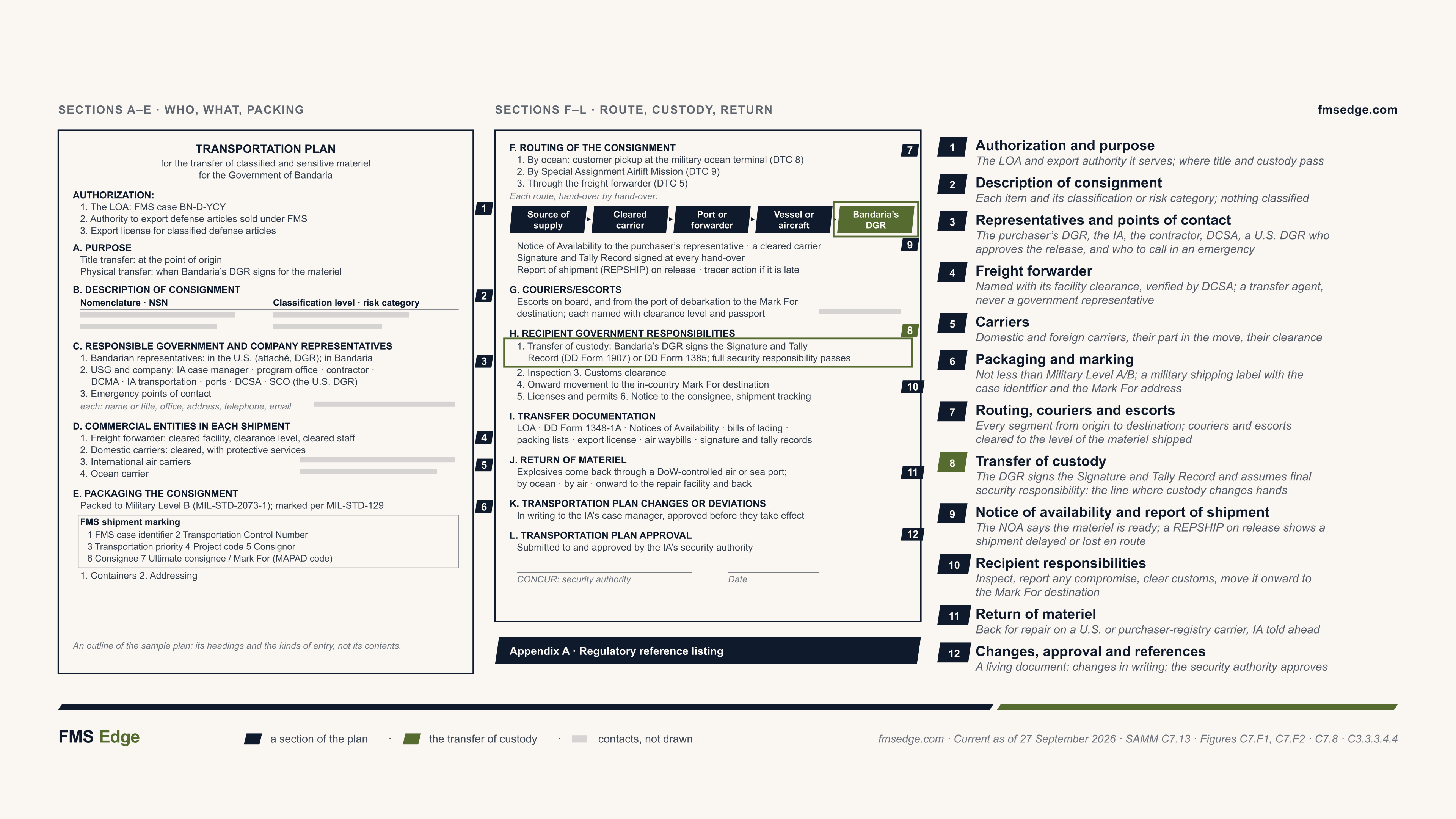
The sections of a Transportation Plan, redrawn from the structure of the Bandaria sample plan for a classified and sensitive shipment. Bandaria is the manual's fictional training country; the figure is a training example, not a real case. The first sheet names the case and the export authority, the materiel, the people responsible on both sides, the freight forwarder and carriers, and the packing and marking; the second follows the materiel hand-over by hand-over to the purchaser's Designated Government Representative, then sets out escorts, the purchaser's duties, the documents, returns for repair, changes and approval. On the site, each numbered part links to the page that explains it.
Transportation planning before the Letter of Request
International purchasers and should address transportation capabilities and limitations in their letters of request or memorandums of request for and , respectively. The most difficult commodities to move are sensitive , classified items, , cryptographic or other sensitive (nonexplosive) items, and oversized major items such as vehicles, aircraft, tanks, helicopters, boats, or heavy construction equipment. Some of these items can be moved by a commercial , but many must move through the . customers and should address the following concerns in pre- discussions in order to plan for delivery of these commodities:
1. Does the customer have the capability to pick up the materiel in and transport it to their country using their own carrier?
2. If the materiel will move by surface carrier overseas, does the customer have the capability to accept the materiel at the POD and arrange for movement to the final destination? What if the POD is in a third country? The customer will be responsible for clearing customs and arranging for transportation through any other country the materiel must transit.
3. Are there any unique documents, permits, or handling requirements for the shipment to clear customs?
4. What military or commercial air or water ports are available for delivering materiel? What is the carrier capacity of each port? Does the port have secured storage space? If the answers to these questions are unknown, it may be necessary for SDDC to conduct a port to identify the size and type of carriers that the port can accommodate and to assess the port’s physical security.
5. Does the customer have the ability to move the materiel securely from the POD to the final destination?
References
SAMM
- SAMM GLOSSARY/transportation-plan — Transportation Plan
- SAMM C7.13.1 — General.
- SAMM C7.13.2 — Transportation Plan Preparation.
- SAMM C3.3.3.4.4.1 — Transportation Plan for Purchaser-Sponsored Shipments.
- SAMM C7.14.1.1
- SAMM C8.3.3 — Arms, Ammunition, & Explosives.
- SAMM C3.3.3.4.4.2 — Foreign Government Representative.
- SAMM C7.13.3.1.1
- SAMM C7.13.3.2 — Arms, Ammunition, & Explosives Requirements.
- SAMM C7.13.3.3.1
- SAMM C2.1.5.4.2 — Shipment of Classified Materiel.
Related
Transportation Plan
A document that details the transportation and security arrangements for moving classified or sensitive material, and identifies individuals responsible for providing security at various points during transportation.
SAMM Glossary, as of 12 September 2026
Glossary entry →Open the manual’s entry → (opens in new tab)
Foreign Military Sales (FMS)
A process, authorized by the Arms Export Control Act, through which eligible foreign governments and international organizations may purchase defense articles, services, and training from the United States Government.
SAMM Glossary, as of 12 September 2026
Glossary entry →Open the manual’s entry → (opens in new tab)
Designated Government Representative (DGR)
A person or persons duly authorized by a foreign government to act on behalf of that government to negotiate, commit, sign contractual agreements, and/or accept delivery of materiel.
SAMM Glossary, as of 12 September 2026
Glossary entry →Open the manual’s entry → (opens in new tab)
Implementing Agency (IA)
The military department or defense agency responsible for the execution of military assistance programs. With respect to FMS, the military department or defense agency assigned responsibility by the Defense Security Cooperation Agency to prepare an LOA and to implement an FMS case. The implementing agency is responsible for the overall management of the actions that will result in delivery of the materials or services set forth in the LOA that was accepted by a foreign country or international organization.
SAMM Glossary, as of 12 September 2026
Glossary entry →Open the manual’s entry → (opens in new tab)
Letter of Offer and Acceptance (LOA)
The legal instrument used by the USG to transfer itemized defense articles, defense services, and design and construction services to foreign partners.
When used under the authorities provided in the Arms Export Control Act for Foreign Military Sales, the LOA is a binding agreement signed by the USG and the foreign partner to transfer such articles and services.
When used under Building Partnership Capacity (BPC) authorities, the BPC LOA is not signed by the Benefitting Partner.
SAMM Glossary, as of 12 September 2026
Glossary entry →Open the manual’s entry → (opens in new tab)
FMS — Foreign Military Sale
SAMM Acronyms, as of 12 September 2026
LOA — Letter of Offer and Acceptance
SAMM Acronyms, as of 12 September 2026
Controlled Cryptographic Items (CCI)
CCIs are devices that embody cryptographic logic or other cryptographic design, but do not perform the entire Communications Security (COMSEC) function. CCIs are dependent upon host equipment or assemblies to complete and operate COMSEC functions. Un-keyed CCI is unclassified. An item may be designated CCI because its entire component is controlled (e.g. Inline Network Encryptor (INE)), or because the item contains an embedded cryptographic National Security Agency (NSA) Type-1 certified module to encrypt/de-encrypt information (e.g. secure radio).
SAMM Glossary, as of 12 September 2026
Glossary entry →Open the manual’s entry → (opens in new tab)
DGR — Designated Government Representative
SAMM Acronyms, as of 12 September 2026
Glossary entry →Designated Government Representative (DGR) →
CCI — Controlled Cryptographic Item
SAMM Acronyms, as of 12 September 2026
Repair and Return
A service where eligible foreign countries return unserviceable repairable items for entry into the U.S. Military Department repair cycle. Upon completion of repairs, the same item is returned to the country and the actual cost of the repair is billed to the country.
SAMM Glossary, as of 12 September 2026
Glossary entry →Open the manual’s entry → (opens in new tab)
DTS — Defense Transportation System
SAMM Acronyms, as of 12 September 2026
LOR — Letter of Request
SAMM Acronyms, as of 12 September 2026
Continental United States (CONUS)
U.S. territory, including the adjacent territorial waters, located within the North American continent between Canada and Mexico. Does not include Hawaii or Alaska.
SAMM Glossary, as of 12 September 2026
Glossary entry →Open the manual’s entry → (opens in new tab)
Defense Transportation System (DTS)
The portion of the worldwide transportation infrastructure that supports DoD transportation needs in peace and war. DTS consists of two major elements: military and commercial resources. These resources include aircraft, assets, services, and systems organic to, contracted for, or controlled by the DoD. DoD's infrastructure, including ports, airlift, sealift, railway, highway, in-transit visibility, information management systems, customs, and traffic management that the DoD maintains and exercises in peacetime, is a vital element of the DoD's capability to project power worldwide. It provides for responsive force projection and a seamless transition between peacetime and wartime operations.
SAMM Glossary, as of 12 September 2026
Glossary entry →Open the manual’s entry → (opens in new tab)
Defense Article (Foreign Assistance Act; Arms Export Control Act, not including commercial sales subject to the International Traffic in Arms Regulation)
Any weapon, weapons system, munition, aircraft, vessel, boat, or other implement of war;
SAMM Glossary, as of 12 September 2026
Site Survey
A team of U.S. personnel who assess the Foreign Military Sales customer's logistics capabilities and shortfalls to determine the optimum type and quantity of logistics support to be included in the Total Package Approach.
SAMM Glossary, as of 12 September 2026
Glossary entry →Open the manual’s entry → (opens in new tab)
Freight Forwarder
A commercial import/export company registered with the Department of State, Bureau of Political-Military Affairs, Directorate of Defense Trade Controls and under contract to the Foreign Military Sales customer which arranges transportation of materiel from a point specified in the Letter of Offer and Acceptance to the final destination.
SAMM Glossary, as of 12 September 2026
Glossary entry →Open the manual’s entry → (opens in new tab)
NOA — Notice of Availability
SAMM Acronyms, as of 12 September 2026
MAPAD — Military Assistance Program Address Directory
SAMM Acronyms, as of 12 September 2026
Glossary entry →Military Assistance Program Address Directory (MAPAD) →
COMSEC — Communications Security
SAMM Acronyms, as of 12 September 2026
Memorandum of Agreement (MOA)
An agreement between sovereign states or international organizations that is legally binding under international law.
SAMM Glossary, as of 12 September 2026
Glossary entry →Open the manual’s entry → (opens in new tab)
CISMOA — Communications Interoperability and Security Memorandum of Agreement
SAMM Acronyms, as of 12 September 2026
SCO — Security Cooperation Organization
SAMM Acronyms, as of 12 September 2026
Security Assistance (SA)
A group of programs authorized by federal statutes by which the United States provides defense articles, military training, and other defense-related services by grant, lease, loan, credit, or cash sales in furtherance of national policies and objectives, and those that are funded and authorized through the Department of State to be administered by Department of Defense/Defense Security Cooperation Agency, which are considered part of security cooperation.
SAMM Glossary, as of 12 September 2026
Glossary entry →Open the manual’s entry → (opens in new tab)
CONUS — Continental United States
SAMM Acronyms, as of 12 September 2026