
Guide
Who is responsible for shipping in a Foreign Military Sale?
Under Section 5 of the standard terms, title passes to the purchaser at the initial point of shipment, even when the U.S. Government arranges onward transport. The purchaser furnishes shipping instructions, insures the shipment, clears customs, and reports shortages, damage and other discrepancies to the U.S. Government on a within the time limits the terms set. Loss or damage caused by a carrier is claimed against the carrier instead.
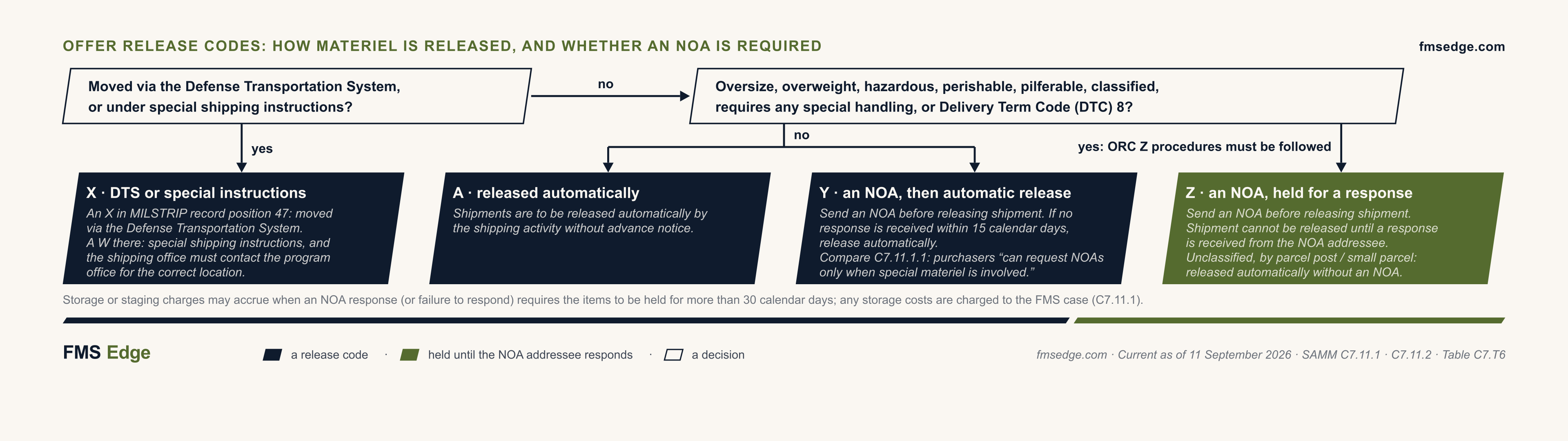
The Offer Release Code on each LOA line says how the shipping activity releases materiel and whether a Notice of Availability is sent first. Which code applies depends on how the purchaser moves the materiel: X marks movement via the Defense Transportation System or special shipping instructions; otherwise A releases without notice, Y sends a notice and releases if no response comes, and Z holds the shipment until the notice is answered, which is required for oversize, hazardous, classified and other special materiel.
Who is responsible for shipping in a Foreign Military Sale?
5.1 Title transfer and delivery point
5.1 The agrees to deliver and pass title to the Purchaser at the initial point of shipment unless otherwise specified in this . With respect to items procured for sale to the Purchaser, this will normally be at the manufacturer’s loading facility; with respect to items furnished from stocks, this will normally be at the U.S. depot. Articles will be packed, crated, or otherwise prepared for shipment prior to the time title passes. If “Point of Delivery” is specified other than the initial point of shipment, the supplying U.S. Department or Agency will arrange movement of the articles to the authorized delivery point as a reimbursable service but will pass title at the initial point of shipment. The disclaims any liability for damage or loss to the items incurred after passage of title irrespective of whether transportation is by common carrier or by the U.S. .
Section 5.1 identifies where title transfers and delivery occur. Title represents ownership. This condition states that the international partner becomes the owner of materiel at the initial shipping point. Delivery, in this context, does not mean the materiel has arrived at the final international partner’s destination. Delivery refers to the point where transportation responsibility transfers from the to the international partner. The applied to each line will indicate where the international partner becomes responsible for transportation. Under certain delivery term codes, the may arrange for transportation in various increments up to and including movement to an inland location within the international partner’s country. Regardless of when the international partner assumes transportation responsibility, the title will still transfer at the initial shipping point. This means that the will not be financially liable for items damaged in transit, even if arranges or provides the transportation.
This condition should not be interpreted to mean that the international partner’s financial liability does not begin until title transfer. Financial liability begins to accrue as soon as the starts work on the case, well before title passes. In Section 3, the international partner agrees to indemnify the and its contractors. Additionally, in Section 2, the international partner agrees to be liable for termination costs if they elect to delete items or to cancel the case.
5.2 Shipping instructions
5.2 The Purchaser agrees to furnish shipping instructions which include Mark For and Codes based on the Offer Release Code.
Section 5.2 describes the international partner’s obligation to provide the required transportation information so that items are shipped through the appropriate channels to arrive at the correct international partner’s destination.
The code identifies the commercial freight company employed by the international partner to accomplish overseas transportation. The mark-for code identifies the ultimate in-country destination address.
5.3 Insurance and export licenses
5.3 The Purchaser is responsible for obtaining insurance coverage and customs clearances. Except for articles exported by the , the Purchaser is responsible for ensuring that export licenses are obtained prior to export of U.S. defense articles. The incurs no liability if export licenses are not granted or they are withdrawn before items are exported.
Given the fact that the international partner bears the risk of any damage that may occur during shipment, the international partner is responsible for obtaining any desired insurance coverage. Additionally, the international partner is responsible for completing the necessary documents to clear customs. Most international partners delegate the task of coordinating customs paperwork to their for cases.
5.4 Delivery documents and claims
5.4 The Purchaser agrees to accept DD Forms 645 or other delivery documents as evidence that title has passed and items have been delivered. Title to defense articles transported by parcel post passes to the Purchaser at the time of parcel post shipment. Standard Form 364 () will be used in submitting claims to the for overage, shortage, damage, duplicate billing, item deficiency, improper identification, improper documentation, or non-shipment of defense articles and non-performance of defense services. The Standard Form 364 will be submitted promptly by the Purchaser. The will disallow any claim, including a claim for shortage or nonperformance, received more than 1 year after delivery or more than 1 year after passage of title to the defense articles, whichever comes first, or received more than 1 year after the end of the scheduled period of performance for defense services, unless the determines that unusual and compelling circumstances involving latent defects justify consideration of the claim. Claims for non-shipment or non-receipt of an entire lot will be disallowed by the if such claims are received more than 1 year after the scheduled delivery date or initial billing, whichever is later. The Purchaser agrees to return discrepant articles to the ’s custody promptly in accordance with any direction provided by the . The Purchaser may submit for documentation purposes regardless of the dollar value, but only valued at $200 or more will be reviewed for possible compensation regardless of the type of discrepancy. This minimum value includes the value of the item plus any transportation and handling costs.
Section 5.4 delineates the international partner’s obligation to accept certain documentation as evidence that title transfer and delivery have occurred. Additionally, this section outlines the process and conditions under which the international partner can submit claims for discrepancies. Although the would like the enterprise to operate error-free, in reality, things sometimes go wrong. The international partner has an avenue to request reimbursement for shipping or billing discrepancies. This process is called supply discrepancy reporting.
References
SAMM
- SAMM C7.4.1 — Delivery Term Code.
- SAMM C5.6.5.4.1 — Standard Terms and Conditions and Letter of Offer and Acceptance Information.
Related
Letter of Offer and Acceptance (LOA)
The legal instrument used by the USG to transfer itemized defense articles, defense services, and design and construction services to foreign partners.
When used under the authorities provided in the Arms Export Control Act for Foreign Military Sales, the LOA is a binding agreement signed by the USG and the foreign partner to transfer such articles and services.
When used under Building Partnership Capacity (BPC) authorities, the BPC LOA is not signed by the Benefitting Partner.
SAMM Glossary, as of 12 September 2026
Glossary entry →Open the manual’s entry → (opens in new tab)
Supply Discrepancy Report (SDR)
A process for international customers to file a complaint with the DoD for product loss, quality deficiencies, damage, and various other problems associated with the delivery of material under the Foreign Military Sales program.
SAMM Glossary, as of 12 September 2026
Glossary entry →Open the manual’s entry → (opens in new tab)
LOA — Letter of Offer and Acceptance
SAMM Acronyms, as of 12 September 2026
Defense Transportation System (DTS)
The portion of the worldwide transportation infrastructure that supports DoD transportation needs in peace and war. DTS consists of two major elements: military and commercial resources. These resources include aircraft, assets, services, and systems organic to, contracted for, or controlled by the DoD. DoD's infrastructure, including ports, airlift, sealift, railway, highway, in-transit visibility, information management systems, customs, and traffic management that the DoD maintains and exercises in peacetime, is a vital element of the DoD's capability to project power worldwide. It provides for responsive force projection and a seamless transition between peacetime and wartime operations.
SAMM Glossary, as of 12 September 2026
Glossary entry →Open the manual’s entry → (opens in new tab)
Delivery Term Code (DTC)
A single character code that represents how far the USG is responsible for arranging transportation of defense articles going to an international customer.
SAMM Glossary, as of 12 September 2026
Glossary entry →Open the manual’s entry → (opens in new tab)
DTC — Delivery Term Code
SAMM Acronyms, as of 12 September 2026
Letter of Request (LOR)
The term used to identify a request from an eligible FMS participant country for the purchase of U.S. defense articles and services. The request may be in message or letter format.
SAMM Glossary, as of 12 September 2026
Glossary entry →Open the manual’s entry → (opens in new tab)
Continental United States (CONUS)
U.S. territory, including the adjacent territorial waters, located within the North American continent between Canada and Mexico. Does not include Hawaii or Alaska.
SAMM Glossary, as of 12 September 2026
Glossary entry →Open the manual’s entry → (opens in new tab)
CONUS — Continental United States
SAMM Acronyms, as of 12 September 2026
Freight Forwarder
A commercial import/export company registered with the Department of State, Bureau of Political-Military Affairs, Directorate of Defense Trade Controls and under contract to the Foreign Military Sales customer which arranges transportation of materiel from a point specified in the Letter of Offer and Acceptance to the final destination.
SAMM Glossary, as of 12 September 2026
Glossary entry →Open the manual’s entry → (opens in new tab)
FMS — Foreign Military Sale
SAMM Acronyms, as of 12 September 2026
SDR — Supply Discrepancy Report
SAMM Acronyms, as of 12 September 2026