
Guide
What are accessorial charges in Foreign Military Sales?
Accessorial charges are the costs of issuing, selling and transferring materiel that its standard price or contract cost does not include, chiefly packing, crating and handling, and transportation. They sit below the line on a . A dedicated airlift mission is instead charged above the line as a , and detention and demurrage provided as a unique service may be charged on a separate line.
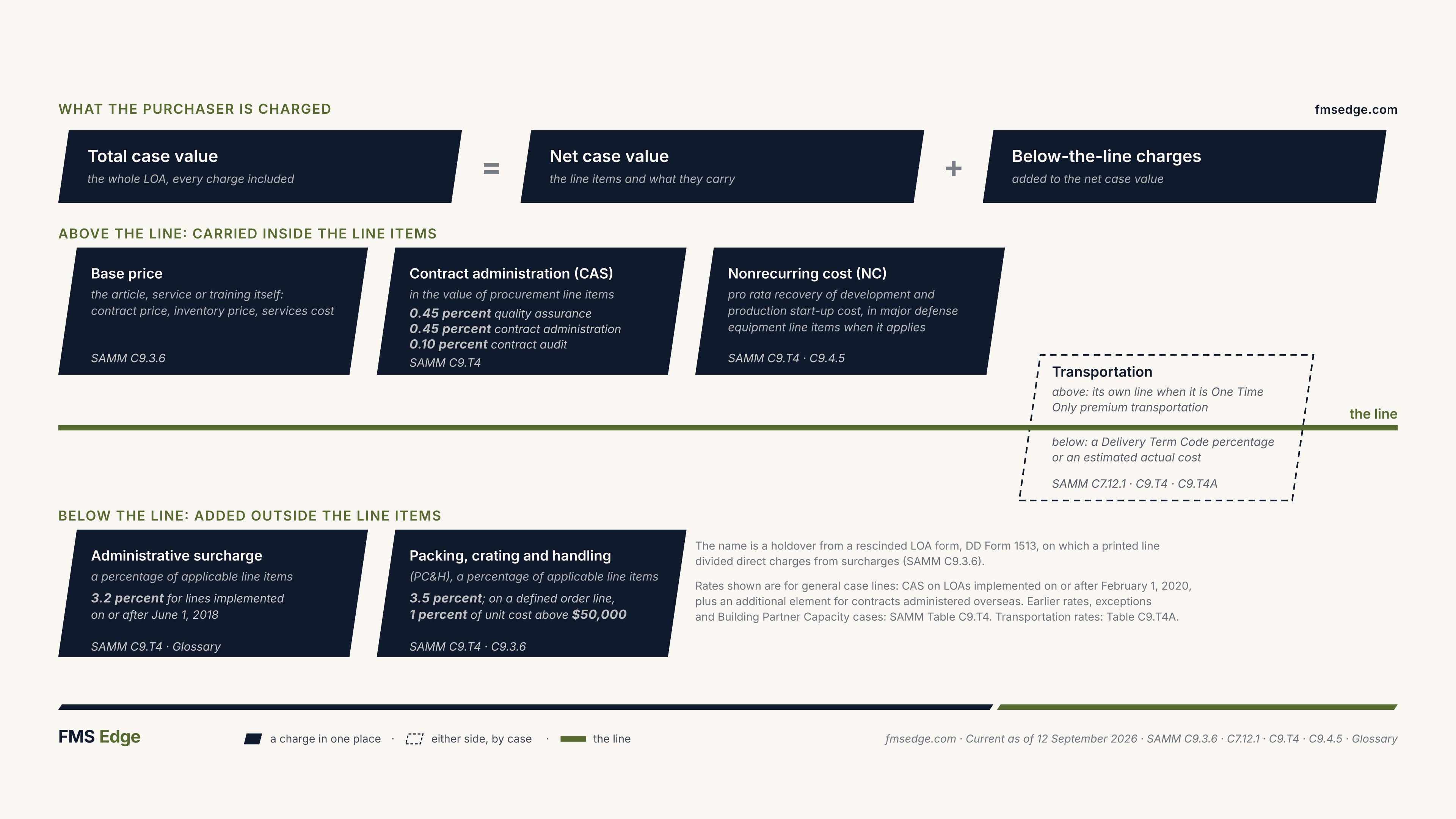
An LOA's total case value is its net case value (the line items) plus the charges added below them. The base price, contract administration services and nonrecurring cost on major defense equipment sit above the line; the administrative surcharge and packing, crating and handling sit below.
What are accessorial charges in Foreign Military Sales?
The and 7000.14-R, Financial Management Regulation () Volume 15, Chapter 7, define accessorial charges as expenses incident to issues, sales, and transfers of materiel that are not always included in the standard price or contract cost of materiel. They include packing, crating, and handling, transportation, pre-positioning, staging of materiel in the , and port loading and unloading.
Transportation costs for other than collect commercial bill of lading (CCBL) shipments are considered accessorial costs. Transportation rates are assessed when the provides transportation for materiel, when items are shipped on a Government Bill of Lading () or Commercial Bill of Lading (), and when packages are shipped prepaid through the U.S. Postal Service (), FedEx, United Parcel Service (), or through any commercial carrier. Table C9.T4A sets out the transportation rates, and Table C9.T4 how they are applied.
In the manual's glossary, an is a cost of packing, crating and handling, or of transportation, that is incidental to the issue, sale or transfer of materiel and is not included in its standard price or contract cost. Working Capital Fund items are an exception.
Every program expense is recovered from the purchaser on the case. It is recovered either through direct charges included in the cost of the materiel or services, or through indirect (accessorial) charges, surcharges or both, usually computed as a percentage of costs. A charge included within the materiel or services line may be called an "above-the-line" charge. The term dates from the rescinded form, DD Form 1513, on which a line divided the direct charges from the accessorial charges. Accessorial charges and surcharges that are not included within a line item value, such as the transportation surcharge and the packing, crating and handling charge, may be called "below-the-line" charges [SAMM ].
A is an airlift requirement, assigned to Air Mobility Command (), for a special pickup or delivery. A may be used for cargo that needs special consideration because of its weight or size, because its movement is urgent or sensitive, or because of other special factors [SAMM ].
A is one way to deliver sensitive or classified materiel to an overseas destination when the recipient country does not have the capability to pick up its materiel at a Department of War (DoW) , 8.
A is billed hourly, from the aircraft’s departure from its home station until its return, and it appears on the as a line item [SAMM ]. Because a is One Time Only premium transportation, its transportation costs must be above-the-line on the [SAMM ].
Detention is a charge made on a carrier held by or for a consignor or consignee beyond the allowable free time for loading or unloading, for forwarding directions, or for any other purpose authorized and documented by the consignor or consignee. Demurrage is a charge against a consignor or consignee for holding carrier equipment beyond the allowable free time for loading and unloading, for forwarding directions, or for any other purpose authorized and documented by the consignor or consignee. Unanticipated services related to detention and demurrage, when provided as a unique service, may be included as a separate line on the [SAMM ].
Where a is not routed back to its home station on its return leg, charges will be incurred only up to the point at which the mission was changed. The procedures are in Chapter 202, Routing, of the Defense Transportation Regulation (), 4500.9-R [SAMM ].
For a materiel line that has an associated line for a flight, the should enter the appropriate against the materiel line. The code depends on the mode of transportation provided, such as port-to-port or depot-to-in-country destination, and on the rate area where the articles are being delivered. For example, a materiel line may show 7 or 9 with an Override Percent (OP) of 0%, with remarks that should state it is a flight [SAMM ].
The must also show in the line note whether transportation is included in the pricing of the materiel line or the U.S. Government is responsible for those costs (a non-Working Capital Fund line). In that second case the line must show 2 with the other code, for example 2/7. The Distribution Screen in the Defense Management System () should then show 100% for 2 and 0% for 7, so that 2 is assessed below the line [SAMM ].
Packing, crating and handling () costs are those DoW costs incurred for labor, materiel, or services in preparing non-Defense Working Capital Fund () materiel for shipment from the storage or distribution point. For defined order lines, is 3.5 percent for the first $50,000 in unit cost and 1 percent for the portion of the unit cost that exceeds it. For blanket order lines, is 3.5 percent of the line value. When provided as a unique service, such as for , these charges may be included as a separate line on the [SAMM ]. Under the , does not apply to sales from procurement unless the item is processed through a DoW depot or distribution center, and on is computed on the original acquisition value, not the reduced value. Actual costs are used when known, and charges normally appear in block 9 of the ’s Estimated Cost Summary.
How transportation is priced on the case
When the international partners use the , an estimated amount is placed above the line to pay for transportation services that are not appropriate to be funded with below-the-line estimates. Examples of these transportation services include premium transportation such as flights, securing a vessel for a one-time only shipment, for consolidating shipments, Radio-Frequency Identification tagging and tracking devices, special security (guards hired to escort the shipment), and other unique requirements [].
Transportation on an FMS case is paid in one of five ways, from inside a Working Capital Fund item's price to payment straight to the purchaser's own carrier. Where SAMM Table C9.T4A shows a zero rate, the cost has moved to one of the others.
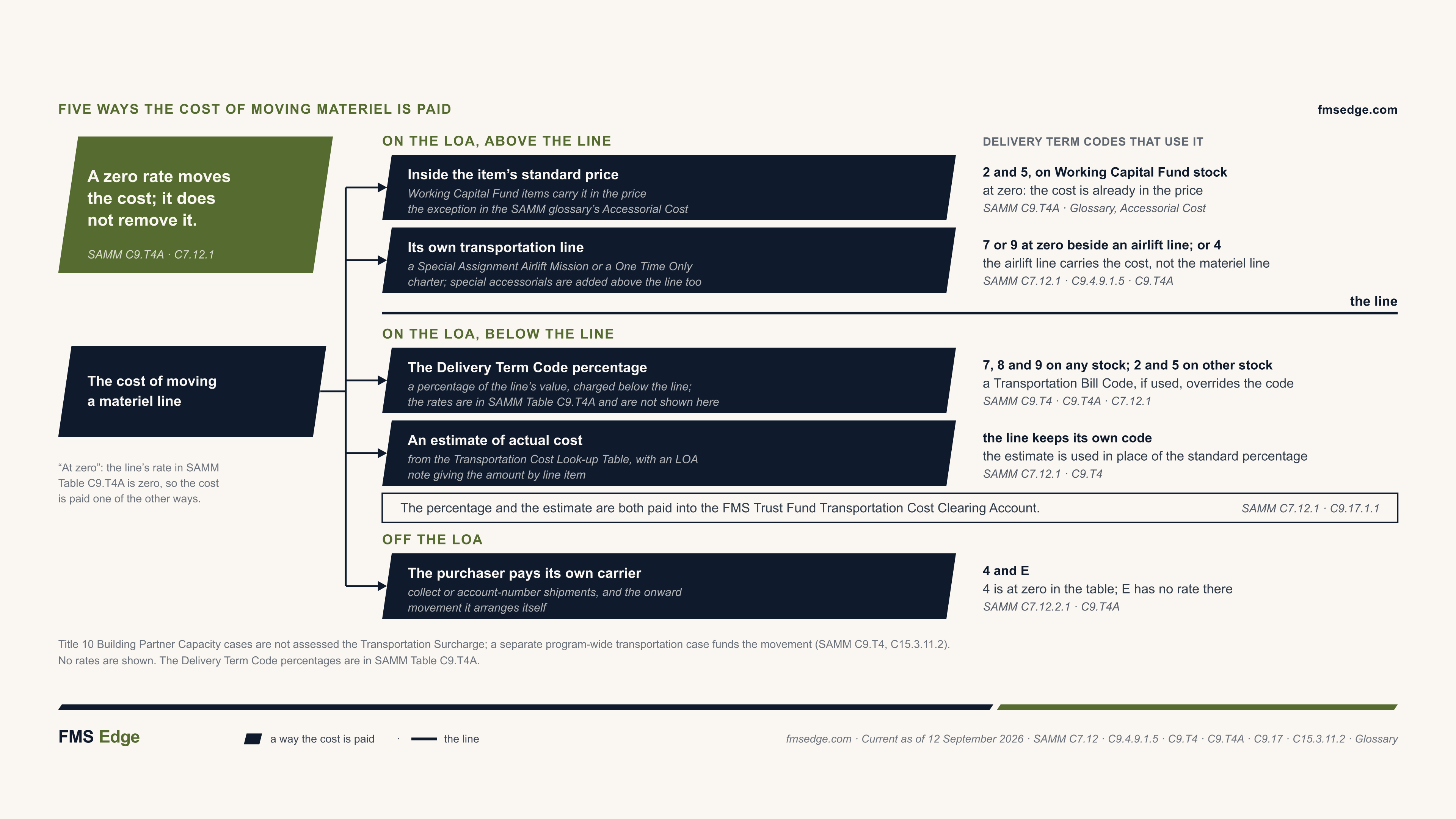
When a or some other form of dedicated premium transportation must be used to move the materiel purchased under a case, a separate transportation service line is included in the . When expenditures are made for actual transportation, this line is adjusted to meet the full cost of this special transportation and a transportation account code needs to be supplied to the DoW [SAMM ].
The costs of special transportation accessorials, such as containerization, storage in transit, escorts or any other special accessorial requirement, are not included in the standard transportation percentages or in the costs the Transportation Cost Look-up Table gives. These charges are to be placed above the line, and they are adjusted as needed to capture the actual cost [SAMM ].
The Transportation Cost Look-Up Tables posted in the , Appendix 2, contain estimated actual transportation costs for items normally shipped via the [SAMM ].
When international partners use the and either an above-the-line charge or the Transportation Cost Look-Up Tables are not applicable, a percentage is applied to the line to compute an estimated amount for transportation costs on the case. percentages are based on the mode of transportation provided (e.g., port-to-port and depot-to-in-country destination) and the rate area where articles are being delivered [SAMM , ]. For defined order lines, the applicable percent is charged on the case for the first $10,000 in unit cost, and then 25 percent of the percent for the portion of the unit cost above that amount. For blanket order lines, the applicable percent is charged on the case for the total line value [SAMM ].
A Transportation Bill Code (), if used, overrides the for both blanket and defined order line entries [SAMM ]. are used to bill the international partner for “below-the-line” transportation costs if the actual method of transportation is different from that identified by the . The list of is in FMR Volume 15, Chapter 8, Table 8-4 [].
For excess items, transportation costs are computed on the original acquisition value and not the excess materiel’s reduced value, except when accountability for the excess items has been transferred to property disposal. The use of actual costs, when known, is highly encouraged [].
The transportation are shown on the ’s block eleven (11) in the Estimated Cost Summary section [SAMM ].
Other charges that recover the full cost
In addition to the above direct (i.e., above-the-line) and indirect (i.e., below-the-line) charges, other authorized charges can be included on cases and bills to recover the full cost of the U.S. Government () providing articles and/or services [SAMM ]. They include royalties, staging and prepositioning charges.
Royalties are incremental payments for the use of intellectual property that is subject to contractor proprietary rights restrictions and are included in the pricing of the item. Prior to 1 January 1998, charges for usage were included as a separate line item on the case but were discontinued for cases implemented on or after 1 January 1998 for U.S.-owned that are not subject to contractor proprietary rights restrictions. For Building Partner Capacity () cases, apply royalties only to the extent that the cost is included in the contract [SAMM ].
Staging covers the cost of consolidating or prepositioning materiel in U.S. facilities within . It is priced as an estimated actual cost, below the line when the appropriate is used and above the line when a staging is used [SAMM ]. The actual costs of staging must be recovered as an above-the-line service charge unless the has authorized below-the-line recoupment, and such charges must not duplicate any other . activities must bill the actual costs they incur as an above-the-line service. When non-excess materiel is supplied for DoW storage points located , the applicable rates must be charged as a prepositioning cost [].
Prepositioning covers supply distribution costs incurred by locations outside the U.S. in anticipation of support to other authorized international partners, and these costs are included as a separate line item on the . These costs are applicable when shipments are made from overseas storage and distribution points. No positioning costs shall be assessed on “long supply stocks” [SAMM ].
References
SAMM
- SAMM C7.12.1: Defense Transportation System Costs.
- SAMM C5.F8: Sample Letter of Offer and Acceptance
- SAMM C9.3.6: Direct and/or Indirect Charges.
- SAMM C9.T4: Table of Charges
- SAMM C9.T4A: Table of Delivery Term Codes and Percentage
- SAMM C7.6.2.1.2: Special Assignment Airlift Mission Flights.
- SAMM C9.4.9.1.5: Transportation.
Public authorities
- DoD FMR Vol 15: DoD Financial Management Regulation 7000.14-R, Volume 15 (Security Cooperation Policy)
Facts referenced
- Override Percent (OP) shown, in the manual's example, on a materiel line that has an associated Special Assignment Airlift Mission (SAAM) line (DTC 7 or DTC 9): 0% (as of 11 September 2026; SAMM C9.4.9.1.5)
- DSAMS Delivery Term Code Distribution Screen setting for DTC 2 on a SAAM-associated materiel line whose CONUS transportation the USG is responsible for (non-Working Capital Fund line, DTC 2/7): 100% (as of 11 September 2026; SAMM C9.4.9.1.5)
- DSAMS Delivery Term Code Distribution Screen setting for DTC 7 on a SAAM-associated materiel line whose CONUS transportation the USG is responsible for (non-Working Capital Fund line, DTC 2/7): 0% (as of 11 September 2026; SAMM C9.4.9.1.5)
- PC&H charge, defined order lines, on the first part of the unit cost up to the threshold: 3.5 percent (as of 5 October 2026; SAMM C9.T4)
- PC&H unit-cost threshold at which the defined-order rate steps down: $50,000 (as of 5 October 2026; SAMM C9.T4)
- PC&H charge, portion of a defined order line's unit cost above the threshold: 1 percent (as of 5 October 2026; SAMM C9.T4)
- PC&H charge, blanket order lines (and defined order lines up to the unit-cost threshold): 3.5 percent (as of 5 October 2026; SAMM C9.T4)
- Transportation charge unit-cost threshold for defined order lines, the full Delivery Term Code percent applies up to it (Table C9.T4, Transportation row): $10,000 (as of 5 October 2026; SAMM C9.T4)
- Transportation charge on the portion of a defined order line's unit cost above the threshold, share of the Delivery Term Code percent (Table C9.T4, Transportation row): 25 percent (as of 5 October 2026; SAMM C9.T4)
Related
Letter of Offer and Acceptance (LOA)
The legal instrument that lists the defense articles and services, including training, that the U.S. Government transfers to a foreign country or international organization, with their estimated costs and the terms and conditions. The benefitting partner does not sign a Building Partner Capacity (BPC) LOA.
The Letter of Offer and Acceptance (LOA) is the instrument the U.S. Government uses to sell under the Arms Export Control Act (AECA); signed LOAs and their later Amendments and Modifications are also called Foreign Military Sales (FMS) cases [SAMM C5.6.1].
FMS Edge glossary, as of 10 October 2026
Glossary entry →Open the manual’s entry → (opens in new tab)
Direct Cost
A cost identified specifically with a single final cost objective, such as one contract or activity; it is not limited to the labor and material built into the end product.
FMS Edge glossary, as of 10 October 2026
Glossary entry →Open the manual’s entry → (opens in new tab)
Security Assistance Management Manual (SAMM)
DSCA Manual 5105.38-M required under DoD Directive 5105.65, "Defense Security Cooperation Agency" mandatory for use by all DoD Components. The SAMM provides DoD-wide guidance to the Office of the Secretary of Defense (OSD), the Military Departments (MILDEPs), the Office of the Chairman of the Joint Chiefs of Staff and the Joint Staff, the Combatant Commands, the Defense Agencies, the DoD Field Activities, the Security Cooperation Organizations (SCOs), and all other organizational entities within the DoD engaged in the management or implementation of DoD Security Assistance and Security Cooperation programs over which DSCA has responsibility.
SAMM Glossary, as of 12 September 2026
Glossary entry →Open the manual’s entry → (opens in new tab)
Continental United States (CONUS)
U.S. territory, including the adjacent territorial waters, located within the North American continent between Canada and Mexico. Does not include Hawaii or Alaska.
SAMM Glossary, as of 12 September 2026
Glossary entry →Open the manual’s entry → (opens in new tab)
Defense Transportation System (DTS)
The part of the worldwide transportation infrastructure that supports Department of War transportation needs in peace and war, made up of military (organic) and commercial resources that are organic to the Department, under contract to it or controlled by it [SAMM C7.6.1].
It takes in organic and commercial aircraft and ships, commercial small-package services under Department contract, and U.S. military air and ocean terminals in and outside the United States.
FMS Edge glossary, as of 10 October 2026
Glossary entry →Open the manual’s entry → (opens in new tab)
Foreign Military Sales (FMS)
The part of U.S. security assistance, authorized by the Arms Export Control Act (AECA), in which eligible foreign governments and international organizations buy defense articles, services and training from the U.S. Government under formal government-to-government agreements.
The articles come either from Department of War stocks or from new procurement under contracts the Department manages [22 U.S.C. 2761, 22 U.S.C. 2762]. A sale is FMS whatever the source of the purchaser's financing.
FMS Edge glossary, as of 10 October 2026
Glossary entry →Open the manual’s entry → (opens in new tab)
UPS: United Parcel Service
SAMM: Security Assistance Management Manual
SAMM Acronyms, as of 12 September 2026
Glossary entry →Security Assistance Management Manual (SAMM) →
Accessorial Cost
The costs of Packing, Crating, and Handling, and transportation which are incidental to issues, sales, and transfers of materiel and are not included in the standard price or contract cost of materiel. An exception to this is Working Capital Fund items.
SAMM Glossary, as of 12 September 2026
Glossary entry →Open the manual’s entry → (opens in new tab)
FMS: Foreign Military Sale
SAMM Acronyms, as of 12 September 2026
Special Assignment Airlift Mission (SAAM)
A dedicated U.S. military aircraft, chartered to deliver sensitive, classified or explosive defense articles to a specific customer location when no commercial delivery capability exists.
SAMM Glossary, as of 12 September 2026
Glossary entry →Open the manual’s entry → (opens in new tab)
SAAM: Special Assignment Airlift Mission
SAMM Acronyms, as of 12 September 2026
CONUS: Continental United States
SAMM Acronyms, as of 12 September 2026
Port of Embarkation (POE)
A military or commercial air or ocean port at which a carrier begins the journey to deliver materiel to the consignee. This is also referred to as the Port of Exit.
SAMM Glossary, as of 12 September 2026
Glossary entry →Open the manual’s entry → (opens in new tab)
Delivery Term Code (DTC)
A single-character logistics code that shows how far, from the source of supply to the final destination, the Department of War is responsible for transporting a shipment; it does not set the mode of transportation or how the movement is financed [SAMM C7.4.1].
FMS Edge glossary, as of 10 October 2026
Glossary entry →Open the manual’s entry → (opens in new tab)
LOA: Letter of Offer and Acceptance
SAMM Acronyms, as of 12 September 2026
Foreign Military Sales (FMS) Trust Fund
A single account that is authorized to be credited with receipts that may be obligated and expended in accordance with the Arms Export Control Act (AECA). Foreign Military Sales (FMS) Trust Fund receipts must be apportioned prior to obligation and expenditure; however, an official, designated under 31 U.S.C. 1513 (as per 31 U.S.C. 1516), may exempt trust funds from apportionment. The FMS Trust Fund is managed as a single cash entity, regardless of the source of the deposits. All FMS Trust Fund deposits are accounted for at purchaser and FMS case level by source of financing. Examples of funds include Foreign Military Financing (FMF) (FMS Credit and FMS Credit (nonrepayable)) and the Military Assistance Program (MAP) Merger. Examples of other types of funds are a purchaser's national funds, which include third-party funds, and other DoD appropriated funds.
SAMM Glossary, as of 12 September 2026
Glossary entry →Open the manual’s entry → (opens in new tab)
Cost Clearing Account
An account used when standard rates are employed. The actual expenses are debited to the cost clearing account and the amounts billed to customers are credited to the account. At the end of the fiscal year, the account is closed with analysis performed to determine if rates require adjustment.
SAMM Glossary, as of 12 September 2026
Glossary entry →Open the manual’s entry → (opens in new tab)
Service Contract
A contract that calls directly for a contractor's time and effort rather than for a physical end product.
SAMM Glossary, as of 12 September 2026
Glossary entry →Open the manual’s entry → (opens in new tab)
Implementing Agency (IA)
The military department or defense agency responsible for the execution of military assistance programs. With respect to FMS, the military department or defense agency assigned responsibility by the Defense Security Cooperation Agency to prepare an LOA and to implement an FMS case. The implementing agency is responsible for the overall management of the actions that will result in delivery of the materials or services set forth in the LOA that was accepted by a foreign country or international organization.
SAMM Glossary, as of 12 September 2026
Glossary entry →Open the manual’s entry → (opens in new tab)
DTC: Delivery Term Code
SAMM Acronyms, as of 12 September 2026
Security Assistance (SA)
A group of programs authorized by federal statutes by which the United States provides defense articles, military training, and other defense-related services by grant, lease, loan, credit, or cash sales in furtherance of national policies and objectives, and those that are funded and authorized through the Department of State to be administered by Department of Defense/Defense Security Cooperation Agency, which are considered part of security cooperation.
SAMM Glossary, as of 12 September 2026
Glossary entry →Open the manual’s entry → (opens in new tab)
DSAMS: Defense Security Assistance Management System
SAMM Acronyms, as of 12 September 2026
Glossary entry →Defense Security Assistance Management Systems (DSAMS) →
Excess Defense Articles (EDA)
Defense articles owned by the USG which are neither procured in anticipation of military assistance or sales requirements, nor procured pursuant to a military assistance or sales order. EDA are items (except construction equipment) that are in excess of the Approved Force Acquisition Objective and Approved Force Retention Stock of all DoD components at the time such articles are dropped from inventory by the supplying agency for delivery to countries or international organizations.
SAMM Glossary, as of 12 September 2026
Glossary entry →Open the manual’s entry → (opens in new tab)
EDA: Excess Defense Articles
SAMM Acronyms, as of 12 September 2026
DTS: Defense Transportation System
SAMM Acronyms, as of 12 September 2026
Staging Cost
The cost incurred by DoD to consolidate materiel before shipment to an Foreign Military Sales customer. Includes costs incident to storage and control of inventory, consolidation of incoming articles into a single shipment, and a break in Continental United States transportation.
SAMM Glossary, as of 12 September 2026
Glossary entry →Open the manual’s entry → (opens in new tab)
Below-the-line Costs
Accessorial charges and surcharges that are not included within the value of a Letter of Offer and Acceptance (LOA) line, such as the transportation surcharge and packing, crating and handling (PC&H) [SAMM C9.3.6]. They are added to the line values to reach the LOA's total estimated cost.
FMS Edge glossary, as of 10 October 2026
Glossary entry →Open the manual’s entry → (opens in new tab)
Technical Data Package (TDP)
Normally includes technical design and manufacturing information sufficient to enable the construction or manufacture of a defense item component modification, or to enable the performance of certain maintenance or production processes. It may include blueprints, drawings, plans, or instructions that can be used or adapted for use in the design, production, manufacture, or maintenance of defense items or technology.
SAMM Glossary, as of 12 September 2026
Glossary entry →Open the manual’s entry → (opens in new tab)
TDP: Technical Data Package
SAMM Acronyms, as of 12 September 2026
Military Articles And Services List (MASL)
A catalogue of materiel, services, and training used in the planning and programming of International Military Education and Training (IMET), and Foreign Military Sales (FMS). Separate MASLs are maintained for IMET and FMS training that provides data on course identification, course availability, price, and duration of training.
SAMM Glossary, as of 12 September 2026
Glossary entry →Open the manual’s entry → (opens in new tab)
Defense Security Cooperation Agency (DSCA)
The Department of War agency that directs, administers and provides guidance to the Department's components and its representatives at U.S. missions for the execution of the security cooperation programs for which it is responsible [SAMM C1.3.2.2]. The agency also provides financial and technical assistance, arranges the transfer of defense materiel, training and services to international partners, and promotes military-to-military contacts.
FMS Edge glossary, as of 10 October 2026
Glossary entry →Open the manual’s entry → (opens in new tab)
Outside CONUS
All geographic areas not within the territorial boundaries of the Continental United States (CONUS). OCONUS includes Hawaii and Alaska.
SAMM Glossary, as of 12 September 2026
Glossary entry →Open the manual’s entry → (opens in new tab)
SAMM C9.3.6: Direct and/or Indirect Charges.
“All FMS program expenses are recovered from the purchaser through direct charges (included in the materiel and/or services cost) or indirect (accessorial) charges and/or surcharges (usually computed as a percentage of costs) on the FMS case. Charges included within the materiel and/or services line may be referred to as “above-the-line” charges. This term is a holdover from the rescinded LOA …”
Security Assistance Management Manual, as of 11 September 2026
SAMM C7.6.2.1.2: Special Assignment Airlift Mission Flights.
“A Special Assignment Airlift Mission (SAAM) is an assigned airlift requirement for special pickup or delivery by AMC. Costs are billed by the hour from the time the aircraft leaves its home station until it returns to its home station. It is billed as a line item on the Letter of Offer and Acceptance (LOA). If a SAAM is not …”
Security Assistance Management Manual, as of 26 October 2026
SAMM C7.12.1: Defense Transportation System Costs.
“When preparing a Letter of Offer and Acceptance (LOA), standard transportation percentages are normally applied based on the Delivery Term Code (DTC). The Transportation Cost Look-up Table (See Appendix 2) is used to compute estimated actual transportation costs for the items listed. When estimated actual costs are used, a note is included in the LOA that identifies the amount, by …”
Security Assistance Management Manual, as of 26 October 2026
SAMM C9.T4: Table of Charges
“Table C9.T4. Table of Charges Charge Description How Priced Applied by - for Billing References Acceleration Rates To recover full cost of providing USG services. Included in the line item value on the Letter of Offer and Acceptance (LOA). Specific to Building Partner Capacity (BPC) cases: Do not charge unfunded civilian retirement. Implementing Agency (IA) DoD Financial Management Regulation (DoD …”
Security Assistance Management Manual, as of 5 October 2026
SAMM C9.4.9.1.5: Transportation.
“For materiel lines that have an associated line for a Special Assignment Airlift Mission (SAAM) flight, the IA should enter the appropriate DTC against the materiel line based on the mode of transportation provided (e.g., port-to-port, depot-to-in-country destination) and the rate area where articles are being delivered. For example, a materiel line may reflect a DTC 7 or DTC 9 …”
Security Assistance Management Manual, as of 11 September 2026
DoD Financial Management Regulation 7000.14-R, Volume 15 (Security Cooperation Policy)
DoD FMR Vol 15 · Regulation
SAMM C9.T4A: Table of Delivery Term Codes and Percentage
“Table C9.T4A. Table of Delivery Term Codes and Percentage Percentages to be used when Shipping from: # Delivery Term Codes Defense Working Capital Fund Other than Defense Working Capital Fund 2 a) Inland origin to inland destination within the continental United States (CONUS)/Canada (except Newfoundland and Labrador) 0.00% 2.75% b) Inland origin to inland destination within a foreign country other …”
Security Assistance Management Manual, as of 5 October 2026
SAMM C5.F8: Sample Letter of Offer and Acceptance
“… Pursuant to the Arms Export Control Act, the Government of the United States (USG) offers to sell to the Embassy of Bandaria Office of the Air Attaché 1234 Massachusetts Ave, NW Washington, DC 29999, the defense articles or defense services (which may include defense design and construction services) collectively referred to as "items," set forth herein, subject to the provisions, …”
Security Assistance Management Manual, as of 11 September 2026