
Guide
What is the Military Assistance Program Address Directory (MAPAD)?
The holds the addresses used to ship materiel and send its documentation, including those of freight forwarders, country representatives and in-country destinations. Type Address Codes show what each address is used for, and each purchaser's special instructions set out its shipping preferences. The purchaser is responsible for keeping its addresses current. A failure to update them may lead to storage charges.
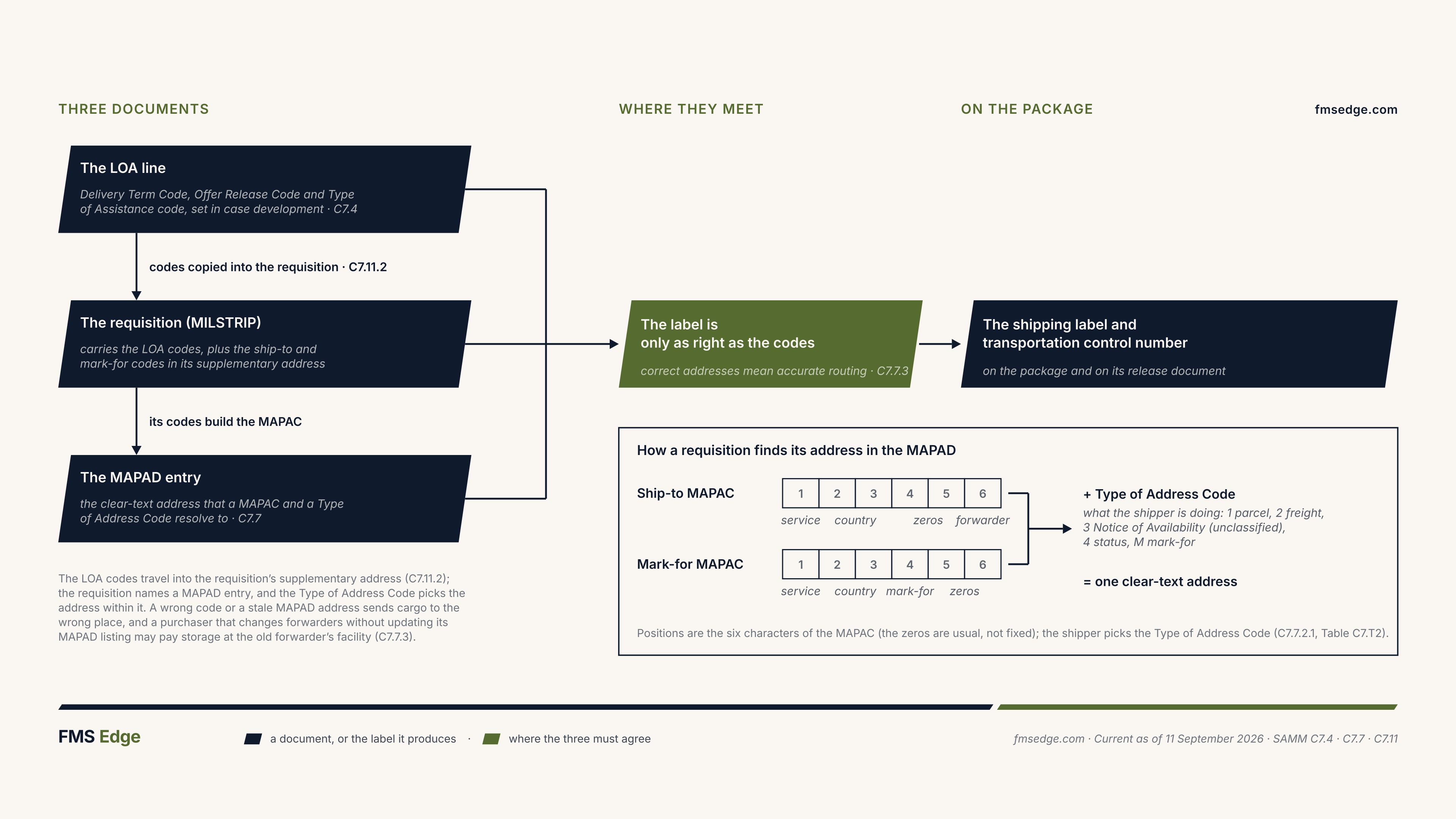
Three documents decide where a Foreign Military Sales shipment goes. The LOA line sets the codes, the MILSTRIP requisition adds the ship-to and mark-for codes, and the MAPAD resolves the address code to a clear-text address. All three documents meet on the shipping label, which is only as right as the codes behind it.
What is the Military Assistance Program Address Directory (MAPAD)?
The website contains the addresses required for shipment of materiel and distribution of related documentation under and /Grant Aid. The is available for use by Department of War (DoW) activities, the General Services Administration, commercial firms, foreign governments, and international organizations participating in and /Grant Aid Programs [SAMM ]. Correct addresses are essential for accurate routing of cargo and documentation and for charging the purchaser the correct transportation rate [SAMM ]. The is an internet-accessible database.
The contains addresses and corresponding address codes to identify where materiel/documentation is to be shipped. It includes addresses of Offices, freight forwarders, country representatives, and customer addresses within the country. Generally, the information is coded to provide the following:
- A shipping address for parcel post, small package shipments, and freight
- An address to receive Notices of Availability ()
- An address to receive supply and shipment status
- Mark-for addresses for in-country destinations
The Type Address Code () is a one-character code, a letter or a digit, that shows what an address is used for. The manual explains each in the in Table C7.T2 [SAMM ].
Each purchaser's special instructions in the may name the commercial airports to use for commercial air freight. They may also state a preference for particular surface carriers, or restrict certain types of freight. Organizational email addresses and point of contact details should be included with the addresses [SAMM ].
The following are specific policies:
- Administration: The is administered by the Defense Logistics Agency () Logistics Management Standards Office, which coordinates all entries with the and the Defense Transportation Regulation (), 4500.9-R Part II, “Cargo Movement.”
- Custodian: The Transaction Services is responsible for hosting the automated file and directory.
- Post Office Addresses: Military post office addresses (/DPO) are not used for shipments unless the specifies them, and they are approved by the applicable service before publication in the .
- International Mail Addressees: International mail addresses and addresses of U.S. activities are likewise approved by the service and specified in the .
- Classified Shipment Addresses: Some countries have and other addresses published in the for the receipt of classified shipments. Although the may be cleared to handle classified materiel, the preceding the shipment must be sent to the foreign representative identified in the special instructions, not the Type Address Code () 3 address [SAMM , ]. The foreign representative is typically at the customer’s embassy in Washington, DC, or a foreign government office located in the U.S. Once Defense Counterintelligence and Security Agency () has cleared a facility/ to handle classified materiel, will send a letter of clearance to the Defense Logistics Management Standards Office that will enter the correct addresses into the .
- Special Instructions: Clear text special instructions are listed at the beginning of each country section. This is a means by which customer countries place their unique requirements in the regarding shipments/documentation.
- Changes: Purchasers are responsible for keeping addresses current, and when the changes, the purchaser adjusts its listing through the focal point. A failure to update the may result in storage charges at the former ’s or a DoW vendor’s facility [SAMM ].
Addresses for the delivery of materiel, documents and reports are published in the , and purchasers are responsible for keeping them current and their contact information accurate [SAMM ]. The addresses are coordinated with the individual services’ administrators.
When the changes, the purchaser is also responsible for reconciling the shipments its former received. It is strongly recommended that each ensure its assigned Organizations () meet the purchaser's point of contact on a set schedule, at least once a year, to review all the purchaser's addresses. The review should check each address and its content and find any that are no longer valid. The findings need to go to each , which deletes the addresses no longer required and updates the others as required [SAMM ].
Ship-to addresses and the shipping label
The U.S. Government () initiates shipments to purchasers or freight forwarders and provides transportation services for specific items identified in the . As the shipment initiator, the can cause problems in the movement of articles to the purchasing country. Any failure in the packing and shipping process can result in problems for the carrier, the , and the customer and can also prevent prompt processing of claims or prevent U.S. customs clearance.
shipments are packed for the mode of shipment selected, through to the ultimate destination [SAMM ]. They are marked and labeled with a military shipping label in accordance with MIL-STD-129, carrying as a minimum the data in Table C7.T3, which include the and, where applicable, the mark-for address code with its clear-text address [SAMM , ]. Hazardous materiel is certified for transport. The online system is used to create the clear-text address on the shipping label; if not, items could be shipped to the wrong ship-to or mark-for addressee.
A ship-to address is typically a destination in the U.S. through which materiel will transit, such as a facility, a staging location, or consolidation point. Besides the marking data, the shipping activity shows on the shipping label or the accompanying documentation (a DD 1348-1, Single Line Item Release/Receipt Document, a DD 250, Material Inspection and Receiving Report, or a DD 1149, Requisition and Invoice/Shipping Document) the price or value of the shipment, the transportation priority, a description of the item, the , the document number and the supplementary address. Without this ship-to address, the cannot obtain customs clearance or identify the final destination for onward shipment. The item then becomes frustrated cargo and remains undeliverable until the applicable and shipping activity correct the errors. This applies to items shipped directly from procurement as well as those being shipped from stock.
The military departments’ transportation coordinators at each are the points of contact for country representatives and may assist the country representative and in the determination of proper addresses and codes for entry in the and subsequent use in requisitions. Additionally, the transportation coordinators may assist freight forwarders in processing claims against carriers for lost or damaged freight received at the ’s facility.
The Military Assistance Program Address Code
The key to using the is the Address Code (). The appears as a six-position code in the . It is constructed from selected codes located in various data fields of the requisition. Specifically, requisition record positions 31, 32, 33, 45, 46, and 47 provide all the information necessary to construct a when the shipment is made through a .
A does not exist as a discrete entity without a defining . The is a suffix to the , which further defines the clear-text address to be used.
The ’s address is represented by the ship-to , and the final destination address is represented by the mark-for .
When shipment is made entirely through the , there is no and no . In this case, the offer/release option and code are replaced in the supplementary address fields by “XX.” The mark-for address becomes the ship-to address.
Grant aid shipments have different construction rules. Grant aid materiel is usually shipped through the , but the materiel is not designated for any specific foreign military service, and there is no . Consequently, the data in the supplementary address fields of a grant aid requisition are quite different from the data in an requisition. In these shipments, the ship-to and mark-for are usually the same.
For information on how to construct for Canadian shipments, see 4500.9-R Part II, Appendix E []. Shipments to Canada do not follow the construction rules for other shipments. In these shipments, there is no mark-for .
Address Code Construction. The first position of the designates the country military service to which the address applies. Generally the code will be B (in-country Army), D (in-country Air Force), P (in-country Navy), K (in-country Marines), or T (in-country joint activity or nonspecific). Grant aid shipments are not made to military services but, rather, to foreign governments in general. For this reason, the service identifier in position forty-five on the document is Y. The Y is converted to X in the because the DoW has designated the Y for other purposes in coding for transportation.
Country and program codes are listed in Table C4.T2 [SAMM ]. In the , the second and third positions carry the country or activity code.
For a ship-to with shipment going to a , the fourth and fifth positions will usually contain zeros, and the sixth position will indicate the code.
For a mark-for (an entry in record position thirty-three indicates that a requisitioner also wants an in-country destination mark-for address included in the documentation and on the shipping label), positions one, two, and three remain the same, but position four will include the mark-for code and positions five and six will usually be zeros.
For a complete list of from the , one needs only to input the purchaser’s service followed by the country or program code. The query is repeated for each military service applicable to the customer.
The Type of Address Code
Individual may indicate numerous addresses. The question then is which address should be selected. Table C7.T2 lists the and explains the use of each [SAMM ]. The key to the selection of the correct address is the , which appears in the second column of the country address page. The represents the action being taken by the shipping activity. For example, if a supply depot is shipping an unclassified small package, the appropriate would be 1. If the same has multiple addresses, the shipping activity would ship to the 1 address.
The selection of the proper is determined by the type of action being taken. For example, when a requisition is processed, the following sequence of events may take place:
- A need for an address to send supply status documents ( 4)
- Possibly a need for an address to send a , indicating stock is on hand and ready for shipment ( 3)
- The need for an address to send parcel post, freight, or classified materiel ( A-D, 1, 2)
- The need for an address to send materiel release documents ( 5, 6)
- The need for an address to send shipment status documents ( 4)
Each purchaser’s Special Instructions in the identify preferences such as clear-text addresses and shipping instructions, and M addresses must be used as the shipping address on all documentation [SAMM ]. A clear-text mailing or shipping address may be obtained from the by constructing a from the requisition data and determining the type of shipping action to be accomplished. The and its corresponding clear-text address appear on the materiel release document (DD 1348-1A, Issue Release/Receipt Document, or the DD 250, Materiel Inspection and Receiving Report) and on the shipping label, DD 1387. The , however, never appears on any documentation.
References
SAMM
- SAMM C7.7.1: Definition.
- SAMM C3.3.3.4.4.2: Foreign Government Representative.
- SAMM C7.11.1.2: Classified Shipments.
- SAMM C7.8.1: Packaging.
- SAMM C7.8.2: Marking.
- SAMM C7.T3: FMS Shipment Marking
- SAMM C4.T2: Security Cooperation Customer and Regional Codes and FMS Eligibility Tables
- SAMM C7.T2: Type of Address Codes
- SAMM C7.7.2.1: Type Address Code.
- SAMM C7.7.2.2: Special Instructions.
- SAMM C7.7.3: Military Assistance Program Address Directory Address Changes.
Public authorities
- DTR 4500.9-R: Defense Transportation Regulation, DTR 4500.9-R
Related
Military Assistance Program Address Directory (MAPAD)
The directory of clear-text addresses of country representatives, freight forwarders and in-country customers used to release Foreign Military Sales (FMS) and grant aid shipments processed under Military Standard Requisitioning and Issue Procedures (MILSTRIP), and to send their shipping documents.
The Military Assistance Program Address Directory (MAPAD) is available to Department of War activities, the General Services Administration (GSA), commercial firms, foreign governments and international organizations taking part in FMS or grant aid programs [SAMM C7.7.1].
FMS Edge glossary, as of 10 October 2026
Glossary entry →Open the manual’s entry → (opens in new tab)
Foreign Military Sales (FMS)
The part of U.S. security assistance, authorized by the Arms Export Control Act (AECA), in which eligible foreign governments and international organizations buy defense articles, services and training from the U.S. Government under formal government-to-government agreements.
The articles come either from Department of War stocks or from new procurement under contracts the Department manages [22 U.S.C. 2761, 22 U.S.C. 2762]. A sale is FMS whatever the source of the purchaser's financing.
FMS Edge glossary, as of 10 October 2026
Glossary entry →Open the manual’s entry → (opens in new tab)
MAPAD: Military Assistance Program Address Directory
SAMM Acronyms, as of 12 September 2026
Glossary entry →Military Assistance Program Address Directory (MAPAD) →
Military Assistance Program (MAP)
That portion of the United States Security Assistance program authorized by the Foreign Assistance Act of 1961, as amended, which once provided defense articles and services to recipients on a nonreimbursable (grant) basis. Funding for MAP was consolidated under the Foreign Military Financing program beginning in Fiscal Year 1990.
SAMM Glossary, as of 12 September 2026
Glossary entry →Open the manual’s entry → (opens in new tab)
FMS: Foreign Military Sale
SAMM Acronyms, as of 12 September 2026
Security Cooperation
Activities by which the Department of War encourages and enables international partners to cooperate with the United States toward strategic objectives, spanning every interaction with foreign defense and security establishments and every security assistance program the Department administers.
Under chapter 16 of Title 10, their purposes are to develop allied and friendly security capabilities for self-defense and multinational operations, to give U.S. forces peacetime and contingency access, and to build relationships promoting specific U.S. security interests [10 U.S.C. 301(7)].
FMS Edge glossary, as of 10 October 2026
Glossary entry →Open the manual’s entry → (opens in new tab)
NOA: Notice of Availability
SAMM Acronyms, as of 12 September 2026
Defense Transportation System (DTS)
The part of the worldwide transportation infrastructure that supports Department of War transportation needs in peace and war, made up of military (organic) and commercial resources that are organic to the Department, under contract to it or controlled by it [SAMM C7.6.1].
It takes in organic and commercial aircraft and ships, commercial small-package services under Department contract, and U.S. military air and ocean terminals in and outside the United States.
FMS Edge glossary, as of 10 October 2026
Glossary entry →Open the manual’s entry → (opens in new tab)
Defense Logistics Agency
The Department of War agency that is the item manager for consumable, stock-funded secondary items. Its supply centers work with the military departments to fill Foreign Military Sales (FMS) requisitions, process supply discrepancy reports and repair and return items, and close cases when supply is complete, and it prepares FMS cases for cataloging services and excess defense articles [SAMM C1.3.2.6.2.3.2].
FMS Edge glossary, as of 10 October 2026
Military Standard Requisitioning And Issue Procedures (MILSTRIP)
The uniform Department of War procedures for requisitioning and issuing materiel within standardized priorities, using standard data elements, codes, forms and transaction formats that foreign governments and international organizations also use by agreement.
The Implementing Agency (IA) or the purchaser may initiate MILSTRIP requisitions under implemented Letters of Offer and Acceptance (LOAs) [SAMM C6.4.3].
FMS Edge glossary, as of 10 October 2026
Glossary entry →Open the manual’s entry → (opens in new tab)
Letter of Offer and Acceptance (LOA)
The legal instrument that lists the defense articles and services, including training, that the U.S. Government transfers to a foreign country or international organization, with their estimated costs and the terms and conditions. The benefitting partner does not sign a Building Partner Capacity (BPC) LOA.
The Letter of Offer and Acceptance (LOA) is the instrument the U.S. Government uses to sell under the Arms Export Control Act (AECA); signed LOAs and their later Amendments and Modifications are also called Foreign Military Sales (FMS) cases [SAMM C5.6.1].
FMS Edge glossary, as of 10 October 2026
Glossary entry →Open the manual’s entry → (opens in new tab)
LOA: Letter of Offer and Acceptance
SAMM Acronyms, as of 12 September 2026
Freight Forwarder
A commercial import/export company registered with the Department of State, Bureau of Political-Military Affairs, Directorate of Defense Trade Controls and under contract to the Foreign Military Sales customer which arranges transportation of materiel from a point specified in the Letter of Offer and Acceptance to the final destination.
SAMM Glossary, as of 12 September 2026
Glossary entry →Open the manual’s entry → (opens in new tab)
Implementing Agency (IA)
The military department or defense agency responsible for the execution of military assistance programs. With respect to FMS, the military department or defense agency assigned responsibility by the Defense Security Cooperation Agency to prepare an LOA and to implement an FMS case. The implementing agency is responsible for the overall management of the actions that will result in delivery of the materials or services set forth in the LOA that was accepted by a foreign country or international organization.
SAMM Glossary, as of 12 September 2026
Glossary entry →Open the manual’s entry → (opens in new tab)
Combatant Command (CCMD)
A unified or specified command with a broad continuing mission under a single commander established and so designated by the President, through the Secretary of Defense and with the advice and assistance of the Chairman of the Joint Chiefs of Staff. Also called CCMD.
SAMM Glossary, as of 12 September 2026
Glossary entry →Open the manual’s entry → (opens in new tab)
SCO: Security Cooperation Organization
SAMM Acronyms, as of 12 September 2026
SAMM: Security Assistance Management Manual
SAMM Acronyms, as of 12 September 2026
Glossary entry →Security Assistance Management Manual (SAMM) →
Case Identifier
A unique six-digit identifier assigned to an Foreign Military Sales case for the purpose of identification, accounting, and data processing of each Letter of Offer and Acceptance. The case identifier consists of the two-letter country code, a one-letter designator for the Implementing Agency, and a three-letter case designator.
SAMM Glossary, as of 12 September 2026
Glossary entry →Open the manual’s entry → (opens in new tab)
MILSTRIP: Military Standard Requisitioning and Issue Procedures
SAMM Acronyms, as of 12 September 2026
Glossary entry →Military Standard Requisitioning And Issue Procedures (MILSTRIP) →
International Logistics Control Office (ILCO)
The office in each Military Department that manages the logistics support programs and transactions of Foreign Military Sales (FMS) and other security cooperation programs, and the central point in the continental United States for monitoring purchasers' requisitions.
A purchaser reports a valid supply discrepancy to the International Logistics Control Office (ILCO) of the Military Department concerned [SAMM C2.1.5.4.3].
FMS Edge glossary, as of 10 October 2026
Glossary entry →Open the manual’s entry → (opens in new tab)
ILCO: International Logistics Control Office
SAMM Acronyms, as of 12 September 2026
Glossary entry →International Logistics Control Office (ILCO) →
DTS: Defense Transportation System
SAMM Acronyms, as of 12 September 2026
Notice of Availability (NOA)
Notice, on DD Form 1348-5, from a shipping activity to a Foreign Military Sales (FMS) purchaser or its freight forwarder that materiel is ready for shipment, in time for the recipient to prepare for receipt and respond with delivery instructions.
The Notice of Availability (NOA) goes to the appropriate address in the Military Assistance Program Address Directory (MAPAD) and coordinates the release of materiel requiring special receipt, export processing or special storage procedures [SAMM C7.11.1].
FMS Edge glossary, as of 10 October 2026
Glossary entry →Open the manual’s entry → (opens in new tab)
SAMM C7.7.1: Definition.
“The Military Assistance Program Address Directory (MAPAD) contains information and addresses required for shipment of materiel and distribution of related documentation under Foreign Military Sales (FMS) or grant aid programs. It includes addresses of FMS freight forwarders, country representatives, and purchasers. The MAPAD is available for use by DoW activities, the General Services Administration (GSA), commercial firms, foreign governments, and …”
Security Assistance Management Manual, as of 26 October 2026
SAMM C7.7.3: Military Assistance Program Address Directory Address Changes.
“Correct MAPAD addresses are essential for accurate routing of cargo and documentation and will also ensure the FMS purchasers are charged the correct transportation rate. Purchasers are responsible for ensuring MAPAD addresses are current and maintaining accurate contact information. It is strongly recommended each Combatant Command (CCMD) ensure that assigned U.S. Military Groups (MILGPs) meet on an established basis, not …”
Security Assistance Management Manual, as of 26 October 2026
SAMM C7.7.2.1: Type Address Code.
“The Type Address Code (TAC) is a one-position alpha or numeric code designating the use of the address; See Table C7.T2. for explanation of the TAC in the MAPAD.”
Security Assistance Management Manual, as of 11 September 2026
SAMM C7.7.2.2: Special Instructions.
“Each purchaser has Special Instructions in the MAPAD that identify customer preferences such as clear-text addresses and shipping instructions. Special instructions may identify the name and location of commercial airports to be used for commercial Defense Transportation System air freight, a preference for specific surface carriers, or restrictions for certain types of freight. TAC M addresses must be used as …”
Security Assistance Management Manual, as of 11 September 2026
SAMM C3.3.3.4.4.2: Foreign Government Representative.
“Classified materiel may be released only to a person who has been designated by the purchasing government in writing as its Designated Government Representative (DGR) or as its transfer agent (e.g., a cleared freight forwarder) that is used for onward movement to the point where custody of the shipment is assumed by the government’s DGR. The Military Assistance Program Address …”
Security Assistance Management Manual, as of 5 October 2026
SAMM C7.11.1.2: Classified Shipments.
“Shipping activities send NOAs for classified shipments to the country representative listed in the Special Instructions of the appropriate MAPAD address and not to a FMS freight forwarder.”
Security Assistance Management Manual, as of 11 September 2026
SAMM C7.8.1: Packaging.
“Packaging includes packing, preservation, and other procedures designed to protect materiel from damage or deterioration while in transit or in storage. Foreign Military Sales (FMS) shipments are packed to not less than Military Level A/B as defined in Military Standard (MILSTD)-129 or in accordance with best commercial practices based on the mode of shipment selected for the purchased items (i.e. …”
Security Assistance Management Manual, as of 26 October 2026
SAMM C7.8.2: Marking.
“Marking identifies the contents along with the shipper and consignee. FMS shipments are marked and labeled with a military shipping label in accordance with MIL-STD-129. As a minimum, these publications require the data shown in Table C7.T3. on a FMS shipment. Table C7.T3. FMS Shipment Marking # FMS Shipment Marking Requirements 1 FMS case identifier 2 Transportation Control Number (TCN) …”
Security Assistance Management Manual, as of 11 September 2026
SAMM C7.T3: FMS Shipment Marking
“Table C7.T3. FMS Shipment Marking # FMS Shipment Marking Requirements 1 FMS case identifier 2 Transportation Control Number (TCN) 3 Transportation Priority 4 Project Code, if applicable 5 Consignor’s Name and Ship From Address, Phone Number 6 Consignee’s Ship To Address, Phone Number 7 Ultimate consignee/Mark For Address (MAPAD address code and clear text address, if applicable) 8 Military Shipping …”
Security Assistance Management Manual, as of 11 September 2026
SAMM C4.T2: Security Cooperation Customer and Regional Codes and FMS Eligibility Tables
“Table C4.T2. Security Cooperation Customer and Regional Codes and FMS Eligibility Tables Click to view : Table C4.T2A. Security Cooperation Customer and Regional Codes and Foreign Military Sales Eligibility Table C4.T2B. Security Cooperation Customer and Regional Codes and Foreign Military Sales Eligibility (DSCA/Defense Finance and Accounting Service Reserved) Table C4.T2C. Security Cooperation Customer and Regional Codes and Foreign Military Sales …”
Security Assistance Management Manual, as of 26 September 2026
SAMM C7.T2: Type of Address Codes
“Table C7.T2. Type of Address Codes Purpose Explanation 1 Materiel UNCLASSIFIED materiel moving by small parcel carrier. A Materiel Materiel classified SECRET or CONFIDENTIAL moving by small parcel carrier. C Materiel Materiel classified CONFIDENTIAL moving by small parcel. 2 Materiel UNCLASSIFIED materiel moving by surface or air freight. B Materiel Materiel classified SECRET or CONFIDENTIAL moving by surface or air …”
Security Assistance Management Manual, as of 26 October 2026