
Guide
How is classified materiel shipped in a Foreign Military Sale?
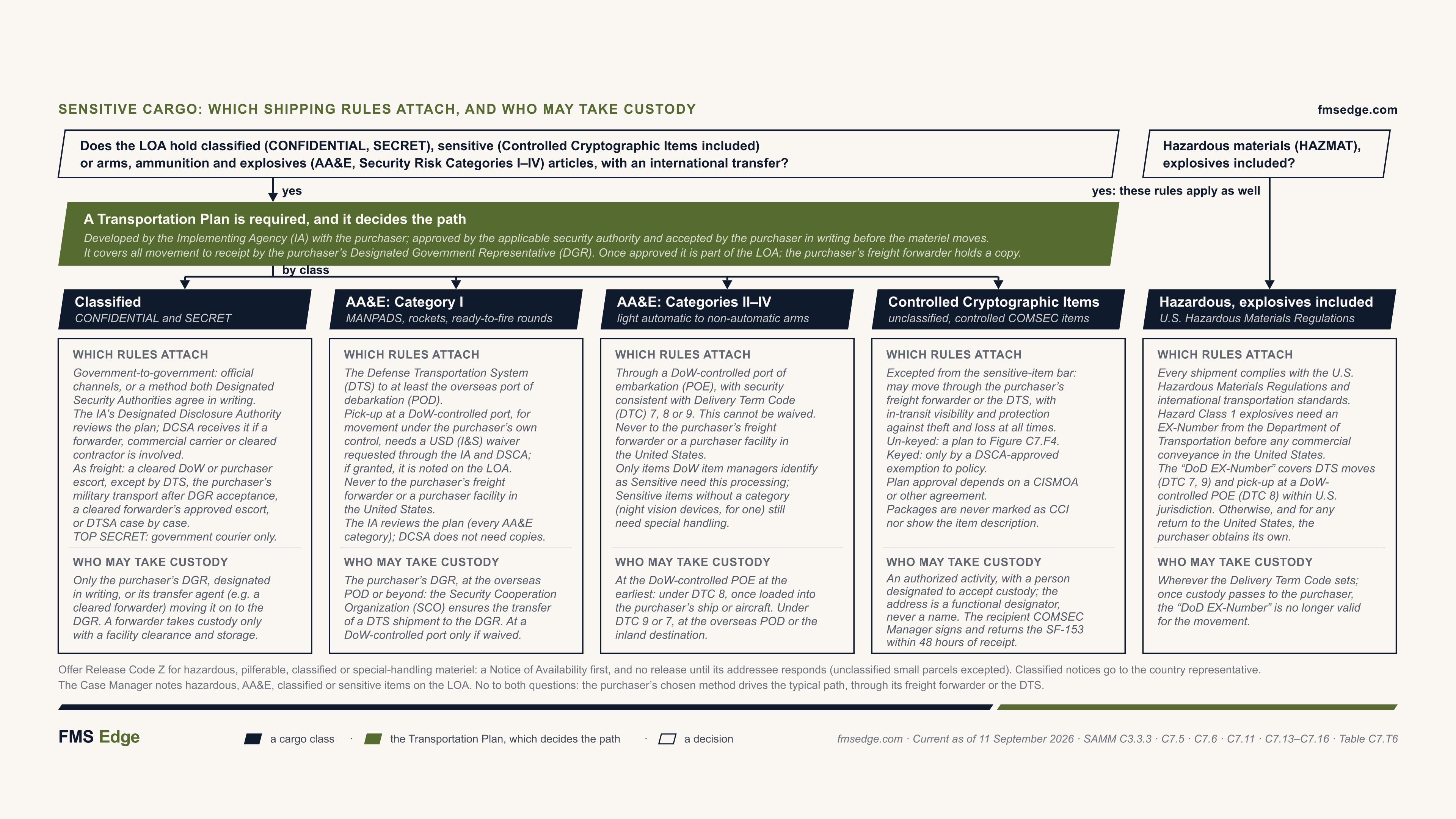
Classified materiel moves through official government-to-government channels, or by another method the two governments' Designated Security Authorities agree in writing. Before it ships, the and the purchaser agree a that names who safeguards it at every point, and custody passes only when the purchaser's accepts it.
For ordinary cargo the purchaser's chosen method drives the typical path. For classified, sensitive or arms, ammunition and explosives (AA&E) cargo moving internationally, a Transportation Plan is required, and it decides the path: the Implementing Agency develops it with the purchaser, and it is approved and accepted in writing before anything moves. Each class then carries its own shipping rules and its own rule for who may take custody. Hazardous materials rules apply alongside, whatever the class.
How is classified materiel shipped in a Foreign Military Sale?
Classified shipments of materiel are often made via the , which provides the required security and enables the DoW to maintain control and custody of the materiel until delivery to the purchaser. Classified materiel or data must be moved under security safeguards appropriate to the transportation mode employed, as established by Manual 5200.01, Volume 3, Program: Protection of Classified Information.
Classified and is identifiable through the Controlled Inventory Item Code (CIIC) listed in the catalog data for that item. Classified items should also be identified on the .
The Manual 5200.01, Volume 3, Program: Protection of Classified Information specifically advises that classified materiel shall be transferred on a government-to-government basis by duly authorized representatives of each government. This means that classified materiel shall be sent only to an embassy or other official agency of the recipient government, or for loading on board a ship, aircraft, or other flag carrier designated by the recipient government at the point of departure from the U.S.
The release of a shipment to a does not constitute transfer of custody and security responsibility to the recipient foreign government; this occurs only when the receiving government’s assumes custody of the consignment. The acts only as a transfer agent.
Before classified materiel can be shipped, the procedures for safeguarding it must be spelled out in a detailed by the preparing the , in cooperation with the customer. The must identify the individual responsible for safeguarding the classified materiel, the methods of transport, the locations of transfer and delivery, the location of storage or processing facilities, and the security clearances of all personnel and facilities involved in the transfer. The must ensure that its own security officials review and approve the .
The must be finalized, reviewed, and approved by the selling command’s security officials before any classified materiel can be shipped. The completed must be maintained in the case file. It must also be made available to U.S. Customs and Border Protection and other security officials when classified materiel is exported.
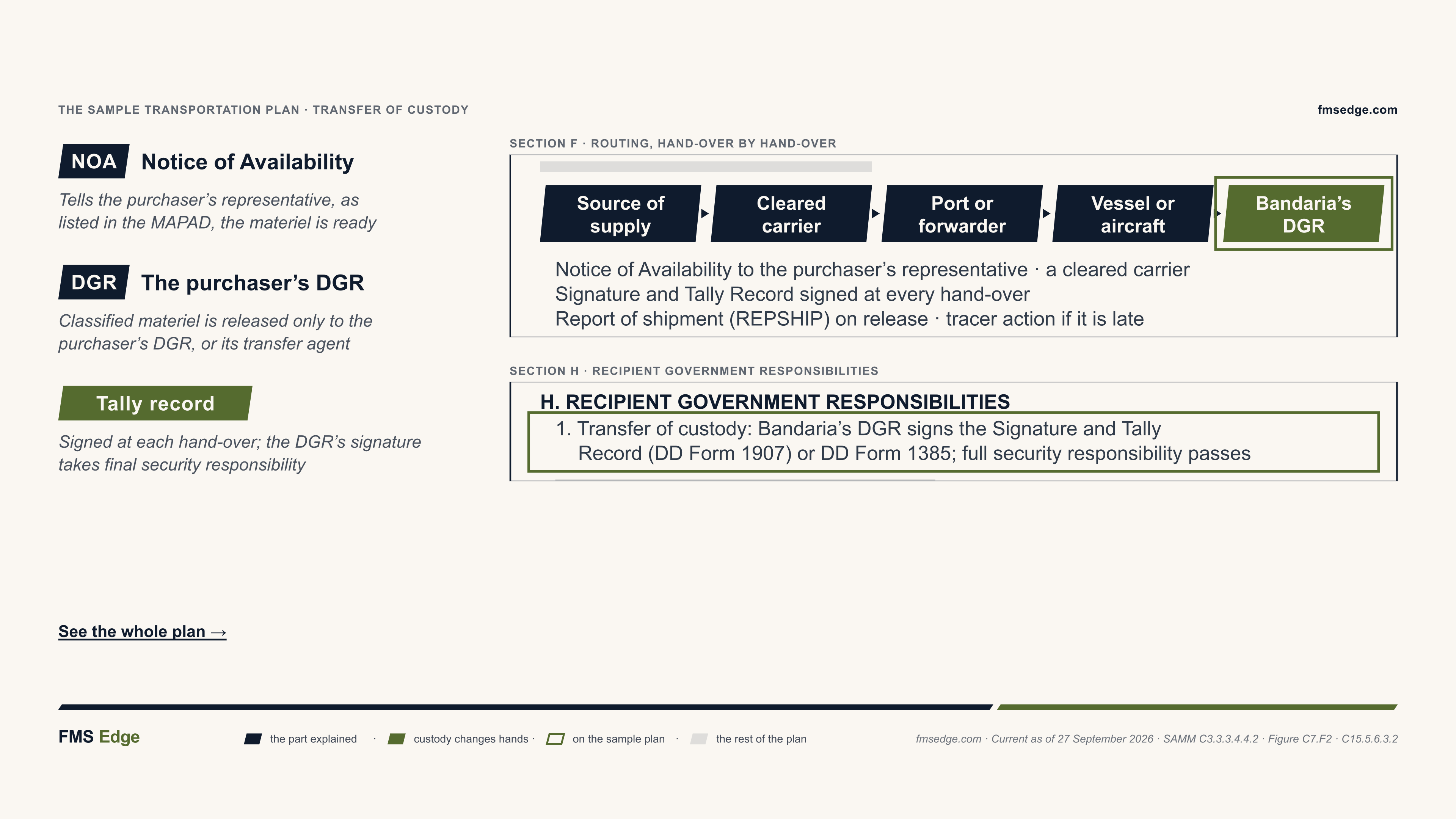
The transfer of custody on the sample Transportation Plan for a classified and sensitive shipment. Bandaria is the manual's fictional training country; the figure is a training example, not a real case. The routing section follows the materiel from hand-over to hand-over; the recipient government's section says where custody passes: when the purchaser's Designated Government Representative signs.
Movement of sensitive for customers requires a , which should be coordinated with the customer as part of the negotiation process. The will be coordinated following the same procedure as for classified shipments.
Classified, sensitive and hazardous shipments require the shipper to notify the customer representative or of the intent to ship the materiel. This notification is known as a . The may be submitted on a DD Form 1348-5, , or the can be sent using a commercial fax, e-mail, letter, or some other traceable document. These notices may be mailed or sent electronically by the shipper. The alerts the or country representative that a shipment is ready for movement, that appropriate actions are to be taken to ensure the protection of the materiel, and, for classified items, that proper government-to-government transfer must occur. The or country representative must respond to the confirming readiness to receive the materiel. The response should provide specific packaging and documentation instructions to enable the shipper to package the materiel for the appropriate mode of shipment. For classified shipments, the must identify the name of the recipient government’s . The shipper is not permitted to ship the materiel unless the response has been received. Shippers may charge materiel storage charges against the when freight forwarders or customer representatives are unable or unwilling to accept materiel.
References
SAMM
- SAMM C7.14.1.2
- SAMM C7.14.1.1
- SAMM C7.13.2 — Transportation Plan Preparation.
- SAMM C7.11.1.2 — Classified Shipments.
Related
Foreign Military Sales (FMS)
A process, authorized by the Arms Export Control Act, through which eligible foreign governments and international organizations may purchase defense articles, services, and training from the United States Government.
SAMM Glossary, as of 12 September 2026
Glossary entry →Open the manual’s entry → (opens in new tab)
Implementing Agency (IA)
The military department or defense agency responsible for the execution of military assistance programs. With respect to FMS, the military department or defense agency assigned responsibility by the Defense Security Cooperation Agency to prepare an LOA and to implement an FMS case. The implementing agency is responsible for the overall management of the actions that will result in delivery of the materials or services set forth in the LOA that was accepted by a foreign country or international organization.
SAMM Glossary, as of 12 September 2026
Glossary entry →Open the manual’s entry → (opens in new tab)
Transportation Plan
A document that details the transportation and security arrangements for moving classified or sensitive material, and identifies individuals responsible for providing security at various points during transportation.
SAMM Glossary, as of 12 September 2026
Glossary entry →Open the manual’s entry → (opens in new tab)
Designated Government Representative (DGR)
A person or persons duly authorized by a foreign government to act on behalf of that government to negotiate, commit, sign contractual agreements, and/or accept delivery of materiel.
SAMM Glossary, as of 12 September 2026
Glossary entry →Open the manual’s entry → (opens in new tab)
FMS — Foreign Military Sale
SAMM Acronyms, as of 12 September 2026
DTS — Defense Transportation System
SAMM Acronyms, as of 12 September 2026
Information Security (INFOSEC)
The protection of information systems against unauthorized access to or modification of information, whether in storage, processing, or transit, and against the denial of service to authorized users, including those measures necessary to detect, document and counter such threat. INFOSEC is applied through the application of Cybersecurity and Communications Security (COMSEC).
SAMM Glossary, as of 12 September 2026
Glossary entry →Open the manual’s entry → (opens in new tab)
Sensitive Materiel
Volatile and dangerous explosives which require special handling and transportation arrangements. The term sensitive also applies to highly desirable selected technologies which are not explosive, but which require special security procedures for transportation.
SAMM Glossary, as of 12 September 2026
Glossary entry →Open the manual’s entry → (opens in new tab)
LOA — Letter of Offer and Acceptance
SAMM Acronyms, as of 12 September 2026
DTSA — Defense Technology Security Administration
SAMM Acronyms, as of 12 September 2026
Freight Forwarder
A commercial import/export company registered with the Department of State, Bureau of Political-Military Affairs, Directorate of Defense Trade Controls and under contract to the Foreign Military Sales customer which arranges transportation of materiel from a point specified in the Letter of Offer and Acceptance to the final destination.
SAMM Glossary, as of 12 September 2026
Glossary entry →Open the manual’s entry → (opens in new tab)
LOR — Letter of Request
SAMM Acronyms, as of 12 September 2026
Continental United States (CONUS)
U.S. territory, including the adjacent territorial waters, located within the North American continent between Canada and Mexico. Does not include Hawaii or Alaska.
SAMM Glossary, as of 12 September 2026
Glossary entry →Open the manual’s entry → (opens in new tab)
Letter of Offer and Acceptance (LOA)
The legal instrument used by the USG to transfer itemized defense articles, defense services, and design and construction services to foreign partners.
When used under the authorities provided in the Arms Export Control Act for Foreign Military Sales, the LOA is a binding agreement signed by the USG and the foreign partner to transfer such articles and services.
When used under Building Partnership Capacity (BPC) authorities, the BPC LOA is not signed by the Benefitting Partner.
SAMM Glossary, as of 12 September 2026
Glossary entry →Open the manual’s entry → (opens in new tab)
Defense Transportation System (DTS)
The portion of the worldwide transportation infrastructure that supports DoD transportation needs in peace and war. DTS consists of two major elements: military and commercial resources. These resources include aircraft, assets, services, and systems organic to, contracted for, or controlled by the DoD. DoD's infrastructure, including ports, airlift, sealift, railway, highway, in-transit visibility, information management systems, customs, and traffic management that the DoD maintains and exercises in peacetime, is a vital element of the DoD's capability to project power worldwide. It provides for responsive force projection and a seamless transition between peacetime and wartime operations.
SAMM Glossary, as of 12 September 2026
Glossary entry →Open the manual’s entry → (opens in new tab)
Repair and Return
A service where eligible foreign countries return unserviceable repairable items for entry into the U.S. Military Department repair cycle. Upon completion of repairs, the same item is returned to the country and the actual cost of the repair is billed to the country.
SAMM Glossary, as of 12 September 2026
Glossary entry →Open the manual’s entry → (opens in new tab)
Notice of Availability (NOA)
The method by which the U.S. shipping installation will provide advance notification to the designated Foreign Military Sales (FMS) country representative or freight forwarder that the materiel is ready for shipment and, where appropriate, that the shipment requires an export release.
SAMM Glossary, as of 12 September 2026
Glossary entry →Open the manual’s entry → (opens in new tab)
NOA — Notice of Availability
SAMM Acronyms, as of 12 September 2026
DGR — Designated Government Representative
SAMM Acronyms, as of 12 September 2026
Glossary entry →Designated Government Representative (DGR) →