
Guide
Who claims when a Foreign Military Sales shipment is lost or damaged?
It depends on who arranged the transportation. Title passes to the purchaser at the point of origin, and the U.S. Government bears no loss in transit. Where the purchaser or its hired or paid the carrier, they claim against it directly. Where the Department of War furnished or contracted the transportation, it files the claim, and any proceeds go to the purchaser's account at . Either way the carrier's liability is limited, so insurance is the purchaser's protection for the rest.
Who claims for a lost or damaged shipment depends on who arranged the carrier for that leg. On legs the purchaser or its freight forwarder arranged, they claim directly against the carrier. On Defense Transportation System legs the Department of War claims, and the Implementing Agency forwards any proceeds to the purchaser's account at DFAS-IN. On military airlift or sealift there is no carrier claim. Beyond the carrier's limited liability, the purchaser's protection is its own insurance.
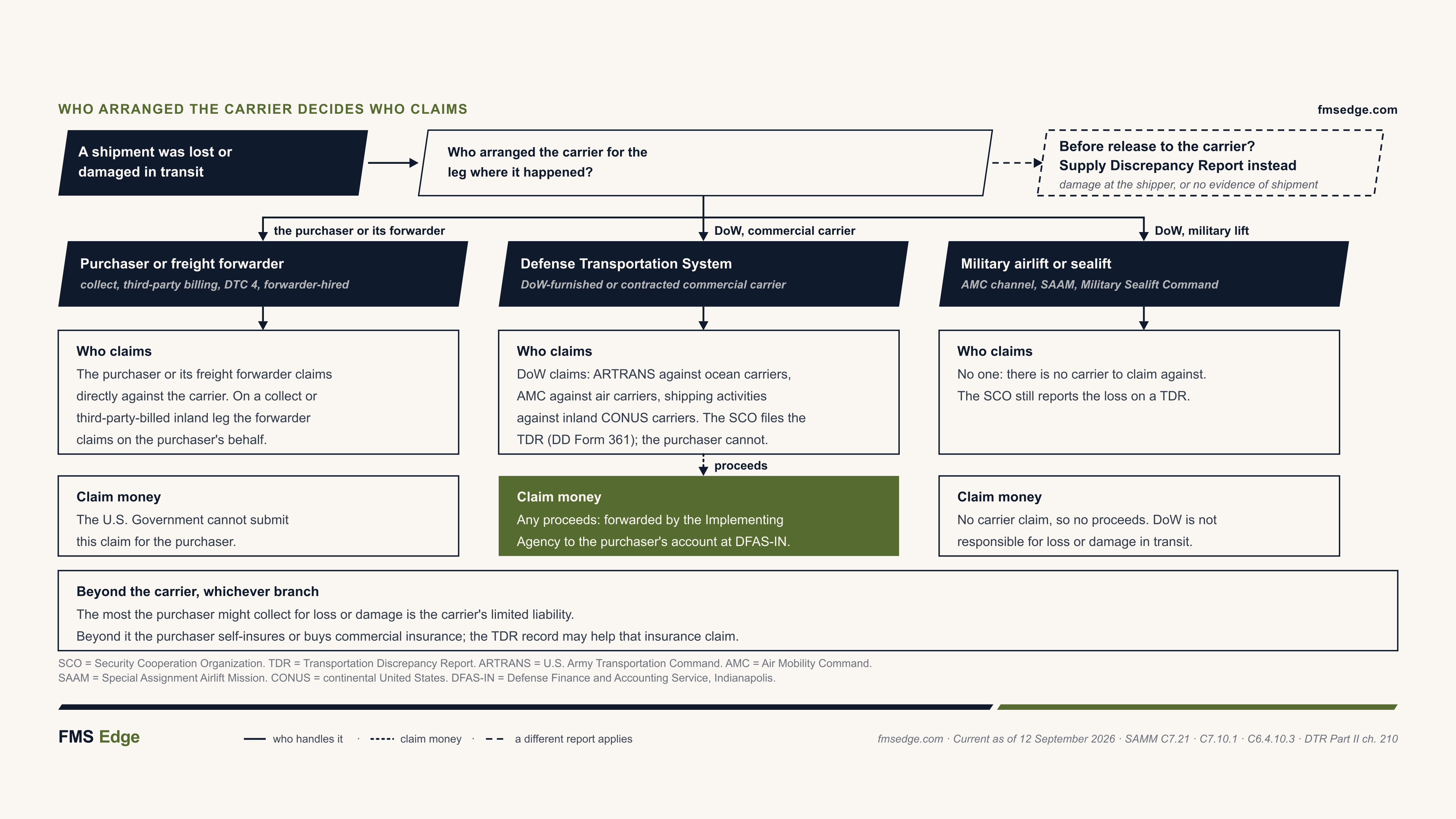
Who claims when a Foreign Military Sales shipment is lost or damaged?
Very few freight forwarders are permitted to open containers to check for possible damage of the contents. Claims must be filed against commercial carriers for shortages and visible damages. Because title to the materiel transfers to the customer at the initial point of shipment, the should generally not refuse a shipment that is destined for the customer. The DoW shipper has no authority to take the materiel back, because the title is warranted to the purchaser in the . The should accept damaged articles and resolve discrepancies with the shipper.
When using the , the generally maintains control and custody of the materiel (but not the title) until delivery to the purchaser. Since use of an -funded bill of lading for an shipment is considered a shipment, the DoW is performing a reimbursable service for the customer, and custody must not be construed to mean retention of title or acceptance by the DoW of any risk of loss or damage. If the ships an item to an recipient, including a recipient , and loss or damage occurs, the recipient must notify the shipper. The shipper may choose to file a claim with the carrier. The customer may not file claims directly against the carrier. The has responsibility for filing and processing claims with carriers when the shipment is made on a prepaid basis to locations where DoW personnel or other representatives have primary responsibility for receipt inspection and acceptance.
References
SAMM
- SAMM C7.10.1
- SAMM C7.21.1 — Claims That Cannot be Submitted by the United States Government.
- SAMM C7.21.3.3
- SAMM C7.6.2.7 — Shipments by the U.S. Government to a Freight Forwarder or Embassy (DTC 5).
- SAMM C6.4.10.3 — Causes of Discrepancies.
- SAMM C7.21 — Transportation Discrepancies.
- SAMM C7.21.2 — Claims That Can Be Submitted by the United States Government.
Public authorities
Related
Freight Forwarder
A commercial import/export company registered with the Department of State, Bureau of Political-Military Affairs, Directorate of Defense Trade Controls and under contract to the Foreign Military Sales customer which arranges transportation of materiel from a point specified in the Letter of Offer and Acceptance to the final destination.
SAMM Glossary, as of 12 September 2026
Glossary entry →Open the manual’s entry → (opens in new tab)
DFAS-IN — Defense Finance and Accounting Service - Indianapolis
SAMM Acronyms, as of 12 September 2026
Foreign Military Sales (FMS)
A process, authorized by the Arms Export Control Act, through which eligible foreign governments and international organizations may purchase defense articles, services, and training from the United States Government.
SAMM Glossary, as of 12 September 2026
Glossary entry →Open the manual’s entry → (opens in new tab)
Letter of Offer and Acceptance (LOA)
The legal instrument used by the USG to transfer itemized defense articles, defense services, and design and construction services to foreign partners.
When used under the authorities provided in the Arms Export Control Act for Foreign Military Sales, the LOA is a binding agreement signed by the USG and the foreign partner to transfer such articles and services.
When used under Building Partnership Capacity (BPC) authorities, the BPC LOA is not signed by the Benefitting Partner.
SAMM Glossary, as of 12 September 2026
Glossary entry →Open the manual’s entry → (opens in new tab)
FMS — Foreign Military Sale
SAMM Acronyms, as of 12 September 2026
Implementing Agency (IA)
The military department or defense agency responsible for the execution of military assistance programs. With respect to FMS, the military department or defense agency assigned responsibility by the Defense Security Cooperation Agency to prepare an LOA and to implement an FMS case. The implementing agency is responsible for the overall management of the actions that will result in delivery of the materials or services set forth in the LOA that was accepted by a foreign country or international organization.
SAMM Glossary, as of 12 September 2026
Glossary entry →Open the manual’s entry → (opens in new tab)
LOA — Letter of Offer and Acceptance
SAMM Acronyms, as of 12 September 2026
SAMM — Security Assistance Management Manual
SAMM Acronyms, as of 12 September 2026
Glossary entry →Security Assistance Management Manual (SAMM) →
Defense Transportation System (DTS)
The portion of the worldwide transportation infrastructure that supports DoD transportation needs in peace and war. DTS consists of two major elements: military and commercial resources. These resources include aircraft, assets, services, and systems organic to, contracted for, or controlled by the DoD. DoD's infrastructure, including ports, airlift, sealift, railway, highway, in-transit visibility, information management systems, customs, and traffic management that the DoD maintains and exercises in peacetime, is a vital element of the DoD's capability to project power worldwide. It provides for responsive force projection and a seamless transition between peacetime and wartime operations.
SAMM Glossary, as of 12 September 2026
Glossary entry →Open the manual’s entry → (opens in new tab)
DTS — Defense Transportation System
SAMM Acronyms, as of 12 September 2026