
Guide
What happens after Congress is notified of a Foreign Military Sale?
Once the notification is formally made it becomes public, and the may, once the Department of State confirms the formal notification, give the purchaser a draft of the ; the offer itself waits for the end of the statutory review period. A notification then remains valid for Letters of Offer and Acceptance drawn against it, within limits the manual sets.
Once State formally notifies Congress, the review period runs, and normally it ends with no joint resolution of disapproval enacted, so the LOA may be offered. To stop a sale, the House and the Senate must both adopt a joint resolution, and the President can veto it.
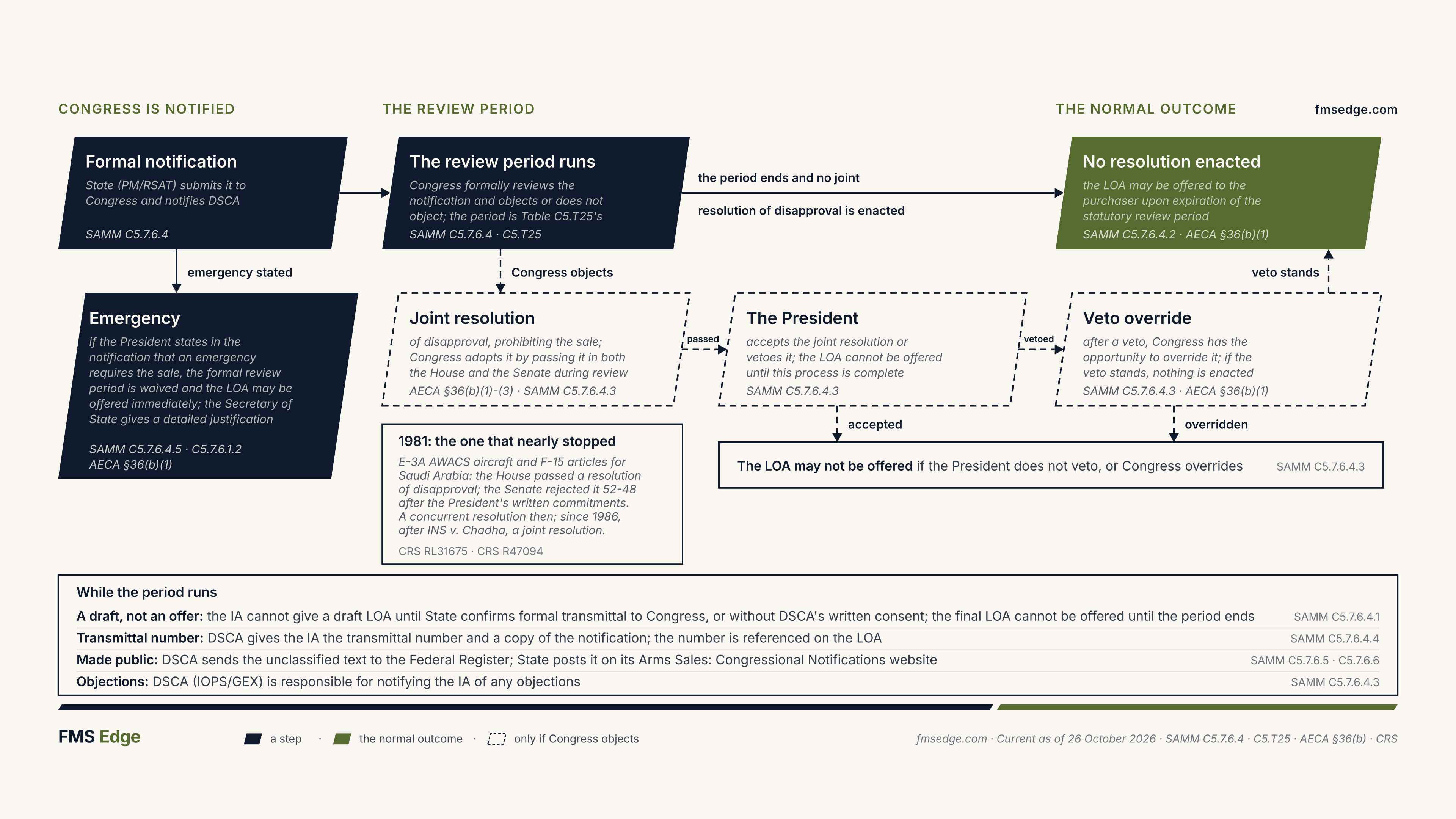
What happens after Congress is notified of an arms sale?
For a Section 36(b)(1) or 36(b)(5)(C) notification, the cannot give the purchaser a draft until the Department of State confirms that the notification has been formally transmitted to Congress. Before that confirmation, the cannot give a draft without the express written consent of the Assistant Director for International Operations at the . The final cannot be offered until the statutory review period ends [SAMM ]. After formal notification, submits the full text of each unclassified Section 36(b)(1) and 36(b)(5)(C) notification to the Federal Register for publication [SAMM ].
The notification then stands as the basis for the drawn against it. Several may reference one notification if together they stay within the quantities and dollar value remaining on it, but each , amendment or modification may reference only one Section 36(b)(1) notification, together with any Section 36(b)(5)(A) and 36(b)(5)(C) amendments made to the same notification where they apply [SAMM ].
Notification and the offer
Where a sets a "not to exceed" () threshold, any significant increase in the will require either an updated or an official email confirmation from the Military Group () or the partner. The email comes from a level at or above that of the original signatory and attests that the partner verbally confirmed its approval of the revised case amount [SAMM ].
For a Section 36(b)(1) or 36(b)(5)(C) notification, the cannot give the purchaser a draft until the Department of State confirms that the notification has been formally transmitted to Congress. Before that confirmation, the cannot give a draft without the express written consent of the Assistant Director for International Operations at ; the offer waits for the end of the statutory review period [SAMM ]. The unclassified notification is published in the Congressional Record and, for 36(b)(1) and 36(b)(5)(C) notifications, in the Federal Register [SAMM ].
Publication after notification
Section 36(f) of the requires 's Federal Register submittal, and a Section 36(b)(5)(A) notification needs none [SAMM ] []. The Department of State posts each unclassified Section 36(b)(1) notification on its Arms Sales: Congressional Notifications website [SAMM ].
How long a notification stays valid
Until a foreign government has accepted an against it, a notification remains valid for accepting and implementing for no more than five years. Once a case has been implemented against the notification, that limit no longer applies, and the notification can still be drawn against for as long as enough notified articles and dollar value remain on it [SAMM ].
References
SAMM
- SAMM C5.7.6.4.1: Rules for Offering Letters of Offer and Acceptance Following Notification.
- SAMM C5.7.3.3.1: Not-to-Exceed.
- SAMM C5.7.5.1.1.2: Public Information.
- SAMM C5.7.3.3: Congressional Notifications and Letters of Offer and Acceptance.
- SAMM C5.7.6.5: Federal Register.
- SAMM C5.7.6.6: Major Arms Sales.
- SAMM C5.7.6.7: Period of Validity.
Public authorities
- AECA §36(f): Arms Export Control Act of 1976, as amended, §36(f) (22 U.S.C. §2776(f))
Facts referenced
- Maximum period a congressional notification that has resulted in no accepted LOA remains valid for LOAs to be accepted and implemented against it (not applicable once a case is implemented against it): five years (as of 5 October 2026; SAMM C5.7.6.7)
Related
Implementing Agency (IA)
The military department or defense agency responsible for the execution of military assistance programs. With respect to FMS, the military department or defense agency assigned responsibility by the Defense Security Cooperation Agency to prepare an LOA and to implement an FMS case. The implementing agency is responsible for the overall management of the actions that will result in delivery of the materials or services set forth in the LOA that was accepted by a foreign country or international organization.
SAMM Glossary, as of 12 September 2026
Glossary entry →Open the manual’s entry → (opens in new tab)
Letter of Offer and Acceptance (LOA)
The legal instrument that lists the defense articles and services, including training, that the U.S. Government transfers to a foreign country or international organization, with their estimated costs and the terms and conditions. The benefitting partner does not sign a Building Partner Capacity (BPC) LOA.
The Letter of Offer and Acceptance (LOA) is the instrument the U.S. Government uses to sell under the Arms Export Control Act (AECA); signed LOAs and their later Amendments and Modifications are also called Foreign Military Sales (FMS) cases [SAMM C5.6.1].
FMS Edge glossary, as of 10 October 2026
Glossary entry →Open the manual’s entry → (opens in new tab)
LOA: Letter of Offer and Acceptance
SAMM Acronyms, as of 12 September 2026
Defense Security Cooperation Agency (DSCA)
The Department of War agency that directs, administers and provides guidance to the Department's components and its representatives at U.S. missions for the execution of the security cooperation programs for which it is responsible [SAMM C1.3.2.2]. The agency also provides financial and technical assistance, arranges the transfer of defense materiel, training and services to international partners, and promotes military-to-military contacts.
FMS Edge glossary, as of 10 October 2026
Glossary entry →Open the manual’s entry → (opens in new tab)
DSCA: Defense Security Cooperation Agency
SAMM Acronyms, as of 12 September 2026
Glossary entry →Defense Security Cooperation Agency (DSCA) →
Major Defense Equipment (MDE)
Any item of Significant Military Equipment on the U.S. Munitions List having a nonrecurring research and development cost of more than $50 million or a total production cost of more than $200 million. Also defined in section 47 (6), Arms Export Control Act.
SAMM Glossary, as of 12 September 2026
Glossary entry →Open the manual’s entry → (opens in new tab)
Letter of Request (LOR)
The term used to identify a request from an eligible FMS participant country for the purchase of U.S. defense articles and services. The request may be in message or letter format.
SAMM Glossary, as of 12 September 2026
Glossary entry →Open the manual’s entry → (opens in new tab)
Total Case Value (Letter of Offer and Acceptance)
The total value of the Letter of Offer and Acceptance at the time of calculation, which includes the cost of the materiel, services, all Indirect Pricing Components, administrative charges, and all accessorial charges.
SAMM Glossary, as of 12 September 2026
Glossary entry →Open the manual’s entry → (opens in new tab)
LOR: Letter of Request
SAMM Acronyms, as of 12 September 2026
Arms Export Control Act (AECA)
The basic U.S. law providing the authority and general rules for the conduct of Foreign Military Sales and commercial sales of defense articles, defense services, and training. The Arms Export Control Act (AECA) came into existence with the passage of the Foreign Military Sales Act (FMSA) of 1968. An amendment in the International Security Assistance and AECA of 1976 changed the name of FMSA to the AECA.
SAMM Glossary, as of 12 September 2026
Glossary entry →Open the manual’s entry → (opens in new tab)
SAMM C5.7.6.4.1: Rules for Offering Letters of Offer and Acceptance Following Notification.
“For AECA, Section 36(b)(1) (22 U.S.C. 2776(b)(1)) and AECA, Section 36(b)(5)(C) (22 U.S.C. 2776(b)(5)(C)) notifications, the IA cannot provide a draft LOA to the purchaser until the Department of State confirms the CN has been formally transmitted to Congress or without the express written consent from the Assistant Director for International Operations at DSCA. Additionally, a final LOA cannot be …”
Security Assistance Management Manual, as of 5 October 2026
SAMM C5.7.6.5: Federal Register.
“Following notification, DSCA submits the full text of unclassified AECA, Section 36(b)(1) (22 U.S.C. 2776(b)(1)) and AECA, Section 36(b)(5)(C) (22 U.S.C. 2776(b)(5)(C)) notifications to the Federal Register for publication, as required by AECA, Section 36(f) (22 U.S.C. 2776(f)). A Federal Register submittal is not required for AECA, Section 36(b)(5)(A) (22 U.S.C. 2776(b)(5)(A)) CNs.”
Security Assistance Management Manual, as of 5 October 2026
SAMM C5.7.3.3: Congressional Notifications and Letters of Offer and Acceptance.
“Multiple LOAs can reference a single CN, provided they do not in total exceed the MDE quantities and dollar value remaining on the CN. Each LOA, Amendment, and Modification may only reference one Section 36(b)(1) CN, in addition to any 36(b)(5)(A) and 36(b)(5)(C) amendments to that same 36(b)(1), if applicable.”
Security Assistance Management Manual, as of 11 September 2026
SAMM C5.7.3.3.1: Not-to-Exceed.
“If the LOR specifies a "not to exceed" (NTE) threshold, any significant upward adjustment to the total case value will require an updated LOR or official email confirmation from the MILGP or partner, at or above the level of the original LOR signatory, attestation that the partner verbally confirmed approving the revised case amount.”
Security Assistance Management Manual, as of 5 October 2026
SAMM C5.7.5.1.1.2: Public Information.
“Following formal notification, the full text of the unclassified CN is published in the Congressional Record, which is available to the public online. With the exception of classified notifications and classified annexes, the full texts of 36(b)(1) and 36(b)(5)(C) CNs are also posted for the public in the Federal Register after notification and the details of 36(b)(1) notifications are published …”
Security Assistance Management Manual, as of 2 November 2026
Arms Export Control Act of 1976, as amended, §36(f) (22 U.S.C. §2776(f))
AECA §36(f) · Statute
SAMM C5.7.6.6: Major Arms Sales.
“Following notification, State publishes a web post for each unclassified AECA, Section 36(b)(1) (22 U.S.C. 2776(b)(1)) CN on the State Arms Sales: Congressional Notifications website.”
Security Assistance Management Manual, as of 5 October 2026
SAMM C5.7.6.7: Period of Validity.
“A CN that has not resulted in any accepted LOA(s) by a foreign government remains a valid notification against which LOAs may be accepted and implemented for a period of time not to exceed five years. Once a case has been implemented against a CN, the five-year validity period does not apply. In this case, the CN remains a valid …”
Security Assistance Management Manual, as of 5 October 2026