
Guide
What is a Direct Commercial Sale?
A is made by U.S. industry directly to a foreign buyer under a Department of State license and is not administered through procedures. The two are different procurement methods for the same U.S. defense articles and services.
The same three parties stand at the corners of both triangles, and only the edges that carry the sale differ. Foreign Military Sales rides on the LOA and a Department of War contract. A Direct Commercial Sale rides on one commercial contract, made under a Department of State export license.
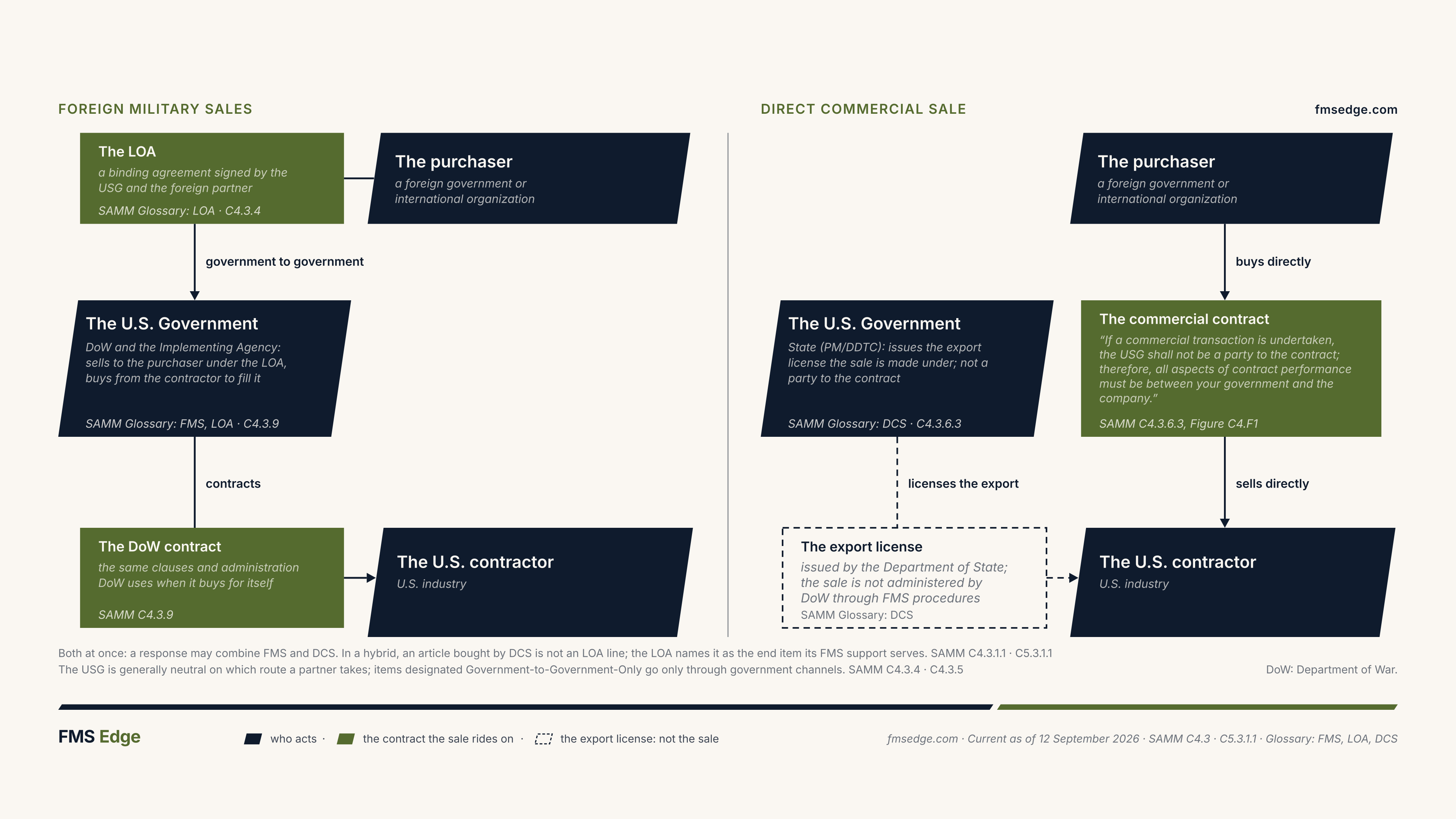
What is a Direct Commercial Sale?
A is a sale of defense articles or defense services that U.S. industry makes directly to a foreign buyer under a license the Department of State issues, and that the Department of War does not administer through procedures. , by contrast, is the process, authorized by the , that lets eligible foreign governments and international organizations buy defense articles, services and training from the U.S. Government.
Direct Commercial Sales () are commercial exports of defense articles, services, and training licensed under Section 38 of the , directly to a foreign government from U.S. defense industry []. Unlike the procedures employed for , the Department of War (DoW) does not administer transactions, and a sale does not typically include a government-to-government agreement. Rather, the Department of State () Directorate of Defense Trade Controls (PM/) implements the required U.S. Government () controls through licensing. The International Traffic in Arms Regulations () (22 CFR 120-130) contains the day-to-day rules and procedures for Direct Commercial Sales.
Not all license approvals result in signed contracts and actual deliveries.
The and systems are different procurement methods that the international partner may employ for the purchase of U.S. defense articles and services. In a commercial acquisition, a U.S. contractor and an international partner enter into a direct contract in accordance with U.S. law and regulations and provisions of international commercial law, except for export control approval and compliance enforcement. The is not a party to these commercial contractual transactions. The international partner has the responsibility to select the source and manage the contract directly with the U.S. contractor.
Under the system, the and the international partner enter into an agreement, the , which specifies the terms and conditions of the sale. Except for items supplied directly from DoW inventory, the purchases the desired items or services from the U.S. manufacturer on behalf of the international partner. The DoW employs essentially the same procurement criteria as if the item/service was being purchased for U.S. needs. The , not the international partner, selects the source and manages the contract consistent with the provisions of the , the Defense Supplement (), and the case.
The Department of State's policies and procedures for the permanent export of U.S. items bought through the program are set out in the . If marketing involves disclosing or exporting defense articles temporarily, the contractor must obtain the appropriate export license. For the DoW, the Defense Administration () researches and validates license applications [SAMM ].
Under traditional , the essentially has no direct involvement in the procurement process, except for one essential element: the export license. Export of U.S. () items, including certain services and technical information, requires a license unless it is done through [SAMM ].
Following export license approval, the generally does not participate in the .
This exclusion includes contract negotiation, , quality control, inspection, acceptance, and audit functions. In , the international partner gets what they negotiate.
License provisos or limitations may be imposed on an export license requiring involvement to support continued national security and foreign policy reviews (for example, Technology Control Plans (TCPs)) to control the transfer mechanism of classified information and goods, and under other limited situations.
In the scenario, the international partner addresses the contractor directly to resolve any issues that arise. The promptness and acceptability of the resolution will depend solely upon the international partner and the . Although the DoW may concurrently be procuring the same or similar items with the same contractor, the DoW is not a participant in the contract and therefore, has no legal authority to direct the contractor in any aspect of contract performance.
References
SAMM
- SAMM C3.3.1: International Traffic in Arms Regulations Requirements.
Public authorities
- AECA §38: Arms Export Control Act of 1976, as amended, §38 (22 U.S.C. §2778)
Related
Direct Commercial Sale (DCS)
A sale of defense articles or defense services made under a Department of State issued license by U.S. industry directly to a foreign buyer, and which is not administered by DoD through Foreign Military Sales procedures.
SAMM Glossary, as of 12 September 2026
Glossary entry →Open the manual’s entry → (opens in new tab)
Foreign Military Sales (FMS)
The part of U.S. security assistance, authorized by the Arms Export Control Act (AECA), in which eligible foreign governments and international organizations buy defense articles, services and training from the U.S. Government under formal government-to-government agreements.
The articles come either from Department of War stocks or from new procurement under contracts the Department manages [22 U.S.C. 2761, 22 U.S.C. 2762]. A sale is FMS whatever the source of the purchaser's financing.
FMS Edge glossary, as of 10 October 2026
Glossary entry →Open the manual’s entry → (opens in new tab)
FMS: Foreign Military Sale
SAMM Acronyms, as of 12 September 2026
Arms Export Control Act (AECA)
The basic U.S. law providing the authority and general rules for the conduct of Foreign Military Sales and commercial sales of defense articles, defense services, and training. The Arms Export Control Act (AECA) came into existence with the passage of the Foreign Military Sales Act (FMSA) of 1968. An amendment in the International Security Assistance and AECA of 1976 changed the name of FMSA to the AECA.
SAMM Glossary, as of 12 September 2026
Glossary entry →Open the manual’s entry → (opens in new tab)
DCS: Direct Commercial Sales
SAMM Acronyms, as of 12 September 2026
DDTC: Directorate of Defense Trade Controls
ITAR: International Traffic in Arms Regulations
SAMM Acronyms, as of 12 September 2026
Glossary entry →International Traffic in Arms Regulation (ITAR) →
Letter of Offer and Acceptance (LOA)
The legal instrument that lists the defense articles and services, including training, that the U.S. Government transfers to a foreign country or international organization, with their estimated costs and the terms and conditions. The benefitting partner does not sign a Building Partner Capacity (BPC) LOA.
The Letter of Offer and Acceptance (LOA) is the instrument the U.S. Government uses to sell under the Arms Export Control Act (AECA); signed LOAs and their later Amendments and Modifications are also called Foreign Military Sales (FMS) cases [SAMM C5.6.1].
FMS Edge glossary, as of 10 October 2026
Glossary entry →Open the manual’s entry → (opens in new tab)
Federal Acquisition Regulation (FAR)
The FAR is the primary regulation for use by federal executive agencies for the acquisition of supplies and services with appropriated funds. The document, published in 1984, consolidated the major procurement regulations of various departments and agencies. The intent of the FAR is to standardize the content, decrease the volume of documents, and to achieve consistency throughout government. The principal agencies involved in putting together the FAR were DoD, the General Services Administration, and the National Aeronautics and Space Administration, the three largest buyers. The FAR is broader than just contracting and applies to all goods and services. It directs the defense program manager in many ways, including contract award procedures, acquisition planning, warranties, and establishing guidelines for competition. Besides the FAR, each agency has its supplement to describe its own particular way of doing business. The DoD supplement is called Defense FAR Supplement.
SAMM Glossary, as of 12 September 2026
Glossary entry →Open the manual’s entry → (opens in new tab)
DFARS: Defense Federal Acquisition Regulation Supplement
SAMM Acronyms, as of 12 September 2026
Munitions List
The list, in Part 121 of the International Traffic in Arms Regulations (ITAR), of the defense articles and defense services, related technical data included, that the Department of State controls for export and temporary import.
The U.S. Munitions List (USML) designates the specific items that are defense articles and defense services under Section 47 of the Arms Export Control Act (AECA), and marks Significant Military Equipment (SME) with an asterisk [SAMM C4.4] [22 U.S.C. 2794].
FMS Edge glossary, as of 10 October 2026
Glossary entry →Open the manual’s entry → (opens in new tab)
Technical Data
Recorded information of a scientific or technical nature, regardless of form or characteristic. Examples of technical data packages include research and engineering drawings and associated lists, specifications, standards, process sheets, manuals, technical reports, catalog item identifications, and related information and computer software documentation.
SAMM Glossary, as of 12 September 2026
Glossary entry →Open the manual’s entry → (opens in new tab)
Technology Security
The comprehensive framework of policies, practices, and procedures designed to protect U.S. military and dual-use technologies from unauthorized access, transfer, or exploitation by adversaries.
SAMM Glossary, as of 26 October 2026
DTSA: Defense Technology Security Administration
SAMM Acronyms, as of 12 September 2026
Contract Administration
All the activities associated with the performance of a contract, from pre-award to closeout.
SAMM Glossary, as of 12 September 2026
Glossary entry →Open the manual’s entry → (opens in new tab)
Defense Contractor
Any individual, firm, corporation, partnership, association, or other legal non-Federal entity that enters into a contract directly with the DoD to furnish services, supplies, or construction. Foreign governments, representatives of foreign governments, or foreign corporations wholly owned by foreign governments that have entered into contracts with the DoD are not defense contractors.
SAMM Glossary, as of 12 September 2026
Glossary entry →Open the manual’s entry → (opens in new tab)
Arms Export Control Act of 1976, as amended, §38 (22 U.S.C. §2778)
AECA §38 · Statute
SAMM C3.3.1: International Traffic in Arms Regulations Requirements.
“Department of State (State) policies and procedures for the permanent export of items on the U.S. Munitions List (USML), purchased under the Foreign Military Sales (FMS) program, are set forth in the International Traffic in Arms Regulations (ITAR). Export of USML items, including certain services and technical information, requires a license unless it is done via FMS. If marketing efforts …”
Security Assistance Management Manual, as of 5 October 2026