
Guide
Can a Foreign Military Sales purchaser take part in contract negotiations?
The U.S. Government alone negotiates the contracts that fill a , and the purchaser does not direct . A purchaser that wants a role should say so early, ideally in its , and may then join discussions with industry on specifications, schedules and warranties. The decides how far the purchaser takes part in negotiations, and the purchaser can be given contract price information, though a copy of the contract is released only in limited cases.
Who holds a Foreign Military Sales procurement once the LOA is signed. The case manager, the program office, the procuring contracting officer and the administrative contracting officer each hold one lane, and the contract award passes the work from the officer who buys to the officer who administers.
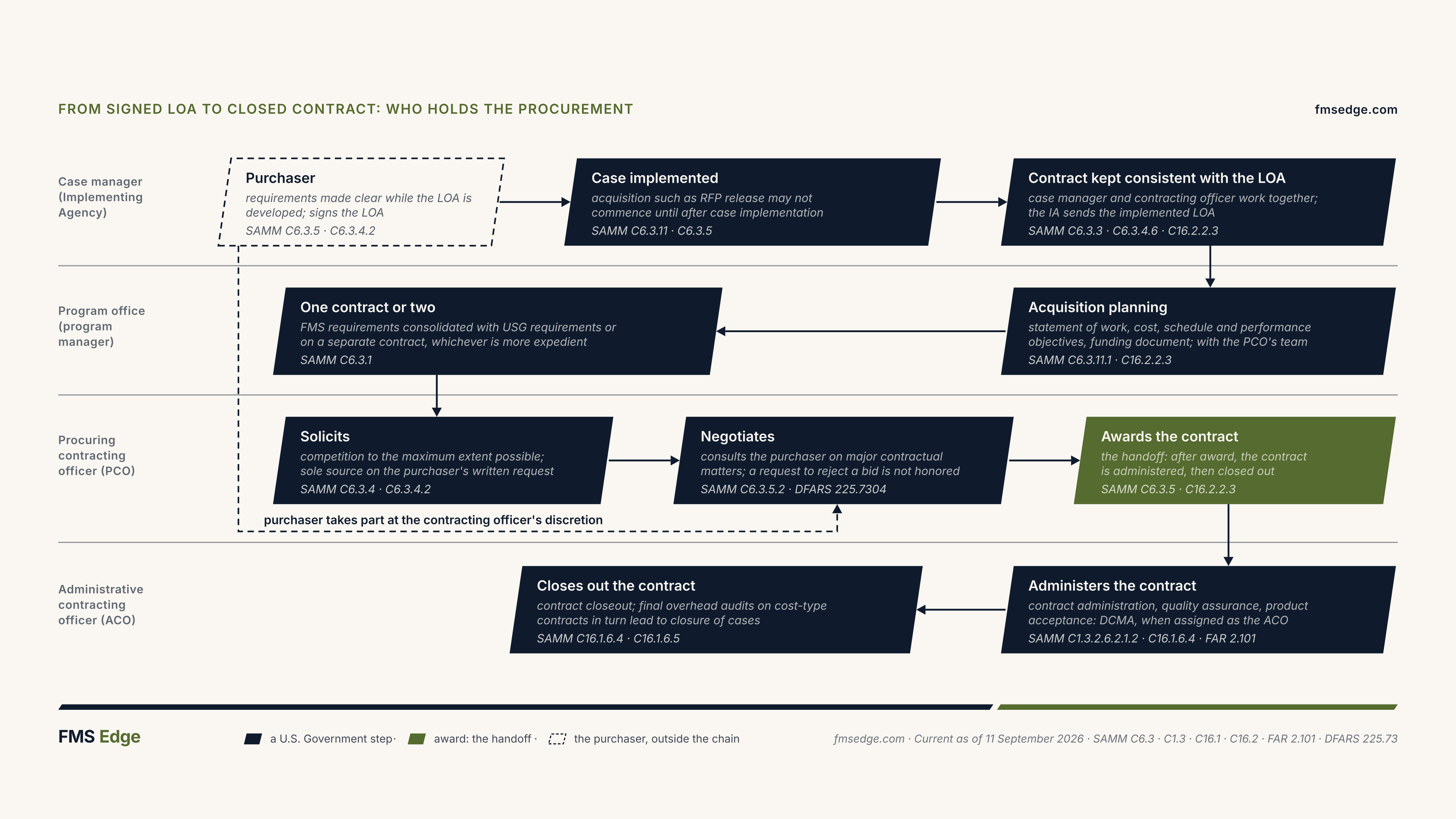
Can a Foreign Military Sales purchaser take part in contract negotiations?
A purchaser can take part in contract negotiations as far as the decides after consulting the contractor, though the Department of War alone is responsible for negotiating the contracts behind a [SAMM , ]. The purchaser’s representatives may not observe negotiations on certified cost or pricing data without a deviation [].
The process primarily involves the international partner in related issues. After the is accepted, internal U.S. Government () processes are undertaken to fulfill the requirements. Generally, these internal processes are accomplished without direct international partner involvement. C6.3.5 states that sufficient details should be included in the to allow the U.S. to negotiate and award a contract without requiring foreign country representation or direct involvement in the formal negotiation process.
The is meant to hold enough detail for the to negotiate and award without foreign country representation. Even so, policy in both the and the Defense Supplement () does permit international partners to participate in certain elements of the contracting process [SAMM ] []. If an international partner has an interest in participating in the acquisition process, these desires should be identified early in the development process, preferably in the , in order that the implementation plans can include international partner participation.
C6.3.5 outlines the areas for potential international partner participation in the Department of War (DoW) contracting process.
The DoW Components do not take direction from the purchaser on , or on contract terms other than the special contract provisions and warranties that condition 6.1 of the refers to. Nor may the purchaser interfere when a prime contractor places its subcontracts. To the extent Section C6.3.4 permits, however, the DoW Components may honor a purchaser's sole source request that names a specific prime or subcontract source for the defense articles or services [SAMM ].
Competitive contract awards are the default procurement method for . The process does provide an option whereby the international partner can request the contract on a non-competitive basis with a specific vendor in support of an requirement. This process is referred to as other than , commonly called “sole source” [SAMM ]. Unless the international partner has requested a sole source contractor in writing and the reflects the DoW’s acceptance of that designation, the international partner cannot direct decisions. The Standard Terms and Conditions are an official part of each . Condition 1.2 states that the selection of the contractor source to fill requirements is the responsibility of the , which will select the contractor on the same basis used to select contractors for requirements [SAMM , ].
Unless an sole source request has been approved, the international partner may not direct the to exclude certain vendors from an competitive [SAMM ] []. International partners may suggest the inclusion of certain firms [].
The should be able to accomplish contracting actions without international partner involvement [SAMM ]. Even so, the should consult with the international partner about major contractual matters, especially any matter that could be perceived as inconsistent with or significantly different from the [SAMM ]. Under 225.7304, international partners should be encouraged to participate with acquisition personnel in discussions with industry to develop technical specifications, establish delivery schedules, and identify any special warranty provisions or other requirements unique to the international partner. They should also be encouraged to review prices of varying alternatives, quantities, and options needed to make price-performance trade-offs [SAMM ] []. The degree of participation of the international partner during contract negotiations is left to the discretion of the after consultation with the contractor. personnel should not release any contractor proprietary data, except where the contractor authorizes release of specific data [SAMM ]. International partner participation may be limited in situations where the contract includes requirements for more than one international partner, the contract includes unique U.S. requirements, or negotiations involve contractor proprietary data [].
If the purchaser asks, the U.S. may at his or her discretion provide a version of the for information only, not for general comment. That version redacts any information companies deem proprietary and any information that and policy bars from release. International customers may be given 30 days to comment on any area where they can show a significant deviation from the . A purchaser's request that a bid or proposal be rejected will not be honored. Questions on these provisions go to the Director of the [SAMM ].
Under condition 1.2 of the Standard Terms and Conditions, the purchaser agrees that the DoW is solely responsible for negotiating the terms and conditions of the contracts that fulfill the [SAMM ]. Representatives of the international partner may not observe or participate in negotiations involving certified cost or pricing data unless a deviation is granted [].
If the international partner requests more information on contract prices, the should, after consultation with the contractor, provide enough information to demonstrate the reasonableness of the price and respond to relevant questions about it [SAMM ]. Pricing information may include top-level pricing summaries, historical prices, or an explanation of any significant differences between the actual contract prices and the estimated contract price included in the initial price [SAMM ].
The issue may arise as to whether copies of the procurement contract may be released to the international partner. As noted in C6.3.6.2, all pertinent information and contractual obligations between the and the international partner are identified in the . Consequently, there is no need to provide a copy of the contract to the international partner. However, if the contract is unclassified and provides only for the requirements of the requesting country without including or other country requirements, release can be considered, subject to restrictions on release of contractor proprietary information. Releasable information does not include internal documentation such as negotiation or pricing memoranda [SAMM ].
References
SAMM
- SAMM C5.F9: Letter of Offer and Acceptance Standard Terms and Conditions
- SAMM C6.3.5: Foreign Military Sales Purchaser Involvement.
- SAMM C6.3.4: Requests for Other than Full and Open Competition.
- SAMM C5.6.5.4.1: Standard Terms and Conditions and Letter of Offer and Acceptance Information.
- SAMM C6.3.6.1: Price Information.
- SAMM C6.3.6.2: Contractual Documents.
- SAMM C6.3.5.1: Source Selection.
- SAMM C6.3.5.2: Negotiations.
Public authorities
- DFARS 225.7304: Defense Federal Acquisition Regulation Supplement 225.7304, FMS customer involvement
Facts referenced
- Days an international customer may have to comment on a redacted Statement of Work, on areas where it can show a significant deviation from the LOA: 30 days (as of 26 October 2026; SAMM C6.3.5.2)
Related
Letter of Offer and Acceptance (LOA)
The legal instrument that lists the defense articles and services, including training, that the U.S. Government transfers to a foreign country or international organization, with their estimated costs and the terms and conditions. The benefitting partner does not sign a Building Partner Capacity (BPC) LOA.
The Letter of Offer and Acceptance (LOA) is the instrument the U.S. Government uses to sell under the Arms Export Control Act (AECA); signed LOAs and their later Amendments and Modifications are also called Foreign Military Sales (FMS) cases [SAMM C5.6.1].
FMS Edge glossary, as of 10 October 2026
Glossary entry →Open the manual’s entry → (opens in new tab)
Source Selection
The process wherein the requirements, facts, recommendations, and government policy relevant to an award decision in a competitive procurement of a system/project are examined and the decision made.
SAMM Glossary, as of 12 September 2026
Glossary entry →Open the manual’s entry → (opens in new tab)
Letter of Request (LOR)
The term used to identify a request from an eligible FMS participant country for the purchase of U.S. defense articles and services. The request may be in message or letter format.
SAMM Glossary, as of 12 September 2026
Glossary entry →Open the manual’s entry → (opens in new tab)
Contracting Officer
A person with the authority to enter into, administer, and/or terminate contracts and make related determinations and findings. The term includes certain authorized representatives of the Contracting Officer acting within the limits of their authority as delegated by the Contracting Officer. A Contracting Officer whose primary responsibility is to enter into contracts is called a procuring contracting officer. One whose primary responsibility is to administer contracts is called an administrative contracting officer. One whose primary responsibility is to terminate contracts and/or settle terminated contracts is called a "termination contracting officer." A single contracting officer may be responsible for duties in any or all of these areas.
SAMM Glossary, as of 12 September 2026
Glossary entry →Open the manual’s entry → (opens in new tab)
Foreign Military Sales (FMS)
The part of U.S. security assistance, authorized by the Arms Export Control Act (AECA), in which eligible foreign governments and international organizations buy defense articles, services and training from the U.S. Government under formal government-to-government agreements.
The articles come either from Department of War stocks or from new procurement under contracts the Department manages [22 U.S.C. 2761, 22 U.S.C. 2762]. A sale is FMS whatever the source of the purchaser's financing.
FMS Edge glossary, as of 10 October 2026
Glossary entry →Open the manual’s entry → (opens in new tab)
LOA: Letter of Offer and Acceptance
SAMM Acronyms, as of 12 September 2026
SAMM: Security Assistance Management Manual
SAMM Acronyms, as of 12 September 2026
Glossary entry →Security Assistance Management Manual (SAMM) →
Procuring Contracting Officer (PCO)
The individual authorized to enter into contracts for supplies and services on behalf of the government by detailed bids or negotiations and who is responsible for overall procurement under such contracts.
SAMM Glossary, as of 12 September 2026
Glossary entry →Open the manual’s entry → (opens in new tab)
Federal Acquisition Regulation (FAR)
The FAR is the primary regulation for use by federal executive agencies for the acquisition of supplies and services with appropriated funds. The document, published in 1984, consolidated the major procurement regulations of various departments and agencies. The intent of the FAR is to standardize the content, decrease the volume of documents, and to achieve consistency throughout government. The principal agencies involved in putting together the FAR were DoD, the General Services Administration, and the National Aeronautics and Space Administration, the three largest buyers. The FAR is broader than just contracting and applies to all goods and services. It directs the defense program manager in many ways, including contract award procedures, acquisition planning, warranties, and establishing guidelines for competition. Besides the FAR, each agency has its supplement to describe its own particular way of doing business. The DoD supplement is called Defense FAR Supplement.
SAMM Glossary, as of 12 September 2026
Glossary entry →Open the manual’s entry → (opens in new tab)
DFARS: Defense Federal Acquisition Regulation Supplement
SAMM Acronyms, as of 12 September 2026
FMS: Foreign Military Sale
SAMM Acronyms, as of 12 September 2026
Full And Open Competition
When used with respect to a contract action, means that all responsible sources are permitted to compete.
SAMM Glossary, as of 12 September 2026
Glossary entry →Open the manual’s entry → (opens in new tab)
Statement of Work (SOW)
That portion of a contract that establishes and defines all nonspecification requirements for contractor's efforts either directly or with the use of specific cited documents.
SAMM Glossary, as of 12 September 2026
Glossary entry →Open the manual’s entry → (opens in new tab)
Technology Security
The comprehensive framework of policies, practices, and procedures designed to protect U.S. military and dual-use technologies from unauthorized access, transfer, or exploitation by adversaries.
SAMM Glossary, as of 26 October 2026
Foreign Disclosure
The authorized release or transfer of classified or controlled unclassified information (CUI) from the U.S. government to foreign governments, international organizations, or foreign nationals. This process is governed by strict policies and procedures to ensure that the release of information aligns with U.S. national security and foreign policy objectives.
SAMM Glossary, as of 26 October 2026
Glossary entry →Open the manual’s entry → (opens in new tab)
Defense Security Cooperation Agency (DSCA)
The Department of War agency that directs, administers and provides guidance to the Department's components and its representatives at U.S. missions for the execution of the security cooperation programs for which it is responsible [SAMM C1.3.2.2]. The agency also provides financial and technical assistance, arranges the transfer of defense materiel, training and services to international partners, and promotes military-to-military contacts.
FMS Edge glossary, as of 10 October 2026
Glossary entry →Open the manual’s entry → (opens in new tab)
SAMM C6.3.5.2: Negotiations.
“During the contracting process between the contractor and the DoW, the contracting officer should consult with the FMS purchaser about major contractual matters, especially any matter that could be perceived as inconsistent with or significantly different from the LOA. As specified in the DFARS Subpart 225.7304(b), FMS purchasers should be encouraged to participate with USG acquisition personnel in discussions with …”
Security Assistance Management Manual, as of 26 October 2026
SAMM C5.F9: Letter of Offer and Acceptance Standard Terms and Conditions
“1. Conditions - United States Government (USG) Obligations 1.1. Unless otherwise specified, items will be those which are standard to the U.S. Department of War (DoW), without regard to make or model. 1.2. The USG will furnish the items from its stocks and resources, or will procure them under terms and conditions consistent with DoW regulations and procedures. When procuring …”
Security Assistance Management Manual, as of 11 September 2026
Defense Federal Acquisition Regulation Supplement 225.7304, FMS customer involvement
DFARS 225.7304 · Regulation
SAMM C6.3.5: Foreign Military Sales Purchaser Involvement.
“Discussions are held with the purchaser during the development of the LOA and prior to actual implementation to ensure requirements are clear and understood. Once the LOA is signed, the purchasing activities of defense components and prime contractors implement FMS requirements using normal procurement and contract management procedures in accordance with the FAR and other directives and contractual provisions. The …”
Security Assistance Management Manual, as of 11 September 2026
SAMM C6.3.5.1: Source Selection.
“The DoW Components do not accept directions from the FMS purchaser as to source selection decisions or contract terms (other than the special contract provisions and warranties referred to in condition 6.1. of the LOA), nor is the FMS purchaser permitted to interfere with a prime contractor’s placement of its subcontracts. However, to the extent permitted in Section C6.3.4., the …”
Security Assistance Management Manual, as of 26 October 2026
SAMM C6.3.4: Requests for Other than Full and Open Competition.
“The competitive procurement process is used to the maximum extent possible when procuring articles or services. The Competition in Contracting Act (CICA) (10 U.S.C. 3204), however, provides certain limited circumstances in which the contracting activity can consider FMS purchaser requests for procurement using other than full and open competition (commonly referred to as “sole source”) when the contract to be …”
Security Assistance Management Manual, as of 26 October 2026
SAMM C5.6.5.4.1: Standard Terms and Conditions and Letter of Offer and Acceptance Information.
“Standard Terms and Conditions ( See Figure C5.F9.) are an official part of each LOA, whether or not they are attached to a particular copy. The Standard Terms and Conditions that are in effect at the time the LOA is prepared and signed are the conditions that apply throughout the life of the FMS case. An LOA Information document (See …”
Security Assistance Management Manual, as of 11 September 2026
SAMM C5.F9: Letter of Offer and Acceptance Standard Terms and Conditions
“… 1.2. The USG will furnish the items from its stocks and resources, or will procure them under terms and conditions consistent with DoW regulations and procedures. When procuring for the Purchaser, DoW will, in general, employ the same contract clauses, the same contract administration, and the same quality and audit inspection procedures as would be used in procuring for itself; …”
Security Assistance Management Manual, as of 11 September 2026
SAMM C6.3.6.1: Price Information.
“If the purchaser requests additional information concerning FMS contract prices, the contracting officer should, after consultation with the contractor, provide sufficient information to demonstrate the reasonableness of the price and reasonable responses to relevant questions concerning contract price. This may include tailored responses, top level pricing summaries, historical prices, or an explanation of any significant differences between the actual contract …”
Security Assistance Management Manual, as of 11 September 2026
SAMM C6.3.6.2: Contractual Documents.
“Since all pertinent information and contractual obligations between the DoW and the purchaser are identified in the LOA, there is no need to provide a copy of the contract to the purchaser. If the contract is unclassified and only includes requirements for the requesting country, release can be considered subject to restrictions on release of contractor proprietary information. Releasable information …”
Security Assistance Management Manual, as of 26 October 2026