
Guide
Do you need an export license for a Foreign Military Sale?
No license is needed for the government-to-government transfer itself: the export is authorized under the . U.S. companies supporting the sale, and any , still need their own export authorization.
U.S. export controls run on two ladders, and each rung names who sets the rule and where it is written. Defense articles and defense services climb the State ladder: the Arms Export Control Act, the Department of State's Directorate of Defense Trade Controls, the International Traffic in Arms Regulations and the U.S. Munitions List. Other items subject to U.S. export control climb the Commerce ladder: the Export Control Reform Act of 2018, the Bureau of Industry and Security, the Export Administration Regulations and the Commerce Control List, whose 600 series holds munitions entries, including items once on the Munitions List. One question decides the column: is the item on the U.S. Munitions List? An item sold through FMS under an LOA stays in the State column either way.
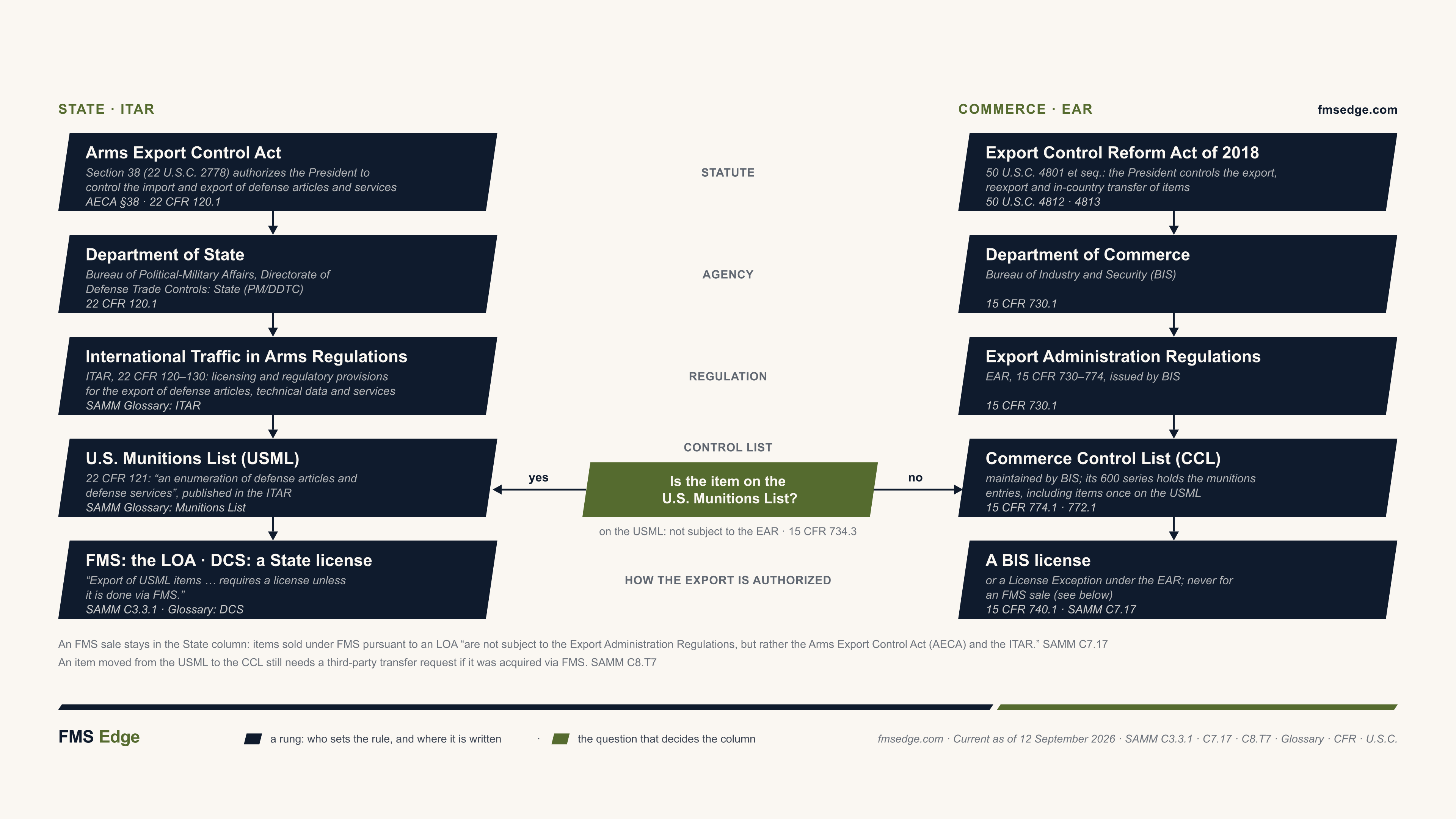
Do you need an export license for a Foreign Military Sale?
Government-to-government international transfers under are authorized for export under the per the from the Department of State. This export authorization is limited to the United States Government’s activities that fall within the scope of the .
Building Partner Capacity programs, whose authorities come from Title 10 or annual National Defense Authorization Acts, are executed on Letters of Offer and Acceptance, also known as cases.
U.S. industry requires separate export authorization. This authorization may be in the form of export licenses/agreements or exceptions/exemptions from the Department of State or the Department of Commerce, as appropriate.
The governs the export of defense articles and defense services to foreign countries and international organizations and includes both commercial and government programs. It authorizes a list of controlled articles, the , which is contained in the published by the Department of State (DOS) and is available online via the DECCS Industry Service Portal. The forms the legal basis for the security requirements in most DoW international programs. The states that foreign sales (i.e., access) should be consistent with U.S. foreign policy interests, strengthen the security of the U.S., and contribute to world peace. The also requires the President to provide Congress assurances that proposed recipient foreign countries or international organizations have agreed to certain security conditions regarding the protection of the articles or information. The three security-related conditions, which must be satisfied prior to the export of controlled defense articles and information to a foreign country or international organization, are as follows:
- Transfer: The recipient country or organization agrees not to transfer title or possession of the articles or related to anyone who is not an officer, employee or agent of the country or organization without prior consent.
- Use: The recipient country or organization agrees not to use the articles or related or permit their use for other than the purpose for which they were furnished without prior consent.
- Protection: The recipient country or organization agrees to maintain security of the articles or related technical information, and provide substantially the same degree of security to it as does the .
These security-related conditions are incorporated into the process via the standard terms and conditions of each . Within any , the standard terms and conditions will be listed at Section 2 “General Purchaser Agreements.” Transfer, use, and protection are specifically addressed in subsections 2.4-2.6 of any . By stating these conditions of sale in the , the international partner agrees to these conditions when they sign to accept the .
Any release or disclosure of export controlled technology or to any foreign person, whether it occurs in the United States or abroad, is deemed to be an export, requiring either an export license or an authorization for disclosure.
The Department of State and/or Department of Commerce provide export authorizations with export license/agreements for exports under the International Traffic in Arms Regulations and Export Administration Regulations. Alternatively, U.S. exporters may utilize exceptions/exemptions under the respective regulations.
References
SAMM
- SAMM C3.3.1 — International Traffic in Arms Regulations Requirements.
- SAMM C3.3.3.4.1 — Export License Requirements for Purchaser-Sponsored Shipments.
- SAMM GLOSSARY/international-traffic-in-arms-regulation-itar — International Traffic in Arms Regulation (ITAR)
- SAMM C3.3.2 — International Traffic in Arms Regulations Exemptions.
Related
Letter of Offer and Acceptance (LOA)
The legal instrument used by the USG to transfer itemized defense articles, defense services, and design and construction services to foreign partners.
When used under the authorities provided in the Arms Export Control Act for Foreign Military Sales, the LOA is a binding agreement signed by the USG and the foreign partner to transfer such articles and services.
When used under Building Partnership Capacity (BPC) authorities, the BPC LOA is not signed by the Benefitting Partner.
SAMM Glossary, as of 12 September 2026
Glossary entry →Open the manual’s entry → (opens in new tab)
Direct Commercial Sale (DCS)
A sale of defense articles or defense services made under a Department of State issued license by U.S. industry directly to a foreign buyer, and which is not administered by DoD through Foreign Military Sales procedures.
SAMM Glossary, as of 12 September 2026
Glossary entry →Open the manual’s entry → (opens in new tab)
Foreign Military Sales (FMS)
A process, authorized by the Arms Export Control Act, through which eligible foreign governments and international organizations may purchase defense articles, services, and training from the United States Government.
SAMM Glossary, as of 12 September 2026
Glossary entry →Open the manual’s entry → (opens in new tab)
FMS — Foreign Military Sale
SAMM Acronyms, as of 12 September 2026
Technical Data
Recorded information of a scientific or technical nature, regardless of form or characteristic. Examples of technical data packages include research and engineering drawings and associated lists, specifications, standards, process sheets, manuals, technical reports, catalog item identifications, and related information and computer software documentation.
SAMM Glossary, as of 12 September 2026
Glossary entry →Open the manual’s entry → (opens in new tab)
DTSA — Defense Technology Security Administration
SAMM Acronyms, as of 12 September 2026
Arms Export Control Act (AECA)
The basic U.S. law providing the authority and general rules for the conduct of Foreign Military Sales and commercial sales of defense articles, defense services, and training. The Arms Export Control Act (AECA) came into existence with the passage of the Foreign Military Sales Act (FMSA) of 1968. An amendment in the International Security Assistance and AECA of 1976 changed the name of FMSA to the AECA.
SAMM Glossary, as of 12 September 2026
Glossary entry →Open the manual’s entry → (opens in new tab)
LOA — Letter of Offer and Acceptance
SAMM Acronyms, as of 12 September 2026
DSCA — Defense Security Cooperation Agency
SAMM Acronyms, as of 12 September 2026
Glossary entry →Defense Security Cooperation Agency (DSCA) →
Security Cooperation Information Portal (SCIP)
A DSCA-managed web-based tool for international purchasers, purchaser agents (e.g., freight forwarders), and USG personnel with appropriate permissions that provides information on U.S. Foreign Military Sales Letters of Offer and Acceptance and other key Security Cooperation programs and processes. The data is sourced from Defense Security Assistance Management System and the Military Department's case execution systems.
SAMM Glossary, as of 12 September 2026
Glossary entry →Open the manual’s entry → (opens in new tab)
Freight Forwarder
A commercial import/export company registered with the Department of State, Bureau of Political-Military Affairs, Directorate of Defense Trade Controls and under contract to the Foreign Military Sales customer which arranges transportation of materiel from a point specified in the Letter of Offer and Acceptance to the final destination.
SAMM Glossary, as of 12 September 2026
Glossary entry →Open the manual’s entry → (opens in new tab)
Transportation Plan
A document that details the transportation and security arrangements for moving classified or sensitive material, and identifies individuals responsible for providing security at various points during transportation.
SAMM Glossary, as of 12 September 2026
Glossary entry →Open the manual’s entry → (opens in new tab)
AECA — Arms Export Control Act
SAMM Acronyms, as of 12 September 2026
ITAR — International Traffic in Arms Regulations
SAMM Acronyms, as of 12 September 2026
Glossary entry →International Traffic in Arms Regulation (ITAR) →
Munitions List
The U.S. Munitions List is an enumeration of defense articles and defense services and is published in the Department of State's International Traffic in Arms Regulations.
SAMM Glossary, as of 12 September 2026
Glossary entry →Open the manual’s entry → (opens in new tab)
DCS — Direct Commercial Sales
SAMM Acronyms, as of 12 September 2026