
Guide
How is military training bought through Foreign Military Sales?
A partner nation buys U.S. military training on a training line of a case, either on the case for the equipment it supports or on a separate training case, paid with its own funds or with Foreign Military Financing. The tuition rate it pays depends on how the training is funded.
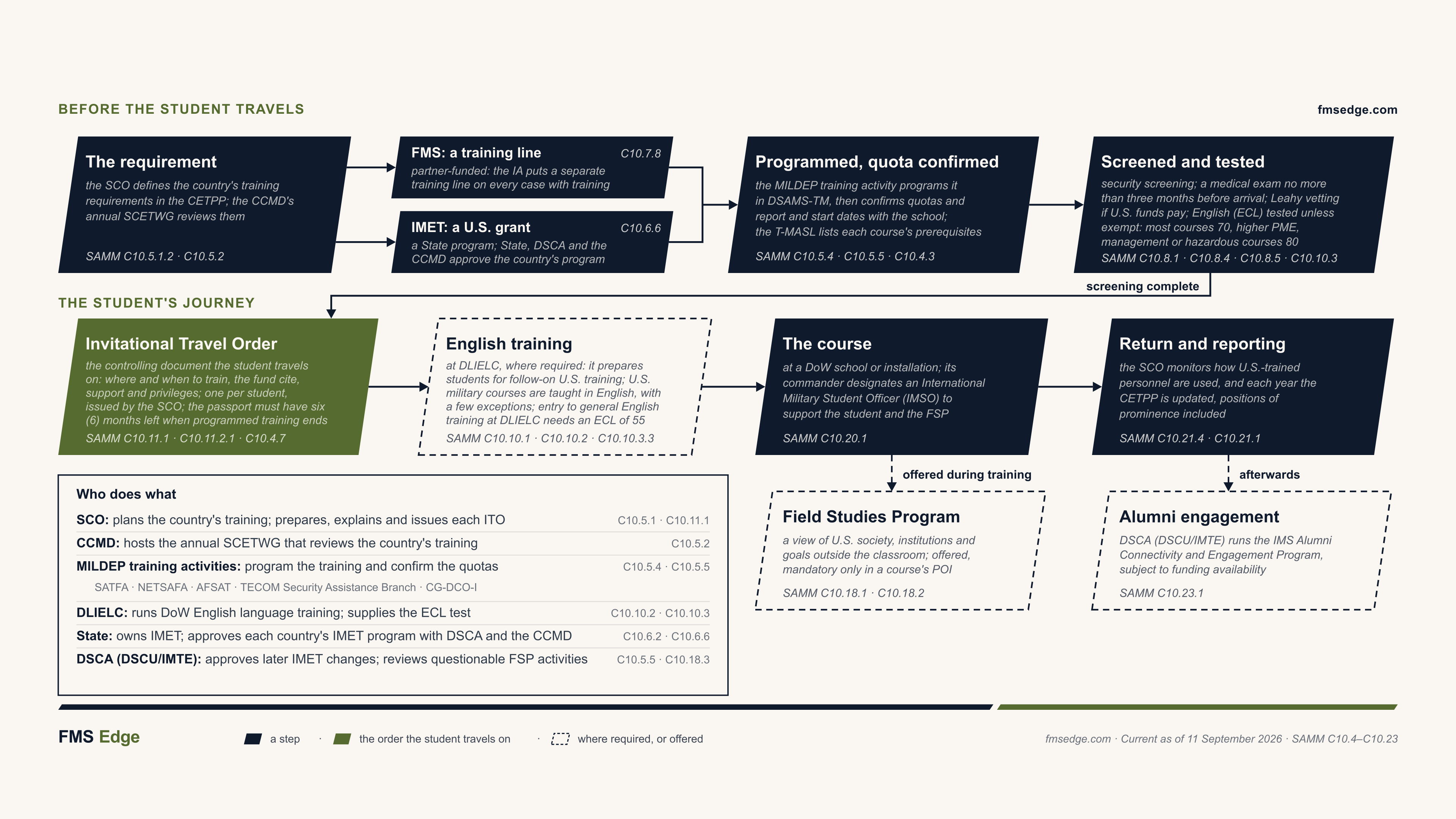
An international military student reaches a U.S. course through a chain of plans and paperwork: the Security Cooperation Organization defines the requirement, the training is paid for on a Foreign Military Sales training line or through IMET, the Military Department's training activity programs it and confirms a seat, and the student is screened. The Invitational Travel Order is the document the student travels on; English language training comes first where required, and the Field Studies Program is offered during the course.
How is military training bought through Foreign Military Sales?
Training can also be purchased via a , funded by either host nation funds or funds such as the Foreign Military Financing Program (FMFP).
training cases are developed between the and country representatives, with coordination by the . If the training is in support of a materiel purchase, the materiel or systems command of the MILDEP providing the item may also be involved. No matter if the training on an case is for training only or if it is in support of a materiel purchase, it is essential that the military service training activities be made aware of the training requirement so that it can be programmed into the and accounted for.
Once defined, -funded training requests are entered into the by the military service training activity. training on the is identified by Country Code, , case line number, and (e.g., BN-D-YCY989-2004). The implementation procedures are similar to those for . cases normally do not include , as those are the responsibility of the country and are provided to the IMS directly without U.S. involvement. training cases may include a medical services line to cover medical costs incurred by the IMS. Alternatively, the country may decide to not include medical coverage in the case and, instead, have the bills for such services sent to the country’s embassy for payment, or the IMS may obtain health insurance. If the country wants the case to pay for or medical care, this must be annotated in the and subsequently written into the . Arrangements must be made in advance to cover associated costs such as special clothing and personal equipment either by including such items in the case or having the IMS or IMS’s government pay for them upon issuance at the training installation.
training is provided through the normal process either on a training line of the case for the system sale or on a separate training case, written as a Defined Order or a Blanket Order. Blanket Order cases give more flexibility for a major system purchase or an annual training program.
Can Foreign Military Financing pay for training?
Many training managers and host nation personnel do not realize that a blanket order training case can be funded with Foreign Military Financing () program funds. The value of this is that some of the constraints and restrictions placed on the program do not apply under FMFP. For example, there would be no requirement to obtain a waiver for an funded by FMFP. Most importantly, this additional source of funds can provide for training that exceeds the country’s allocation.
Implementation of an -funded case mirrors that of host nation-funded cases except that funds are paying for the training.
What does training cost under Foreign Military Sales?
The and the prescribe a multi-tier tuition pricing structure for training. The separate tuition rates for the same course differ because various cost elements have been authorized by law to be excluded or charged at an incremental rate based on various tuition rate categories.
The total cost of training includes all associated costs to include the tuition price, paid to IMS, medical and dental costs, special clothing, and personal equipment items not included in the tuition, etc. Any of these articles and services to be furnished by the U.S. training facility, which are not included in the tuition price, must be identified and included as specific items to be funded in the training case, or reimbursed in cash by the student or the participating government.
References
SAMM
- SAMM C10.13.2.1
- SAMM C10.7.8
- SAMM C5.6.5.4.9 — Schedule of Personnel Training.
- SAMM C10.7.4 — Location of Training for Foreign Military Sales Case Students.
- SAMM C10.7.1 — Foreign Military Financing-Funded Training.
- SAMM C10.14.1.1 — Rate A (Formerly Foreign Military Sales Full Rate).
- SAMM C10.14.1.2 — Rate B (Formerly Foreign Military Sales North Atlantic Treaty Organization Rate).
- SAMM C10.14.1.3 — Rate C (Formerly Foreign Military Sales Incremental Rate).
- SAMM C10.14.1.4 — Rate D.
- SAMM C10.14.1.5 — Rate E (Formerly International Military Education and Training Rate).
Related
Foreign Military Sales (FMS)
A process, authorized by the Arms Export Control Act, through which eligible foreign governments and international organizations may purchase defense articles, services, and training from the United States Government.
SAMM Glossary, as of 12 September 2026
Glossary entry →Open the manual’s entry → (opens in new tab)
Foreign Military Sales (FMS) Case
A USG Letter of Offer and Acceptance (LOA), and any subsequent Amendment or Modification, that is the legal instrument used by the USG to transfer defense articles and defense services under the FMS program. See also "FMS" and "LOA."
SAMM Glossary, as of 12 September 2026
Glossary entry →Open the manual’s entry → (opens in new tab)
FMS — Foreign Military Sale
SAMM Acronyms, as of 12 September 2026
SCO — Security Cooperation Organization
SAMM Acronyms, as of 12 September 2026
Standard Training List (STL)
List of all the Security Cooperation training courses that a country has requested from DoD and the status of the courses.
SAMM Glossary, as of 12 September 2026
Glossary entry →Open the manual’s entry → (opens in new tab)
STL — Standard Training List
SAMM Acronyms, as of 12 September 2026
Case Identifier
A unique six-digit identifier assigned to an Foreign Military Sales case for the purpose of identification, accounting, and data processing of each Letter of Offer and Acceptance. The case identifier consists of the two-letter country code, a one-letter designator for the Implementing Agency, and a three-letter case designator.
SAMM Glossary, as of 12 September 2026
Glossary entry →Open the manual’s entry → (opens in new tab)
IMET — International Military Education and Training
SAMM Acronyms, as of 12 September 2026
Travel and Living Allowance (TLA) (International Military Students)
Those costs associated with transportation, baggage, and living allowances of International Military Students, which are authorized for payment under Security Assistance and Security Cooperation training programs. See also "Living Allowance" and "Travel Allowance."
SAMM Glossary, as of 12 September 2026
Glossary entry →Open the manual’s entry → (opens in new tab)
TLA — Travel and Living Allowance
SAMM Acronyms, as of 12 September 2026
Letter of Request (LOR)
The term used to identify a request from an eligible FMS participant country for the purchase of U.S. defense articles and services. The request may be in message or letter format.
SAMM Glossary, as of 12 September 2026
Glossary entry →Open the manual’s entry → (opens in new tab)
Letter of Offer and Acceptance (LOA)
The legal instrument used by the USG to transfer itemized defense articles, defense services, and design and construction services to foreign partners.
When used under the authorities provided in the Arms Export Control Act for Foreign Military Sales, the LOA is a binding agreement signed by the USG and the foreign partner to transfer such articles and services.
When used under Building Partnership Capacity (BPC) authorities, the BPC LOA is not signed by the Benefitting Partner.
SAMM Glossary, as of 12 September 2026
Glossary entry →Open the manual’s entry → (opens in new tab)
Security Cooperation Organization (SCO)
A Department of Defense element that is part of the United States Diplomatic mission located in a foreign country to carry out security assistance and security cooperation management functions under the supervision and coordination authority of the senior defense official/defense attaché.
SAMM Glossary, as of 12 September 2026
Glossary entry →Open the manual’s entry → (opens in new tab)
Implementing Agency (IA)
The military department or defense agency responsible for the execution of military assistance programs. With respect to FMS, the military department or defense agency assigned responsibility by the Defense Security Cooperation Agency to prepare an LOA and to implement an FMS case. The implementing agency is responsible for the overall management of the actions that will result in delivery of the materials or services set forth in the LOA that was accepted by a foreign country or international organization.
SAMM Glossary, as of 12 September 2026
Glossary entry →Open the manual’s entry → (opens in new tab)
Security Assistance (SA)
A group of programs authorized by federal statutes by which the United States provides defense articles, military training, and other defense-related services by grant, lease, loan, credit, or cash sales in furtherance of national policies and objectives, and those that are funded and authorized through the Department of State to be administered by Department of Defense/Defense Security Cooperation Agency, which are considered part of security cooperation.
SAMM Glossary, as of 12 September 2026
Glossary entry →Open the manual’s entry → (opens in new tab)
DSAMS — Defense Security Assistance Management System
SAMM Acronyms, as of 12 September 2026
Glossary entry →Defense Security Assistance Management Systems (DSAMS) →
LOA — Letter of Offer and Acceptance
SAMM Acronyms, as of 12 September 2026
Continental United States (CONUS)
U.S. territory, including the adjacent territorial waters, located within the North American continent between Canada and Mexico. Does not include Hawaii or Alaska.
SAMM Glossary, as of 12 September 2026
Glossary entry →Open the manual’s entry → (opens in new tab)
DCS — Direct Commercial Sales
SAMM Acronyms, as of 12 September 2026
DSCA — Defense Security Cooperation Agency
SAMM Acronyms, as of 12 September 2026
Glossary entry →Defense Security Cooperation Agency (DSCA) →
Security Cooperation
Activities undertaken by the DoD to encourage and enable international partners to work with the United States to achieve strategic objectives. It includes all DoD interactions with foreign defense and security establishments, including all DoD-administered security assistance programs, that: build defense and security relationships that promote specific U.S. security interests, including all international armaments cooperation activities and security assistance activities; develop allied and friendly military capabilities for self-defense and multinational operations; and provide U.S. forces with peacetime and contingency access to host nations.
SAMM Glossary, as of 12 September 2026
Glossary entry →Open the manual’s entry → (opens in new tab)
DSCU — Defense Security Cooperation University
SAMM Acronyms, as of 12 September 2026
MTT — Mobile Training Team
SAMM Acronyms, as of 12 September 2026
AECA — Arms Export Control Act
SAMM Acronyms, as of 12 September 2026
National Funds
Source of funding that is provided directly from the purchaser.
SAMM Glossary, as of 12 September 2026
Glossary entry →Open the manual’s entry → (opens in new tab)
Building Partner Capacity (BPC) Programs
Security cooperation and security assistance activities funded with USG appropriations (not including Foreign Military Sales Credit and Military Assistance Program/Merger).
SAMM Glossary, as of 12 September 2026
Glossary entry →Open the manual’s entry → (opens in new tab)
Training Military Articles and Services Listing (T-MASL)
The master list of formal training available to the international community. It contains course descriptions, prerequisites, duration (in weeks), location, cost, international notes, special medical and health coverage information (e.g. medical paperwork required for Fast Track countries), dependent authorization, English language prerequisites and a training analysis code signifying the type of training.
SAMM Glossary, as of 12 September 2026
Glossary entry →Open the manual’s entry → (opens in new tab)