
Guide
What does an international military student officer (IMSO) do?
An officer () is the person a U.S. training installation designates to give its international military students administrative support while they train. The also runs the installation's , which shows students U.S. society and institutions outside the classroom. Where the authorizes it, a country training many students may assign its own country liaison officers to handle its students' administration and discipline.
An international military student reaches a U.S. course through a chain of plans and paperwork, from the Security Cooperation Organization's requirement to a seat confirmed by the Military Department's training activity. The student travels on an Invitational Travel Order.
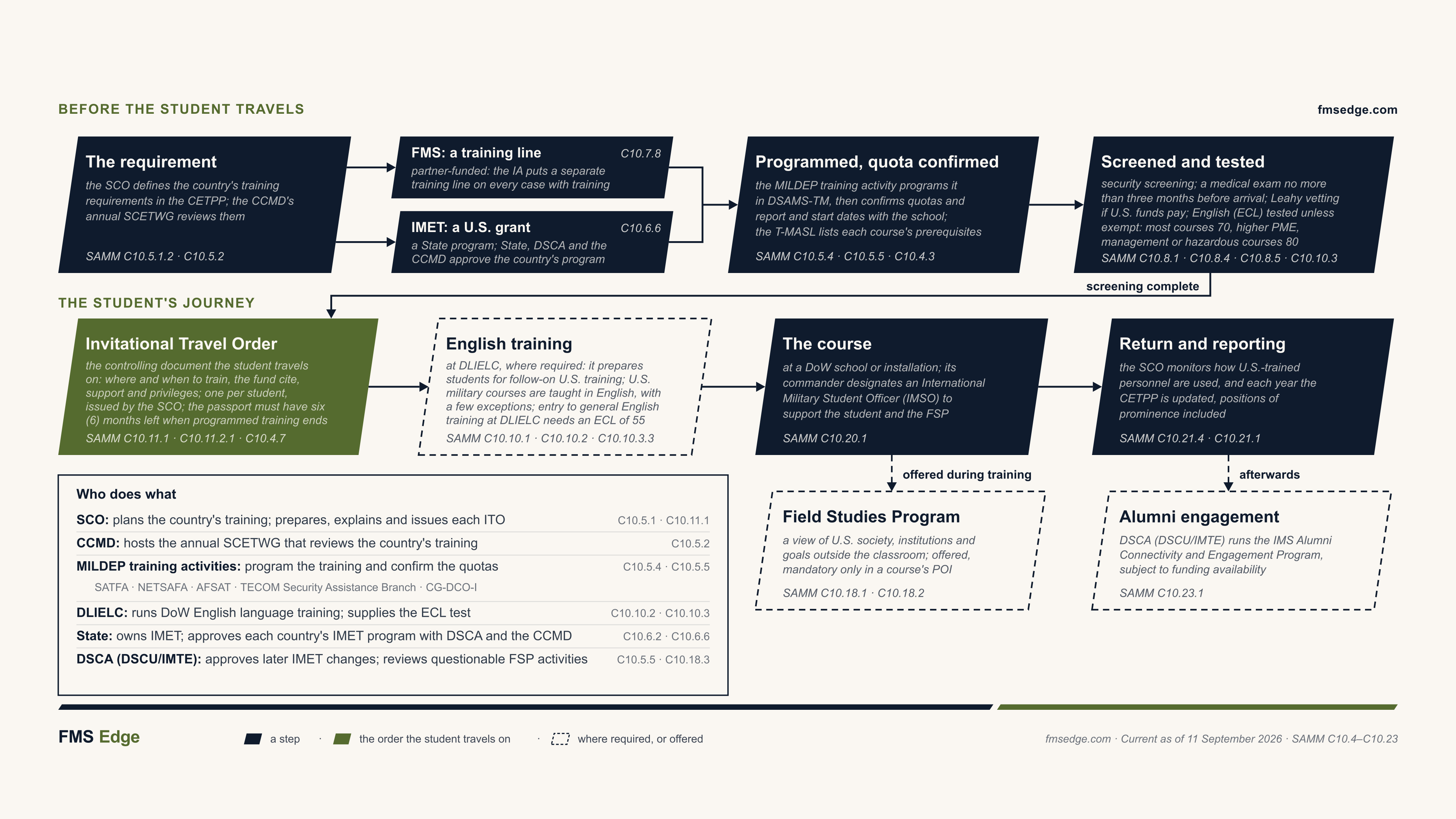
What does an international military student officer do?
An officer gives the international students at a U.S. training installation their administrative support and runs the installation's U.S. for them; the installation's commander designates the officer [SAMM ].
Although International Military Students () are integrated into the U.S. military education and training system as fully as possible, they still have some unique requirements []. Commanders of U.S. installations with scheduled for training designate an Officer () for the administrative support of the and the U.S. [SAMM ].
The serves as the training installation point of contact for international training issues. In addition to the overall administration of the , the will brief them on arrival, maintain their personnel and training records, implement procedures to avoid their indebtedness, and plan and conduct the for them [].
The Field Studies Program
United States . In accordance with Instruction (DoDI) 5410.17, each attending a formal course in the United States under () and other related programs is given the opportunity to participate in the , and the Implementing Agencies () are responsible for implementation. The objective is to provide a view of U.S. society, institutions and goals outside the classroom, and of the way in which these reflect the U.S. commitment to the basic principles of internationally recognized human rights [SAMM ]. funds are generally used for field trips, admissions and other activities that accomplish one or more of the facets of American life the program covers []. Cost factors for implementing the are developed by the and included in course tuition costs [SAMM ].
The should include discussion with each of the facets of human rights, with a focus on these areas: the Law of War; International Peace and Security; the Media; Health and Human Services; Education; the Free Market System; the Judicial System; Political Processes; U.S. Government Institutions; and Diversity and American Life [SAMM ].
The covers international students and military-sponsored visitors while they are in the United States under the training program. Where the surrounding environment makes it appropriate, it also applies to Department of War training installations overseas that perform military training functions. Students are given the opportunity to take part, but the is not mandatory unless it is part of a course's Program of Instruction [SAMM ].
Country liaison officers
Country Liaison Officers () are assigned by the sponsoring country to handle its students’ administration and discipline []. They are authorized only after the acknowledges the need and can provide the logistics support, and may not take a course while serving as liaison [SAMM ]. When a is not assigned for a particular country, the country’s senior at the training installation may be used in this capacity. Direct communication between training installations and the is authorized only on routine administrative matters concerning , such as the , biographical data and travel arrangements. Matters that involve policy determinations or program changes will be directed to the implementing Military Service through the chain of command [].
A is authorized only for a country scheduled to train many students, or where the students' background calls for help from liaison personnel [SAMM ].
Because need to be accountable, all are required to report to the for in-processing and out-processing. They are also required to tell the of any departure from their assigned duty location, such as leave, temporary duty () or scheduled leave in the country. will follow the same administrative requirements as the , to ensure accountability [SAMM ].
References
SAMM
- SAMM C10.20.8: Country Liaison Officers.
- SAMM C10.20.1: International Military Student Officer.
- SAMM C10.18.1
- SAMM C10.18.2: Field Studies Program Participation.
- SAMM C10.20.8.1
Public authorities
- AR 12-15: Joint Security Cooperation Education and Training (JSCET), Army Regulation 12-15, also issued as SECNAVINST 4950.4B and AFI 16-105 (3 January 2011; administrative revision 18 March 2025)
Related
International Military Student (IMS)
A national of a foreign government, with military or civilian status of that government, who is receiving education or training or is touring USG activities under the sponsorship of the security assistance training program.
SAMM Glossary, as of 12 September 2026
Glossary entry →Open the manual’s entry → (opens in new tab)
International Military Student Office/Manager (IMSO)
The office, or the officer, that a U.S. installation designates to give administrative support to international military students training there and to run the Field Studies Program for that installation.
Commanders of U.S. installations with international military students scheduled for training designate an International Military Student Officer (IMSO) for administrative support of the students and the U.S. Field Studies Program (FSP) [SAMM C10.20.1].
FMS Edge glossary, as of 10 October 2026
Glossary entry →Open the manual’s entry → (opens in new tab)
Field Studies Program (FSP)
A program that gives international military students and military-sponsored visitors in the United States a view of U.S. society, institutions and goals outside the classroom, including the U.S. commitment to internationally recognized human rights.
Under DoD Instruction 5410.17, each International Military Student (IMS) attending a formal course in the United States under security cooperation programs is given the opportunity to take part, though participation is not mandatory unless it is part of a course Program of Instruction [SAMM C10.18.1, C10.18.2].
FMS Edge glossary, as of 10 October 2026
Glossary entry →Open the manual’s entry → (opens in new tab)
Implementing Agency (IA)
The military department or defense agency responsible for the execution of military assistance programs. With respect to FMS, the military department or defense agency assigned responsibility by the Defense Security Cooperation Agency to prepare an LOA and to implement an FMS case. The implementing agency is responsible for the overall management of the actions that will result in delivery of the materials or services set forth in the LOA that was accepted by a foreign country or international organization.
SAMM Glossary, as of 12 September 2026
Glossary entry →Open the manual’s entry → (opens in new tab)
FSP: Field Studies Program
SAMM Acronyms, as of 12 September 2026
Security Cooperation
Activities by which the Department of War encourages and enables international partners to cooperate with the United States toward strategic objectives, spanning every interaction with foreign defense and security establishments and every security assistance program the Department administers.
Under chapter 16 of Title 10, their purposes are to develop allied and friendly security capabilities for self-defense and multinational operations, to give U.S. forces peacetime and contingency access, and to build relationships promoting specific U.S. security interests [10 U.S.C. 301(7)].
FMS Edge glossary, as of 10 October 2026
Glossary entry →Open the manual’s entry → (opens in new tab)
Country Liaison Officer (CLO)
An officer or non-commissioned officer of a partner's armed forces, selected by that government and attached to a U.S. military department or Department of War agency to help administer the international military students from his or her own country.
Country Liaison Officers (CLOs) are authorized only for a country with a large number of students scheduled to train, or where student background warrants liaison personnel assistance [SAMM C10.20.8].
FMS Edge glossary, as of 10 October 2026
Glossary entry →Open the manual’s entry → (opens in new tab)
Security Cooperation Organization (SCO)
A Department of Defense element that is part of the United States Diplomatic mission located in a foreign country to carry out security assistance and security cooperation management functions under the supervision and coordination authority of the senior defense official/defense attaché.
SAMM Glossary, as of 12 September 2026
Glossary entry →Open the manual’s entry → (opens in new tab)
Invitational Travel Order (ITO)
A written authorization (DD Form 2285) for International Military Students to travel to, from, and between U.S. activities for the purpose of training under an approved and funded International Military Education and Training or Foreign Military Sales program.
SAMM Glossary, as of 12 September 2026
Glossary entry →Open the manual’s entry → (opens in new tab)
Temporary Duty Travel (TDY)
A period of time during which an individual is assigned to work at a location away from their permanent location.
SAMM Glossary, as of 12 September 2026
Glossary entry →Open the manual’s entry → (opens in new tab)
SAMM C10.20.1: International Military Student Officer.
“Commanders of U.S. installations with International Military Students (IMSs) scheduled for training designate an International Military Student Officer (IMSO) for administrative support of IMS and the U.S. Field Studies Program (FSP).”
Security Assistance Management Manual, as of 11 September 2026
Joint Security Cooperation Education and Training (JSCET), Army Regulation 12-15, also issued as SECNAVINST 4950.4B and AFI 16-105 (3 January 2011; administrative revision 18 March 2025)
AR 12-15 · Regulation
SAMM C10.18.1
“In accordance with DoD Instruction (DoDI) 5410.17, each International Military Student (IMS) attending a formal course in the United States under security cooperation (SC) and other related programs is given the opportunity to participate in the U.S. Field Studies Program (FSP). The FSP objective is to provide a view of U.S. society, institutions, and goals, outside the classroom. The FSP …”
Security Assistance Management Manual, as of 11 September 2026
SAMM C10.18.2: Field Studies Program Participation.
“The FSP applies to international students and military-sponsored visitors in the United States under the SC training program. As appropriate to the surrounding environment, the FSP also applies to DoW training installations overseas performing SC military training functions. While students are given the opportunity to participate in the FSP, it is not mandatory unless it is part of a course …”
Security Assistance Management Manual, as of 26 October 2026
SAMM C10.20.8: Country Liaison Officers.
“Use of foreign liaison personnel to assist U.S. training activities with student administration is authorized only after the Implementing Agency (IA) has acknowledged the need for assistance and can provide the logistics support. Country Liaison Officers (CLOs) are authorized only when a country is scheduled to train a large number of students or where student background warrants liaison personnel assistance. …”
Security Assistance Management Manual, as of 11 September 2026
SAMM C10.20.8.1
“Due to the need for CLO accountability, it is required that all CLOs report to the IMSOs for in/out processing in addition to notifying IMSOs of any departure from assigned duty location (i.e. leave, TDY, etc.) scheduled leave in-country. CLOs will adhere to the same administrative requirements as the IMS to ensure accountability.”
Security Assistance Management Manual, as of 11 September 2026