
Guide
Title 22 or Title 10: which authority is behind a case?
, Foreign Military Financing and International Military Education and Training are Title 22 programs, which the Secretary of supervises and the Department of War administers. A case is paid for with the partner's own funds or Foreign Military Financing and signed by the partner. Title 10 programs such as Section 333 are funded with U.S. appropriations and executed through Building Partner Capacity cases, which the partner does not sign or pay for.
Title 22 and Title 10 answer the same four questions differently. Security assistance rests on the Foreign Assistance Act and the Arms Export Control Act under the Secretary of State's supervision; security cooperation programs rest on Title 10 or the annual NDAA and are funded by Department of War appropriations.
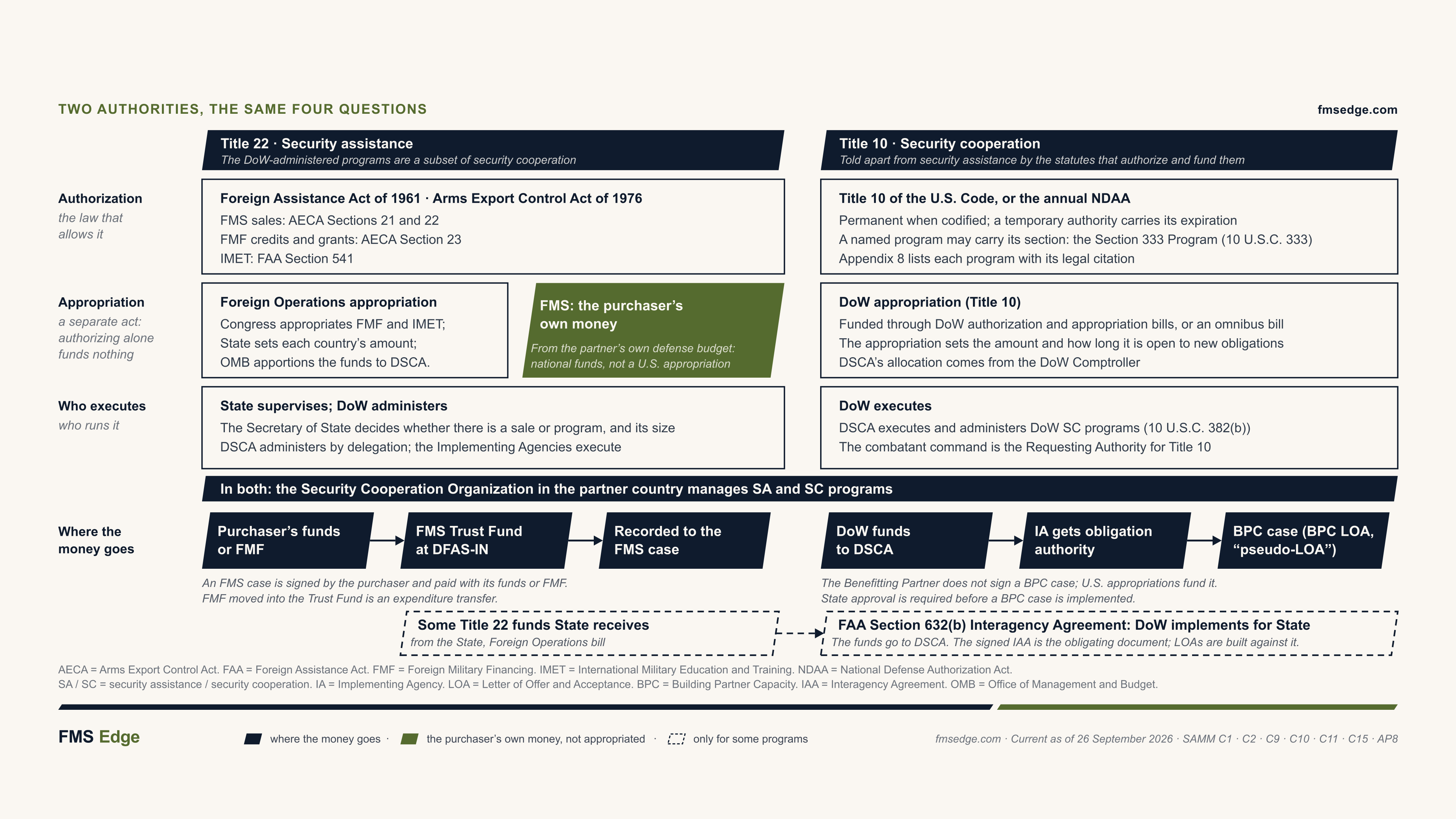
Title 22 or Title 10: which authority is behind a case?
A case runs under Title 22 authority and is signed by the partner; a Building Partner Capacity case runs under Title 10 or the annual National Defense Authorization Act and is not signed by the partner [SAMM , , ]. The case is paid for with the partner's or Foreign Military Financing, and the Building Partner Capacity case is funded only with U.S. appropriations unless U.S. law provides otherwise [SAMM ].
Some Title 22 programs are implemented and managed by the Department of State (); all are subject to the continuous supervision and general direction of the Secretary of [SAMM ]. The following programs are authorized by either the Foreign Assistance Act () (22 U.S.C. 2151 et seq.) or the (22 U.S.C. 2751 et seq.):
- Direct Commercial Sales () []
- Drawdowns []
- Global Peace Operations Initiative ()
- []
- Nonproliferation, Antiterrorism, Demining, and Related Programs ()
- Peacekeeping Operations () []
- Third-Party Transfers [, ]
While under the authority of , the Department of War (DoW) provides materiel assistance and related training to international partners to develop specific capabilities and/or capacities. These programs are also authorized by either the (22 U.S.C. 2151 et seq.) or the (22 U.S.C. 2751 et seq.):
- []
- Foreign Military Financing Program () []
- [, ]
- Foreign Military Construction Sales (FMCS) []
- International Military Education and Training () []
- Leases []
- []
authorizations and appropriations come mainly from the annual Appropriations Acts, supplemental appropriations and a range of other Title 10 provisions, which Chapter 11 and Appendix 8 discuss in detail [SAMM ].
Under the authority of Title 10, Chapter 16, and the annual National Defense Authorization Act (), the DoW provides materiel assistance and related training to international partners to build their security force capability. These programs are funded under annual appropriations legislation; Building Partner Capacity () authorities receive DoW Operations and Maintenance () appropriations [SAMM , ]. By statute or , these programs are sometimes required to be exercised in coordination with the Secretary of [SAMM ]. Three kinds of transfer under equipping programs that the manages under authorities must be provided pursuant to a case, absent a waiver by the Director, . They are defense articles or subject to export controls, defense articles that require Enhanced End-Use Monitoring (), and defense articles or that the partner must safeguard under a special security arrangement or analogous measure [SAMM ]. is responsible for notifications and other reporting to Congress for certain authorities [SAMM ].
Each program is designed, coordinated and managed in accordance with its own statutory authorization [SAMM ].
The (RA) is the organization responsible for planning regional or partner capacity-building activities and for monitoring how the program is executed. For Title 10 authorities, the RAs are the geographic Combatant Commands (). The RA sends detailed requirements to and the in the pre-planning documents for a program, such as the or the Training and Equipment List (). It receives the 's feedback so that it can complete those documents. The RA must make sure the has the information it needs to develop the case or training grant. The RA must also approve any substitutions or program adjustments proposed because of cost overages if a requested article cannot be procured in time for expiring funds to be obligated [SAMM ].
On a case funded under Title 10, the must not apply accessorial charges, the surcharge or the administrative surcharge [SAMM ].
Title 10 appropriations are treated as obligated when contracts or other legal liabilities are established. The receives Obligation Authority (OA) when the case is implemented, and from then on it is responsible for obligating the funds and for executing the case on the RA's timelines. Section C15.5.2 sets further restrictions on obligations for cases, as does Section C15-Legacy.5.2 for the programs the Chapter 15 introduction identifies [SAMM ].
References
SAMM
- SAMM C15.1.1: Definition of Building Partner Capacity.
- SAMM C15.1.4.1: Current or Unexpired Funds.
- SAMM C1.1.2.1: Security Cooperation Programs.
- SAMM C15.1.3.1
- SAMM C15.1.6.4.1: Defense Security Cooperation Agency.
- SAMM C1.1.2.2: Security Assistance Programs.
- SAMM C1.2.2: Legislative Authorities for Security Cooperation.
- SAMM C15.1.3: Department of War Building Partner Capacity Cases.
- SAMM C15.1.6.2: Requesting Authority.
- SAMM C15.3.10.1: Surcharges and Accessorial Charges.
- SAMM C11.3.3.1.1.2: Title 10 Obligations
Public authorities
- AECA §38: Arms Export Control Act of 1976, as amended, §38 (22 U.S.C. §2778)
- FAA §506: Foreign Assistance Act of 1961, as amended, §506 (22 U.S.C. §2318), Special authority (drawdown)
- FAA §481: Foreign Assistance Act of 1961, as amended, §481 (22 U.S.C. §2291), Policy, general authorities, coordination, foreign police actions, definitions, and other provisions
- FAA §551: Foreign Assistance Act of 1961, as amended, §551 (22 U.S.C. §2348), Peacekeeping operations: general authorization
- AECA §3: Arms Export Control Act of 1976, as amended, §3 (22 U.S.C. §2753)
- FAA §505: Foreign Assistance Act of 1961, as amended, §505 (22 U.S.C. §2314), Furnishing of defense articles or related training or other defense service on grant basis
- FAA §516: Foreign Assistance Act of 1961, as amended, §516 (22 U.S.C. §2321j), Authority to transfer excess defense articles
- AECA §23: Arms Export Control Act of 1976, as amended, §23 (22 U.S.C. §2763), Credit sales
- AECA §21: Arms Export Control Act of 1976, as amended, §21 (22 U.S.C. §2761)
- AECA §22: Arms Export Control Act of 1976, as amended, §22 (22 U.S.C. §2762)
- AECA §29: Arms Export Control Act of 1976, as amended, §29 (22 U.S.C. §2769), Foreign military construction sales
- FAA §541: Foreign Assistance Act of 1961, as amended, §541 (22 U.S.C. §2347), International military education and training: general authority
- AECA §61: Arms Export Control Act of 1976, as amended, §61 (22 U.S.C. §2796), Leasing authority
- FAA §503: Foreign Assistance Act of 1961, as amended, §503 (22 U.S.C. §2311), Military assistance: general authority
Related
Foreign Military Sales (FMS)
The part of U.S. security assistance, authorized by the Arms Export Control Act (AECA), in which eligible foreign governments and international organizations buy defense articles, services and training from the U.S. Government under formal government-to-government agreements.
The articles come either from Department of War stocks or from new procurement under contracts the Department manages [22 U.S.C. 2761, 22 U.S.C. 2762]. A sale is FMS whatever the source of the purchaser's financing.
FMS Edge glossary, as of 10 October 2026
Glossary entry →Open the manual’s entry → (opens in new tab)
Security Assistance (SA)
A group of programs authorized by federal statutes by which the United States provides defense articles, military training, and other defense-related services by grant, lease, loan, credit, or cash sales in furtherance of national policies and objectives, and those that are funded and authorized through the Department of State to be administered by Department of Defense/Defense Security Cooperation Agency, which are considered part of security cooperation.
SAMM Glossary, as of 12 September 2026
Glossary entry →Open the manual’s entry → (opens in new tab)
National Funds
Source of funding that is provided directly from the purchaser.
SAMM Glossary, as of 12 September 2026
Glossary entry →Open the manual’s entry → (opens in new tab)
Arms Export Control Act (AECA)
The basic U.S. law providing the authority and general rules for the conduct of Foreign Military Sales and commercial sales of defense articles, defense services, and training. The Arms Export Control Act (AECA) came into existence with the passage of the Foreign Military Sales Act (FMSA) of 1968. An amendment in the International Security Assistance and AECA of 1976 changed the name of FMSA to the AECA.
SAMM Glossary, as of 12 September 2026
Glossary entry →Open the manual’s entry → (opens in new tab)
DCS: Direct Commercial Sales
SAMM Acronyms, as of 12 September 2026
Economic Support Fund (ESF)
A USG security assistance program through which economic assistance is provided on a grant basis, to selected foreign governments. The funds may be used to finance imports of commodities, capital, or technical assistance in accordance with the terms of a bilateral agreement; counterpart funds thereby generated may be used as budgetary support. These funds enable a recipient to devote more of its own resources to defense and security purposes than it otherwise could do without serious economic or political consequences (Formerly termed "Security Supporting Assistance").
SAMM Glossary, as of 12 September 2026
Glossary entry →Open the manual’s entry → (opens in new tab)
GPOI: Global Peacekeeping Operations Initiative
SAMM Acronyms, as of 12 September 2026
International Narcotics Control And Law Enforcement (INCLE)
Counter drug bureau/programs managed by Department of State, but can have materiel, services, and training support provided and managed by DoD using Security Cooperation assets and procedures.
SAMM Glossary, as of 12 September 2026
Glossary entry →Open the manual’s entry → (opens in new tab)
AECA: Arms Export Control Act
SAMM Acronyms, as of 12 September 2026
Excess Defense Articles (EDA)
Defense articles owned by the USG which are neither procured in anticipation of military assistance or sales requirements, nor procured pursuant to a military assistance or sales order. EDA are items (except construction equipment) that are in excess of the Approved Force Acquisition Objective and Approved Force Retention Stock of all DoD components at the time such articles are dropped from inventory by the supplying agency for delivery to countries or international organizations.
SAMM Glossary, as of 12 September 2026
Glossary entry →Open the manual’s entry → (opens in new tab)
FMFP: Foreign Military Financing Program
IMET: International Military Education and Training
SAMM Acronyms, as of 12 September 2026
Military Assistance Program (MAP)
That portion of the United States Security Assistance program authorized by the Foreign Assistance Act of 1961, as amended, which once provided defense articles and services to recipients on a nonreimbursable (grant) basis. Funding for MAP was consolidated under the Foreign Military Financing program beginning in Fiscal Year 1990.
SAMM Glossary, as of 12 September 2026
Glossary entry →Open the manual’s entry → (opens in new tab)
Security Cooperation
Activities by which the Department of War encourages and enables international partners to cooperate with the United States toward strategic objectives, spanning every interaction with foreign defense and security establishments and every security assistance program the Department administers.
Under chapter 16 of Title 10, their purposes are to develop allied and friendly security capabilities for self-defense and multinational operations, to give U.S. forces peacetime and contingency access, and to build relationships promoting specific U.S. security interests [10 U.S.C. 301(7)].
FMS Edge glossary, as of 10 October 2026
Glossary entry →Open the manual’s entry → (opens in new tab)
SAMM: Security Assistance Management Manual
SAMM Acronyms, as of 12 September 2026
Glossary entry →Security Assistance Management Manual (SAMM) →
Executive Order (EO)
A numbered official document through which the President manages the operations of the Federal Government, normally used to create or change the organization or procedures of executive branch agencies; its authority rests on the Constitution or on powers that acts of Congress grant. The text of each executive order is published in the Federal Register once the President has signed it.
FMS Edge glossary, as of 10 October 2026
Glossary entry →Open the manual’s entry → (opens in new tab)
Defense Security Cooperation Agency (DSCA)
The Department of War agency that directs, administers and provides guidance to the Department's components and its representatives at U.S. missions for the execution of the security cooperation programs for which it is responsible [SAMM C1.3.2.2]. The agency also provides financial and technical assistance, arranges the transfer of defense materiel, training and services to international partners, and promotes military-to-military contacts.
FMS Edge glossary, as of 10 October 2026
Glossary entry →Open the manual’s entry → (opens in new tab)
DSCA: Defense Security Cooperation Agency
SAMM Acronyms, as of 12 September 2026
Glossary entry →Defense Security Cooperation Agency (DSCA) →
Technical Data
Recorded information of a scientific or technical nature, regardless of form or characteristic. Examples of technical data packages include research and engineering drawings and associated lists, specifications, standards, process sheets, manuals, technical reports, catalog item identifications, and related information and computer software documentation.
SAMM Glossary, as of 12 September 2026
Glossary entry →Open the manual’s entry → (opens in new tab)
Combatant Command (CCMD)
A unified or specified command with a broad continuing mission under a single commander established and so designated by the President, through the Secretary of Defense and with the advice and assistance of the Chairman of the Joint Chiefs of Staff. Also called CCMD.
SAMM Glossary, as of 12 September 2026
Glossary entry →Open the manual’s entry → (opens in new tab)
Implementing Agency (IA)
The military department or defense agency responsible for the execution of military assistance programs. With respect to FMS, the military department or defense agency assigned responsibility by the Defense Security Cooperation Agency to prepare an LOA and to implement an FMS case. The implementing agency is responsible for the overall management of the actions that will result in delivery of the materials or services set forth in the LOA that was accepted by a foreign country or international organization.
SAMM Glossary, as of 12 September 2026
Glossary entry →Open the manual’s entry → (opens in new tab)
Memorandum of Request (MOR)
A document prepared and submitted by the Requesting Authority which identifies requirements and initiates the case development process under a Building Partner Capacity program.
SAMM Glossary, as of 12 September 2026
Glossary entry →Open the manual’s entry → (opens in new tab)
Contract Administration Services (CAS)
All those actions accomplished in or near a contractor's plant for the benefit of the U.S. government which are necessary to the performance of a contract or in support of the buying offices, system/project managers, and other organizations, including quality assurance, engineering support, production surveillance, pre-award surveys, mobilization planning, contract administration, property administration, industrial security, and safety.
SAMM Glossary, as of 12 September 2026
Glossary entry →Open the manual’s entry → (opens in new tab)
FMS: Foreign Military Sale
SAMM Acronyms, as of 12 September 2026
SAMM C1.1.2.2: Security Assistance Programs.
“SA is a group of programs, authorized under Title 22 authorities, by which the United States provides defense articles, military education and training, and other defense-related services by grant, loan, credit, cash sales, or lease, in furtherance of national policies and objectives. All SA programs are subject to the continuous supervision and general direction of the Secretary of State to …”
Security Assistance Management Manual, as of 26 October 2026
SAMM C15.1.1: Definition of Building Partner Capacity.
“Building Partner Capacity (BPC) programs are USG security cooperation (SC) projects, programs, activities, and engagements, funded by USG appropriations for the purpose of building partner security force capability. Program authorizations originate in Title 10 of the U.S. Code or in annual National Defense Authorization legislation and are funded under annual appropriations legislation. The SC community designs, coordinates, and centrally manages …”
Security Assistance Management Manual, as of 11 September 2026
SAMM C15.1.3: Department of War Building Partner Capacity Cases.
“The DoW utilizes BPC cases to provide defense articles, services, and training to partners, and to facilitate the DoW’s ability to meet other statutory requirements such as reporting, AM&E, and audit readiness. Unlike Foreign Military Sales (FMS) cases which are funded with partner national funds or Foreign Military Financing (FMF) funds and signed by the partner, BPC cases are only …”
Security Assistance Management Manual, as of 5 October 2026
Arms Export Control Act of 1976, as amended, §38 (22 U.S.C. §2778)
AECA §38 · Statute
Foreign Assistance Act of 1961, as amended, §506 (22 U.S.C. §2318), Special authority (drawdown)
FAA §506 · Statute
Foreign Assistance Act of 1961, as amended, §481 (22 U.S.C. §2291), Policy, general authorities, coordination, foreign police actions, definitions, and other provisions
FAA §481 · Statute
Foreign Assistance Act of 1961, as amended, §551 (22 U.S.C. §2348), Peacekeeping operations: general authorization
FAA §551 · Statute
Foreign Assistance Act of 1961, as amended, §505 (22 U.S.C. §2314), Furnishing of defense articles or related training or other defense service on grant basis
FAA §505 · Statute
Foreign Assistance Act of 1961, as amended, §516 (22 U.S.C. §2321j), Authority to transfer excess defense articles
FAA §516 · Statute
Arms Export Control Act of 1976, as amended, §23 (22 U.S.C. §2763), Credit sales
AECA §23 · Statute
Arms Export Control Act of 1976, as amended, §21 (22 U.S.C. §2761)
AECA §21 · Statute
Arms Export Control Act of 1976, as amended, §22 (22 U.S.C. §2762)
AECA §22 · Statute
Arms Export Control Act of 1976, as amended, §29 (22 U.S.C. §2769), Foreign military construction sales
AECA §29 · Statute
Foreign Assistance Act of 1961, as amended, §541 (22 U.S.C. §2347), International military education and training: general authority
FAA §541 · Statute
Arms Export Control Act of 1976, as amended, §61 (22 U.S.C. §2796), Leasing authority
AECA §61 · Statute
Foreign Assistance Act of 1961, as amended, §503 (22 U.S.C. §2311), Military assistance: general authority
FAA §503 · Statute
SAMM C1.2.2: Legislative Authorities for Security Cooperation.
“Security cooperation (SC) authorizations and appropriations are provided primarily under annual DoW Appropriations Acts, Supplementals, and a range of other Title 10 provisions. These authorities and programs are discussed in detail in Chapter 11 and Appendix 8.”
Security Assistance Management Manual, as of 26 October 2026
SAMM C15.1.4.1: Current or Unexpired Funds.
“The period of availability (POA) of funds is the period of time in which budget authority is available to incur new obligations (see DoW FMR, Volume 3, Chapter 13, Section 3.2.1.1.) During the period of availability (see DoW FMR, Volume 3, Chapter 13, Section 3.2.1.2.1.), IAs and Program Offices have the authority to utilize current funds for new obligations, obligation …”
Security Assistance Management Manual, as of 5 October 2026
SAMM C1.1.2.1: Security Cooperation Programs.
“SC program authorizations and appropriations are provided to the Secretary of War (SECWAR) primarily under the annual National Defense Authorization Act (NDAA) and appropriations acts. By statute or Executive Order (EO), they are sometimes required to be exercised in coordination with the Secretary of State. These programs vary greatly in terms of the agency or DoW activity responsible and the …”
Security Assistance Management Manual, as of 26 October 2026
SAMM C15.1.3.1
“DSCA-managed BPC equipping programs must be provided pursuant to a BPC case, absent a waiver by the Director, DSCA, for the following: The transfer of any defense article or technical data that are subject to export controls, The transfer of any defense article that requires Enhanced End-Use Monitoring (EEUM), and The transfer of a defense article or technical data that …”
Security Assistance Management Manual, as of 5 October 2026
SAMM C15.1.6.4.1: Defense Security Cooperation Agency.
“DSCA supports DoW components on the appropriate use, integration, and execution of SC programs to develop comprehensive, full-spectrum, and sustainable approaches building allied or partner defense and security capabilities and capacity, and to achieve other USG defense policy goals. DSCA provides guidance to DoW components, U.S. Military Groups (MILGPs), and IAs on the development, administration, and execution of BPC program …”
Security Assistance Management Manual, as of 5 October 2026
SAMM C15.1.6.2: Requesting Authority.
“The RA is the organization responsible for planning and monitoring program execution of regional or partner capacity building activities. The geographic Combatant Commands (CCMDs) serve as RAs for Title 10 authorities. The RA communicates detailed requirements to DSCA and the IA as part of pre-planning document for a BPC program (e.g. Memorandum of Request (MOR), Training and Equipment List (TEL), …”
Security Assistance Management Manual, as of 11 September 2026
SAMM C15.3.10.1: Surcharges and Accessorial Charges.
“The IA must not apply the FMS Administrative surcharge, Contract Administration Services (CAS) surcharge, and accessorial charges to Title 10 funded BPC cases.”
Security Assistance Management Manual, as of 5 October 2026
SAMM C11.3.3.1.1.2: Title 10 Obligations
“Title 10 appropriations are considered obligated when contracts, or other legal liabilities described above, are established. The Implementing Agency (IA) receives Obligation Authority (OA) upon case implementation and is then responsible for obligating the funds and executing the case to meet the Requesting Authority’s (RA's) timelines. See Section C15.5.2. and Section C15-Legacy.5.2. (for programs as identified in the Chapter 15 …”
Security Assistance Management Manual, as of 26 October 2026