
Guide
How are U.S. Government services and training priced on a Foreign Military Sales case?
Services that U.S. Government personnel perform on a case are priced to recover their full cost and appear on well-defined services lines, unless the Administrative Surcharge funds them. Civilian pricing starts from base salary and adds the acceleration, fringe benefits and unfunded retirement factors; military pricing uses the composite pay rate and its acceleration factors. Training is priced at one of five tuition rates, and the rate is fixed at the time of sale.
A U.S. Government employee's work on a Foreign Military Sales case is priced at more than salary. A civilian's salary carries benefit and retirement factors; military services are priced at the composite rate plus health care factors. The result goes on a services line unless the FMS Administrative Surcharge funds the function.
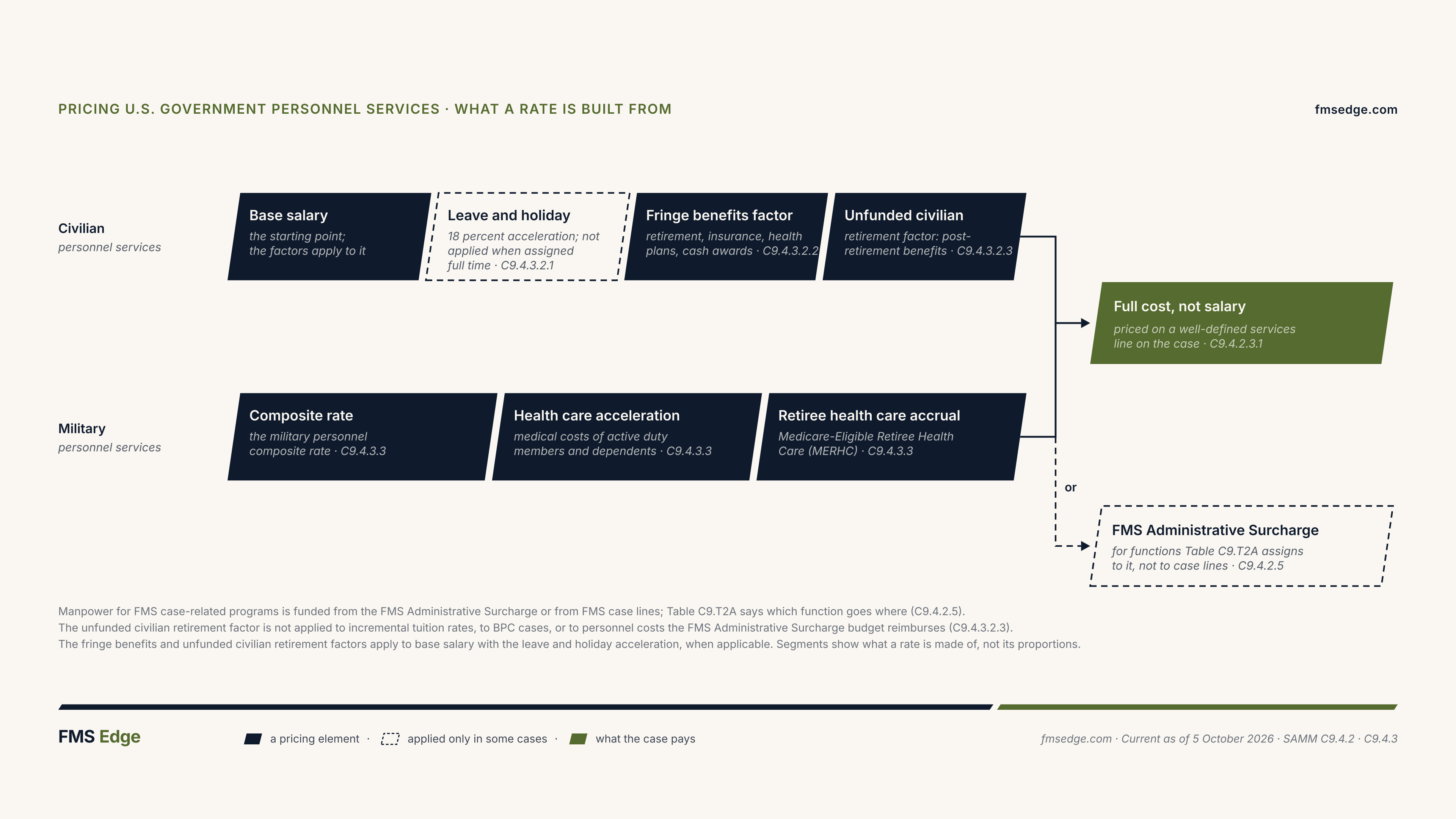
How are U.S. Government personnel services priced on a case?
Personnel services on and Building Partner Capacity () cases must be priced to recover all U.S. Government () costs and will be included as separate, well-defined lines on the cases [SAMM , ]. They include engineering, configuration data management, technical services and training team members. Training services that Department of War (DoW) personnel perform are priced as training instead. Under the Financial Management Regulation (), DoW personnel services case lines recover not only the appropriate wages but also all applicable entitlements, and the base price for civilian and military personnel includes wages, acceleration factors, temporary duty and permanent change of station costs, and personnel support costs. The prices personnel services at actual cost where actual cost data is available, and at an estimate where it is not.
The work each individual performs on a program management services line must be documented by an auditable methodology, and personnel charges must be identifiable by position number, employee identification number or other traceable means [SAMM ].
The Case-Related Manpower Functions and Funding Source Matrix ( Table C9.T2A) indicates which activities should be included as line items on the case (direct charges) and which activities are covered under the Administrative Surcharge (indirect charges) [SAMM ]. For cases or case line items “accepted” after 1 August 2006, any program management services will be included on well-defined, services line items on the case [SAMM ].
Manpower for case-related programs is funded from either the Administrative Surcharge or case lines, and Table C9.T2A describes each case-related manpower function and how it should be funded. For case-related programs funded under Title 10, manpower comes from one of three sources: Title 10 funded case lines, Title 10 funded Program Support Costs, or Title 10 funded Costs; Table C9.T2B describes those functions and their funding. Any request to deviate from these funding sources must be coordinated with the , Financial Policy Division (/FPRE/FP) [SAMM ].
Civilian personnel pricing has several components: base salary, the leave and holiday acceleration factor, the civilian personnel fringe benefits factor and the Unfunded Civilian Retirement (UCR) factor [SAMM , , ]. The leave and holiday acceleration factor of 18 percent is not applied to civilian personnel assigned full time to a given requirement [SAMM ]. The FMR, Volume 15, Chapter 7, paragraph 072001, sets out how base salary rates are accelerated [SAMM ]. The same pricing principles apply whether the civilian pay is a stand-alone line or is embedded in a unit cost. Under the , civilian personnel services are priced at the rates in effect when the services are performed.
The civilian personnel fringe benefits factor applies to base salary, including leave and holiday acceleration when that applies, and recovers the 's contribution to civilian employee benefits, such as retirement, insurance, health plans and cash awards. Each year the Civilian Fringe Benefit Rates are published among the reimbursable rates of the Under Secretary of War (Comptroller) [SAMM ].
The UCR factor is also applied to base salary, plus leave and holiday acceleration where applicable, and recovers the retirement, post-retirement health benefit and post-retirement life insurance costs that the incurs. It is published each year with the Civilian Fringe Benefit Rates, and both can be found on the Department of Defense Fiscal Year Reimbursable Rates webpage. The UCR factor applies to full cost tuition rates but not to incremental tuition rates. Nor is it applied to cases, or in calculating personnel costs that the Administrative Surcharge Budget will reimburse [SAMM ].
Military personnel services are priced using the military personnel composite rate, plus an acceleration factor for the health care costs of active duty personnel and their dependents and a per capita normal cost for Medicare-Eligible Retiree Health Care () accruals [SAMM ]. Under the , the rates used are those current when the services are performed, computed for from the “Annual Rate Billable to Other Federal Agencies”. The also makes travel, per diem, payments and other entitlements to DoW personnel working on cases identical to those of DoW personnel on direct DoW mission assignments at similar locations.
The Office of the Under Secretary of War (Comptroller) publishes these factors each year on the Department of Defense Fiscal Year Reimbursable Rates webpage. Military fringe benefits are made up of quarters (family housing), subsistence, medical (hospital) care and other personnel support, such as commissaries and exchanges. These costs apply to direct and indirect military salaries alike, and they are worked out with the acceleration factors for officers and for enlisted personnel. They are included for every military member allocated to the training course [SAMM ].
Tuition Rates D and E leave out both direct and indirect military salaries, so they leave out military fringe benefits too. Where military fringe benefit costs form part of the base operating support costs allocated to a training course, they count as indirect costs in the tuition rates. They must not be counted a second time in the tuition rates as direct and indirect costs under Pay and Fringe Benefits [SAMM ].
From the rates in Section C9.4.3.3, Implementing Agencies will calculate the actual dollar amount of manpower spent on the case lines. To reimburse the Military Personnel (MILPERS) account for pay and allowances, they will use the G-Invoicing solution (Section C14.9) or a comparable process; for health benefits and accruals, they will transfer the funds from the case to the required accounts with Standard Form (SF) 1080 [SAMM ].
Every office that receives case funds or Administrative Surcharge funds shall keep a current manpower report covering its military, civilian and contracted personnel. The report should follow Section 25(a)(6) of the , should include an estimate of the reimbursement expected for military pay and allowances, and should align closely with the 's authorized military reimbursable positions [SAMM ].
Section 503(a) of the Foreign Assistance Act () excludes military pay and entitlements from the price of a case totally financed by funds [SAMM ]. It also excludes them from the tuition rate for training on a case fully funded by funds or non-repayable Foreign Military Financing () [SAMM ].
How is training priced?
Training on an case is priced at one of five tuition rates, Rates A to E, under the FMR, Volume 15, Chapter 7 [SAMM ]. There are several factors that impact the tuition rate for which an international student is eligible. The source of financing is one determinant (e.g., whether a country uses its to purchase training or whether U.S. appropriated funds are used to purchase the training). Other factors include whether a country is a high-income country, whether it has signed a reciprocal training agreement with the U.S., and/or whether the country is concurrently in receipt of International Military Education and Training () funds [SAMM , , ]. The FMR, Volume 15, Chapter 7, sets out the tuition rate pricing structure in Table 7-3 and the pricing rules for tuition-based training in section 23.0 [].
Tuition rates appear in the Training (), the master list of available to the international community, which gives each course's cost and is provided through the [SAMM , ].
The Military Departments must compute tuition rates annually, and approved rates must remain constant for the year. Adjustments must be made only to correct significant errors in computation, a change in syllabus, or major unanticipated increases or decreases in costs such as fuel and salaries. The purchaser must be billed for the actual time the student is in training when it varies from the scheduled length of the course. An international student who audits a course must be charged the same price as an enrolled student. Certain costs associated with the support of international students or their dependents are the purchaser’s responsibility and are not included in the tuition rate [].
Section 541 of the and Section 21 of the establish the legal basis for a multi-tier tuition pricing structure for training provided under U.S. authorities. The structure provides for five separate tuition rates (A, B, C, D and E), set out in the FMR, Volume 15, Chapter 7, Table 7-3, “Tuition Rate Pricing Structure” [SAMM ] [].
The rate charged for education and training is set at the time of sale, not when the training begins. The rate, whether incremental or full, applies to all training under the and its amendments until the total value of the training line is obligated. Incremental and full rates may not be mixed on the same training line [SAMM ].
Under Section 21(a)(1)(C) of the , a country that buys education and training on an case with is to be charged the incremental rate, Rate C, if it is concurrently receiving funds, that is, receiving them in the same fiscal year as the case. A country not concurrently receiving is not eligible for incremental pricing on education and training paid under accepted or signed once the fiscal year of its funding allocation has ended [SAMM ].
Dedicated training programs (e.g., the Euro- Joint Jet Pilot Training Program and PEACE CARVIN) are priced in accordance with the terms and conditions of a formal agreement between the and the recipient countries. Full-cost pricing principles must be applied, and the appropriate legislative authority and the terms of the formal agreement must be taken into consideration [].
Tuition Rate A includes attrition charges for flying and non-flying training courses whenever the course uses training equipment or operational equipment as training aids. For the other tuition rates, such as Rates B, C and D, and for non-tuition-based training that uses training or operational equipment as training aids, the liability statement in the FMR, Volume 15, Chapter 7, applies instead. For dedicated training programs, the provisions must state whether an attrition factor is charged or whether some other arrangement for the destruction of equipment has been made in the liability statement [SAMM ].
Attrition charges are entered directly in the attrition account, and must approve any use of those funds. When student error damages equipment beyond repair, a report of the loss and a request for funds to buy the replacement items are submitted to 's Office of Business Operations () for approval. After approves, the sends Defense Finance and Accounting Services - Indianapolis () a request, along with a copy of the approval, so that processes the payment from the attrition account to the appropriate recipients [SAMM ].
How are teams that train in country priced?
When training is conducted by a Team (SCT) or Team (SAT) away from the normal training institution, the services of the team must be treated as a service and priced in accordance with the . All pay and allowances, travel and per diem paid to members of a team established to conduct in-country training must be considered costs of the training team, with stated exceptions. Military pay and allowances and civilian unfunded retirement are excluded from the costs established for a team conducting in-country training fully financed by Merger funds or , financed under the program, or a DoW-funded team [].
References
SAMM
- SAMM C9.4.2.3.1: Cases “Accepted” After August 1, 2006.
- SAMM C9.T4: Table of Charges
- SAMM C9.4.2.6: Foreign Military Sales Program Management Services - Tracking Costs.
- SAMM C9.4.2.1: Foreign Military Sales Case-Related Manpower Functions and Funding Source Matrix.
- SAMM C9.4.3.2.2: Fringe Benefits Factor.
- SAMM C9.4.3.2.3: Unfunded Civilian Retirement.
- SAMM C9.4.3.2.1: Leave and Holiday Factor.
- SAMM C9.4.3.3: Military Composite Rates and Fringe Benefits.
- SAMM C9.4.3.3.1: Military Pay and Allowance Reimbursement.
- SAMM AP8.MAP.4.2: Pricing.
- SAMM C10.14.1.2: Rate B (Formerly Foreign Military Sales North Atlantic Treaty Organization Rate).
- SAMM C10.14.1.3: Rate C (Formerly Foreign Military Sales Incremental Rate).
- SAMM C10.4.3: Training Military Articles and Services List.
- SAMM C10.4.3.1
- SAMM C9.4.3.1.2
- SAMM C9.4.3.1.1
- SAMM C9.4.3.5: Attrition Charges for Foreign Military Sales Training.
- SAMM C9.4.2.5: Manpower Funding Sources.
- SAMM C9.4.3: Training.
- SAMM C10.14.1
- SAMM C9.T2A: Foreign Military Sales Case-Related Manpower Functions and Funding Source Matrix
Public authorities
- DoD FMR Vol 15: DoD Financial Management Regulation 7000.14-R, Volume 15 (Security Cooperation Policy)
Facts referenced
- Leave and holiday acceleration factor on civilian personnel pricing (not applied to civilians assigned full time to a given requirement): 18 percent (as of 11 September 2026; SAMM C9.4.3.2.1)
Related
Foreign Military Sales (FMS)
The part of U.S. security assistance, authorized by the Arms Export Control Act (AECA), in which eligible foreign governments and international organizations buy defense articles, services and training from the U.S. Government under formal government-to-government agreements.
The articles come either from Department of War stocks or from new procurement under contracts the Department manages [22 U.S.C. 2761, 22 U.S.C. 2762]. A sale is FMS whatever the source of the purchaser's financing.
FMS Edge glossary, as of 10 October 2026
Glossary entry →Open the manual’s entry → (opens in new tab)
SAMM: Security Assistance Management Manual
SAMM Acronyms, as of 12 September 2026
Glossary entry →Security Assistance Management Manual (SAMM) →
FMS: Foreign Military Sale
SAMM Acronyms, as of 12 September 2026
Performing Activity
An activity which is responsible for performing work or service, including the production of material and/or the procurement of goods and services from other contractors and activities.
SAMM Glossary, as of 12 September 2026
Glossary entry →Open the manual’s entry → (opens in new tab)
Defense Security Cooperation Agency (DSCA)
The Department of War agency that directs, administers and provides guidance to the Department's components and its representatives at U.S. missions for the execution of the security cooperation programs for which it is responsible [SAMM C1.3.2.2]. The agency also provides financial and technical assistance, arranges the transfer of defense materiel, training and services to international partners, and promotes military-to-military contacts.
FMS Edge glossary, as of 10 October 2026
Glossary entry →Open the manual’s entry → (opens in new tab)
Living Allowance (International Military Students)
Funds for lodging, meals, and incidental expenses that are paid, if authorized, to international military students while participating in USG security cooperation programs.
SAMM Glossary, as of 12 September 2026
Glossary entry →Open the manual’s entry → (opens in new tab)
Arms Export Control Act (AECA)
The basic U.S. law providing the authority and general rules for the conduct of Foreign Military Sales and commercial sales of defense articles, defense services, and training. The Arms Export Control Act (AECA) came into existence with the passage of the Foreign Military Sales Act (FMSA) of 1968. An amendment in the International Security Assistance and AECA of 1976 changed the name of FMSA to the AECA.
SAMM Glossary, as of 12 September 2026
Glossary entry →Open the manual’s entry → (opens in new tab)
Implementing Agency (IA)
The military department or defense agency responsible for the execution of military assistance programs. With respect to FMS, the military department or defense agency assigned responsibility by the Defense Security Cooperation Agency to prepare an LOA and to implement an FMS case. The implementing agency is responsible for the overall management of the actions that will result in delivery of the materials or services set forth in the LOA that was accepted by a foreign country or international organization.
SAMM Glossary, as of 12 September 2026
Glossary entry →Open the manual’s entry → (opens in new tab)
Military Assistance Program (MAP)
That portion of the United States Security Assistance program authorized by the Foreign Assistance Act of 1961, as amended, which once provided defense articles and services to recipients on a nonreimbursable (grant) basis. Funding for MAP was consolidated under the Foreign Military Financing program beginning in Fiscal Year 1990.
SAMM Glossary, as of 12 September 2026
Glossary entry →Open the manual’s entry → (opens in new tab)
National Funds
Source of funding that is provided directly from the purchaser.
SAMM Glossary, as of 12 September 2026
Glossary entry →Open the manual’s entry → (opens in new tab)
IMET: International Military Education and Training
SAMM Acronyms, as of 12 September 2026
Military Articles And Services List (MASL)
A catalogue of materiel, services, and training used in the planning and programming of International Military Education and Training (IMET), and Foreign Military Sales (FMS). Separate MASLs are maintained for IMET and FMS training that provides data on course identification, course availability, price, and duration of training.
SAMM Glossary, as of 12 September 2026
Glossary entry →Open the manual’s entry → (opens in new tab)
Training Military Articles and Services Listing (T-MASL)
The master list of formal training available to the international community. It contains course descriptions, prerequisites, duration (in weeks), location, cost, international notes, special medical and health coverage information (e.g. medical paperwork required for Fast Track countries), dependent authorization, English language prerequisites and a training analysis code signifying the type of training.
SAMM Glossary, as of 12 September 2026
Glossary entry →Open the manual’s entry → (opens in new tab)
Formal Training (military)
Training (including special training) in an officially designated course. It is conducted or administered according to an approved program of instruction. This training generally leads to a specific skill in a certain military occupational specialty.
SAMM Glossary, as of 12 September 2026
Glossary entry →Open the manual’s entry → (opens in new tab)
Security Assistance Network (SAN)
A web-based system, also called SANweb, that hosts security cooperation applications, chiefly for international training management and its budget, planning and programming data, together with a library for sharing documents and tools to manage user accounts and access.
Its counterpart, the International SAN (ISAN), gives partner countries limited access, and its one application is the Partner Security Cooperation Training Management System.
FMS Edge glossary, as of 10 October 2026
Glossary entry →Open the manual’s entry → (opens in new tab)
Security Assistance (SA)
A group of programs authorized by federal statutes by which the United States provides defense articles, military training, and other defense-related services by grant, lease, loan, credit, or cash sales in furtherance of national policies and objectives, and those that are funded and authorized through the Department of State to be administered by Department of Defense/Defense Security Cooperation Agency, which are considered part of security cooperation.
SAMM Glossary, as of 12 September 2026
Glossary entry →Open the manual’s entry → (opens in new tab)
Letter of Offer and Acceptance (LOA)
The legal instrument that lists the defense articles and services, including training, that the U.S. Government transfers to a foreign country or international organization, with their estimated costs and the terms and conditions. The benefitting partner does not sign a Building Partner Capacity (BPC) LOA.
The Letter of Offer and Acceptance (LOA) is the instrument the U.S. Government uses to sell under the Arms Export Control Act (AECA); signed LOAs and their later Amendments and Modifications are also called Foreign Military Sales (FMS) cases [SAMM C5.6.1].
FMS Edge glossary, as of 10 October 2026
Glossary entry →Open the manual’s entry → (opens in new tab)
AECA: Arms Export Control Act
SAMM Acronyms, as of 12 September 2026
LOA: Letter of Offer and Acceptance
SAMM Acronyms, as of 12 September 2026
DSCA: Defense Security Cooperation Agency
SAMM Acronyms, as of 12 September 2026
Glossary entry →Defense Security Cooperation Agency (DSCA) →
Military Department (MILDEP)
One of the departments within the DoD created by the National Security Act of 1947, as amended. The Military Departments are: the Department of the Air Force, the Department of the Army, and the Department of the Navy.
SAMM Glossary, as of 12 September 2026
Glossary entry →Open the manual’s entry → (opens in new tab)
DFAS-IN: Defense Finance and Accounting Service - Indianapolis
SAMM Acronyms, as of 12 September 2026
Security Cooperation
Activities by which the Department of War encourages and enables international partners to cooperate with the United States toward strategic objectives, spanning every interaction with foreign defense and security establishments and every security assistance program the Department administers.
Under chapter 16 of Title 10, their purposes are to develop allied and friendly security capabilities for self-defense and multinational operations, to give U.S. forces peacetime and contingency access, and to build relationships promoting specific U.S. security interests [10 U.S.C. 301(7)].
FMS Edge glossary, as of 10 October 2026
Glossary entry →Open the manual’s entry → (opens in new tab)
SAMM C9.4.2.3.1: Cases “Accepted” After August 1, 2006.
“For LOAs or case line items “accepted” after August 1, 2006, any program management services will be included on well-defined, services line items on the case. The tailored line item description note for each of these line items must include details describing exactly what services will be provided and the length of time they will be performed.”
Security Assistance Management Manual, as of 11 September 2026
SAMM C9.T4: Table of Charges
“Table C9.T4. Table of Charges Charge Description How Priced Applied by - for Billing References Acceleration Rates To recover full cost of providing USG services. Included in the line item value on the Letter of Offer and Acceptance (LOA). Specific to Building Partner Capacity (BPC) cases: Do not charge unfunded civilian retirement. Implementing Agency (IA) DoD Financial Management Regulation (DoD …”
Security Assistance Management Manual, as of 5 October 2026
SAMM C9.4.2.6: Foreign Military Sales Program Management Services - Tracking Costs.
“An auditable methodology must be used to document work each individual performs on a program management services line (for cases “accepted” on or after August 1, 2006) or a Program Management Line (for cases “accepted” prior to August 1, 2006). Personnel charges must be identifiable by position number, employee identification number, or other traceable means.”
Security Assistance Management Manual, as of 11 September 2026
SAMM C9.4.2.1: Foreign Military Sales Case-Related Manpower Functions and Funding Source Matrix.
“The Foreign Military Sales Case-Related Manpower Functions and Funding Source Matrix table describes FMS case-related activities/functions and their proper source of funding. The activities/functions listed in Table C9.T2A. in the "FMS Admin" column represents indirect costs funded by the FMS Administrative Surcharge and should not be included and/or priced as direct costs on the Letter of Offer and Acceptance (LOA). …”
Security Assistance Management Manual, as of 11 September 2026
SAMM C9.4.2.5: Manpower Funding Sources.
“Manpower for FMS case-related programs is funded from one of two sources: the FMS Administrative Surcharge or FMS case lines. See Table C9.T2A. for a description of case-related manpower functions and how each function should be funded. Manpower for Title 10 funded BPC case-related programs is funded from one of three sources: Title 10 funded BPC Program Support Costs, Performing …”
Security Assistance Management Manual, as of 11 September 2026
SAMM C9.4.3.2.2: Fringe Benefits Factor.
“The civilian personnel fringe benefits factor is applied to the base salary, with leave and holiday acceleration when applicable, to recover the USG's contribution of civilian employee benefits such as retirement, insurance and health plans, and cash awards. The Civilian Fringe Benefit Rates are published annually at the Under Secretary of War (Comptroller) (USW(C)) reimbursable rates.”
Security Assistance Management Manual, as of 5 October 2026
SAMM C9.4.3.2.3: Unfunded Civilian Retirement.
“The Unfunded Civilian Retirement (UCR) factor is applied to the base salary, with leave and holiday acceleration when applicable, to recover retirement, post-retirement health benefits, and post-retirement life insurance costs incurred by USG. The UCR factor is published annually with the Civilian Fringe Benefit Rates. These factors may be found at Department of Defense Fiscal Year (FY) Reimbursable Rates webpage. …”
Security Assistance Management Manual, as of 11 September 2026
SAMM C9.4.3.2.1: Leave and Holiday Factor.
“The leave and holidays acceleration factor of 18 percent is not applied to civilian personnel assigned full time to a given requirement.”
Security Assistance Management Manual, as of 11 September 2026
SAMM C9.4.3.3: Military Composite Rates and Fringe Benefits.
“Military personnel services are priced using the applicable DoW Military Personnel Composite Rate plus an acceleration factor that covers medical health care costs of active duty personnel and their dependents. In addition, rates include a per capita normal cost for Medicare-Eligible Retiree Health Care (MERHC) accruals. These factors are published annually by OUSW(C) at Department of Defense Fiscal Year (FY) …”
Security Assistance Management Manual, as of 5 October 2026
SAMM C9.4.3.3.1: Military Pay and Allowance Reimbursement.
“Implementing Agencies (IA) will calculate the actual dollar amount of manpower expended on the FMS case line(s) based on the rates listed in Section C9.4.3.3. IAs will utilize the G-Invoicing solution (see Section C14.9.), or comparable process, to reimburse the MILPERS account for pay and allowances. For health benefits/accrual, IAs will use the Standard Form (SF) 1080, Voucher for Transfers …”
Security Assistance Management Manual, as of 5 October 2026
SAMM AP8.MAP.4.2: Pricing.
“Chapter 9 provides detailed guidance on pricing LOAs. Foreign Assistance Act (FAA), section 503(a) was amended to eliminate the cost of military pay and entitlements if the case is totally financed by MAP. Effective October 1, 1985, services provided under Arms Export Control Act (AECA), Section 21 (22 U.S.C. 2761), AECA, Section 22 (22 U.S.C. 2762), or AECA, Section 29 …”
Security Assistance Management Manual, as of 30 September 2026
SAMM C10.14.1
“Foreign Assistance Act (FAA), Section 541 (22 U.S.C. 2347) and Arms Export Control Act (AECA), Section 21 (22 U.S.C. 2761), establish the legal basis for a multi-tier pricing structure for training provided under the U.S. security assistance (SA) authorities. Department of War Financial Management Regulation (DoW FMR), DoW 7000.14-R, Volume 15, Chapter 7, addresses training rates and pricing procedures. When …”
Security Assistance Management Manual, as of 26 October 2026
SAMM C9.4.3: Training.
“DoW FMR, Volume 15, Chapter 7, provides detailed guidance for the pricing of training on FMS cases and under the International Military Education and Training (IMET) funded program. The following paragraphs provide additional policy applicable to the various tuition rates (Rates A-E). See Chapter 10 for information on Travel and Living Allowance (TLA) charges for the IMET funded program.”
Security Assistance Management Manual, as of 5 October 2026
SAMM C10.14.1.2: Rate B (Formerly Foreign Military Sales North Atlantic Treaty Organization Rate).
“Countries with a ratified reciprocal pricing agreement with the USG purchasing training via an FMS case are charged Rate B. Table C10.T14. lists the countries and effective dates of the reciprocal agreements. Note that some of these countries are also eligible for Rate C. Table C10.T14. NATO Reciprocal Agreement Participants Country Effective Date Albania (ALB) JAN 2015 Belgium (BEL) MAR …”
Security Assistance Management Manual, as of 26 September 2026
SAMM C10.14.1.3: Rate C (Formerly Foreign Military Sales Incremental Rate).
“Countries currently in receipt of International Military Education and Training (IMET) or designated as a high-income foreign country, in accordance with the FAA, Section 546(b) (22 U.S.C. 2347e(b) (Austria, Finland, the Republic of Korea, Singapore, and Spain) and purchasing training via an FMS case using their own national funds, are eligible for Rate C. DSCA (Office of Business Operations (OBO)) …”
Security Assistance Management Manual, as of 26 October 2026
DoD Financial Management Regulation 7000.14-R, Volume 15 (Security Cooperation Policy)
DoD FMR Vol 15 · Regulation
SAMM C10.4.3: Training Military Articles and Services List.
“The Training Military Articles and Services List (T-MASL) is the master list of formal training available to the international community. It contains course descriptions, prerequisites, duration (in weeks), location, cost, international notes, special medical and health coverage information (e.g. medical paperwork required for Fast Track countries), dependent authorization, English language prerequisites and a training analysis code (TACs) signifying the type …”
Security Assistance Management Manual, as of 2 November 2026
SAMM C10.4.3.1
“The T-MASL must be updated on a regular basis and provided through the SAN. In addition to administrative updates of the information captured above, miscellaneous tables and databases, such as Expanded International Military Education and Training (E-IMET) courses, location codes, and Oral Proficiency Interview (OPI) must also be updated along with the T-MASL.”
Security Assistance Management Manual, as of 11 September 2026
SAMM C9.4.3.1.2
“The rate to be charged for education and training is established at the time of sale, not at the time that the education and training begins or periods to which it may extend. The rate, whether incremental or full, will continue to apply to all education and training provided under the LOA, or Amendments to it, until the total value …”
Security Assistance Management Manual, as of 11 September 2026
SAMM C9.4.3.1.1
“Under Arms Export Control Act (AECA), Section 21(a)(1)(C) (22 U.S.C. 2761(a)(1)(C)), countries purchasing education and training via an FMS case and using national funds are to be charged the incremental rate (Rate C) if they are concurrently in receipt of IMET funds (receiving IMET funds in the same fiscal year as the case). If a country is not concurrently in …”
Security Assistance Management Manual, as of 11 September 2026
SAMM C9.4.3.5: Attrition Charges for Foreign Military Sales Training.
“Attrition charges are included in tuition Rate A for flying and/or non-flying training courses whenever the training or educational course includes the use of training equipment or operational equipment used as training aids. For all other FMS tuition rates (e.g., Rates B, C, and D) and non-tuition based training that includes the use of training/operational equipment as training aids, the …”
Security Assistance Management Manual, as of 5 October 2026