
Guide
How is a Foreign Military Sales contract competed?
A purchase is competed to the maximum extent possible, under the same regulations and procedures the Department of War uses for its own purchases. The department does not take the purchaser's direction on , although it may honor a sole source request to the extent the competition rules permit. Under the , competitive uses simplified acquisition procedures, sealed bids or negotiation, in that order of preference.
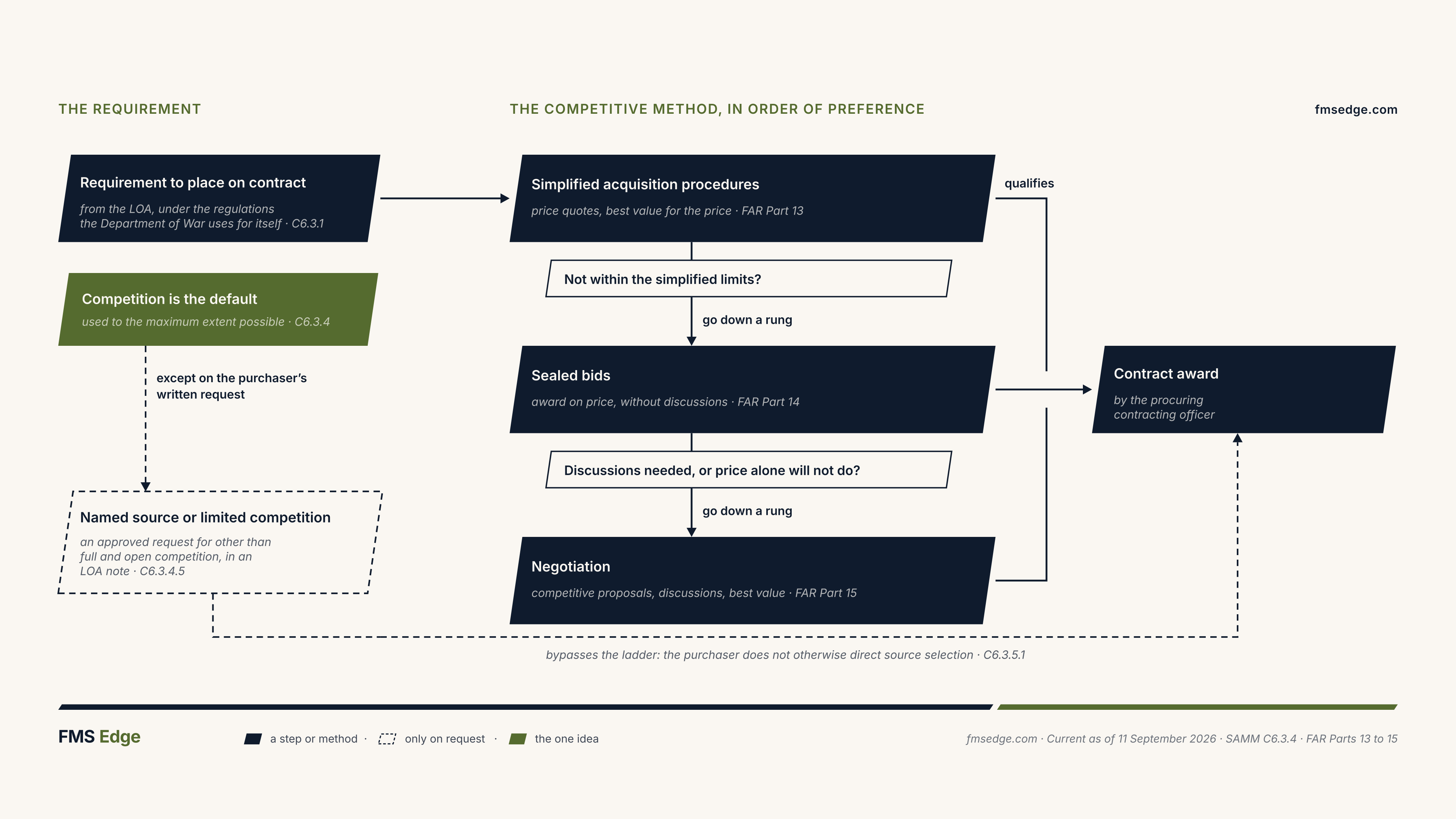
Competition is the default for a Foreign Military Sales contract. The contracting officer works down a ladder of competitive methods in order of preference. An approved purchaser request named in the LOA takes the purchase to a named source instead.
Is a Foreign Military Sales purchase competed?
A purchase is competed to the maximum extent possible, under the same regulations and procedures the Department of War (DoW) uses for its own purchases [SAMM , ]. A purchaser may instead ask in writing for a named source, or for competition limited to named sources, and that request should come with the or refer to it [SAMM , ]. The DoW Components do not take direction from the purchaser on , or on contract terms other than the special contract provisions and warranties that condition 6.1 of the refers to. Nor may the purchaser interfere when a prime contractor places its subcontracts. To the extent Section C6.3.4 permits, however, the DoW Components may honor a purchaser's sole source request that names a specific prime or subcontract source for the defense articles or services [SAMM ].
The competitive process takes time, and part of the item lead-time involves the period necessary to plan and conduct the competitive process.
Which competitive method does the contracting officer use?
Under the , competitive uses one of three methods: Simplified Acquisition Procedures (SAP), sealed bids, or negotiation. The three form a hierarchy of preferred use. Agencies shall use SAP to the maximum extent practicable for all purchases of supplies or services not exceeding the simplified acquisition threshold []. Sealed bidding shall be used whenever its conditions are met []. Under the , negotiation through is used when sealed bids are not appropriate.
This hierarchy reflects the degree of difficulty and cost invested by the U.S. Government () in the procurement. SAP is the easiest and least-costly type whereas negotiation uses the most government resources and incurs the highest cost.
Simplified acquisition procedures
SAP is meant to reduce administrative costs and to promote efficiency and economy in contracting. Price quotations are solicited from vendors, and the government then issues an order to the vendor that offers the best value. The limits SAP to acquisitions that do not exceed the simplified acquisition threshold, and Subpart 13.5 gives a special authority above that threshold for commercial products and commercial services [].
Part 13 describes these procedures, and a contract expected not to exceed the simplified acquisition threshold is contracted for under Part 13 [SAMM ].
Sealed bids
Sealed bidding shall be used whenever all of the following conditions are met []:
- Time permits the solicitation, submission, and evaluation of sealed bids
- The award will be made on the basis of price and other price-related factors
- It is not necessary to conduct discussions with the responding offerors about their bids
- There is a reasonable expectation of receiving more than one sealed bid
Under sealed bidding, the government advertises its requirements and invites interested firms to submit bids. Vendors interested in competing submit their respective bids in accordance with the invitation for bid instructions. Generally, there will be a deadline date for bid submission and a date established when the government will open the bids. On the bid opening day, the will open and review all the bids submitted. The contract is normally awarded to the responsible firm that submitted the lowest-priced responsive bid. “Responsive” means that the bidder offered what the government requested and not something else. The , part 14, describes this process [].
Negotiation
Negotiation is used if the conditions for SAP or sealed bidding cannot be met and when it is necessary to conduct discussions with prospective contractors. The main steps in this process, as described in the , part 15, are as follows:
- The solicits
- Offerors prepare and submit proposals
- The makes a competitive range determination to decide with which offerors to conduct written or oral discussions
- The conducts technical and price evaluations of the proposals
The selects and awards a contract to the vendor whose offer is most advantageous to the government. The most advantageous or best value offer is the one determined to provide the best combination of performance and price. It is not necessarily the lowest price offer or the best performing product or service.
References
SAMM
- SAMM C6.3.4.2: Timing of Requests.
- SAMM C6.3.4: Requests for Other than Full and Open Competition.
- SAMM C6.3.1: Compliance with Department of War Regulations and Procedures.
- SAMM C6.3.5.1: Source Selection.
Public authorities
- FAR Part 13: Federal Acquisition Regulation Part 13, Simplified Acquisition Procedures
- FAR Part 14: Federal Acquisition Regulation Part 14, Sealed Bidding
Related
Foreign Military Sales (FMS)
The part of U.S. security assistance, authorized by the Arms Export Control Act (AECA), in which eligible foreign governments and international organizations buy defense articles, services and training from the U.S. Government under formal government-to-government agreements.
The articles come either from Department of War stocks or from new procurement under contracts the Department manages [22 U.S.C. 2761, 22 U.S.C. 2762]. A sale is FMS whatever the source of the purchaser's financing.
FMS Edge glossary, as of 10 October 2026
Glossary entry →Open the manual’s entry → (opens in new tab)
Source Selection
The process wherein the requirements, facts, recommendations, and government policy relevant to an award decision in a competitive procurement of a system/project are examined and the decision made.
SAMM Glossary, as of 12 September 2026
Glossary entry →Open the manual’s entry → (opens in new tab)
Federal Acquisition Regulation (FAR)
The FAR is the primary regulation for use by federal executive agencies for the acquisition of supplies and services with appropriated funds. The document, published in 1984, consolidated the major procurement regulations of various departments and agencies. The intent of the FAR is to standardize the content, decrease the volume of documents, and to achieve consistency throughout government. The principal agencies involved in putting together the FAR were DoD, the General Services Administration, and the National Aeronautics and Space Administration, the three largest buyers. The FAR is broader than just contracting and applies to all goods and services. It directs the defense program manager in many ways, including contract award procedures, acquisition planning, warranties, and establishing guidelines for competition. Besides the FAR, each agency has its supplement to describe its own particular way of doing business. The DoD supplement is called Defense FAR Supplement.
SAMM Glossary, as of 12 September 2026
Glossary entry →Open the manual’s entry → (opens in new tab)
Letter of Request (LOR)
The term used to identify a request from an eligible FMS participant country for the purchase of U.S. defense articles and services. The request may be in message or letter format.
SAMM Glossary, as of 12 September 2026
Glossary entry →Open the manual’s entry → (opens in new tab)
Letter of Offer and Acceptance (LOA)
The legal instrument that lists the defense articles and services, including training, that the U.S. Government transfers to a foreign country or international organization, with their estimated costs and the terms and conditions. The benefitting partner does not sign a Building Partner Capacity (BPC) LOA.
The Letter of Offer and Acceptance (LOA) is the instrument the U.S. Government uses to sell under the Arms Export Control Act (AECA); signed LOAs and their later Amendments and Modifications are also called Foreign Military Sales (FMS) cases [SAMM C5.6.1].
FMS Edge glossary, as of 10 October 2026
Glossary entry →Open the manual’s entry → (opens in new tab)
Competitive Proposals
A method for awarding a U.S. government contract on a basis other than low bid, whereby the best and final offer may be obtained after discussions are concluded.
SAMM Glossary, as of 12 September 2026
Glossary entry →Open the manual’s entry → (opens in new tab)
SAMM C6.3.4: Requests for Other than Full and Open Competition.
“The competitive procurement process is used to the maximum extent possible when procuring articles or services. The Competition in Contracting Act (CICA) (10 U.S.C. 3204), however, provides certain limited circumstances in which the contracting activity can consider FMS purchaser requests for procurement using other than full and open competition (commonly referred to as “sole source”) when the contract to be …”
Security Assistance Management Manual, as of 26 October 2026
SAMM C6.3.1: Compliance with Department of War Regulations and Procedures.
“Acquisition for Foreign Military Sales (FMS) purchasers must be in accordance with DoW regulations and other applicable USG procedures. This affords the foreign purchaser the same benefits and protection that apply to DoW procurement and is one of the principal reasons why foreign governments and international organizations prefer to procure through FMS channels. FMS requirements may be consolidated with USG …”
Security Assistance Management Manual, as of 26 October 2026
SAMM C6.3.4.2: Timing of Requests.
“Official written direction to use other than full and open competition should be submitted in the Letter of Request (LOR), or it can be submitted separately with a reference to the LOR. The designation of a procurement to be conducted using other than full and open competition for an LOA that has already been accepted by the partner nation and …”
Security Assistance Management Manual, as of 26 October 2026
SAMM C6.3.5.1: Source Selection.
“The DoW Components do not accept directions from the FMS purchaser as to source selection decisions or contract terms (other than the special contract provisions and warranties referred to in condition 6.1. of the LOA), nor is the FMS purchaser permitted to interfere with a prime contractor’s placement of its subcontracts. However, to the extent permitted in Section C6.3.4., the …”
Security Assistance Management Manual, as of 26 October 2026
Federal Acquisition Regulation Part 13, Simplified Acquisition Procedures
FAR Part 13 · Regulation