
Guide
Can a Foreign Military Sales purchaser sell back spare parts it no longer needs?
Yes, through Worldwide Warehouse Redistribution Services (), which the U.S. Air Force manages for the under Section 21(m) of the . A purchaser can return articles that are not , bought through or Direct Commercial Sales, on a new case with a services line, for sale to other partners or to the Department of War. Buyers order through a blanket order line, never a Supply Support Arrangement case, and fills a requisition only if the article is in stock and priced below current Department of War pricing.
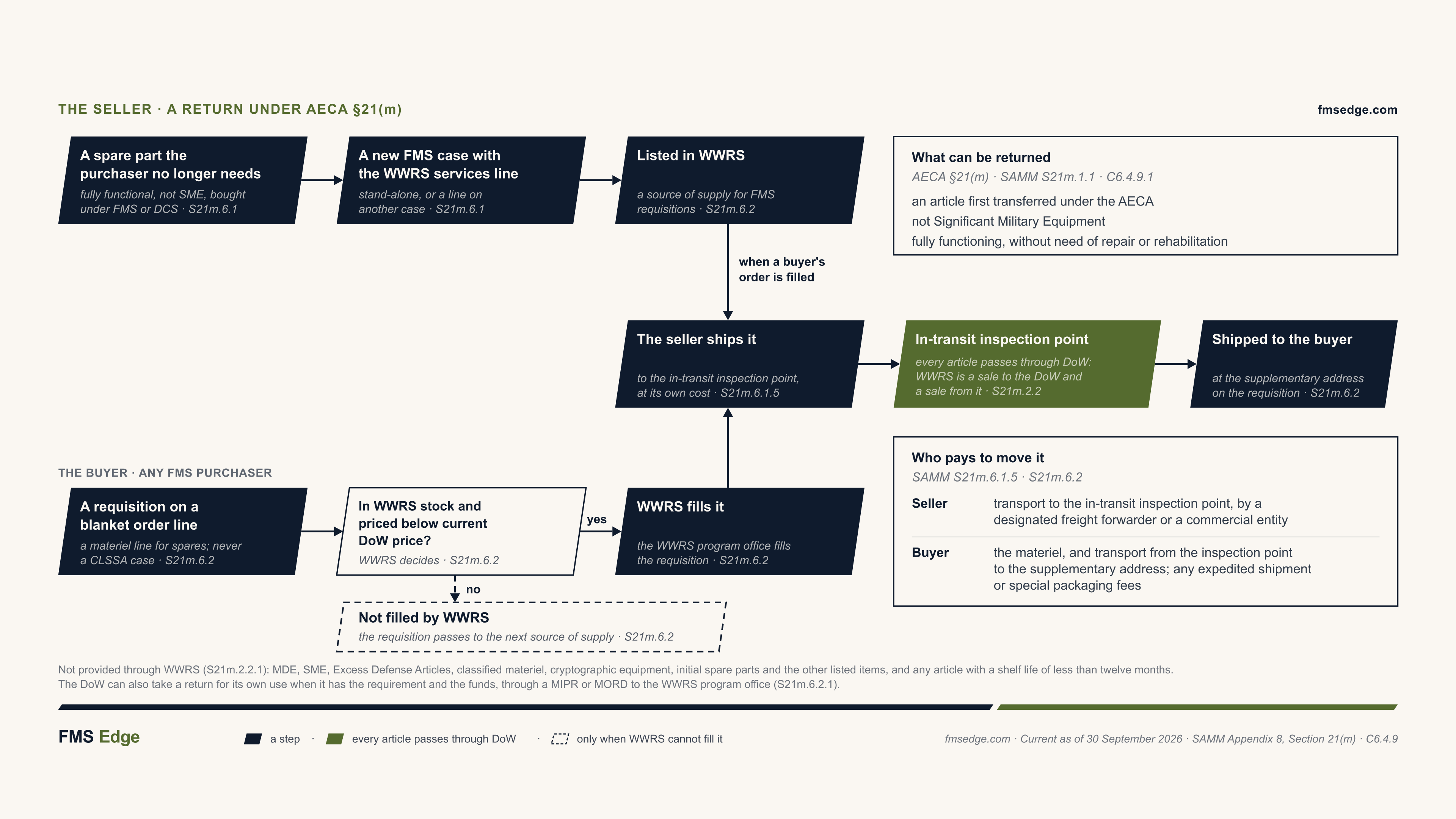
Worldwide Warehouse Redistribution Services (WWRS) lets a purchaser return a fully functional spare part it no longer needs, for another purchaser to buy through a blanket order requisition. WWRS fills a requisition only if the part is in stock and priced below the current Department of War price.
Can a Foreign Military Sales purchaser sell back spare parts it no longer needs?
The Worldwide Warehouse Redistribution Services () program provides a mechanism for partners to transfer to the Department of War (DoW) defense articles they purchased under or Direct Commercial Sales (). The articles are then sold to other partners through a , or to the DoW [SAMM ]. The articles must be fully functional. The U.S. Government manpower that supports the program is funded through the services line on the seller's case, as a percentage of the defense articles sold [SAMM ]. For any return, the partner must submit a request for a change of end use to the Department of State (PM/RSAT) and notify the relevant [SAMM ].
is a source of supply for requisitions. An purchaser must use a blanket order materiel line for spares or support equipment to buy -listed articles; Supply Support Arrangement () cases cannot be used [SAMM ]. International partners submit their list of excess items for sale through the program office at the Air Force and Cooperation () Directorate of the Air Force Life Cycle Management Center. posts the items to the website. Prices are determined by the seller. Once a buyer requisitions the item, the seller is instructed by to ship the materiel to the in-transit inspection point. After inspection and sanitization, the item is shipped to the buyer.
Section 21(m) of the authorizes the President to accept a back from a country or international organization on three conditions. The article was transferred to that country or organization under the , it is not , and it is fully functioning with no need of repair or rehabilitation [SAMM ]. Under that section, the Director of the has approved and delegated its management to the U.S. Air Force [SAMM ].
A return through may be accepted if the article meets the same three conditions. A DoW or -funded requirement for the article must also exist. Where the requirement is -funded, sensitive articles that need export controls and release determinations may not pass to other partners through returns. The return program should be used mainly where an partner itself asks the DoW to accept the return of non- articles it bought through on a partner-funded . Any later transfer to a foreign partner stays subject to the policies, regulations and agreements that govern the article's sale, transfer and use [SAMM ].
None of the following defense articles may be provided through [SAMM ]:
- Classified materiel
- Commercial materiel more readily provided in-country
- Controlled medical items
- Cryptographic equipment
- Explosive ordnance items
- Initial spare parts
- Items subject to a release approval
- Modification kits
- Ozone depleting substances
- Parachutes
- Publications
- packages (), or other documents of that kind that convey manufacturing process information
Nor is a with a shelf life of less than twelve months provided through [SAMM ].
For an partner to return non- items to the DoW, the items must be fully functional defense articles bought through or . The partner must also open, with an , a new case that provides for the return. That case must include the services line, "WWWRED1STSERV". The line can be the only line on its case or one of several. The need not prepare a Manpower Travel Data Sheet () for the services, since the services line already carries the U.S. Government manpower funding for the program [SAMM ].
All -eligible purchasers can buy eligible defense articles through , and the program office does not need to be told of each eligible purchase it fills. purchasers can order -listed articles, found on the website of the U.S. Air Force Life Cycle Management Center, through their existing Army, Navy or Air Force blanket order requisition cases or lines. They can direct a requisition to with "FWW" and routing media process code "R" in cc 71, in A01 format under the Military Standard Requisitioning and Issue Procedure (). With "FNH" they can instead have checked first as a possible source of supply [SAMM ].
The program office will fill the requisition if it has current inventory priced below current DoW pricing. If not, the requisition moves on to the next source of supply. An purchaser of articles is responsible for paying for the materiel and for transportation from the in-transit inspection point to the requisition's supplementary address, as well as any fees for expedited shipment or special packaging [SAMM ].
References
SAMM
- SAMM C6.4.9: Returns and Buy Backs.
- SAMM AP8.S21m.2.2.1: Defense Articles Not Provided.
- SAMM AP8.S21m.1.1
- SAMM AP8.S21m.2.2: Worldwide Warehouse Redistribution Services.
- SAMM AP8.S21m.6.1: Worldwide Warehouse Redistribution Services Sellers.
- SAMM AP8.S21m.6.2: Worldwide Warehouse Redistribution Services Buyers.
- SAMM C6.4.9.1: Returns under Worldwide Warehouse Redistribution Services.
Facts referenced
- Shelf life below which a defense article is not provided through Worldwide Warehouse Redistribution Services (WWRS): twelve months (as of 30 September 2026; SAMM AP8.S21m.2.2.1)
Related
Worldwide Warehouse Redistribution Service (WWRS)
Pursuant to AECA Section 21(m), a defense service provided by the U.S. Air Force that provides a mechanism for partners to transfer to the DoD defense articles that were purchased under Foreign Military Sales (FMS) or purchased under Direct Commercial Sales (DCS) for sale to other partners through a Letter of Offer and Acceptance or to the DoD.
SAMM Glossary, as of 12 September 2026
Glossary entry →Open the manual’s entry → (opens in new tab)
Defense Security Cooperation Agency (DSCA)
The Department of War agency that directs, administers and provides guidance to the Department's components and its representatives at U.S. missions for the execution of the security cooperation programs for which it is responsible [SAMM C1.3.2.2]. The agency also provides financial and technical assistance, arranges the transfer of defense materiel, training and services to international partners, and promotes military-to-military contacts.
FMS Edge glossary, as of 10 October 2026
Glossary entry →Open the manual’s entry → (opens in new tab)
Arms Export Control Act (AECA)
The basic U.S. law providing the authority and general rules for the conduct of Foreign Military Sales and commercial sales of defense articles, defense services, and training. The Arms Export Control Act (AECA) came into existence with the passage of the Foreign Military Sales Act (FMSA) of 1968. An amendment in the International Security Assistance and AECA of 1976 changed the name of FMSA to the AECA.
SAMM Glossary, as of 12 September 2026
Glossary entry →Open the manual’s entry → (opens in new tab)
Significant Military Equipment (SME)
Defense articles for which special export controls are warranted because of the capacity of such articles for substantial military utility or capability. These items are identified on the U.S. Munitions List in the International Traffic in Arms Regulations by an asterisk preceding the item category listing.
SAMM Glossary, as of 12 September 2026
Glossary entry →Open the manual’s entry → (opens in new tab)
Foreign Military Sales (FMS)
The part of U.S. security assistance, authorized by the Arms Export Control Act (AECA), in which eligible foreign governments and international organizations buy defense articles, services and training from the U.S. Government under formal government-to-government agreements.
The articles come either from Department of War stocks or from new procurement under contracts the Department manages [22 U.S.C. 2761, 22 U.S.C. 2762]. A sale is FMS whatever the source of the purchaser's financing.
FMS Edge glossary, as of 10 October 2026
Glossary entry →Open the manual’s entry → (opens in new tab)
Cooperative Logistics
The logistics support provided a foreign government/agency through its participation in a U.S. DoD logistics system, with reimbursement paid to the USG for the support provided.
SAMM Glossary, as of 12 September 2026
Glossary entry →Open the manual’s entry → (opens in new tab)
DCS: Direct Commercial Sales
SAMM Acronyms, as of 12 September 2026
Letter of Offer and Acceptance (LOA)
The legal instrument that lists the defense articles and services, including training, that the U.S. Government transfers to a foreign country or international organization, with their estimated costs and the terms and conditions. The benefitting partner does not sign a Building Partner Capacity (BPC) LOA.
The Letter of Offer and Acceptance (LOA) is the instrument the U.S. Government uses to sell under the Arms Export Control Act (AECA); signed LOAs and their later Amendments and Modifications are also called Foreign Military Sales (FMS) cases [SAMM C5.6.1].
FMS Edge glossary, as of 10 October 2026
Glossary entry →Open the manual’s entry → (opens in new tab)
FMS: Foreign Military Sale
SAMM Acronyms, as of 12 September 2026
Security Cooperation Organization (SCO)
A Department of Defense element that is part of the United States Diplomatic mission located in a foreign country to carry out security assistance and security cooperation management functions under the supervision and coordination authority of the senior defense official/defense attaché.
SAMM Glossary, as of 12 September 2026
Glossary entry →Open the manual’s entry → (opens in new tab)
CLSSA: Cooperative Logistics Supply Support Arrangement
SAMM Acronyms, as of 12 September 2026
Glossary entry →Cooperative Logistics Supply Support Arrangements (CLSSA) →
Security Assistance (SA)
A group of programs authorized by federal statutes by which the United States provides defense articles, military training, and other defense-related services by grant, lease, loan, credit, or cash sales in furtherance of national policies and objectives, and those that are funded and authorized through the Department of State to be administered by Department of Defense/Defense Security Cooperation Agency, which are considered part of security cooperation.
SAMM Glossary, as of 12 September 2026
Glossary entry →Open the manual’s entry → (opens in new tab)
Defense Article (Foreign Assistance Act; Arms Export Control Act, not including commercial sales subject to the International Traffic in Arms Regulation)
Any weapon, weapon system, munition, aircraft, vessel or other implement of war, together with the property, equipment, tooling, components and parts used to furnish military assistance or sales or to make, maintain or use such items; the International Traffic in Arms Regulations (ITAR) define the term separately for commercial exports.
Section 47 of the Arms Export Control Act (AECA) defines the term, and the U.S. Munitions List designates the specific items that fall within it [SAMM C4.4] [22 U.S.C. 2794].
FMS Edge glossary, as of 10 October 2026
Glossary entry →Open the manual’s entry → (opens in new tab)
AECA: Arms Export Control Act
SAMM Acronyms, as of 12 September 2026
LOA: Letter of Offer and Acceptance
SAMM Acronyms, as of 12 September 2026
Excess Defense Articles (EDA)
Defense articles owned by the USG which are neither procured in anticipation of military assistance or sales requirements, nor procured pursuant to a military assistance or sales order. EDA are items (except construction equipment) that are in excess of the Approved Force Acquisition Objective and Approved Force Retention Stock of all DoD components at the time such articles are dropped from inventory by the supplying agency for delivery to countries or international organizations.
SAMM Glossary, as of 12 September 2026
Glossary entry →Open the manual’s entry → (opens in new tab)
Major Defense Equipment (MDE)
Any item of Significant Military Equipment on the U.S. Munitions List having a nonrecurring research and development cost of more than $50 million or a total production cost of more than $200 million. Also defined in section 47 (6), Arms Export Control Act.
SAMM Glossary, as of 12 September 2026
Glossary entry →Open the manual’s entry → (opens in new tab)
Technical Data
Recorded information of a scientific or technical nature, regardless of form or characteristic. Examples of technical data packages include research and engineering drawings and associated lists, specifications, standards, process sheets, manuals, technical reports, catalog item identifications, and related information and computer software documentation.
SAMM Glossary, as of 12 September 2026
Glossary entry →Open the manual’s entry → (opens in new tab)
TDP: Technical Data Package
SAMM Acronyms, as of 12 September 2026
Implementing Agency (IA)
The military department or defense agency responsible for the execution of military assistance programs. With respect to FMS, the military department or defense agency assigned responsibility by the Defense Security Cooperation Agency to prepare an LOA and to implement an FMS case. The implementing agency is responsible for the overall management of the actions that will result in delivery of the materials or services set forth in the LOA that was accepted by a foreign country or international organization.
SAMM Glossary, as of 12 September 2026
Glossary entry →Open the manual’s entry → (opens in new tab)
Military Articles And Services List (MASL)
A catalogue of materiel, services, and training used in the planning and programming of International Military Education and Training (IMET), and Foreign Military Sales (FMS). Separate MASLs are maintained for IMET and FMS training that provides data on course identification, course availability, price, and duration of training.
SAMM Glossary, as of 12 September 2026
Glossary entry →Open the manual’s entry → (opens in new tab)
Routing Identifier Code (RIC)
Routing Identifier Codes are assigned by services/agencies for processing inter-service/agency and intra-service/agency logistics transactions. The codes serve multiple purposes in that they are source of supply codes, intersystem routing codes, intrasystem routing codes and consignor (shipper) codes.
SAMM Glossary, as of 12 September 2026
Glossary entry →Open the manual’s entry → (opens in new tab)
MILSTRIP: Military Standard Requisitioning and Issue Procedures
SAMM Acronyms, as of 12 September 2026
Glossary entry →Military Standard Requisitioning And Issue Procedures (MILSTRIP) →
SAMM AP8.S21m.2.2: Worldwide Warehouse Redistribution Services.
“Pursuant to AECA, Section 21(m) (22 U.S.C. 2761), the Director, DSCA has approved the Worldwide Warehouse Redistribution Services (WWRS) program and delegated its management to the U.S. Air Force (USAF). It provides a mechanism for partners to transfer to the DoW defense articles that were purchased under FMS or purchased under Direct Commercial Sales (DCS) for sale to other partners …”
Security Assistance Management Manual, as of 9 November 2026
SAMM AP8.S21m.6.1: Worldwide Warehouse Redistribution Services Sellers.
“For Foreign Military Sales (FMS) partners to return non-significant military equipment (SME) back to the DoW, the items must be fully functional defense articles purchased under FMS or Direct Commercial Sales (DCS), and the foreign partner must establish a new FMS case with an Implementing Agency (IA) to provide for the return of the defense article(s). The FMS case must …”
Security Assistance Management Manual, as of 9 November 2026
SAMM C6.4.9: Returns and Buy Backs.
“The DoW may accept returns of defense articles through the Worldwide Warehouse Redistribution Services (WWRS) program under Section 21(m) of the AECA and may utilize U.S. procurement authorities to purchase (i.e., buy back) defense articles previously sold to partners under the AECA. For any returns or buy backs, the partner must submit a request for a change of end use …”
Security Assistance Management Manual, as of 26 October 2026
SAMM AP8.S21m.6.2: Worldwide Warehouse Redistribution Services Buyers.
“WWRS is a source of supply for FMS requisitions. All FMS-eligible purchasers can purchase eligible defense articles through WWRS. For FMS purchasers, a blanket order materiel line for spares or support equipment must be used. Cooperative Logistics Supply Support Arrangement (CLSSA) cases cannot be used to purchase through WWRS. The WWRS program office does not need to be advised for …”
Security Assistance Management Manual, as of 9 November 2026
SAMM AP8.S21m.1.1
“Arms Export Control Act (AECA), Section 21(m) (22 U.S.C. 2761) authorizes the President to accept the return of a defense article from a country or international organization if it was: previously transferred to such country or organization under the AECA; is not significant military equipment (SME); and is in fully functioning condition without need of repair or rehabilitation.”
Security Assistance Management Manual, as of 30 September 2026
SAMM C6.4.9.1: Returns under Worldwide Warehouse Redistribution Services.
“The Worldwide Warehouse Redistribution Services (WWRS) program provides a mechanism for FMS partners to sell and return defense articles to the DoW that were purchased under FMS. Returns may be accepted if the defense article was previously provided under the AECA, is not Significant Military Equipment (SME), and is in fully functioning condition without need of repair or rehabilitation. In …”
Security Assistance Management Manual, as of 26 October 2026
SAMM AP8.S21m.2.2.1: Defense Articles Not Provided.
“The following defense articles may not be provided through WWRS: Major Defense Equipment (MDE), SME, Excess Defense Articles (EDA), parachutes, explosive ordnance items, commercial items of materiel more readily provided from in-country, controlled medical items, modification kits, ozone depleting substances, technical data packages (TDP) or other similar documentation that conveys manufacturing process information, publications, cryptographic equipment, classified materiel, items subject …”
Security Assistance Management Manual, as of 30 September 2026