
Guide
Do security cooperation office staff have diplomatic immunity?
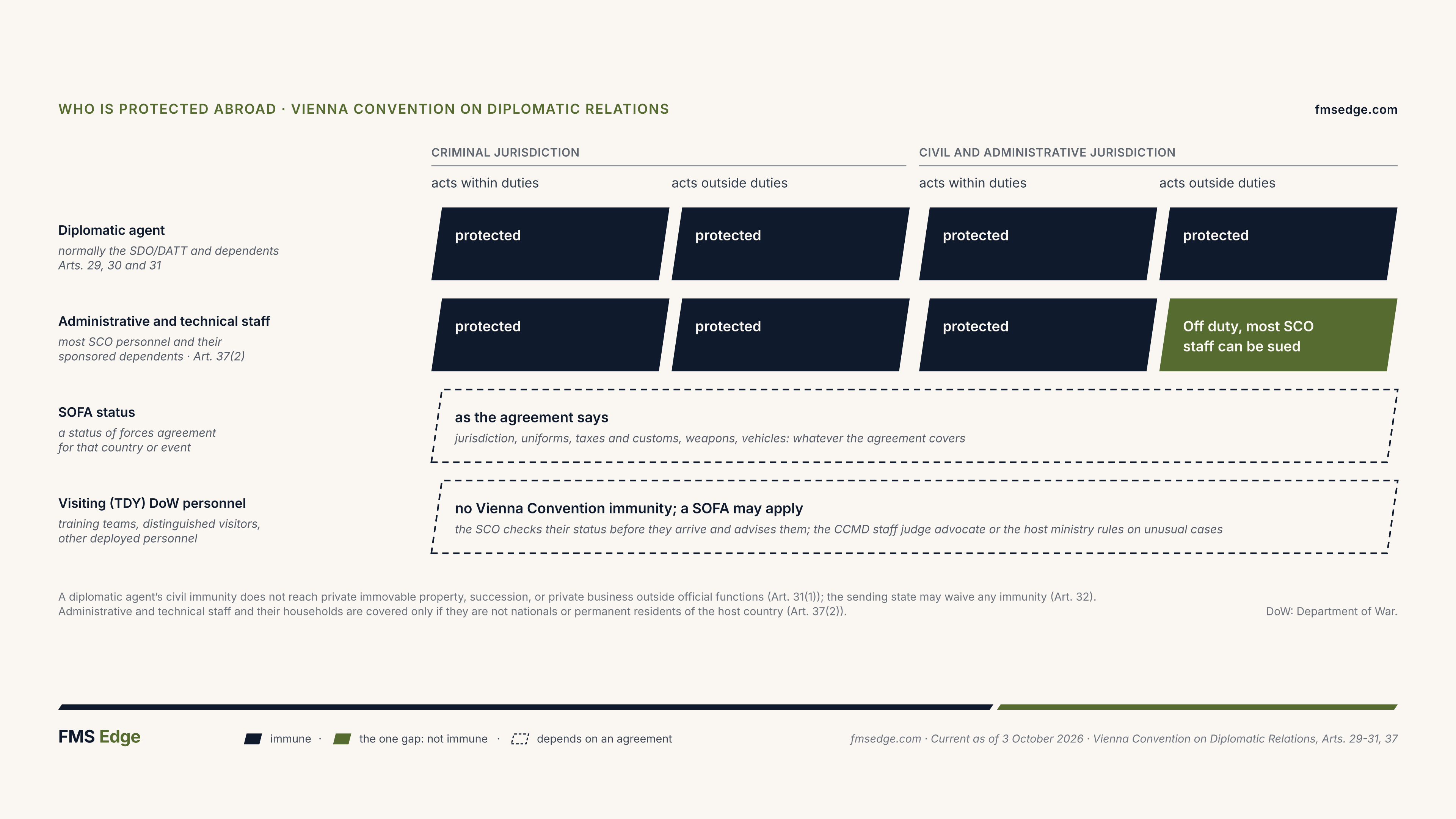
Some do, and most have a lesser status. Under the Vienna Convention on Diplomatic Relations, a diplomatic agent, normally only the Senior Defense Official/Defense Attaché and family, is immune from the host nation's criminal, civil and administrative jurisdiction. Most office staff have administrative and technical status: full immunity from criminal jurisdiction, but civil immunity only for acts in the course of their duties. Visiting personnel on temporary duty have no Vienna Convention immunity, though a status of forces agreement may protect them.
Under the Vienna Convention on Diplomatic Relations a diplomatic agent, normally the Senior Defense Official/Defense Attaché, is immune from the host country's criminal, civil and administrative jurisdiction. Most security cooperation office staff have administrative and technical status. Off duty, they can be sued.
What protection does the Vienna Convention give?
The Vienna Convention on Diplomatic Relations of 1961 protects members of a from the host nation's jurisdiction, to a degree set by each member's status. The Senior Defense Official/Defense Attaché (/) is the embassy's diplomatically accredited defense attaché and the chief of the . The / and family normally hold the status of diplomatic agents, which carries the widest protection. Most other members hold administrative and technical (A&T) status: full immunity from criminal jurisdiction, but civil immunity only for acts in the course of their official duties.
The provisions of one or more treaties, international agreements, or laws affect the legal status of personnel while they are performing their official duties in foreign countries. In many cases, the immunities afforded by these agreements are specific to the country and to the status of the individual involved.
A primary element of national sovereignty is the exercise of jurisdiction by a government over persons within its territory. The U.S. Government () strives to obtain legally binding international agreements that provide protections and immunities for Department of War (DoW) personnel overseas to protect them against arbitrary, discriminatory, or politically motivated legal abuses. DoW personnel not diplomatically accredited or otherwise protected under an existing multinational convention or bilateral agreement are entirely subject to the host nation’s laws and jurisdiction while in that country. Jurisdiction applies not only to criminal issues, but also to routine civil/administrative legal matters such as taxation, civil liabilities, etc. The Vienna Convention on Diplomatic Relations of 1961 provides both criminal and civil protections, to varying degrees, for personnel; however, the level of protection varies according to the employment status, citizenship, and specific diplomatic accreditation of individual members.
members considered “diplomatic agents” receive the most comprehensive protection. Governments often refer to this status as “full diplomatic immunity,” and, under Article 31 of the Vienna Convention, personnel with this status receive immunity from the criminal jurisdiction of the country that granted them accreditation. With limited exceptions, they are also immune from its civil and administrative jurisdiction. The host government may not search or detain personnel in such status and may not search or enter their homes, offices, and vehicles in accordance with Articles 22, 29 and 30 of the Vienna Convention []. Normally, this level of protection extends only to the / and his/her dependents as the other members are typically not fully accredited diplomats.
In addition, a diplomat is not obliged to give evidence as a witness in the courts of the receiving country. However, the sending government (or government that the diplomat represents), may waive this immunity. Immunity in the receiving country does not exempt the diplomat from the jurisdiction of the sending country. In addition, those with full diplomatic status do not enjoy immunity from civil and administrative jurisdiction related to private business activities not associated with their position or conducted on behalf of the sending state [].
The second recognized category of protection is “administrative and technical” (A&T) status. Persons in this category and their families receive full immunity against criminal prosecution but receive only partial protection against the receiving country’s administrative and civil jurisdiction. In particular, civil protections only extend to acts performed in conjunction with official duties and not conduct or actions that occur while off duty. Most personnel and their sponsored dependents fall into this category.
Personnel having diplomatic rank will generally possess diplomatic passports. A&T staff will carry either diplomatic or official passports but still only have A&T status. The type of passport is not the critical issue; a registry on the host nation’s official diplomatic list, normally maintained by the Ministry of Foreign Affairs () in the receiving state, determines proof and accreditation level for diplomats. More practical verification of status comes in the form of personnel demonstrating possession of either a diplomatic identification card issued by the , often known as a “carnet”, or possession of a diplomatic visa. The U.S. embassy’s human resources office normally obtains and tracks these credentials for all U.S. embassy personnel.
What about status of forces agreements and visitors?
Visiting DoW personnel have no immunity under the Vienna Convention, but a Status of Forces Agreement () or a similar agreement can give them some protection. A is a multilateral or bilateral agreement that addresses the presence and activities of U.S. forces, military and civilian, in a foreign country. Foreign countries do not treat personnel on temporary duty () as part of the embassy's A&T staff, whatever their rank.
In addition to the Vienna Convention, the has also established multilateral and bilateral agreements, known as , that address the presence and activities of U.S. forces (military and civilian) in a foreign country. While there are no formal requirements concerning the form, content, length, or title of a , a typically addresses, but is not limited to the following: criminal and civil jurisdiction; the wearing of uniforms; taxes, fees, and customs; the use of radio frequencies; the importation, use, and export of official and personal weapons; and motor vehicle registration and requirements for driver licensing. A may be written for a specific event or provide general, long-term coverage. The Department of State negotiates these agreements in cooperation with the DoW.
A single person can only fall into one of these three categories (diplomatic, A&T, or status) at any given time, and locally employed (LE) staff will normally fall under host nation laws.
Regardless of a DoW visitor’s rank or position, foreign countries do not consider visiting () DoW personnel part of the local U.S. embassy’s administrative and technical staff. As such, these visitors do not receive immunity under the Vienna Convention. However, a or similar agreement may provide a degree of protection and privileges. As part of the planning process for the arrival of DoW training teams, distinguished visitors (DVs), and other deployed personnel, should verify the jurisdictional status of those personnel and appropriately advise the travelers concerned. should consult the staff judge advocate (SJA) of the appropriate or the of the country in unusual circumstances to make a formal determination on the status of visitors.
References
Public authorities
- Vienna Convention on Diplomatic Relations: Vienna Convention on Diplomatic Relations (1961)
- CRS RL34531: Congressional Research Service, RL34531, "Status of Forces Agreement (SOFA): What Is It, and How Has It Been Utilized?" (15 March 2012)
Related
Security Cooperation
Activities by which the Department of War encourages and enables international partners to cooperate with the United States toward strategic objectives, spanning every interaction with foreign defense and security establishments and every security assistance program the Department administers.
Under chapter 16 of Title 10, their purposes are to develop allied and friendly security capabilities for self-defense and multinational operations, to give U.S. forces peacetime and contingency access, and to build relationships promoting specific U.S. security interests [10 U.S.C. 301(7)].
FMS Edge glossary, as of 10 October 2026
Glossary entry →Open the manual’s entry → (opens in new tab)
Security Cooperation Organization (SCO)
A Department of Defense element that is part of the United States Diplomatic mission located in a foreign country to carry out security assistance and security cooperation management functions under the supervision and coordination authority of the senior defense official/defense attaché.
SAMM Glossary, as of 12 September 2026
Glossary entry →Open the manual’s entry → (opens in new tab)
Senior Defense Official (SDO) and Defense Attaché (DATT)
Principal DoD official in a U.S. embassy, as designated by the Secretary of Defense. The SDO or DATT is the Chief of Mission's principal military advisor on defense and national security issues, the senior diplomatically accredited DoD military officer assigned to a diplomatic mission, and the single point of contact for all DoD matters involving the embassy or DoD elements assigned to or working from the embassy. The SDO or DATT is considered the dual-hatted chief of both the Security Cooperation Organization and Defense Attaché Office in the embassy. This position was established by DoDD 5205.75, Department of Defense Operations at U.S. Embassies, December 21, 2007. The same document gives coordinating authority (see glossary definition) to the SDO or DATT for the purpose of ensuring that all DoD elements in a country are working in consonance with each other and under the guidance of the Chief of Mission. The SDO or DATT program replaces the now defunct U.S. Defense Representative model.
SAMM Glossary, as of 12 September 2026
Glossary entry →Open the manual’s entry → (opens in new tab)
SCO: Security Cooperation Organization
SAMM Acronyms, as of 12 September 2026
Temporary Duty Travel (TDY)
A period of time during which an individual is assigned to work at a location away from their permanent location.
SAMM Glossary, as of 12 September 2026
Glossary entry →Open the manual’s entry → (opens in new tab)
Combatant Command (CCMD)
A unified or specified command with a broad continuing mission under a single commander established and so designated by the President, through the Secretary of Defense and with the advice and assistance of the Chairman of the Joint Chiefs of Staff. Also called CCMD.
SAMM Glossary, as of 12 September 2026
Glossary entry →Open the manual’s entry → (opens in new tab)
Vienna Convention on Diplomatic Relations (1961)
Vienna Convention on Diplomatic Relations · Treaty