
Guide
What is a problem disbursement in Foreign Military Sales, and how is it resolved?
A problem disbursement is a payment that the official accounting office cannot match to the obligation or amount it should liquidate, such as an unmatched disbursement or a . The matches it to an obligation source in a set order, and the Comptroller decides what to do with an unmatched disbursement that none of the options resolves. Every problem disbursement must be resolved before the case closes.
What is a problem disbursement in Foreign Military Sales, and how is it resolved?
A Problem Disbursement () is a payment that reaches the official accounting office but cannot be matched to the original obligation or amount it is meant to liquidate [SAMM ]. include (UMDs) and Negative Unliquidated Obligations (NULOs). Implementing Agencies () and the Defense Finance and Accounting Service () find and resolve with reporting tools from the 's disbursing and general ledger accounting systems and from the . They also use the U.S. Government Standard General Ledger (USSGL) reports receives from the Department of the Treasury [SAMM ].
A is a transaction that has been reported to the Department of the Treasury's Bureau of the Fiscal Service but cannot be matched to its obligation or amount when the official accounting station receives it. also cover in-transit disbursements made by disbursing officers, and these are counted with the UMDs. An unmatched disbursement is recorded in the accounting system with no obligation matched to it. A is a disbursement that has been matched to the detail obligation it cites, but the total of the disbursements is more than the obligation's amount.
For a transaction of up to $2,500, the decides at its discretion whether to continue or stop the research. For one over $2,500, the Comptroller, a Defense Agency Comptroller, a Assistant Secretary for Financial Management and Comptroller (FM&C), or another delegated funds control official may require the research to continue [SAMM ]. In that case, written approval from one of those officials must be obtained before the research stops, and the approval must describe the research done [SAMM ].
Once a has been resolved under C16.2.6.3, its UMDs or NULOs need no further research or reporting. If the fund manager, the accounting office or both later find that a further adjustment or correction is needed and supply the adjusting or correcting document, the adjustment or correction must be recorded [SAMM ]. If the recorded adjustment or correction is over $2,500, should notify with a “ Comptroller Notification of Adjustment/Correction over $2,500” request in the Case Closure Submission Tool, under Problem Disbursement [SAMM ].
The research timeline for resolving NULOs does not apply where a contract overpayment caused the NULO. For determining and collecting contract debts, the manual points to the , subpart 32.6 [SAMM ]. Where such a NULO cannot be resolved by the options above, the applicable debt collection rules and policies apply, and for post-closure financial activity the manual points to C16.3.14 and C16.3.3.16 [SAMM ].
Once the research shows whether a falls on the or on a Building Partner Capacity () program, match it to an obligation source, taking the options in a set order [SAMM ]. On the side, look first for the obligation source within the case and match the UMD or NULO to it. This first option also covers the administrative account when the research shows that account is the source of the [SAMM ]. If that first option fails, should submit a “ Comptroller Approval for UMD to Country ” request under Problem Disbursement in the Case Closure Submission Tool. The request must include all relevant facts and amounts and show how the UMD is tied to a particular country [SAMM ]. Once the Comptroller has approved matching the UMD to the Country , should create a Miscellaneous Obligation (DD Form 2406) and post it to that account to resolve the UMD [SAMM ].
If neither option resolves a UMD, should write a Memorandum for Record () for the Comptroller to consider and decide how to resolve. Then should submit a “ Comptroller UMD ” request under Problem Disbursement in the Case Closure Submission Tool, and the must be attached to it. For the requirements, the manual points to Figure C16.F2 [SAMM ].
On the side, if the original appropriation behind a UMD or NULO has canceled, the must be resolved with a current and available appropriation as its obligation source, and that appropriation must be executed outside the [SAMM ]. If a UMD cannot be resolved that way, should write an for the Comptroller to consider and decide how to resolve the on the appropriation obligation sources. should submit a “ Comptroller UMD ” request under Problem Disbursement in the same tool, and the must be attached to it [SAMM ].
Once a UMD or NULO has been resolved to one of those obligation sources, the funds holder's accounting office must immediately give the component financial manager a copy of the obligation document, so that the financial manager can record the obligation [SAMM ].
When found in USSGL reports are reconciled to the 's accounting system, also work with to make sure shows that reconciliation accurately. must work with Accounting to keep the accounting systems aligned with while they resolve [SAMM ].
A Departmental Accountable Official (DAO) supplies the information, data or services that certifying officers rely on when they certify vouchers. The DAO stays subject to pecuniary liability as a departmental accountable official [SAMM ] []. Resolving a disbursement with current funds does not automatically waive the requirement to investigate possible negligence or fraud. For (ADA) violations, the manual points to C16.2.6.5 and to 31 U.S.C. 1341(a) [SAMM ].
must resolve before the case closes, by making sure every disbursement is reconciled to a valid obligation, using current-year appropriations where necessary [SAMM ]. Under no circumstances shall a disbursement be taken off the financial records without a matching funding source and/or supporting documentation [SAMM ].
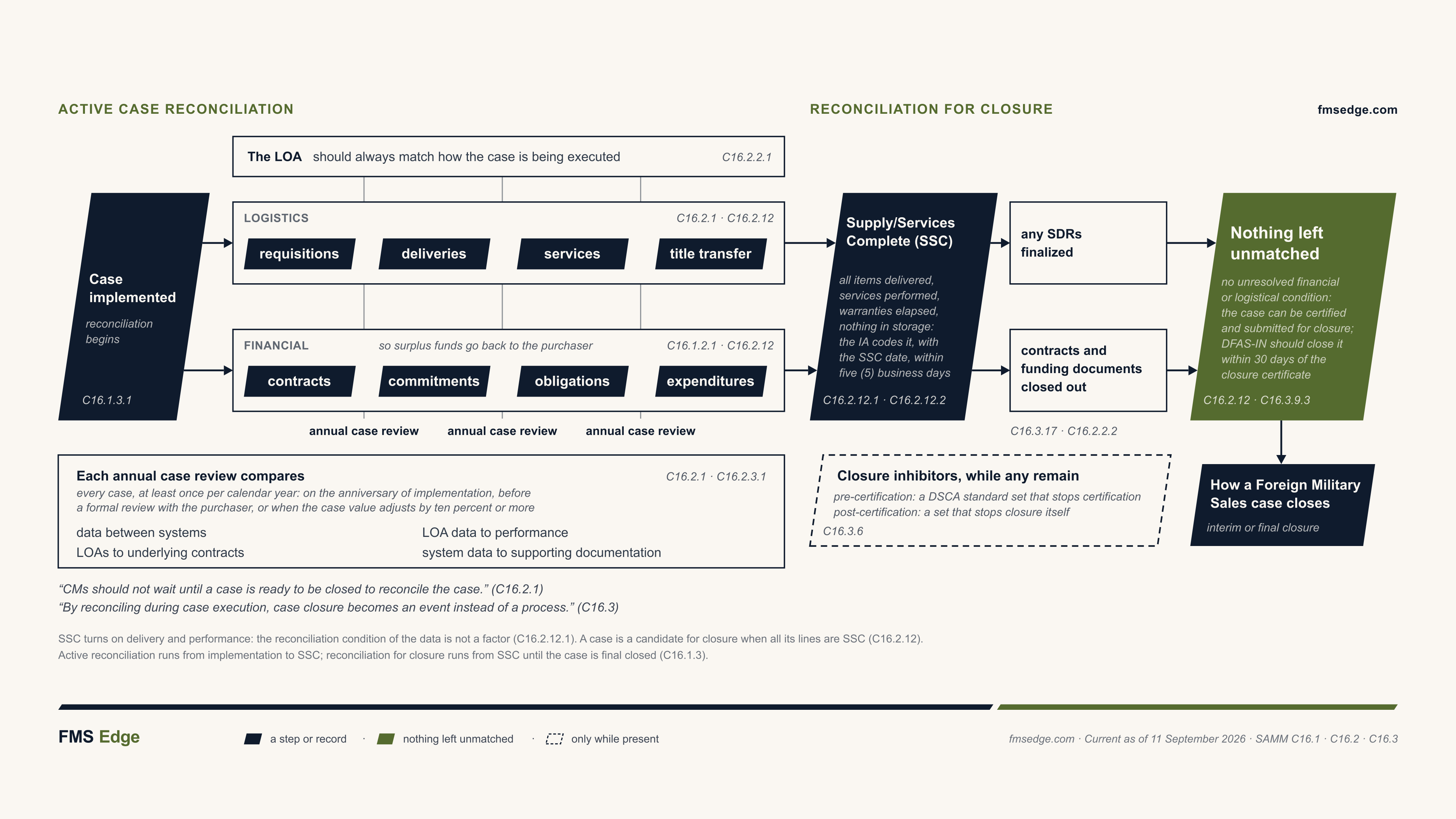
Reconciliation starts when a case is implemented, and each annual case review checks the records against the LOA. After Supply/Services Complete (SSC) it runs until nothing is left unmatched; only then can the case be certified and submitted for closure. What follows is shown in How a Foreign Military Sales case closes.
A Title 22 closure adjustment is the last resort when an , despite its best efforts, cannot fully reconcile a case with the established procedures before closure, for example because of irreconcilable discrepancies between systems. In that event, and only after every other option has been exhausted, the must submit an signed at GS-15 level or above, asking for a closure adjustment to reconcile the case before it can submit a case closure certificate [SAMM ].
The should coordinate the with the appropriate Country Finance Director () in 's Financial Policy & Regional Execution Directorate (/FPRE) before it formally sends the closure adjustment request to the case closure team through the Case Closure Tool. Figure C16.F2 shows the . On receipt, 's Financial Analysis and Compliance Division (/FPRE/FAC) will pass the to the offices that review and approve it. If the is approved, /FPRE/FAC will sign it, return it to the and forward the approved Closure Adjustment Package to Indianapolis () for processing in . If not, /FPRE/FAC will return the to the for revision. Once has processed the closure adjustment, the will complete a Case Closure Certificate in line with C16.3.8 [SAMM ].
References
SAMM
- SAMM C16.2.6.2.1
- SAMM C16.2.6.2.2
- SAMM C16.2.6.2.4
- SAMM C16.2.6.2.5
- SAMM C16.2.6.3.5
- SAMM C16.2.6.3: Resolve Problem Disbursements through Reconciliation and Obligation Procedures.
- SAMM C16.2.6.3.1.1
- SAMM C16.2.6.3.1.2
- SAMM C16.2.6.3.1.2.1
- SAMM C16.2.6.3.1.3
- SAMM C16.2.6.3.2.1
- SAMM C16.2.6.3.2.2
- SAMM C16.2.6.3.3
- SAMM C16.2.6.3.4
- SAMM C16.2.6.3.6
- SAMM C16.2.16: Title 22 Foreign Military Sales Closure Adjustment.
- SAMM C16.2.6.1: Definition.
- SAMM C16.2.6.4: Impact on Closure.
Public authorities
- 10 U.S.C. §2773a: 10 U.S.C. §2773a, Departmental accountable officials
Facts referenced
DSCA policy memoranda
- DSCA 26-10: Requirements to Resolve Problem Disbursements [SAMM E-Change 807]
Related
Accounts Receivable
Assets that arise from specifically identifiable, legally enforceable claims to cash or other assets through an entity’s established assessment processes or when goods or services are provided.
SAMM Glossary, as of 12 September 2026
Glossary entry →Open the manual’s entry → (opens in new tab)
Negative Unliquidated Obligation
A disbursement transaction that has been matched to the cited detail obligation, but the total disbursement(s) exceeds the amount of that obligation.
SAMM Glossary, as of 12 September 2026
Glossary entry →Open the manual’s entry → (opens in new tab)
Implementing Agency (IA)
The military department or defense agency responsible for the execution of military assistance programs. With respect to FMS, the military department or defense agency assigned responsibility by the Defense Security Cooperation Agency to prepare an LOA and to implement an FMS case. The implementing agency is responsible for the overall management of the actions that will result in delivery of the materials or services set forth in the LOA that was accepted by a foreign country or international organization.
SAMM Glossary, as of 12 September 2026
Glossary entry →Open the manual’s entry → (opens in new tab)
Defense Security Cooperation Agency (DSCA)
The Department of War agency that directs, administers and provides guidance to the Department's components and its representatives at U.S. missions for the execution of the security cooperation programs for which it is responsible [SAMM C1.3.2.2]. The agency also provides financial and technical assistance, arranges the transfer of defense materiel, training and services to international partners, and promotes military-to-military contacts.
FMS Edge glossary, as of 10 October 2026
Glossary entry →Open the manual’s entry → (opens in new tab)
Problem Disbursements (PD)
A transaction reported to the Treasury Department's Bureau of Fiscal Services, but upon receipt at the official accounting station cannot be successfully matched to the original obligation or accounts receivable amount for liquidation purposes. Problem Disbursements include unmatched disbursements (UMDs), negative unliquidated obligations (NULOs), and in-transit disbursements made by disbursing officers. For purposes of this guide, Problem Disbursements are classified into two categories - UMDs (to include in-transits) and NULOs.
SAMM Glossary, as of 12 September 2026
Glossary entry →Open the manual’s entry → (opens in new tab)
Unmatched Disbursements (UMD)
When a disbursement is recorded in the accounting system but not matched to an obligation, the disbursement results in an unmatched disbursement.
SAMM Glossary, as of 12 September 2026
Glossary entry →Open the manual’s entry → (opens in new tab)
Defense Integrated Financial System (DIFS)
A financial system providing DoD-level financial management functions for the security assistance (SA) program. This includes centralized Foreign Military Sales (FMS) trust fund accounting, foreign customer billing, and financial management reporting. DIFS consolidates FMS data from the Army, Navy, Air Force, and other implementing agencies, and provides efficient accountability for oversight of the financial and program management aspects of SA.
SAMM Glossary, as of 12 September 2026
Glossary entry →Open the manual’s entry → (opens in new tab)
Military Department (MILDEP)
One of the departments within the DoD created by the National Security Act of 1947, as amended. The Military Departments are: the Department of the Air Force, the Department of the Army, and the Department of the Navy.
SAMM Glossary, as of 12 September 2026
Glossary entry →Open the manual’s entry → (opens in new tab)
SAMM: Security Assistance Management Manual
SAMM Acronyms, as of 12 September 2026
Glossary entry →Security Assistance Management Manual (SAMM) →
DSCA: Defense Security Cooperation Agency
SAMM Acronyms, as of 12 September 2026
Glossary entry →Defense Security Cooperation Agency (DSCA) →
Federal Acquisition Regulation (FAR)
The FAR is the primary regulation for use by federal executive agencies for the acquisition of supplies and services with appropriated funds. The document, published in 1984, consolidated the major procurement regulations of various departments and agencies. The intent of the FAR is to standardize the content, decrease the volume of documents, and to achieve consistency throughout government. The principal agencies involved in putting together the FAR were DoD, the General Services Administration, and the National Aeronautics and Space Administration, the three largest buyers. The FAR is broader than just contracting and applies to all goods and services. It directs the defense program manager in many ways, including contract award procedures, acquisition planning, warranties, and establishing guidelines for competition. Besides the FAR, each agency has its supplement to describe its own particular way of doing business. The DoD supplement is called Defense FAR Supplement.
SAMM Glossary, as of 12 September 2026
Glossary entry →Open the manual’s entry → (opens in new tab)
Foreign Military Sales (FMS) Trust Fund
A single account that is authorized to be credited with receipts that may be obligated and expended in accordance with the Arms Export Control Act (AECA). Foreign Military Sales (FMS) Trust Fund receipts must be apportioned prior to obligation and expenditure; however, an official, designated under 31 U.S.C. 1513 (as per 31 U.S.C. 1516), may exempt trust funds from apportionment. The FMS Trust Fund is managed as a single cash entity, regardless of the source of the deposits. All FMS Trust Fund deposits are accounted for at purchaser and FMS case level by source of financing. Examples of funds include Foreign Military Financing (FMF) (FMS Credit and FMS Credit (nonrepayable)) and the Military Assistance Program (MAP) Merger. Examples of other types of funds are a purchaser's national funds, which include third-party funds, and other DoD appropriated funds.
SAMM Glossary, as of 12 September 2026
Glossary entry →Open the manual’s entry → (opens in new tab)
FMS: Foreign Military Sale
SAMM Acronyms, as of 12 September 2026
Holding Account
An account established for each Foreign Military Sales country/international organization for the purpose of recording and safeguarding unidentified and certain earmarked funds for future use
SAMM Glossary, as of 12 September 2026
Glossary entry →Open the manual’s entry → (opens in new tab)
Trust Fund
A fund or account that law designates as a trust fund, credited with receipts that law earmarks and that the government holds in trust, in a fiduciary capacity, for specific purposes and programs under an agreement.
A trust fund account is usually a receipt account, an expenditure account or a revolving fund account.
FMS Edge glossary, as of 10 October 2026
Glossary entry →Open the manual’s entry → (opens in new tab)
DIFS: Defense Integrated Financial System
SAMM Acronyms, as of 12 September 2026
Glossary entry →Defense Integrated Financial System (DIFS) →
Security Cooperation
Activities by which the Department of War encourages and enables international partners to cooperate with the United States toward strategic objectives, spanning every interaction with foreign defense and security establishments and every security assistance program the Department administers.
Under chapter 16 of Title 10, their purposes are to develop allied and friendly security capabilities for self-defense and multinational operations, to give U.S. forces peacetime and contingency access, and to build relationships promoting specific U.S. security interests [10 U.S.C. 301(7)].
FMS Edge glossary, as of 10 October 2026
Glossary entry →Open the manual’s entry → (opens in new tab)
Antideficiency Act
Federal law that prohibits the making of expenditures or the incurring of obligations in advance of an appropriation; prohibits the incurring of obligations or the making of expenditures in excess of amounts available in appropriation or fund accounts unless specifically authorized by law (31 U.S.C. 1341(a)); prohibits the acceptance of voluntary or personal services unless authorized by law (31 U.S.C. 1342); requires the Office of Management and Budget, via delegation from the President, to apportion appropriated funds and other budgetary resources for all executive branch agencies (31 U.S.C. 1512); requires a system of administrative controls within each agency (see 31 U.S.C. 1514 for the administrative divisions established); prohibits incurring any obligation or making any expenditure in excess of an apportionment or reapportionment or in excess of other subdivisions established pursuant to sections 1513 and 1514 of title 31 of the United States Code (31 U.S.C. 1517); and specifies penalties for deficiencies (see Anti-deficiency Act Violation).
SAMM Glossary, as of 12 September 2026
Glossary entry →Open the manual’s entry → (opens in new tab)
DFAS-IN: Defense Finance and Accounting Service - Indianapolis
SAMM Acronyms, as of 12 September 2026
SAMM C16.2.6.1: Definition.
“A Problem Disbursement (PD) is a payment transaction that upon receipt at the official accounting office cannot be successfully matched to the original obligation or accounts receivable amount for liquidation purposes. PDs include Unmatched Disbursements (UMDs), and Negative Unliquidated Obligations (NULOs). To identify and proceed to resolve PDs, Implementing Agencies (IA) and the Defense Finance and Accounting Service (DFAS) utilize …”
Security Assistance Management Manual, as of 28 September 2026
SAMM C16.2.6.2.1
“For PD transactions up to $2,500, the decision to continue (or discontinue) research is at the discretion of the IA. For PD transactions over $2,500, the Military Department (MILDEP) Assistant Secretaries for Financial Management and Comptroller (FM&C), Defense Agency Comptroller, DSCA Comptroller, or other delegated funds control officials may require research action to continue.”
Security Assistance Management Manual, as of 28 September 2026
SAMM C16.2.6.2.2
“If continued research action is required for PD transactions over $2,500, written approval to discontinue research must be obtained from the MILDEP Assistant Secretaries (FM&C), Defense Agency Comptroller, DSCA Comptroller, or other delegated funds control officials. Written approval to discontinue research must include a description of the research conducted.”
Security Assistance Management Manual, as of 28 September 2026
SAMM C16.2.6.2.4
“Once PD transactions are resolved in accordance with Section C16.2.6.3., further research or reporting of such UMDs or NULOs is not required. If a fund manager and/or the accounting office later identify the need for an additional adjustment or correction and provide the appropriate adjusting/correcting document, the appropriate adjustment/correction must be recorded. When the recorded adjustment/correction is over $2,500, IAs …”
Security Assistance Management Manual, as of 28 September 2026
SAMM C16.2.6.2.5
“The research timeline for resolution of NULOs does not apply if the NULO was caused by a contract overpayment. See the Federal Acquisition Regulation (FAR), subpart 32.6 for ascertaining and collecting contract debts.”
Security Assistance Management Manual, as of 28 September 2026
SAMM C16.2.6.3.5
“For NULOs that are caused by contract overpayments and cannot be resolved as provided above, applicable debt collection rules and policies apply. See the Federal Acquisition Regulation (FAR), subpart 32.6 for ascertaining and collecting contract debts. Also, see Section C16.3.14. and Section C16.3.3.16. for any valid post-closure financial activity.”
Security Assistance Management Manual, as of 28 September 2026
SAMM C16.2.6.3: Resolve Problem Disbursements through Reconciliation and Obligation Procedures.
“After PDs are identified (see Section C16.2.6.1.) and the IA conducts the requirements for research to determine whether a PD applies to the FMS Trust Fund or a BPC program as provided in Section C16.2.6.2., the IAs match the PD to the obligation source in the following descending order:”
Security Assistance Management Manual, as of 28 September 2026
SAMM C16.2.6.3.1.1
“IAs match the UMD or NULO to the obligation source in the FMS case including the FMS administrative account when research provides the administrative account as the source of the PD; or”
Security Assistance Management Manual, as of 28 September 2026
SAMM C16.2.6.3.1.2
“For UMDs not resolved above, IAs should submit a request titled: “DSCA Comptroller Approval for UMD to Country Holding Account” in the DSCA Case Closure Submission Tool by selecting Requests then the listed option: Problem Disbursement. The Submission Tool provides users with fields to fill-in and/or attach documents. The request must include all relevant facts, amounts, and demonstrate how the …”
Security Assistance Management Manual, as of 28 September 2026
SAMM C16.2.6.3.1.2.1
“After DSCA Comptroller approval to match the UMD to the Country Holding Account, IAs should create and post to the Country Holding Account a Miscellaneous Obligation (MOD) (DD Form 2406) to resolve UMDs; or”
Security Assistance Management Manual, as of 28 September 2026
SAMM C16.2.6.3.1.3
“For UMDs that cannot be resolved by either option above, IAs should create a Memorandum for Record (MFR) for DSCA Comptroller to consider and decide how to resolve. IAs should submit a request titled: “DSCA Comptroller UMD FMS MFR” in the DSCA Case Closure Submission Tool by selecting Requests then the listed option: Problem Disbursement. The MFR must be attached …”
Security Assistance Management Manual, as of 28 September 2026
SAMM C16.2.6.3.2.1
“A current and available appropriation obligation source must be utilized to resolve PDs when the original appropriation associated with a UMD or NULO has canceled. Such current and available appropriation source must be executed outside the FMS Trust Fund; or”
Security Assistance Management Manual, as of 28 September 2026
SAMM C16.2.6.3.2.2
“For UMDs that cannot be resolved as provided above, IAs should create an MFR for DSCA Comptroller to consider and decide how to resolve PDs related to the BPC appropriation obligation sources. IAs should submit a request titled: “DSCA Comptroller UMD BPC MFR” in the DSCA Case Closure Submission Tool by selecting Requests then the listed option: Problem Disbursement. The …”
Security Assistance Management Manual, as of 28 September 2026
SAMM C16.2.6.3.3
“When the UMD or NULO are properly resolved to the obligation sources as described above, the appropriate IA funds holder’s accounting office must immediately provide the appropriate component financial manager with a copy of the obligation document(s) for the financial manager to record the appropriate obligation. Examples of UMD and NULO may include: UMD has an obligation number, however:the Line …”
Security Assistance Management Manual, as of 28 September 2026
SAMM C16.2.6.3.4
“IA’s also work with the DFAS to ensure the reconciliation of PDs identified by USSGL reports to the IA’s accounting system are also accurately reflected in the Defense Integrated Financial System (DIFS). IAs must work with DFAS Security Cooperation Accounting to ensure that the IA accounting systems are aligned with DIFS when resolving PDs.”
Security Assistance Management Manual, as of 28 September 2026
SAMM C16.2.6.3.6
“The Departmental Accountable Official (DAO) remains subject to the pecuniary liability provisions provided in 10 U.S.C. 2773(a). Resolution of the disbursement via current funds does not automatically waive the requirement to investigate for potential negligence or fraud. DAOs provide information, data, or services that certifying officers (COs) rely on to certify vouchers. See Section C16.2.6.5. and 31 U.S.C. 1341(a) Antideficiency …”
Security Assistance Management Manual, as of 26 October 2026
SAMM C16.2.6.4: Impact on Closure.
“IAs must resolve PDs by ensuring all disbursements are reconciled to valid obligations using current-year appropriations where necessary. Resolution must be completed prior to case closure. Under no circumstances shall a disbursement be removed from financial records without a corresponding funding source and/or supporting documentation.”
Security Assistance Management Manual, as of 28 September 2026
SAMM C16.2.16: Title 22 Foreign Military Sales Closure Adjustment.
“There may be instances where an IA, despite best efforts, is unable to fully reconcile a case using established procedures in preparation for case closure (e.g. irreconcilable discrepancies between systems, etc.). In these instances, and after all other options have been exhausted, the IA must submit a memorandum for record (MFR) (signed by a representative at or above GS-15 level) …”
Security Assistance Management Manual, as of 5 October 2026