
Guide
Is the U.S. Government a party to a Foreign Military Sales offset agreement?
No. The agreement is between the purchasing country and the U.S. contractor; the U.S. Government is not a party to it and does not enforce its performance.
An offset agreement runs straight between the purchaser and the U.S. defense contractor; the U.S. Government is not a party to it and may not enter into one or commit a U.S. firm to one. The offset's cost goes the long way round: it sits in the LOA's estimated prices, which the purchaser pays, and the contractor may recover it through the DoW contract only when the LOA is financed wholly by purchaser cash or repayable FMF credits. When the sale is notified to Congress, the notification says whether an offset agreement is proposed, if that is known.
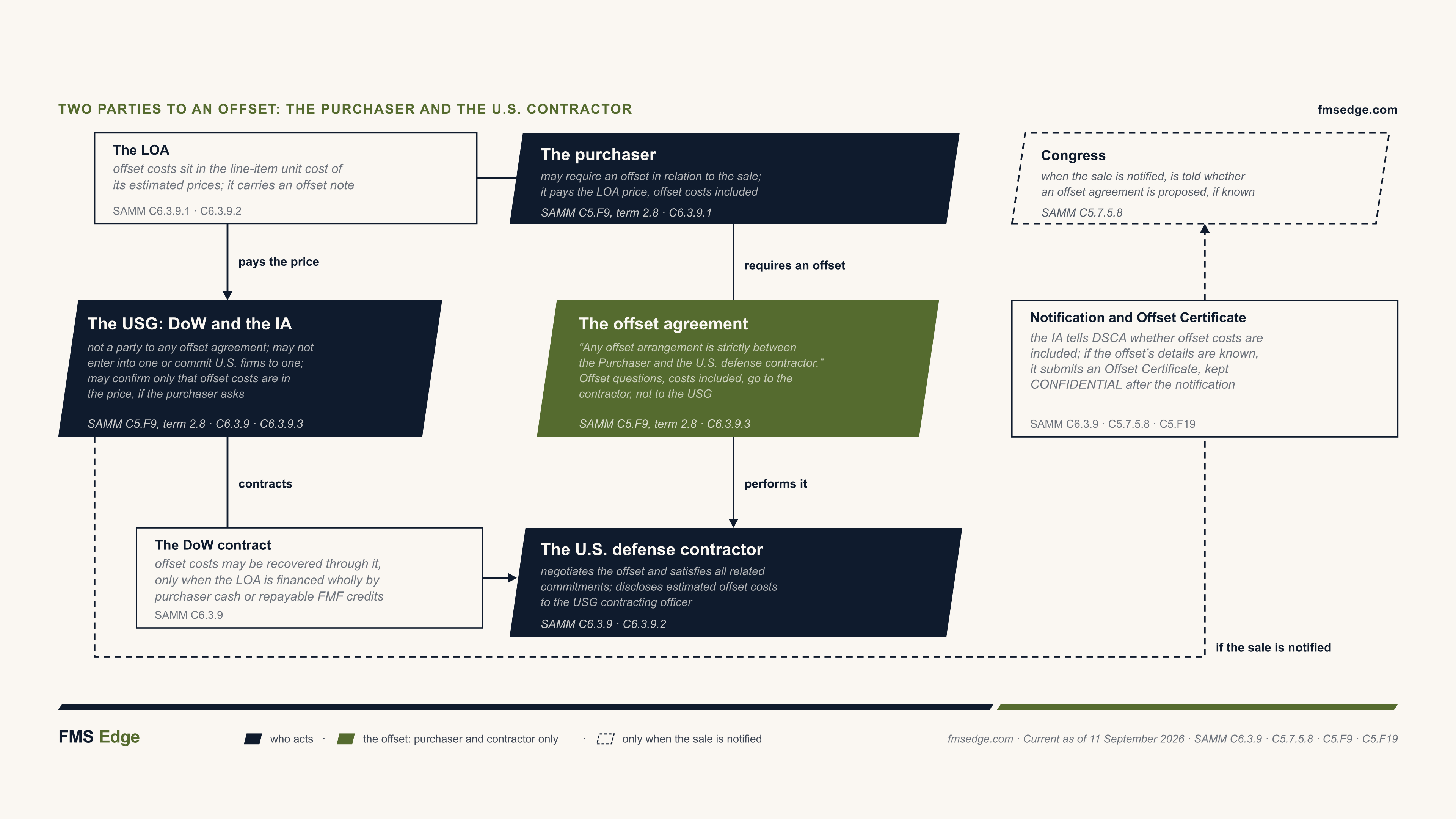
Is the U.S. Government a party to an offset agreement?
Offsets are permissible under . However, it must be emphasized that the is between the purchasing country and the U.S. contractor. The is not party to the agreement and does not retain any obligation to enforce the contractor’s performance of the agreement. This appears to be, and is in fact, an odd arrangement. In an ideal world, the would prefer that offset agreements did not exist; however, the reality of the marketplace is that other countries are competing for international business and are willing to provide offset packages to prospective international partners. If the prohibited offsets under , U.S. firms would be at a huge disadvantage in international competition.
The U.S. policy on offsets in military exports, now incorporated in 225.7306, provides that:
- No agency shall encourage, enter directly into, or commit U.S. firms to any offset arrangement related to the sale of U.S. defense articles or services.
- funds shall not be used to finance offsets.
- Negotiations or decisions regarding offset commitments reside with the companies involved.
References
SAMM
- SAMM C6.3.9.3 — Disclosure of Offset Information.
Related
FMS — Foreign Military Sale
SAMM Acronyms, as of 12 September 2026
Offset Agreement
An agreement, arrangement, or understanding between a U.S. supplier of defense articles or services and a foreign country under which the supplier agrees to purchase or acquire, to promote the purchase or acquisition by other U.S. persons, of goods or services produced, manufactured, grown, or extracted, in whole or in part, in that foreign country in consideration for the purchase by the country of defense articles or services from the supplier [Sec. 39A(d)(1), Arms Export Control Act]. See also direct offset and indirect offset.
SAMM Glossary, as of 12 September 2026
Glossary entry →Open the manual’s entry → (opens in new tab)
DFARS — Defense Federal Acquisition Regulation Supplement
SAMM Acronyms, as of 12 September 2026
P&A — Price and Availability
SAMM Acronyms, as of 12 September 2026
LOA — Letter of Offer and Acceptance
SAMM Acronyms, as of 12 September 2026
Implementing Agency (IA)
The military department or defense agency responsible for the execution of military assistance programs. With respect to FMS, the military department or defense agency assigned responsibility by the Defense Security Cooperation Agency to prepare an LOA and to implement an FMS case. The implementing agency is responsible for the overall management of the actions that will result in delivery of the materials or services set forth in the LOA that was accepted by a foreign country or international organization.
SAMM Glossary, as of 12 September 2026
Glossary entry →Open the manual’s entry → (opens in new tab)